


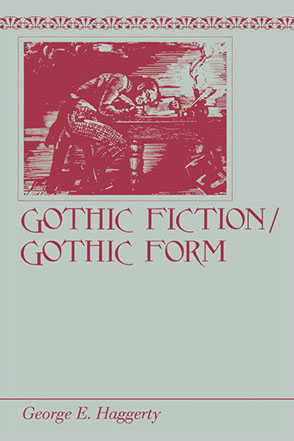
Gothic Fiction/Gothic Form
George E. Haggerty
This work offers a new perspective on Gothic fiction and reassesses its place in literary history. After defining his concept of "affective form" and summarizing the problematic assumptions behind recent critical approaches to the Gothic, George Haggerty introduces a startling theoretical discussion of the Gothic Tale, and he explains in what ways the tale, as a form with identifiable affective properties, is ideally suited to Gothic concerns. Having established a direct relation between this study and recent discussions of narratology and generic identity, Haggerty develops his argument as it applies to major Gothic works in both England and America, including works by Walpole, Radcliffe, Lewis, Maturin, Shelley, Bronte, Poe, Hawthorne, and James. He examines the Gothic Tale as a form that resolves the inconsistency and incoherence of many Gothic novels and offers even the best of them a center of focus and a way of achieving their fullest affective power.
- Description
- Bio
- Subjects
In this study, the Gothic Tale emerges as a means of heightening the emotional intelligibility of Gothic fiction and answering Walpole's confused desire to unite "two kinds of romance" in the Gothic. It is a form that can answer the ontological and epistemological, as well as the structural, challenge of the Gothic writers. From its first hints within the Gothic novel as an alternative literary mode offering the Gothicists various expressive advantages to its eerie success in a work such as James's "The Jolly Corner," the Gothic Tale offers insight into generic distinction and literary expression. This is a major statement about an important literary form.
George Haggerty is Associate Professor of English, University of Califormia at Riverside.
Mailing List
Subscribe to our mailing list and be notified about new titles, journals and catalogs.