


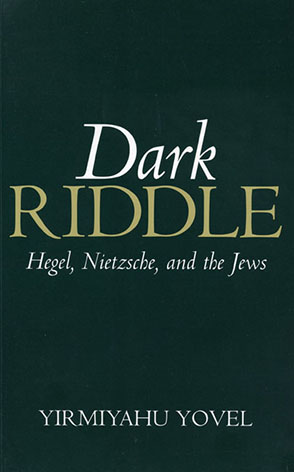
Dark Riddle
Hegel, Nietzsche, and the Jews
Yirmiyahu Yovel
“Yirmiyahu Yovel’s Dark Riddle is a well-crafted and much-needed contribution to three scholarly literatures: on Hegel, on Nietzsche, and on the situation and the perception of the Jewish people in nineteenth-century Europe. Yovel shows precisely how Judaism and the Jews were ‘thematized’ in the work of two influential philosophers. His deep going study of Nietzsche, in particular, is a surprise, setting a much misunderstood record straight. This book is engaging and fascinating reading for anyone who cares about the interplay of philosophical ideas with the events of modern history.”
- Description
- Reviews
- Bio
- Subjects
The mature Hegel partly overcame the fierce anti-Jewish attitude of his youth yet continued to see Judaism as the alienation of its own new principles. Post-Christian Judaism no longer had a real history, only a contingent protracted existence, and although modern Jews deserved civil rights, Hegel saw no place for them in modernity as Jews.
Nietzsche, on the contrary, who grew to be a passionate anti-anti-Semite, admired Diaspora Jews for their power and depth and assigned them a role as Jews in curing Europe of the decadent Christian culture that their own ancestors, the second-temple Jewish "priests," had inflicted upon Europe by begetting Christianity. The ancient corrupters of Europe are thus to be its present redeemers.
Through his masterly analysis of the writings of Hegel and Nietzsche, Yovel shows that anti-Jewish prejudice can exist alongside a philosophy of reason, while a philosophy of power must not necessarily be anti-Semitic.
“Yirmiyahu Yovel’s Dark Riddle is a well-crafted and much-needed contribution to three scholarly literatures: on Hegel, on Nietzsche, and on the situation and the perception of the Jewish people in nineteenth-century Europe. Yovel shows precisely how Judaism and the Jews were ‘thematized’ in the work of two influential philosophers. His deep going study of Nietzsche, in particular, is a surprise, setting a much misunderstood record straight. This book is engaging and fascinating reading for anyone who cares about the interplay of philosophical ideas with the events of modern history.”
“Impartial and gentlemanly to the core, Yovel presents a valuable exposition of two of the thinkers, whose works span the gamut from the completion of the modern project of rationality (Hegel) to its complete rejection from an anti-modern perspective (Nietzsche). The guiding question of this exposition is how Hegel and Nietzsche view and represent Jews and Judaism. The result is remarkable.”
“Nietzsche, Yovel has provided a well balanced and dispassionate study of a topic that probably is more important philosophically than previous scholarship has conceded.”
Yirmiyahu Yovel is Schulman Professor of Philosophy at the Hebrew University of Jerusalem and Hans Jonas Professor at the Graduate Faculty, the New School for Social Research, New York. He is the author of Spinoza and Other Heretics (1989).
Also of Interest
Mailing List
Subscribe to our mailing list and be notified about new titles, journals and catalogs.