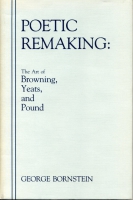




Poetic Remaking
The Art of Browning, Yeats, and Pound
George Bornstein
This volume offers a coherent view of post-romantic poetic development through selective examples both of individual poems and of poetic influence. Bornstein focuses most centrally on Browning in the Victorian period and Yeats and Pound in the Modern, but also looks more briefly at works by Wordsworth, Coleridge, Keats, Shelley, Arnold, Tennyson, and Eliot. The introductory manifesto, "Four Gaps in Postromantic Influence Study," posits four new orientations for such work: taking the volume (rather than the individual poem) as a unit; stressing more centrally the Victorian mediation between Romantic and Modern; allowing for national differences among English, Irish, and American traditions; and basing influence studies as much on manuscript materials as on finished products. Each of the following chapters follows one or more of those orientations.
- Description
- Bio
- Subjects
The initial four chapters, "Remaking Poetry," focus on readings of specific poetic texts. The first treats Browning's first major volume as a unit; the second reads his dramatic monologue "Pictor Ignotus" against Romantic acts of mind; the third maps distinctively Victorian variations in the major form known as Greater Romantic Lyric; and the fourth explores Yeats's mature revision of that form.
The second group of four chapters, "Remaking Poets," stresses the dynamics of literary influence by which poets turn their forerunners into figures helpful to their own development. The first three examine Yeats's encounter with Dante, Spenser, Browning, and Tennyson, respectively; the fourth treats Pound's remaking of the poet he called his poetic "father," Browning, in a way that suggests the limits of anxiety models of poetic influence.
For this volume Professor Bornstein has revised and expanded a select group of his recent essays and added a new one, on the Greater Victorian Lyric.
George Bornstein is a Professor of English at the University of Michigan. His books on 19th- and 20th- century poetry include Yeats and Shelley; Transformations of Romanticism in Yeats, Eliot, and Stevens; The Postromantic Consciousness of Ezra Pound; Ezra Pound Among the Poets; and an edition of W.B. Yeats: The Early Poetry—Manuscript Materials.
Mailing List
Subscribe to our mailing list and be notified about new titles, journals and catalogs.