


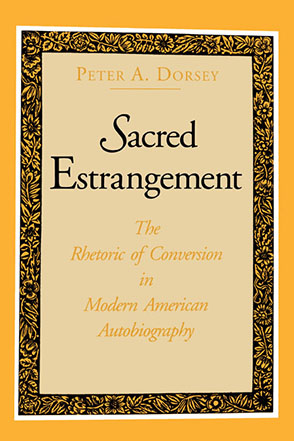
Sacred Estrangement
The Rhetoric of Conversion in Modern American Autobiography
Peter A. Dorsey
“Sacred Estrangement is an excellent study of the ways different autobiographers have found for adopting and adapting a tradition of Christian conversion narrative for their own secular purposes. It is a valuable and most welcome contribution to thought about the nature of the autobiographical act.”
- Description
- Reviews
- Bio
- Subjects
As modern autobiography developed in the eighteenth and nineteenth centuries, the Christian pattern was secularized and individualized. Conversion became a model for many kinds of psychological change. With the coming of the twentieth century, however, the authors upon whom Peter Dorsey focuses, including William and Henry James, Henry Adams, Edith Wharton, Ellen Glasgow, Zora Neale Hurston, and Richard Wright, radically revised conversion rhetoric. If conversion had traditionally linked the search for illumination with the search for a defined social role, these writers increasingly used conversion as an index of estrangement from mainstream America.
Dorsey documents this profound change in the way American intellectuals defined the "self," not in terms of personal orientation toward or away from a given community, but as a resistance to such an orientation altogether, as if social forces by their "nature" were a threat to personal identity.
“Sacred Estrangement is an excellent study of the ways different autobiographers have found for adopting and adapting a tradition of Christian conversion narrative for their own secular purposes. It is a valuable and most welcome contribution to thought about the nature of the autobiographical act.”
Peter A. Dorsey is Assistant Professor of English at Mount Saint Mary's College in Emmitsburg, Maryland.
Mailing List
Subscribe to our mailing list and be notified about new titles, journals and catalogs.