



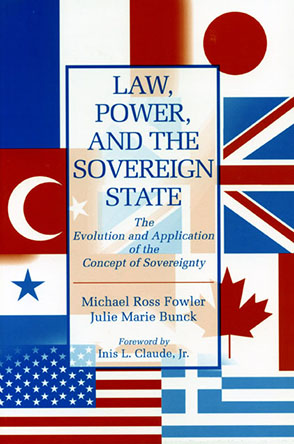
Law, Power, and the Sovereign State
The Evolution and Application of the Concept of Sovereignty
Michael Ross Fowler, and Julie Marie Bunck
Law, Power, and the Sovereign State
The Evolution and Application of the Concept of Sovereignty
Michael Ross Fowler, and Julie Marie Bunck
“This invaluable study of sovereignty explores anew one of the most enduring ideas in political theory and illuminates with lucidity the changing nature of the sovereign state.”
- Description
- Reviews
- Bio
- Subjects
In determining how a political entity gains sovereignty, the authors introduce the requirements of de facto independence and de jure independence and explore the ambiguities inherent in each. They also examine the political process by which the international community formally confers sovereign status. Fowler and Bunck trace the continuing tension of the "chunk and basket" theories of sovereignty through the history of international sovereignty disputes and conclude by considering the usefulness of sovereignty as a concept in the future study and conduct of international affairs. They find that, despite frequent predictions of its imminent demise, the concept of sovereignty is alive and well as the twentieth century draws to a close.
“This invaluable study of sovereignty explores anew one of the most enduring ideas in political theory and illuminates with lucidity the changing nature of the sovereign state.”
Michael Ross Fowler teaches in the Department of Political Science at the University of Louisville and is the author of Thinking About Human Rights: Contending Approaches to Human Rights in U.S. Foreign Policy and Winston Churchill: Philosopher and Statesman (1987 and 1985).
Julie Marie Bunck is Assistant Professor of Political Science at the University of Louisville and the author of Fidel Castro and the Quest for a Revolutionary Culture in Cuba (Penn State, 1994).
Mailing List
Subscribe to our mailing list and be notified about new titles, journals and catalogs.