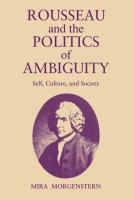




Rousseau and the Politics of Ambiguity
Self, Culture, and Society
Mira Morgenstern
“While devoting close attention to the currently much discussed issues of discourse and gender, Morgenstern makes the focus of her analysis the concepts of authenticity and ambiguity. . . . It is one of the strengths of the work that the author keeps the whole of Rousseau's corpus before us. Another strength is the way she brings out the complexity of Rousseau's work, and seeks to demonstrate its ultimate, but by no means obvious, coherence. . . . Throughout this study Morgenstern demonstrates an admirable command of the secondary sources. Moreover, she has the immense virtue of doing justice to her subject.”
- Description
- Reviews
- Bio
- Subjects
Morgenstern sees Rousseau as an important contributor to the feminist thoughts and concerns that animate so much of our public and private discourse today. While Rousseau is commonly seen as a patriarchal misogynist, Morgenstern finds evidence in his writing that belies much of this claim. Rousseau was very much a man of his time, but he also believed that women were the key to transmitting his ideals of personal and political authenticity, thereby transforming his theory from ephemeral ideas into practical reality.
A careful evaluation of Rousseau's writings on women reveals his highly complex sense of reality, especially his awareness that the solutions to life's complex problems are often temporary and must be renegotiated over time. Rousseau is more persistent than most in highlighting the weaknesses and pitfalls of liberal political thought, whose fundamental characteristic is its categorization of life on the basis of dualistic categories: public and private, outside and inside, male and female.
Ultimately, what makes Rousseau worth reading today, argues Morgenstern, is his ability to illuminate critical weaknesses in the dualisms of liberal political theory and his pointing out, if only by implication, alternative ways of reaching the full measure of our individual and communal humanity. In honoring the traditional liberal emphasis on individual liberty and self-development, Rousseau’s meditations on the proper aim of political life are especially helpful to those today who seek ways to expand liberalism's promise of freedom and authenticity, while not losing sight of the common threads of meaning and community that continue to bind us together.
“While devoting close attention to the currently much discussed issues of discourse and gender, Morgenstern makes the focus of her analysis the concepts of authenticity and ambiguity. . . . It is one of the strengths of the work that the author keeps the whole of Rousseau's corpus before us. Another strength is the way she brings out the complexity of Rousseau's work, and seeks to demonstrate its ultimate, but by no means obvious, coherence. . . . Throughout this study Morgenstern demonstrates an admirable command of the secondary sources. Moreover, she has the immense virtue of doing justice to her subject.”
“In this refreshing contrast to many commentators, Morgenstern does justice to the complexity of Rousseau's work by drawing on his novels as well as his explicity political writings.”
“This book is a well-written, innovative, in-depth investigation of the central themes of Rousseau’s thought.”
“Morgenstern has earned the right to present her conclusions to the scholarly world. Rousseau scholars should be encouraged to face the difficulties she elaborates.”
Mira Morgenstern is Associate Professor of Political Science at The City College, City University of New York. She is the author of Rousseau and the Politics of Ambiguity: Self, Culture, and Society (Penn State, 1996).
Also of Interest
Mailing List
Subscribe to our mailing list and be notified about new titles, journals and catalogs.