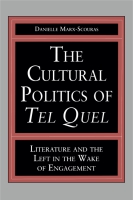




The Cultural Politics of Tel Quel
Literature and the Left in the Wake of Engagement
Danielle Marx-Scouras
The Cultural Politics of Tel Quel
Literature and the Left in the Wake of Engagement
Danielle Marx-Scouras
Founded in 1960 by a group of relatively unknown young writers, Tel Quel quickly became one of the most influential literary journals and controversial intellectual movements in France. During the following two decades Tel Quel published the best in French intellectual thought and writing, including Roland Barthes, Georges Bataille, Jacques Derrida, Jean-Pierre Faye, Michel Foucault, Gérard Genette, Julia Kristeva, Bernard-Henri Lévy, Marcelin Pleynet, Philippe Sollers, and Tzvetan Todorov. By focusing on Tel Quel as an instrument of cultural renewal, Danielle Marx-Scouras demonstrates that literature—even when it claims to be disengaged—can never escape its historical ties.
- Unlocked
- Description
- Bio
- Subjects

An Open Access edition of The Cultural Politics of Tel Quel is available through PSU Press Unlocked. To access this free electronic edition click here. Print editions are also available.
The book elucidates the complexities of French intellectual life and the role played by Tel Quel in the evolution of intellectual thought and writing in the 1960s and 1970s. Tel Quel's cultural politics have been fashioned as much by the unpredictable historical changes of the post-World War II and Cold War era as they have by the advances in literary studies, semiotics, philosophy, and psychoanalysis during this period. The journal ceased publication in 1982, shortly before the dissolution of Marxism-Communism marked by the demolition of the Berlin Wall, the reunification of Europe, and the collapse of the Soviet Union. Marx-Scouras ultimately finds in its cultural venture some significant parting thoughts on a vigorous period of European literary and intellectual history.
Danielle Marx-Scouras is Associate Professor of French at The Ohio State University.
Also of Interest
Mailing List
Subscribe to our mailing list and be notified about new titles, journals and catalogs.