



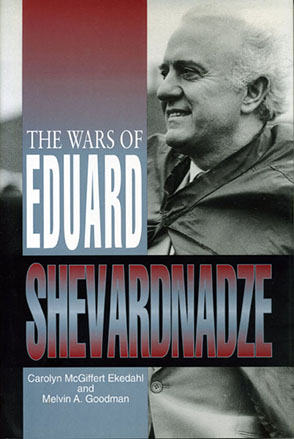
The Wars of Eduard Shevardnadze
Carolyn Ekedahl, and Melvin A. Goodman
“The book is extremely informative and written in an accessible style that maintains the reader’s interest to the end. . . . [The Wars of Eduard Shevardnadze] makes it even more difficult not to be fascinated with the real ‘deliverer’ of the end of the Cold War.”
- Description
- Reviews
- Bio
- Subjects
Carolyn Ekedahl and Melvin Goodman—veteran observers of the Soviet system—describe and analyze Shevardnadze’s career, beginning with his Georgian past. They assess his responsibility for the Soviet collapse and the leadership role he continues to play in the independent state of Georgia. While sympathetic to what he has achieved, the authors show how Shevardnadze was a product of the Soviet system he sought to change but would help to destroy. He has proven a skillful politician who exploited available instruments of power to advance his career and further his policy objectives. For this book, the authors have interviewed many high-ranking American, Georgian, Russian, and Soviet officials, including Shevardnadze himself and former secretaries of state George Shultz and James Baker. Both Shultz and Baker credit Shevardnadze with convincing them that Moscow was committed to serious negotiations. They conclude that history would have been far different if it were not for the personal diplomacy of Shevardnadze.
As historians and specialists seek to explain the end of the Cold War in terms of endemic weaknesses in the Soviet system and the steadfast policies of the West, The Wars of Eduard Shevardnadze shows the folly of neglecting the essential role played by Soviet leaders who saw the need for reform and implemented policies designed to accomplish profound, but peaceful, change.
“The book is extremely informative and written in an accessible style that maintains the reader’s interest to the end. . . . [The Wars of Eduard Shevardnadze] makes it even more difficult not to be fascinated with the real ‘deliverer’ of the end of the Cold War.”
“The book employs a strong analytical approach to the study of the role of the individual in shaping foreign policy and the different personal and organizational factors that affect his performance. The Wars of Eduard Shevardnadze is required reading on how the Cold War came to an end, and the last chapter in the history of Soviet diplomacy.”
“The Wars of Eduard Shevardnadze is the first major effort to take a critical look at the many struggles Shevardnadze had at home and abroad during the coarse of his extraordinary career. . . . This work is a readable and useful study for the specialist and the general reader alike. It is a needed addition to any college library.”
“This political biography has fully succeeded in its aim of restoring Shevardnadze’s place in history, providing an indispensable account of perestroika and of the international relations of this period.”
“Eduard Shevardnadze has been the indispensable man twice in his life. First, in the Soviet Foreign Ministry in the closing years of the Cold War and today in his native Georgia as it struggles to emerge onto the world stage. This biography is worthy of this great man.”
“Former senior CIA analysts Ekedahl and Goodman have applied their long experience in analyzing Soviet politics and foreign policy to provide the first biography of one of Mikhail Gorbachev’s closest advisors and most influential colleagues in moving the Soviet Union away from its Marxist-Leninist past. No one in any country contributed so much to ending the Cold War as did Gorbachev and Shevardnadze, and while Gorbachev’s role has been widely recognized, Shevardnadze’s important contribution is made clear only now with this illuminating study. It is important biography, and important history.”
“This well-researched and well-presented book sheds important new light on how the Cold War ended and how the role of Shevardnadze was of central importance to that process. A rewarding read.”
Carolyn M. Ekedahl is Chief of Public Communications on the Public Affairs Staff at the CIA. She is the author of Moscow's Third World Policy under Gorbachev (1990).
Melvin A. Goodman is Professor of International Security Studies at the National War College. His books include The End of Superpower Conflict in the Third World (1992) and Gorbachev's Retreat: The Third World (1991).
Mailing List
Subscribe to our mailing list and be notified about new titles, journals and catalogs.