


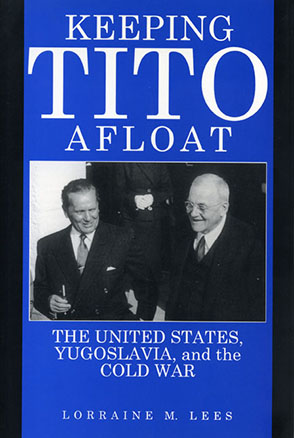
Keeping Tito Afloat
The United States, Yugoslavia, and the Cold War
Lorraine M. Lees
“Keeping Tito Afloat offers the most comprehensive treatment of U.S.-Yugoslav relations during the Cold War. Lees has an excellent feel for the development of policy within the American government, and she provides insightful analysis of the motives and actions of key people in the Truman and Eisenhower administrations. But the book is not simply focused on the U.S.; it offers valuable insight into Tito and his ability to resist American ‘plans’ for him.”
- Description
- Reviews
- Bio
- Subjects
By the end of 1958, Eisenhower and Dulles discontinued this "wedge strategy" because it raised too many questions about the ties that should exist between communist, noncommunist, and neutral states. As Tito shrewdly kept the U.S. at arm's length, Eisenhower was forced to accept Tito's continued absence from the Soviet orbit as victory enough. In the period between 1958 and 1960, Lees examines U.S. political objectives that remained after military support for Tito was discontinued. Although use of Yugoslavia as a wedge never fully succeeded, Lees shows how that strategy reflected the pragmatic and geopolitical policies of the Truman and Eisenhower administrations. Keeping Tito Afloat utilizes diverse sources including personal interviews with key U.S. and Yugoslav officials, official and private papers and oral histories from the Roosevelt, Truman, and Eisenhower libraries, State Department records, some only recently declassified, from the National Archives, and the papers of George F. Kennan and John Foster Dulles.
“Keeping Tito Afloat offers the most comprehensive treatment of U.S.-Yugoslav relations during the Cold War. Lees has an excellent feel for the development of policy within the American government, and she provides insightful analysis of the motives and actions of key people in the Truman and Eisenhower administrations. But the book is not simply focused on the U.S.; it offers valuable insight into Tito and his ability to resist American ‘plans’ for him.”
“This account is the best single source on United States-Yugoslav relations during the Truman and Eisenhower years.”
Lorraine M. Lees is Associate Professor of History at Old Dominion University. She is co-editor of volumes 26 and 27 of Foreign Relations of the United States, 1955–57.
Mailing List
Subscribe to our mailing list and be notified about new titles, journals and catalogs.