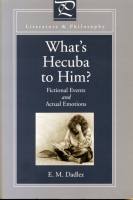




What's Hecuba to Him?
Fictional Events and Actual Emotions
Eva M. Dadlez
“Dadlez offers a clear, precise, and compelling account of why it is rational to have emotions for fictive characters.”
- Description
- Reviews
- Bio
- Subjects
The very nature of our emotional engagement with fiction, says E. M. Dadlez, attests to the possibility of its moral significance, just as the nature of our imaginative engagement makes us collaborators in the creation of the worlds we imagine.
This book engages contemporary debate over the seeming irrationality or inauthenticity of our emotional response to fiction, examining the many positions taken in this debate and arguing that we can understand the relation between cognition and emotion without devaluing our emotional responses to fiction. It takes Hamlet's famous query as the first step in an analytic philosophical inquiry and, by considering some of the answers that derive from that question, arrives at a set of necessary conditions for an emotional response to fiction.
What Hamlet's player feels for Hecuba, proposes Dadlez, is no more illusory than what we feel for Hamlet; that the actor weeps for Hecuba reflects both our capacity to envision and understand a seemingly limitless variety of human situations—to empathize with others—and the capacity of fiction to facilitate such understanding. What's Hecuba to Him? is an enticingly written work that opens an entire philosophical arena to literary scholars and illuminates the significance that literature has for our moral life.
“Dadlez offers a clear, precise, and compelling account of why it is rational to have emotions for fictive characters.”
E. M. Dadlez is Assistant Professor in the Department of Humanities and Philosophy at the University of Central Oklahoma.
Mailing List
Subscribe to our mailing list and be notified about new titles, journals and catalogs.