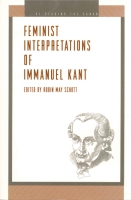




Feminist Interpretations of Immanuel Kant
Edited by Robin Schott
Because of his misogyny and disdain for the body, Kant has been a target of much feminist criticism. Moreover, as the epitome of eighteenth-century Enlightenment philosophy, his thought has been a focal point for feminist debate over the Enlightenment legacy—whether its conceptions of reason and progress offer tools for women's emancipation and empowerment or, rather, have contributed to the historical subordination of women in Western society.
- Description
- Bio
- Subjects
This volume presents radically divergent interpretations of Kant from feminist perspectives. Some essays see Kant as having contributed significantly to theories of rationality and autonomy in ways that can further feminist projects. Other essays argue that Kant is a preeminent exponent of patriarchal views and that gender hierarchies are inscribed in the very structure of his theories of morality and aesthetic judgment. But both critics and sympathizers challenge the accepted topography of Kantian philosophy by which central philosophical concerns are defined as those that are abstract, universal, and transcendental. Instead, these feminist writers resituate Kantian questions in the politics of everyday life and emphasize the embodied nature of knowledge, morality, and aesthetics. They analyze dilemmas that face concrete subjects, involving issues of friendship, collective responsibility, xenophobia, and colonialism, among others.
Contributors are Annette C. Baier, Marcia Baron, Monique David-Ménard, Kim Hall, Cornelia Klinger, Jane Kneller, Sarah Kofman, Marcia Moen, Herta Nagl-Docekal, Adrian M. S. Piper, Jean P. Rumsey, Robin May Schott, Hannelore Schröder, Sally Sedgwick, and Holly L. Wilson.
Robin May Schott is Associate Professor of Philosophy at the University of Copenhagen and the author of Cognition and Eros: A Critique of the Kantian Paradigm (paperback edition, Penn State, 1993).

Mailing List
Subscribe to our mailing list and be notified about new titles, journals and catalogs.