


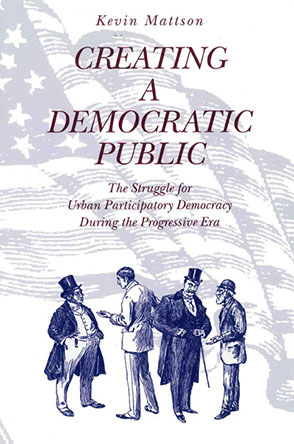
Creating a Democratic Public
The Struggle for Urban Participatory Democracy During the Progressive Era
Kevin Mattson
Creating a Democratic Public
The Struggle for Urban Participatory Democracy During the Progressive Era
Kevin Mattson
“The ultimate lessons Mattson draws from his research are both timely and compelling. Clearly, attempting to connect citizen deliberation to the direct avenues of political power will be no easy task. Furthermore, those who struggle for a democratic community must understand that their efforts require more than the freedoms now available in a consumer society and that fledgling movements are always in danger of being swallowed up by large, bureaucratic institutions.”
- Description
- Reviews
- Bio
- Subjects
Mattson explores the work of early activists like Charles Zueblin, who tried to advance adult education at the University of Chicago, and Frederic Howe, whose People's Institute sparked the nationwide forum movement. He then turns to the social centers movement, which began in Rochester, New York, in 1907 with the opening of public schools to adults in the evening as centers for debate over current issues. Mattson tells how this simple program grew into a national phenomenon and cites its achievements and political ideals, and he analyzes the political thought of activists within the movement—notably Mary Parker Follett and Edward Ward—to show that these intellectuals had a profound understanding of what was needed to create vigorous democratic practices.
Creating a Democratic Public challenges us to reconsider how we think about democracy by bringing us into critical dialogue with the past and exploring the work of yesterday's activists. Combining historical analysis, political theory, and social criticism, Mattson analyzes experiments in grassroots democracy from the Progressive Era and explores how we might foster more public involvement in political deliberation today.
“The ultimate lessons Mattson draws from his research are both timely and compelling. Clearly, attempting to connect citizen deliberation to the direct avenues of political power will be no easy task. Furthermore, those who struggle for a democratic community must understand that their efforts require more than the freedoms now available in a consumer society and that fledgling movements are always in danger of being swallowed up by large, bureaucratic institutions.”
“Creating a Democratic Public, by Kevin Mattson, is one of those books that provide a new lens for viewing American political theory and practice. . . . What makes his contribution so original and valuable is his ability to make philosophical concerns about the meaning of democracy concrete. Practice informs theory throughout the book. Mattson not only succeeds in describing the huge flaws in our political system but also traces the flaws to their source and provides a historical analysis of a kind of institutional reform that could inform present-day efforts to create a participatory democracy.”
“Ultimately Mattson challenges readers to reconsider contemporary conceptions of democracy that view citizens as consumers, and he contributes to contemporary discussions of ways to invigorate democratic practice. Highly recommended for all readership levels.”
“In an era of quickening concern about citizenship and community in contemporary America, we have a lot to learn from the community-building activities of Progressive Era reformers. Kevin Mattson's instructive account of their successes and failures is a timely contribution.”
“The Progressive Era was filled with the rhetoric of democracy, but in recent years historians have found the meaning of progressivism rather in various hierarchies of power. Kevin Mattson's considerable accomplishment in this fine book is to recover the era's emergent democratic public and its localized activities, from adult education to political meetings. Mattson's openly committed history is important for its more complicated rendering of progressive democracy, for its elaboration of a lively public culture, and for the encouragement it offers to the project of participatory democracy.”
“Kevin Mattson's book recovers one of the most important moments in the history of genuinely democratic reform in American history. A major contribution to the rethinking of progressivism, this book also offers a usable past to those struggling in the present to render our politics and culture more democratic.”
Kevin Mattson is Research Director of the Walt Whitman Center for the Culture and Politics of Democracy at Rutgers University.
Also of Interest
Mailing List
Subscribe to our mailing list and be notified about new titles, journals and catalogs.