


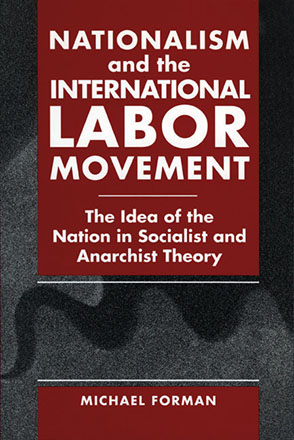
Nationalism and the International Labor Movement
The Idea of the Nation in Socialist and Anarchist Theory
Michael Forman
Nationalism and the International Labor Movement
The Idea of the Nation in Socialist and Anarchist Theory
Michael Forman
“With the concept of ‘nation’ no longer self-evident in Western Europe, this historical study, which seeks to reconstruct and reexamine the concept of ‘nation' that emerged in the international labor movement in the second half of the nineteenth century and at the beginning of World War II, has contemporary significance. Aside from its scholarly merits, the author’s view that the cosmopolitan intent and internationalist vision that informed the international labor movement is worth re(dis)covering makes this work a significant contribution.”
- Media
- Description
- Reviews
- Bio
- Subjects
Winner of the 1999 Michael Harrington Award from the Caucus for a New Political Science
Each of the main sections of the book focuses on the most influential theorists of the international labor movement as it became organized and grew: Bakunin, Marx, and Engels and the concern of the First International (1864–1876) with class solidarity across political borders; Lenin, Luxemburg, and Bauer and the preoccupation of the Second International (1889-1914) with socialism in ethnically plural societies; Stalin and Gramsci in relation to the substitution by the Third International (1919–1943) of nation-building and national liberation for the old class project.
In the conclusion, the author examines the relationships among ethnic and civic nationality, national self-determination, republican institutions, and the process of globalization from the perspective of the post-Soviet era and in the light of social theory and Kant's ideas about cosmopolitan right.
“With the concept of ‘nation’ no longer self-evident in Western Europe, this historical study, which seeks to reconstruct and reexamine the concept of ‘nation' that emerged in the international labor movement in the second half of the nineteenth century and at the beginning of World War II, has contemporary significance. Aside from its scholarly merits, the author’s view that the cosmopolitan intent and internationalist vision that informed the international labor movement is worth re(dis)covering makes this work a significant contribution.”
“Against those who argue that socialist theorists have historically underestimated nationalism and hence its place in the politics of nation building, Forman skillfully interprets the ideas of the most famous thinkers of the international labor movement to reveal that these theorists did indeed take the concepts of nation and nationalism seriously, and that within their writings one can end the theoretical basis for a new, reinvigorated international labor movement. As such, Nationalism and the International Labor Movement represents not only an important and innovative contribution to the literature on nations and nation building but an effective effort to communicate the principles and language of a new cosmopolitan vision of a future where social and economic justice and institutional accountability can finally be realized on a global scale.”
Michael Forman is Visiting Assistant Professor of Politics at Whitman College.
Mailing List
Subscribe to our mailing list and be notified about new titles, journals and catalogs.