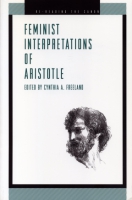




Feminist Interpretations of Aristotle
Edited by Cynthia A. Freeland
“Overall, the essays in this volume represent a welcome addition to the second wave of feminist criticism and reappraisal of Aristotelian thought on central concern to feminism such as biological and metaphysical essentialism, standpoint theory, the normativity of science, and feminist ethics and aesthetics.”
- Description
- Reviews
- Bio
- Subjects
Feminists recognize that they too philosophize within the tradition founded by Plato and Aristotle and owe the Greeks a debt. Aristotle still influences our abstract thinking, search for principles, meditations on virtue, and reflections on nature, essence, and sexual difference. As critics of modernism and liberalism in our day, some feminists seek significant alternatives in the classical era while eschewing ancient sexism.
From the essays in this volume, which are divided into two parts, "Theoretical Sciences" and "Practical and Productive Sciences," reflecting the traditional structure of works in the Aristotelian corpus, we learn not only about Aristotle but about a new feminist methodology in approaching major contemporary issues such as surrogate motherhood and women in the military. We also find a new perspective on feminist debates over whether logic is gendered, the advantages of an "ethics of care," feminist epistemology, and the nature of critical feminist spectatorship.
Contributors are Angela Curran, Marguerite Deslauriers, Cynthia Freeland, Ruth Groenhout, Marjorie Hass, Linda Hirshman, Luce Irigaray, Barbara Koziak, Deborah Modrak, Martha Nussbaum, Carol Poster, and Charlotte Witt.
“Overall, the essays in this volume represent a welcome addition to the second wave of feminist criticism and reappraisal of Aristotelian thought on central concern to feminism such as biological and metaphysical essentialism, standpoint theory, the normativity of science, and feminist ethics and aesthetics.”
“In summary: this is an outstanding, wide-ranging, thoroughgoing collection of essays which set a new standard for feminist work in the history of philosophy in any field. From a very thorough collection interrogation, the tremendous richness of Aristotle’s thought emerges in a fresh way.”
Cynthia A. Freeland is Professor of Philosophy at the University of Houston and also serves as Associate Dean of the College of Humanities, Fine Arts, and Communication.
Mailing List
Subscribe to our mailing list and be notified about new titles, journals and catalogs.