


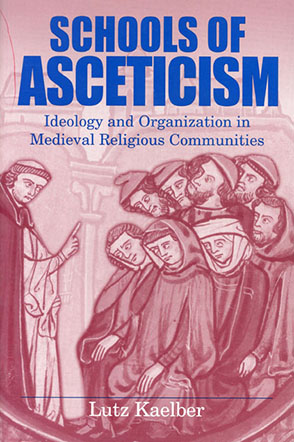
Schools of Asceticism
Ideology and Organization in Medieval Religious Communities
Lutz Kaelber
“Rather than write another of the countless studies in the Weberian tradition, Lutz Kaelber has attempted nothing less than to be Max Weber’s ghost writer and to produce one of the great studies he did not live to undertake—The Christianity of the Occident. The result is a fascinating and engrossing work that adds immensely to our understanding of both then and now.”
- Media
- Description
- Reviews
- Bio
- Subjects
Winner of the 1999 Book of the Year Award from the Sociology of Religion Section of the American Sociological Association
Kaelber first examines monastic and mendicant groups, correcting common misperceptions about the nature of their ascetic practices and their significance for the emergence of a Protestant work ethic. Then he turns to two of the largest and most widespread heretical groups in the Middle Ages, the Waldensians and the Cathars. For the most part, Waldensians and Cathars practiced a form of "other-worldly asceticism" resembling that of monks and nuns. For the Austrian Waldensians, however, Kaelber documents a type of "inner-worldly asceticism" that resembled what Weber described for early modern Protestant groups. Both types of asceticism originated in distinctive heretical establishments: Waldensian schools and Cathar "houses of heretics." As these establishments disappeared, the boundaries separating Waldensianism and Catharism from Catholicism collapsed. Kaelber is therefore able to link organizational aspects of heretical communities to the tenacity of heresy in the Middle Ages.
Based on exhaustive research into both primary and secondary sources, Schools of Asceticism is a bold and original book that bridges the disciplines of comparative historical and theoretical sociology, medieval history, and religious studies.
“Rather than write another of the countless studies in the Weberian tradition, Lutz Kaelber has attempted nothing less than to be Max Weber’s ghost writer and to produce one of the great studies he did not live to undertake—The Christianity of the Occident. The result is a fascinating and engrossing work that adds immensely to our understanding of both then and now.”
Lutz Kaelber is Assistant Professor of Sociology at Lyndon State College in Vermont.
Mailing List
Subscribe to our mailing list and be notified about new titles, journals and catalogs.