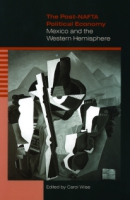




The Post-NAFTA Political Economy
Mexico and the Western Hemisphere
Edited by Carol Wise
“Carol Wise’s collection . . . is a major contribution to the intellectual and political debate about the political and economic forces explaining the transition from state-led inward-looking models of development to market-led outward-looking paradigms in Mexico and to some extent Latin America. . . . Carol Wise has collected a fine and well-balanced selection of topics dealing with regional integration and its impact in Mexican economic and political life. No doubt this book will become a major reference and source of inspiration for both the specialist and non-specialist.”
- Description
- Reviews
- Bio
- Subjects
The first part of the book examines the impact that NAFTA has had on the Mexican economy, seeking to distinguish those trends that can be attributed to Mexico's participation in NAFTA from those that are more related to domestic politics and long-term structural weaknesses of the country’s economy. The second part, using an interdisciplinary approach, studies the wider political and economic ramifications of NAFTA, asking how much NAFTA has helped or hindered the efforts to establish the FTAA. The essays together provide alternative explanations for the anti-NAFTA mood that prevails among important sectors and constituencies within the United States.
The contributors are Peter Andreas, Denise Dresser, Stephan Haggard, Jonathan Heath, Sylvia Maxfield, Manuel Pastor, Adam Shapiro, and Ngaire Woods.
“Carol Wise’s collection . . . is a major contribution to the intellectual and political debate about the political and economic forces explaining the transition from state-led inward-looking models of development to market-led outward-looking paradigms in Mexico and to some extent Latin America. . . . Carol Wise has collected a fine and well-balanced selection of topics dealing with regional integration and its impact in Mexican economic and political life. No doubt this book will become a major reference and source of inspiration for both the specialist and non-specialist.”
“This is a very good book on many levels. It is chock-full of data and yet remains accessible to the non-economist; it presents sound empirical research on the topic and yet provides sufficient background information to make it appropriate for the undergraduate; and it escapes the facile dichotomous pro-NAFTA/anti-NAFTA polemics of the past while raising critically important policy questions regarding the future of Mexico and hemispheric integration.”
“Carol Wise’s well-edited The Post-NAFTA Political Economy: Mexico and the Western Hemisphere has the broadest range and the most synthetic approach of any book under review here.”
Carol Wise is Assistant Professor of Political Science at the School of Advanced International Studies of The Johns Hopkins University.
Also of Interest
Mailing List
Subscribe to our mailing list and be notified about new titles, journals and catalogs.