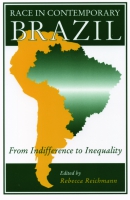




Race in Contemporary Brazil
From Indifference to Inequality
Edited by Rebecca Reichmann
“From Indifference to Inequality brings Brazilian voices to the international debate over racial equality and difference. The authors examine the unique construction and function of race in Brazil offering an up-to-date, clearly written social study of Brazilian race relations. The data and interpretations should be of interest not only to Brazilianists but also to all scholars who are interested in the social, economic, political and cultural patterns of race relations.”
- Description
- Reviews
- Bio
- Subjects
Reichmann assembles the most important work of Brazilians writing today on contemporary racial dynamics in policy-relevant areas: the construction of race and color classification systems, access to education, employment and health, racial inequalities in the judiciary and politics, and black women’s status and roles. Despite these glaring social inequalities, racial discrimination in Brazil is poorly understood, both within and outside Brazil.
The still-widespread notion of harmonious “racial democracy” in Brazil was first articulated by anthropologist Gilberto Freyre in the 1930s and was subsequently reinforced by the popular media, social observers, and scholars. By giving voice to Brazilians’ own interpretations of race, this volume represents an essential contribution to the increasingly international debates about the African diaspora and comparative constructions of race.
“From Indifference to Inequality brings Brazilian voices to the international debate over racial equality and difference. The authors examine the unique construction and function of race in Brazil offering an up-to-date, clearly written social study of Brazilian race relations. The data and interpretations should be of interest not only to Brazilianists but also to all scholars who are interested in the social, economic, political and cultural patterns of race relations.”
“Nevertheless, the book is a good source of information and adds an important perspective on the debate of racial inequality and indifference in Brazil.”
“The works in this volume are a welcome addition to the literature on the concept of race and racial inequalities, on social movements and on gendered and racialized experiences and structures. This volume is also a rare opportunity for North American anthropologists to think outside the box, to become more aware of and familiar with other anthropological and social science traditions, and particularly with those social scientists who are struggling to construct and confront ‘homework’ that is both innovative and socially relevant. Those unfamiliar with Brazil or its social science traditions, however, should be forewarned that this volume, with its exclusive research focus on the states of Rio de Janeiro, São Paulo, and Bahia, on the academic traditions of the hegemonic centers of Rio de Janeiro and São Paulo, and on the more statistically oriented policy studies, has barely scratched the surface of the diversity of approaches and traditions to be found elsewhere in the country.”
Rebecca Reichmann is currently Vice President for Programs at the San Diego Foundation. Previously she served as a Program Officer with the Ford Foundation in Rio de Janeiro (1988–1993) and was a visiting scholar at the Center for Iberian and Latin American Studies at the University of California, San Diego (1995–1997).
Also of Interest

Mailing List
Subscribe to our mailing list and be notified about new titles, journals and catalogs.