



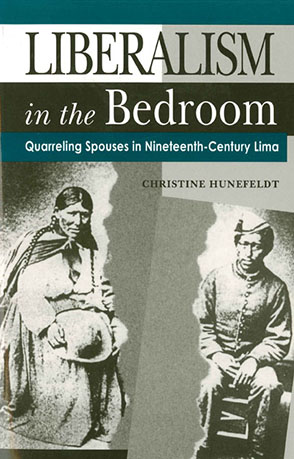
Liberalism in the Bedroom
Quarreling Spouses in Nineteenth-Century Lima
Christine Hunefeldt
“This is an indispensable item for any research library and contributes to fill a noticeable gap in the historiography of gender relations, which, in the case of Latin America, tends to be larger for the colonial period and the twentieth century than for the critical period in between.”
- Media
- Description
- Reviews
- Bio
- Subjects
A 2000 CHOICE Outstanding Academic Title
Careful examination of more than one thousand cases of conjugal suits filed in Lima's archbishopric, as well as wills in notarial records, allowed the author to trace over time quarreling spouses' relationships, attitudes, and perceptions of gender, life cycle, race, and class and to study their evolving moral expectations and the varying pace of social change.
The history of this marital dialogue reveals the construction of a new terminology, based on liberal ideas imported from England and France, that found its way into domestic life and influenced how conflicts were perceived and resolved. Far from opening doors for women, liberalism maintained women's inferior status but also shifted the ground on which women waged battles for survival.
By the end of the nineteenth century, many women had concluded that basic patriarchal and Christian arrangements were a sham, and they sought ways to cope within a system rife with hypocrisy. This book shows how women and children, made destitute by intimate tyranny, challenged this tyranny by finding new means of defense and social support.
“This is an indispensable item for any research library and contributes to fill a noticeable gap in the historiography of gender relations, which, in the case of Latin America, tends to be larger for the colonial period and the twentieth century than for the critical period in between.”
“The quality of Hunefeldt’s research and presentation, coupled with her brilliant analysis, makes a significant contribution to the methodology and literature on Latin American gender and family history issues. Upper-division undergraduates and above.
Hunefeldt’s study uses sophisticated research to demonstrate how women in Lima questioned their status as it was imposed upon them by a predominately patriarchal and Christian society. . . . In her examination of more than 1,000 conjugal cases from Lima’s archbishopric, Hunefeldt reveals how diverse issues—ranging from marriage, dowries, divorce, and inheritance to a woman’s responsibility both inside and outside the home—influenced 19th-century women and their families in Lima. This information alone would be an important contribution, but the author’s investigation extends beyond gender or family history to include questions regarding race, class, female labor, children’s rights, and the role of the governing white elite. The quality of Hunefeldt’s research and presentation, coupled with her brilliant analysis, makes a significant contribution to the methodology and literature on Latin American gender and family history issues. Upper-division undergraduates and above.”
“This is a fine book that deserves a wide readership. It reproduces the voices of women of all walks of life who battled against male prerogative and for moral and economic justice within marriage, continuously readapting their discourse to changing conditions. One of the book’s greatest strengths lies in its skillful blending of race and class into the analysis of gender issues.”
“Although the length of the book may limit its use in undergraduate classes, it should be read by all scholars and graduate students interested in the history of gender, the family, and demography.”
Christine Hunefeldt is Associate Professor of History at the University of California, San Diego. She contributed to The Peruvian Labyrinth (1997) and is the author of Paying the Price of Freedom: Family and Labor Among Lima's Slaves, 1800–1854 (1994).
Mailing List
Subscribe to our mailing list and be notified about new titles, journals and catalogs.