


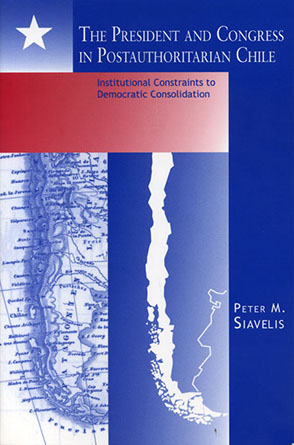
The President and Congress in Postauthoritarian Chile
Institutional Constraints to Democratic Consolidation
Peter M. Siavelis
The President and Congress in Postauthoritarian Chile
Institutional Constraints to Democratic Consolidation
Peter M. Siavelis
“Most casual observers consider Chile one of Latin America’s most stable new democracies, despite its incomplete transition. Siavelis makes the provocative argument that flawed institutional design will jeopardize that reputation once the consensus and cooperation of the democratic transition period wear off. He states his arguments clearly, defends them with impressive evidence, and refutes alternative views. This book is persuasive and prescient, essential reading for students of Chilean politics and highly recommended for those interested in the impact of institutions on politics.”
- Media
- Description
- Reviews
- Bio
- Subjects
A 2000 CHOICE Outstanding Academic Title
In this book, Peter Siavelis takes a close look at the important case of Chile, which had a long tradition of successful legislative resolution of conflict but was left by the Pinochet regime with a changed institutional framework that greatly strengthened the presidency at the expense of the legislature. Weakening of the legislature combined with an exclusionary electoral system, Siavelis argues, undermines the ability of Chile's National Congress to play its former role as an arena of accommodation, creating serious obstacles to interbranch cooperation and, ultimately, democratic governability.
Unlike other studies that contrast presidential and parliamentary systems in the large, Siavelis examines a variety of factors, including socioeconomic conditions and characteristics of political parties, that affect whether or not one of these systems will operate more or less successfully at any given time. He also offers proposals for institutional reform that could mitigate the harm he expects the current political structure to produce.
“Most casual observers consider Chile one of Latin America’s most stable new democracies, despite its incomplete transition. Siavelis makes the provocative argument that flawed institutional design will jeopardize that reputation once the consensus and cooperation of the democratic transition period wear off. He states his arguments clearly, defends them with impressive evidence, and refutes alternative views. This book is persuasive and prescient, essential reading for students of Chilean politics and highly recommended for those interested in the impact of institutions on politics.”
“The political and historical complexity of the Chilean transition has made it one of the most intensely studied of Latin America’s new democracies. Siavelis’s book provides the tools to understand how the new rules of competition and policy-making affect the main actors and shape the policies they produce. The author presents the highly charged issues of military prerogatives, constitutional structure, and electoral reform in a fashion that is both theoretically informed and accessible. The book will be an excellent addition to Latin American politics syllabi at either the undergraduate or graduate level.”
“Observers of Latin American politics have long ignored constitutional and institutional arrangements as important variables in interpreting the course of politics in the area. Siavelis (Wake Forest) provides an important and much-needed corrective to this oversight. This well-researched and sophisticated study repays repeated reading.”
“Peter Siavelis provides a detailed and intelligent account of the way in which the structure of executive-legislative relations impedes the consolidation of democracy in Chile, and the book is doubly valuable because the author is constantly aware of the historical and socio-economic contexts in which those institutions operate.
This book is firmly rooted in the institutional school of analysis and is a model of its kind. This sort of approach is long overdue in the study of Latin American political systems. It is well-written and well-researched, and makes a strong and convincing case for criticizing the structure of executive-congressional relations in Chile. Though the author’s emphasis on the future destabilizing effects of crisis is not so convincing, nevertheless this is one of the best analytical accounts of Chilean politics to have appeared in recent years.”
Peter Siavelis is Assistant Professor of Politics at Wake Forest University.
Also of Interest
Mailing List
Subscribe to our mailing list and be notified about new titles, journals and catalogs.