


Voices from the Gulag
Life and Death in Communist Bulgaria
Tzvetan Todorov, and Translated by Robert Zaretsky
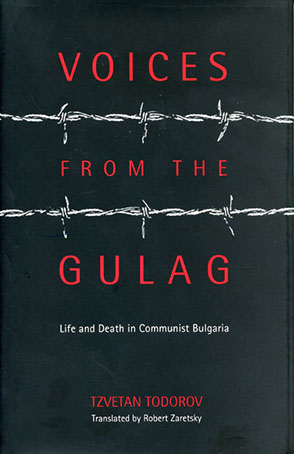
Voices from the Gulag
Life and Death in Communist Bulgaria
Tzvetan Todorov, and Translated by Robert Zaretsky
“Tzvetan Todorov, a Bulgarian-born French philosopher, studied the phenomenon of the concentration camps in totalitarian societies from the detached point of view of the historian and social scientist he is, with as much objectivity as is possible for a normal mind. Taking for example the death camp in Lovech, he used personal accounts by former prisoners and guards in books and interviews published soon after the fall of Communist dictator Zhivkov, or included in the overwhelming 1990 documentary film The Survivors (Stories from the Camps) by director Atanas Kiryakov. The value of Todorov’s book is not so much as a sinister chronicle of atrocities by psychopaths empowered to dispose of their fellow men’s lives. What is impressive is his analysis of the reasons for and nature of such abominable practices. His chilling conclusion is that they were not an exception, not an aberration, but an inherent part of the entire system, a conditio sine qua non institutionalized by the regime.”
- Description
- Reviews
- Bio
- Subjects
We also hear from guards, commandants, and bureaucrats whose lives were bound together with the inmates in an absurd drama. Regardless of their grade and duties, all agree that those responsible for these "excesses" were above or below them, yet never they themselves. Accountability is thereby diffused through the many strata of the state apparatus, providing legal defenses and "clear" consciences. Yet, as the concluding section of interviews—with the children and wives of the victims—reminds us, accountability is a moral and historical imperative.
The testimonies in Voices from the Gulag were written specifically for this volume or have been published in the Bulgarian press or on Bulgarian television. Todorov compiled them for this book and has written an introductory essay—a lucid and troubling analysis of totalitarianism and the role that terror and the concentration camp play in such a world. He reflects upon his own experience living in Bulgaria during the years when Lovech was in operation. It is through that experience that Todorov has sought to understand the totalitarian horrors of our century.
Although Lovech and the other camps of Soviet Russia and Eastern Europe have been closed down, concentration camps still exist in the countries whose communist regimes remain in power—Vietnam, China, North Korea, and Cuba. The voices in this book remind us that we are never completely safe from the threat of totalitarianism, a threat that we all must face. As Todorov writes, "I cannot say that these stories do not concern me."
“Tzvetan Todorov, a Bulgarian-born French philosopher, studied the phenomenon of the concentration camps in totalitarian societies from the detached point of view of the historian and social scientist he is, with as much objectivity as is possible for a normal mind. Taking for example the death camp in Lovech, he used personal accounts by former prisoners and guards in books and interviews published soon after the fall of Communist dictator Zhivkov, or included in the overwhelming 1990 documentary film The Survivors (Stories from the Camps) by director Atanas Kiryakov. The value of Todorov’s book is not so much as a sinister chronicle of atrocities by psychopaths empowered to dispose of their fellow men’s lives. What is impressive is his analysis of the reasons for and nature of such abominable practices. His chilling conclusion is that they were not an exception, not an aberration, but an inherent part of the entire system, a conditio sine qua non institutionalized by the regime.”
“Painful questions will keep disturbing the nation’s conscience, begging for right solutions. But when the civilized world probes them in the future, our children and grandchildren will at least be able to turn to books such as this, as a proof that the martyrs were not totally forgotten.”
Born in Sofia, Tzvetan Todorov left Bulgaria in the early 1960s and moved to Paris, where he established himself as a literary theorist, historian of ideas, and world-renowned essayist. He is a director of research at the Centre National de la Recherche Scientifique (CNRS) and the author of numerous books. Several of these have been translated into English, including: Facing the Extreme (1996), A French Tragedy (1996), On Human Diversity (1993), and The Conquest of America (1984).
Robert D. Zaretsky is an Associate Professor at the University of Houston where he holds a joint appointment in the Honors College and the Department of Modern and Classical Languages. He is the author of Nimes at War: Religion, Politics, and Public Opinion in the Department of the Gard, 1938–94 (Penn State, 1995), which won the 1997 Hans Rosenhaupt Memorial Book Award of the Woodrow Wilson Foundation.
Mailing List
Subscribe to our mailing list and be notified about new titles, journals and catalogs.