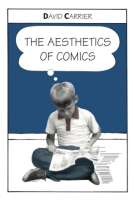




The Aesthetics of Comics
David Carrier
“The ingenuity with which the classical comic strip artists found ways of telling whole stories in four or five panels has been insufficiently appreciated by philosophers or historians of art. Carrier has written a marvelous book on these narrative strategies, from which we cannot but learn something about how the mind processes pictorial information and how the Old Masters coped with the urgent stories simple people had to understand.”
- Description
- Reviews
- Bio
- Sample Chapters
- Subjects
Distinguished philosopher David Carrier looks at popular American and Japanese comic strips to identify and solve the aesthetic problems posed by comic strips and to explain the relationship of this artistic genre to other forms of visual art. He traces the use of speech and thought balloons to early Renaissance art and claims that the speech balloon defines comics as neither a purely visual nor a strictly verbal art form, but as something radically new. Comics, he claims, are essentially a composite art that, when successful, seamlessly combine verbal and visual elements.
Carrier looks at the way an audience interprets comics and contrasts the interpretation of comics and other mass-culture images to that of Old Master visual art. The meaning behind the comic can be immediately grasped by the average reader, whereas a piece of museum art can only be fully interpreted by scholars familiar with the history and the background behind the painting. Finally, Carrier relates comics to art history. Ultimately, Carrier’s analysis of comics shows why this popular art is worthy of philosophical study and proves that a better understanding of comics will help us better understand the history of art.
“The ingenuity with which the classical comic strip artists found ways of telling whole stories in four or five panels has been insufficiently appreciated by philosophers or historians of art. Carrier has written a marvelous book on these narrative strategies, from which we cannot but learn something about how the mind processes pictorial information and how the Old Masters coped with the urgent stories simple people had to understand.”
“Carrier is an academic philosopher who also works as an engaged commentator on contemporary art. His writings tend to be full of witty rhetorical constructions, and thus they are entertaining to read in ways that most contemporary academic writing, whether on philosophy or art or both, is not.”
“David Carrier has written a most perceptive and readable account of that great American apparatus—the comic strip. Historically accurate and philosophically bracing, this is a truly terrific book. Carrier has done a necessary and brilliant service, and he has provided a true gift to all who admire the comic strip tradition.”
“Carrier’s gracefully erudite book will do for the comics what Stanley Cavell has done for Hollywood movies.”
“An indispensable and enjoyable contribution to discussions dealing with the end of Modernism, the function of art history, and the will to form a healthy development beyond current mannerist, postmodern malaise.”
David Carrier is Professor of Philosophy at Carnegie Mellon University. He is the author of many books, including Principles of Art History Writing (1991), The Aesthete in the City: The Philosophy and Practice of American Abstract Painting in the 1980s (1994), and High Art: Charles Baudelaire and the Origins of Modernist Painting (1996), all from Penn State Press.
Introduction
THE REALM OF SPIRIT IS DARK AND DIFFICULT TERRA INCOGNITA SO FAR AS PHILOSOPHICAL UNDERSTANDING IS CONCERNED, THOUGH IT IS AS WELL, SO FAR AS HUMAN UNDERSTANDING IS CONCERNED, THE MOST FAMILIAR TERRITORY OF ALL. IT IS IN THE REALM OF SPIRIT THAT WE EXIST AS HUMAN BEINGS. -ARTHUR C. PANTO, CONNECTIONS TO THE WORLD
This book is the first by an analytic philosopher to identify and solve the aesthetic problems posed by comic strips and to explain the relationship of this artistic genre to other forms of visual art. I distinguish comics from traditional static images-paintings, engravings, and other prints-and from movies, pictures that when projected move automatically. That I sometimes use disagreements about points of detail to motivate the presentation should not obscure my enormous debt to the great pioneering discussions: Ernst Gombrich's essays on caricature; David Kunzle's two volume history of the comic strip; the 1991 exhibition catalogue High arid Low by Kirk Varnedoe and Adam Gopnik; and Scott McCloud's Understanding Comics: The Invisible Art. Alexander Nehamas's essays on television gave me the idea that a popular art form deserves serious philosophical attention. My conception of a post-historical art derives from Arthur C. Danto's writings. Michele Hannoosh's book on caricature showed me how to relate present-day comics to the discussion of aesthetic theory in my own book on Baudelaire. A fully illustrated history of the comic strip would be a large, fat, expensive volume. Because my focus in this slim book is on conceptual issues, I refer the reader to the readily accessible commercial volumes that provide a rich survey of examples.
Comic strips, intrinsically fascinating, raise as-yet-little-discussed problems of great interest; analysis of comics suggests novel ways of understanding the history of visual art. Philosophers dealing with visual art very naturally focus their attention on theory-bound works-on old-master art that has subtle iconography and on modernist artifacts that exist as art only in relation to discourse about theory. Comics, by contrast, are like pop music-an art form almost all of us understand without any need for theorizing. The great discovery of high art was that it was possible to narrate highly complex scenes without any appeal to words. The equally surprising discovery of the comics was that it is possible to deploy many different kinds of verbal information within storytelling visual images. Although this book focuses on comics, the argument is of broader relevance. McCloud's positively Gombrichian willingness to appeal to experimental evidence should be suggestive to historians of art and philosophers interested in the nature of perception.
Aestheticians and art historians have justifiably devoted a great deal of attention to visual representation. Until we understand the different ways in which Giotto and Raphael depict textures, Ruisdael and Constable show clouds, and Poussin and Caravaggio express emotion, we are hardly able to understand how we respond to their pictures. With comics, similarly, until we properly grasp how their particular combination of words and pictures functions, how can we evaluate them critically (and politically) or understand their relation to high art? My goal is Gombrich's "finding out what role the image may play in the household of our mind."1 Film studies have become an important academic concern. It is very odd that, by contrast, the comics have attracted so little academic attention, for they have a much larger audience and raise problems as interesting as paintings.2
Comics have not been properly understood by aestheticians, because as yet the essential philosophical issues they deal with have not been identified. Everyone acknowledges that Poussin's paintings deserve philosophically informed commentary. But slight popular images, art that everyone understands without need of any explanation, could they also deserve the attention of philosophers? Modern philosophy owes much to the close study of humble examples-to Jean-Paul Sartre's and Maurice Merleau Ponty's phenomenological studies of desire, John Austin's account of ordinary language, Ludwig Wittgenstein's analysis of games, and G. E. M. Anscombe's account of intention. What remains unachieved is a proper understanding of the implications of these concerns for aesthetics. Much of this book was written with Arthur C. Danto's Connections to the World: The Basic Concepts of Philosophy on one side of my powerbook and the various histories of comics on the other.3 Adapting the exemplary structure of Danto's Jean-Paul Sartre, each chapter here has two titles, one relating to comics, the other alluding to related issues from within philosophy. My dual concerns, art-historical and philosophical, thus run through the entire book. Appeal to these philosophical concerns is not a merely literary embellishment of my commentary. To understand comics properly, I am arguing, we must identify the conceptual issues posed by their definition and interpretation.
What is a comic? The answer to this question determines the shape of analysis and so also its starting point. Sequences of closely linked images are one essential element-Kunzle makes this the defining element of the comic strip: "(1) There must be a sequence of separate images; (2) There must be a preponderance of image over text; (3) The medium... must be... a mass medium; (4) The sequence must tell a story which is both moral and topical." The speech balloon, he argues, is not "a definitive ingredient of the comic strip."4 Indeed, only occasionally in the examples from 1450 to 1825 assembled in his first volume do we find balloons. Rodoiphe Topifer, whose 1830s strips have a central place in Kunzle's second volume, does not use speech balloons; his stories contain so much writing that they are illustrated novellas. I admire Kunzle, a bold original scholar, for gathering these materials, without which my own philosophical study could not have been conceived. My difference here with him involves no disagreement about the historical facts but only a question of focus. Defining the comic strip as a narrative sequence with speech balloons, I believe that the examples in both of his books belong to the prehistory of comics, which emerge as a populist art form only around 1890. Most late Victorian visual narratives, stories told in a small number of pictures in narrative sequence, do not make systematic use of speech balloons as do true comics.5 What Kunzle presents mostly are image sequences accompanied with words; the full integration of words into pictures in the speech balloon creates a new art, which raises novel aesthetic problems.
The speech balloon is a defining element of the comic because it establishes a word/image unity that distinguishes comics from pictures illustrating a text, like Tenniel's drawings for Alice in Wonderland. Tenniel's images, well suited to the story, are not an essential element of it. Speech balloons, because they are visible to the reader but do not lie within the picture space containing the depicted characters, distinguish comics from both old-master art and the seventeenth-century broadsheets presented by Kunzle. The speech balloon is a great philosophical discovery, a method of representing thought and words. Almost unknown before being exploited by comics artists, the speech balloon defines comics as neither a purely verbal nor a strictly visual art form, but as something radically new. The comic for Kunzle "is essentially a hybrid form, part verbal and part pictorial, the latter must be considered as its primary feature .... it cannot be dominated by text.6 The problem he then faces is determining in individual cases whether image or text "carries the burden of the narrative." He assumes that a narrative must be either visual or verbal-and comics must thus be a mixture of the two. This I deny. Comics in my view are essentially a composite art: when they are successful, they have verbal and visual elements seamlessly combined.
The account I present of the crucial visual technology developed within comics by no means coincides with that presented in various admirable survey accounts, listed in my bibliography, from which I have learned a great deal. A full sociological analysis would need to deal with the great body of archival materials. But just as Descartes could philosophize using but a small selection of examples, so I identify the nature of comics by surveying a limited range of materials. I have little to say about the distinctive styles of the individual comics artists. I focus closely on only Gary Larson and George Herriman, relatively marginal figures for the historian but especially revealing artists for my purposes. The examples illustrate my abstract philosophical reasoning.
A full sociological study, taking Kunzle's concerns into the present, could be a great contribution to cultural studies and would be a useful correction of the tendency of art historians to pay so little attention to an art form that attracts so much more public attention than any work displayed merely in museums. Although there have been various semiotic accounts of comics, no one has identified the specifically philosophical problems posed by comics. The theorizing developed in this book is closer to Gombrich's than to the semiotic theories that became fashionable in the American art world in the 1980s.
The history of representational art, as told by Vasari and Gombrich, is the story of the slow, often difficult discovery of the technology of visual representation. With comics, by contrast, already at the time of Giotto all of the necessary visual technology was available, but their development was possible only when there was a felt need for a readily accessible popular art. All the most important techniques of the comic strip were discovered quickly right at the start of its development. Since its origin, this art form has used these techniques to present stories. In focusing on these devices, the speech balloon and the narrative sequence, my account thus might be called a formal analysis-with the understanding that, as I show in Chapter 5, the form of comics places very real constraints on its content, on the kinds of stories that are most effectively told. The hypothesis governing my discussions of both balloons and narrative sequence is Gombrichian. We seek consistency, aiming to interpret all the elements in the visual field in some way that makes sense of them; and we are remarkably adaptable, willing to overlook minor inconsistencies so long as the words in the balloon can be attached to the image and the sequence of the images constitutes a meaningful narrative.
In the next to last chapter of Art and Illusion, Gombrich turns from the story of representation to the analysis of what he calls "the Experiment of Caricature," moving from an art devoted to visual discovery to this "illusion of life which can do without any illusion of reality." He seems ambivalent about how to analyze caricature. Sometimes he describes it as a special kind of representation: "[C]aricature becomes only a special case of what I have attempted to describe as the artist's test of success. All artistic discoveries are discoveries not of likenesses but of equivalences which enable us to see reality in terms of an image and an image in terms of reality." Just as Constable permits us to see his picture Wivenhoe Park as Wivenhoe Park because it looks like that estate, so a caricaturist enables us to see his image as depicting, in exaggerated ways, his subject. But that parallel takes account only of the conventional aspect of representation, not the way in which representations, unlike mere caricatures, really do look as much as possible like what they depict. This is why Gombrich associates Daumier with the political cartoonists and not "the French tradition of great art."7 Representation making itself is emotionally neutral; caricature is essentially aggressive in its distortions.
Much of Gombrich's argument involves debate about the role of convention in representation. Perspective, he argues, against Erwin Panofsky, shows how things really appear-it is not merely a form of symbolic representation. He rejects the argument of Nelson Goodman that, because perspective is, strictly speaking, designed to "work" only under special viewing conditions, therefore it is not a scientific discovery. While Gombrich allows that there are conventional elements in representation, he claims that naturalistic pictures look like what they depict. He rejects semiotic theories of representation. In comics, almost everyone agrees, the speech balloon (but not the narrative sequence) is purely conventional. The concept of convention is elusive and subtle. For my present purposes, which are simpler than Gombrich's, a pictorial element is conventional if it would not be visible to someone standing within the picture space. If you could stand next to Donald Duck in a comic, you would see him, but not the words or thoughts in his speech balloon.
In the last chapter of Art and Illusion, "From Representation to Expression," the techniques associated with caricature lead forward to the abstract painting of Mondrian. I would describe the tradition of caricature in a different way, treating it as a natural extension of the concern of old master and early modernist art with presenting verbal narratives in visual images. The style of my argumentation about comics is Gombrichian, but my art-historical narrative differs from his. We offer different, but not necessarily incompatible, accounts.
This book has three parts. Chapters 1 through 4 are devoted to identifying the nature of comics, Chapters 5 and 6 to explaining how they should be interpreted, and Chapter 7 to understanding their place in art's history. To interpret an art, we need to know its essence, its defining qualities; and with the art of comics, that requires understanding its origin. Once we know what kind of a thing the artwork is, we are prepared to explain its history. When comics are defined, we see how to interpret them and can recognize the character of their history.
This introduction has defined the comic as a closely grouped sequence of images using balloons. Chapter 1 discusses the origin of comics, explaining how caricatures involve imagining an implicit successor to a single image. That analysis prepares the way for two chapters focused on the comics' identifying features. Chapter 2 discusses speech and thought balloons, noting their origin in early Renaissance art and explaining why this rich visual resource was not systematically exploited until the development of comics. Chapter 3 then takes up the second defining characteristic, the closely linked succession of images. Comics use words and images-how do they bind them together? Chapter 4, dealing with that issue, explores the deep relation between comics and another kind of entity linking two such distinctly different elements, persons. Like literature, comics are narratives that are read; like paintings, comics are images that are viewed. And so a proper account must do justice to our experience of this unity, words-and-pictures. Here, finally, we come to the third and final essential feature of comics-their scale.
Having identified the essential qualities of comics, what then can we say about how they are interpreted? Chapter 5 takes up some relevant theories of text reading and picture viewing. This distinctive unity of comics reflects the identity of comics as a populist art form. Chapter 6 argues that such mass-culture images should be interpreted differently from old-master art. The meaning of a comic is determined not by the artist but by the audience; to interpret a comic we need to identify the ways in which it reflects the fantasies of its public.
Chapter 7, by showing how from the start the comic was essentially a post historical art, incapable of development, returns in a self-conscious way to my starting point. Once we fully understand the essence and history of comics, we are prepared to grasp their philosophical significance.
Notes
1. E. H. Gombrich, Meditations on a Hobby Horse (London: Phaidon, 1963), 127.
2. It is a great misfortune that the reissue of the most famous early comic, Krazy Kat, never was realized. "Surely the prerequisite for serious evaluation of any artist's or writer's contributions is that the work under consideration be accessible" (Rosemont, "Surrealism in the Comics I: Krazy Kat [George Herriman]," in Popular Culture in America, ed. Paul Buhie [Minneapolis: University of Minnesota, 1987], 123). What major painter lacks a catalogue raisonné?
3. The discussion of Kant, Sartre, and Husserl in Umberto Eco's account of Superman is one precedent (Umberto Eco, "The Myth of Superman," Diacritics 2, no. 1 [1972]: 16).
4. David Kunzle, The Early Comic Snip: Narrative Strips arid Picture Stories in the European Broadsheet from c. 1450 to 1825 (Berkeley and Los Angeles: University of California Press, 1973), 2-3. For a view closer to mine, see Robert C. Harvey, "The Aesthetics of the Comic Strip," Journal of Popular Culture 12 (1979): 640-52. I date the actual birth of the comic to 24 October 1897, when The Yellow Kid appeared; see Coulton Waught, The Comics (New York: Macmillan, 1947), fig. 2.
5. See Denis Gifford, Victorian Comics (London: George Allen & Unwin, 1976).
6. Kunzle, The Early Comic Strip, 2.
7. E. H. Gombrich, Art and Illusion (Princeton: Princeton University Press, 1961), 336, 345, 252.
© 2000 The Penn State University
Also of Interest

Mailing List
Subscribe to our mailing list and be notified about new titles, journals and catalogs.