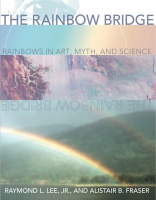




The Rainbow Bridge
Rainbows in Art, Myth, and Science
Raymond L. Lee Jr., and Alistair B. Fraser
$46.95 | Hardcover Edition
ISBN: 978-0-271-01977-2
408 pages
8.5" × 11"
97 color/63 b&w illustrations2001Co-published with SPIE Optical Engineering Press
The Rainbow Bridge
Rainbows in Art, Myth, and Science
Raymond L. Lee Jr., and Alistair B. Fraser
“A learned and gracefully written book which surveys every important aspect of the rainbow, including its role in myth, religion, and art. This eye-opening volume reveals the considerable physical and cultural significance of a remarkable natural masterpiece. . . . The chapters on myth and art are as brilliant as those on modern optics and illustrate how the rainbow has been as elusive to scientists as to ancient mythmakers. This smart, impassioned cross-disciplinary study, with its many color photos and illustrations. provides an eight-course feast for the intellect and the eyes.”—Bruce Cole, Department of the History of Art, Indiana University
- Description
- Reviews
- Bio
- Sample Chapters
- Subjects
Venerated as god and goddess, feared as demon and pestilence, trusted as battle omen, and used as a proving ground for optical theories, the rainbow's image is woven into the fabric of our past and present. From antiquity to the nineteenth century, the rainbow has played a vital role in both inspiring and testing new ideas about the physical world. Although scientists today understand the rainbow's underlying optics fairly well, its subtle variability in nature has yet to be fully explained.Throughout history the rainbow has been seen primarily as a symbol—of peace, covenant, or divine sanction—rather than as a natural phenomenon. Lee and Fraser discuss the role the rainbow has played in societies throughout the ages, contrasting its guises as a sign of optimism, bearer of Greek gods' messages of war and retribution, and a symbol of the Judeo-Christian bridge to the divine.
The authors traverse the bridges between the rainbow's various roles as they explore its scientific, artistic, and folkloric visions. This unique book, exploring the rainbow from the perspectives of atmospheric optics, art history, color theory, and mythology, will inspire readers to gaze at the rainbow anew.
For more information on The Rainbow Bridge, visit: <http://www.usna.edu/Users/oceano/raylee/RainbowBridge/contents.html >
“A learned and gracefully written book which surveys every important aspect of the rainbow, including its role in myth, religion, and art. This eye-opening volume reveals the considerable physical and cultural significance of a remarkable natural masterpiece. . . . The chapters on myth and art are as brilliant as those on modern optics and illustrate how the rainbow has been as elusive to scientists as to ancient mythmakers. This smart, impassioned cross-disciplinary study, with its many color photos and illustrations. provides an eight-course feast for the intellect and the eyes.”—Bruce Cole, Department of the History of Art, Indiana University
“The Rainbow Bridge is a celebration of rainbows as bridges that span between cultures—the liberal arts and the sciences, the past and the present, the living and the dead, the sacred and the profane, the academic and the commercial. It succeeds brilliantly in developing and sustaining this theme by drawing on a great number of original sources. It will be an indispensable resource for scientists interested in art, and for artists interested in science—a bridge indeed.”—George Siscoe, Department of Atmospheric Sciences, UCLA, Retired“This smart, impassioned cross-disciplinary study, with its many color photos and illustrations, provides an eight-course feast for the intellect and the eyes.”—Publishers Weekly“Over it, under it, sideways, you name the angle: a spectacular cultural history of the rainbow in art, myth and science. It shimmers.”—Carlin Romano, Philadelphia Inquirer“Lee and Fraser have written an authoritative book on rainbows. From prehistoric art to modern-day advertising, they explore the cultural and artistic symbolism of the rainbow. . . . This book will be a great addition to the library of anyone interested in art and science.”—D. M. Mason, CHOICE“Stunningly well informed about the art, science, philosophy and history of all eras since the Periclean Golden Age, unerringly elegant, flatteringly intelligent and beautifully illustrated, it is a masterpiece of accessible scholarship.”—Philip Ball, Nature“The rainbow is one of humankind’s premier symbols, permeating our myths, art, and literature. It serves as a perpetual source of inspiration for aspiring atmospheric scientists and cornerstone problem in the history of science. Covering such an extensive field, as the authors have done superbly, requires polyglot abilities. Both authors have made fundamental contributions to our understanding of rainbows and have at the same time become historians of the first class. Reading The Rainbow Bridge is a cultural and scientific happening.
The Rainbow Bridge traverses an immense ground with style, grace, wit, and insight. It will provide atmospheric scientists with an authoritative account of the scientific and cultural roots of their field. And perhaps most important, it will make all of us better observers. Atmospheric scientists who may never have thought of themselves as ‘cultured’ may find themselves with an ability to diagnose paintings with unexpected discrimination and knowledge.”—Stanley Gedzelman, Bulletin of the American Meteorological Society“Lee and Fraser have produced an unusual book with universal appeal to all sighted humans, from pre-literate five-year-olds to hyper-literate scholars.”—Michael C. Barris, Optometry and Vision Science“The Rainbow Bridge is an outstanding book.
A treasure, and a treasure trove.”—Jack Harris, Interdisciplinary Science Reviews“The Rainbow Bridge is the ultimate book for rainbow fact and lore.
For those who enjoy seeing the human face in science, this is an outstanding reference.
It is hard to imagine a more comprehensive book. For those who are interested in human aspects of the rainbow, this is the book for you.”—David K. Lynch, Weatherwise“Lee and Fraser are masters of prose, and their book is sumptuously produced and abundantly illustrated. They are to be congratulated for producing not only a definitive rainbow scholarship but also a gorgeous work of cultural synthesis.”—Michael Berry, Physics World“The Rainbow Bridge, by Lee and Fraser, is an excellent guide to the appealing rainbow world. . . . I heartily recommend this book to everyone interested in the history and development of optics and its relationship with ancient and modern myths and/or artistic representations of natural shapes and colors. I especially recommend it to those seeking to bridge the gap between the ‘two cultures,’ whether they believe themselves citizens of the Republic of Sciences or the Republic of the Arts.”—Salvador X. Bara, Optics and Photonics News“This is a magnificent and scholarly book, exquisitely produced, and definitely not destined only for the coffee table. It is multifaceted in character, addressing rainbow-relevant aspects of mythology, religion, the history of art, art criticism, the history of optics, the theory of color, the philosophy of science, and advertising! The quality of the reproductions and photographs is superb. The authors are experts in meteorological optics,but their book draws on many other subdisciplines.”—John A. Adams, Notices of the American Mathematical Society“Lee and Fraser combine informative text, images, and diagrams in this eclectic survey of cultural and scientific perspectives on the interaction between sunlight and raindrops.”—ScienceRaymond L. Lee, Jr. is adjunct professor in the Mathematics and Science Division at the U. S. Naval Academy. He has contributed articles to Applied Optics, Journal of the Optical Society of America, Color Research and Application, and New Scientist. Alistair Fraser is professor emeritus of Meteorology at Penn State. His articles have appeared in Smithsonian, Reader's Digest, Scientific American, and Weatherwise.
Appendix: A field guide to the rainbow
Q1: What is a rainbow?
Observationally, the rainbow is a circular arc of several colors seen in rain or spray opposite the sun and centered around the shadow of your head (Figs. 4-4 and A-1). The rainbow's colors are in concentric bands, and while they vary slightly from one bow to the next, the colors are always arranged in spectral order: red, orange, yellow, green, blue, and violet. While you are unlikely to see all of these colors in a given rainbow, their order does not change. For the inner (or primary) rainbow, red is on the outside; for the outer (or secondary) rainbow, red is on the inside.
Optically, the rainbow is just a distorted image of the sun. Raindrops perform this rearranging of sunlight via reflection and refraction. Think of the drops as imperfect one-way mirrors: most light passes through them, but the light forming the rainbow is reflected from their rear surfaces (Fig. 5-3). In addition, as sunlight passes from air to water (or vice versa) it is deviated from its original path, with blue light being deviated more than red (Fig. 6-6). As Fig. 5-3 indicates, this combination of refraction and reflection occurs at each air-water boundary. However, the light forming the primary rainbow is that refracted on entering the drop, reflected at its rear, and refracted a second time on exiting (Fig. 6-6).
Q2: When and where can I expect to see a rainbow?
You can see the rainbow whenever you look opposite the sun at sunlit raindrops (or spray drops). The rainbow occurs because raindrops do not scatter sunlight uniformly in all directions (Fig. 6-5). Consider a ray passing through the middle of the drop. It is deviated by 180 degrees , returning in the direction that it entered (ray q in Fig. 6-5 is closest to this ray). As rays strike the drop at ever more glancing angles, the combined refractions and reflection bend the rays through smaller and smaller angles. This does not continue indefinitely. One ray in particular is bent by 138 degrees , the minimum deviation (ray m in Fig. 6-5). Rays that enter the drop more obliquely are deviated by more than 138 degrees . In contrast to other rays, this minimum deviation ray has a great many neighbors leaving the drop at nearly the same angle. It is this concentration of light 138 degrees from the sun that forms the primary rainbow.
We translate the rainbow's geometry to a more convenient reference point, the shadow of your head. Whenever you are illuminated by sunlight, the shadow of your head is 180 degrees from the sun. The shadow of your head thus covers the antisolar point, the point directly opposite the sun. So the primary bow is a 42 degrees -radius circle (180 degrees - 138 degrees = 42 degrees ) centered on the antisolar point (Figs. 4-4 and A-1).1 All rays other than the minimum deviation ray simply add to the general brightness within this 42 degrees -radius circle. Thus the sky within the primary rainbow may look bright compared to the brightness of the surrounding sky. By the same logic, the sky outside an intense secondary rainbow will be relatively bright. The reason is that rays exceeding the secondary rainbow's minimum deviation are seen here (see answer to Q5). A natural corollary of this enhanced primary and secondary brightness is that the sky between bright rainbows looks dark (see answer to Q12).
Q3: What causes the rainbow's circular shape?
Many drops acting in concert cause the rainbow, and all of these must be at the same angle from the sun (that is, the same angle from the antisolar point). Thus at any instant only those drops before you that are on a 42 degrees circle centered about the antisolar point can send you the concentrated rainbow light. These drops may be at any distance, but they must be on the 42 degrees circle. Put another way, the rainbow is a mosaic of light sent to you by many raindrops as they fall through the surface of the imaginary cone whose tip is at your eye and whose radius is 42 degrees (Figs. 4-4 and A-1).
Q4: What causes the rainbow's colors?
The rainbow's colors arise because the minimum deviation ray occurs at a slightly different angle for each color (Fig. 6-7). A prism's refraction of white light into a spectrum is similar to the rainbow's color separation. Because blue light at minimum deviation is bent through a greater angle than red light, the red light is closer to the sun. As a consequence, red will be on the outside of the primary bow, closest to the sun, and blue will be toward the inside. Although an indefinite number of colors is possible, their sequence across the bow is not arbitrary. From the outside to the inside of the primary bow this spectral sequence is red, orange, yellow, green, blue, and violet. (See Fig. 7-21 for an especially colorful primary rainbow.)
A single fact explains the opposite color orders of the secondary and primary rainbows: red light at minimum deviation is bent less than blue light, and thus red appears closer to the sun. However, because minimum deviation rays for the secondary are bent through more than 180 degrees (see answer to Q5 and Figs. 4-3, 6-8), "closer to the sun" now means that red appears on the secondary rainbow's inner edge. In essence, deviating sunlight through more than 180 degrees turns the rainbow colors inside out.
Q5: What causes double rainbows?
Figure 6-8 shows the path of a light ray (ray m) that contributes to the outer (or secondary) rainbow. This ray is reflected twice within the drop. Because each internal reflection is paired with a refraction of light out of the drop, less light is available to form the secondary bow, and thus it is less intense than the primary. At minimum deviation, this secondary-rainbow light is bent through an angle of about 231 degrees , which places the secondary rainbow 51 degrees from the antisolar point (51 degrees = 231 degrees - 180 degrees ). Because the secondary rainbow is inherently dimmer than the primary, it may not always be visible. However, if the primary rainbow is very bright, look for its fainter secondary companion 9 degrees outside it (Fig. 4-3).
Q6: Why are rainbows often incomplete?
Since the raindrops are falling, their supply must be uninterrupted if the bow is to last. Because the edge of a rain shaft can pass quickly across the position where the rainbow might occur, the bow can appear or disappear rapidly. As long as you see sunlit drops at the minimum deviation (or rainbow) angle, the bow will be with you. However, if any part of the circle where the rainbow can occur is devoid of either drops or direct sunlight, that part of the bow will not form, which accounts for the partial bows we often see (Fig. 4-17). Because the rainbow's angular size and angular distance from the sun are fixed, we cannot see a rainbow in a distant shower if the sun is higher than 42 degrees above the horizon (assuming that we are on level ground).
Q7: Can I ever see an entire rainbow circle?
Yes, any time that you can see many sunlit drops in all directions from the antisolar point, the rainbow circle will be complete. For example, you could see the rainbow circle from atop a mountain, a high hill or building, or an airplane in flight. Less ambitiously, you can see the complete circle if you fill the air before you with sunlit spray that extends 42 degrees from the antisolar point. Note that while this spray bow looks smaller than one seen in a distant shower, its angular size is the same.
Q8: How big is the rainbow?
The primary rainbow's angular radius is about 42 degrees and its width is about 2 degrees . The secondary's angular radius is about 51 degrees and its width is about 3 degrees . Neither bow is an object, so neither has a linear size. However, we typically use our perception of an object's angular size and our estimate of its distance from us to infer its linear size. Experience and expectation combine to make these inferences fairly accurate for familiar objects. The rainbow has a fixed angular size and we plausibly (but erroneously) equate its distance with that of the rain or spray in which we see the bow. Everyday experience tells us that, for a fixed angular size, objects that appear more distant are larger than those nearby. Even though the rainbow is not an object, we mistakenly assume that our usual rules relating angular and linear size apply. Thus rainbows seen in a distant shower are compellingly large, while those in a nearby spray seem small. Yet neither bow has a linear size, just a fixed angular size.
Q9: How many colors does a rainbow have?
Quite literally, as many as you think you see, whether that number is three or three hundred! For good perceptual reasons, we recognize discrete bands of color in the rainbow (Chapter 7). However, the number of rainbow colors is actually indeterminate, with each color blending smoothly into the next (Chapter 8).
Q10: Why is the sky inside the primary rainbow sometimes bright?
See answer to Q2.
Q11: Why are bright rainbows most vivid near their base?
As explained in Chapter 9, large raindrops flatten as they fall but smaller ones do not. As a result, all sizes of raindrops contribute to the rainbow near its base, and large drops make this part of the bow both bright and colorful. As we approach the top of the arch, however, only small drops contribute to the rainbow, and these yield a less intense, more pastel bow. See Fig. 7-21 for an example of this color and brightness gradation.
Q12: Why is the sky dark between the primary and secondary rainbows?
By definition, raindrops between the bows cannot send you any light that contributes to either the primary or secondary rainbow. In other words, light that has been internally reflected once (the primary) or twice (the secondary) by water drops does not reach you from this part of the sky, so the sky looks comparatively dark there. This dark band is known as Alexander's dark band (Chapter 4) and is most evident if the primary and secondary bows are bright (Fig. 9-2 and Minnaert 1993, Plate 13).
Q13: Why and when do red or orange rainbows occur?
Near sunrise and sunset, scattering of sunlight over long paths through the atmosphere can make direct sunlight noticeably reddish or orangish. Because direct sunlight shining on water drops causes the rainbow, the resulting rainbows will have a pronounced red or orange cast (see Greenler 1980, Plate 1-7; Minnaert 1993, Plates 11-12).
Q14: What is a cloudbow, and when can I expect to see one?
A cloudbow (Fig. 8-1) is a water-drop bow caused by the same optics that generates the rainbow. However, cloud droplets are about 10 to 100 times smaller than raindrops or spray drops. An interference theory of the rainbow explains (1) the nearly colorless appearance of bows formed by these small drops and (2) the supernumerary bows that accompany both cloudbows and rainbows (Chapter 8). As Fig. 8-1 suggests, a cloudbow may be visible when you fly above a deck of stratus clouds and can see your airplane's shadow on them. Alternatively (and more arduously), you can see a cloudbow if you climb above a sunlit fog bank (that is, stratus near the ground) that envelops the base of a hill or mountain. There you look for the cloudbow about 40 degrees from the shadow of your head.
Q15: Can I ever see rainbows on the ground?
Yes, if the ground is covered with sunlit dew, you may see the colorful dewbow. Like the rainbow, the dewbow's light comes from a circular set of directions that are 42 degrees from the antisolar point. However, because we know that dew lies on the ground before us, we have the compelling sense that the dewbow is a hyperbola (or an ellipse, if the sun is high in the sky). (See Greenler 1980, p. 17, Plate 1-12; and Minnaert 1993, pp. 202-3.)
Q16: What is a lunar rainbow, and why is it white?
Like the sun, the moon can also generate rainbows. However, because moonlight is much less intense than sunlight, the lunar rainbow usually is too dim for us to see any colors in it. Recall that even under a full moon, objects that look vividly colored during the day appear only in shades of gray. Thus the lunar rainbow is white (Chapter 8; Minnaert 1993, pp. 207-8).
Q17: What are the pale green and purple arcs sometimes seen within the primary rainbow?
These are the supernumerary rainbows. Despite their superfluous-sounding name, they are an integral part of the rainbow (Figs. 8-3 and 8-8). In fact, explaining how supernumeraries occur also explains the primary and secondary rainbows (see answer to Q14).
Q18: Why does a rainbow grow brighter and darker so quickly?
See answer to Q6.
Q19: Can I touch the rainbow or reach its end?
No. Because the rainbow is an image, not an object, you can never reach or touch it (Chapter 4). However, in the same way that you can touch a mirror but not your image in it, you can touch the water drops that generate the bow. For example, if you make a rainbow in a sprinkler's sunlit spray, you can certainly touch the spray. That is quite different from the impossible feat of touching the rainbow image.
© 2001 The Penn State University
Also of Interest

Mailing List
Subscribe to our mailing list and be notified about new titles, journals and catalogs.