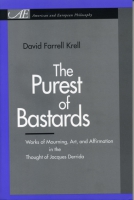




The Purest of Bastards
Works of Mourning, Art, and Affirmation in the Thought of Jacques Derrida
David Farrell Krell
The Purest of Bastards
Works of Mourning, Art, and Affirmation in the Thought of Jacques Derrida
David Farrell Krell
“This is an expertly informed analysis, explanation, defense, and affirmation of Derrida’s work. The focus on mourning is extremely suggestive and provocative—really thought-provoking! The book will be read with delight by specialists in the field and will be of real value also to graduate students—those who wish to engage the formative issues of the tradition.”
- Description
- Reviews
- Bio
- Subjects
But, while affirmative, Derrida is also engaged in a thinking of mourning, which he views as the promise of memory—a fragile yet vital promise that binds past and future. The book explores what mourning means in Derrida’s writing and how the labors of mourning and affirmation are mediated by works of art. Thus the book engages many different areas of Derrida’s work, from the classic texts of deconstruction to the more recent meditations on art and mourning.
"This chance [affirmation without issue] can come to us only from you, do you hear me? Do you understand me? . . . And me, the purest of bastards, leaving bastards of all kinds just about everywhere.” This passage from Derrida’s La Carte postale nicely encapsulates what David Farrell Krell wants to convey about Derrida’s thought—its astonishing mix of negativity and affirmation in his labors of mourning.
“This is an expertly informed analysis, explanation, defense, and affirmation of Derrida’s work. The focus on mourning is extremely suggestive and provocative—really thought-provoking! The book will be read with delight by specialists in the field and will be of real value also to graduate students—those who wish to engage the formative issues of the tradition.”
“This book makes an important contribution to scholarship on the thought of Jacques Derrida. Krell presents a careful reading of selected texts representing Derrida’s encounters with phenomenology, psychoanalysis, literature, and art. . . . [Krell] eschews easy answers to critical questions and often ends discussions with questions for the reader to ponder. An indispensable book for anyone studying Derrida.”
“A study that, while introductory, nevertheless engages effectively with the texts it discusses and develops analyses of them that are evocative and worthy of further development.”
David Farrell Krell is Professor of Philosophy at DePaul University and the author of many books, including Intimations of Mortality: Time, Truth, and Finitude in Heidegger's Thinking of Being (Penn State, 1986), Infectious Nietzsche (1996) and Contagion: Sexuality, Disease, and Death in German Idealism and Romanticism (1998).
Also of Interest
Mailing List
Subscribe to our mailing list and be notified about new titles, journals and catalogs.