


Conscience and Community
Revisiting Toleration and Religious Dissent in Early Modern England and America
Andrew R. Murphy
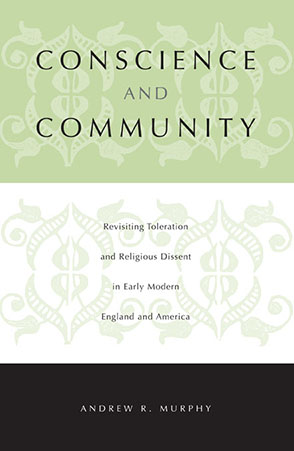
Conscience and Community
Revisiting Toleration and Religious Dissent in Early Modern England and America
Andrew R. Murphy
“At a time when the relationship of religion and politics is being bitterly contested and radically rethought, Andrew Murphy has challenged all parties in this dispute to forgo comfortable myths and confront the profoundly political and pragmatic origins and development of toleration. By comparing the early modern disputes over the limits of toleration and religious dissent in America and England in the 17th and 18th centuries, Murphy has both revitalized this legacy and provided a brilliantly lit mirror in which to view our contemporary quandaries.”
- Description
- Reviews
- Bio
- Subjects
Murphy argues that contemporary liberal theorists have misunderstood and misconstrued the actual historical development of toleration in theory and practice. Murphy approaches the concept through three "myths" about religious toleration: that it was opposed only by ignorant, narrow-minded persecutors; that it was achieved by skeptical Enlightenment rationalists; and that tolerationist arguments generalize easily from religion to issues such as gender, race, ethnicity, and sexuality, providing a basis for identity politics.
“At a time when the relationship of religion and politics is being bitterly contested and radically rethought, Andrew Murphy has challenged all parties in this dispute to forgo comfortable myths and confront the profoundly political and pragmatic origins and development of toleration. By comparing the early modern disputes over the limits of toleration and religious dissent in America and England in the 17th and 18th centuries, Murphy has both revitalized this legacy and provided a brilliantly lit mirror in which to view our contemporary quandaries.”
“Murphy’s work fills a void in the scholarship on toleration. This study of toleration in seventeenth-century England and America analyzes both theory and practice. It also places the case for toleration in the context of a broader debate, which included the arguments of anti-tolerationists, ignored so often by historians of the subject.”
“Conscience and Community is both a major advance in the study of colonial America and a contentious contribution to liberal political philosophy. Historians and political philosophers will have to wrestle with [Murphy's] work for a considerable time to come.”
“Murphy makes this case very well. If I have any objections, it is to his insistence that this argument is urgently needed.”
“This book . . . is more than just a richly detailed and carefully documented work in the history of ideas: it is also one of the more original and persuasive reconsiderations of the negative liberty paradigm to appear in some time.”
“Conscience and Community is a welcome combination of thorough historical analysis and lucid contemporary argument.”
“Andrew Murphy provides an incisive critique of the assumption that the autonomy prized in liberalism has its genesis in the seventeenth-century debates over religious toleration in England and America. . . . Anyone concerned about the historical intricacies of religious toleration within liberalism and their implications for multiculturalism needs to read this text.”
“But I find it to be one of the great strengths of his book that he does try to look at contemporary issues with an eye toward the historical context out of which they emerged. I found my own understanding of contemporary normative arguments about toleration, religious freedom, and liberal public reason enriched and deepened by a reading of Murphy’s clear and lively account of the seventeenth-century arguments.”
Andrew R. Murphy is Assistant Professor of Political Philosophy and Humanities in Christ College, the honors college of Valparaiso University.
Also of Interest
Mailing List
Subscribe to our mailing list and be notified about new titles, journals and catalogs.