


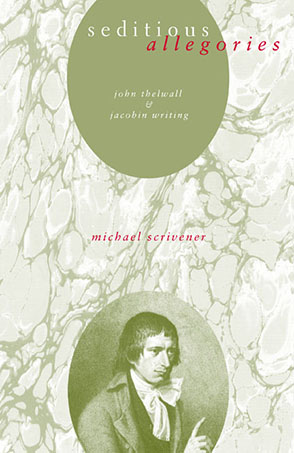
Seditious Allegories
John Thelwall and Jacobin Writing
Michael Scrivener
“This is a fine study of a leading democratic politician and important literary figure . . . [which] is in every respect well written.”
- Description
- Reviews
- Bio
- Subjects
The three parts of the book set Thelwall's achievements and challenges in the political and literary context of his times. Part One, "Jacobin(s) Writing," focuses on the most essential aspects, ideologically and formally, of the insurgent writing of the 1790s to which Thelwall contributed. Part Two, "The Voice of the People," treats both Thelwall's radical oratory and journalism, as well as his writings and activities as a natural scientist and rhetorician, a professor and technician of "elocution." Part Three, "Jacobin Allegory," expounds on Thelwall's characteristic strategy of indirect expression through synecdoche and allegory, which he used in his later career after repression forced him out of politics.
Through Thelwall's life Michael Scrivener succeeds in revealing how British Jacobinism reshaped the public sphere, initiating numerous literary experiments with oratory, pamphlets, periodicals, popularizations, and songs in the spaces opened up by political associations, lectures, meetings, and trials. Jacobinism thus altered the very institutions of reading and writing by expanding literacy, restructuring the popular arena for reading, and generating a body of diverse texts that were "seditious allegories."
“This is a fine study of a leading democratic politician and important literary figure . . . [which] is in every respect well written.”
“This is the only current book devoted to British writer Thelwall; most of what has been written about him is available in journal articles, theses, or essays in books about Jacobin politics or Romantic writers. Scrivener (English, Wayne State Univ.; editor, Poetry and Reform: Periodical Verse from the English Democratic Press, 1792-1824) combines literary analysis of Thelwall’s works with historical description of the political and social situation, evaluating Thelwall’s career and his contributions to English literature and politics during the 1790s and early 1800s. Three major areas are covered: the ideological and political philosophy of the Jacobins; Thelwall’s writings and activities as a poet, journalist, scientist, and orator; and his use of allegory as a means to avoid political repression. This specialized but well-done work will complement The Politics of English Jacobinism: The Writings of John Thelwall, edited by Gregory Claeys (Pennsylvania State Univ., 1995). Recommended for all academic libraries, especially those with in-depth collections in Jacobin studies.”
“Michael Scrivener’s Seditious Allegories is one of the handful of book-length studies of radicalism that rise above simple recovery of progressive traditions because of the author’s ability to explain the more complex implications, connotations, and allusions of radical writing and the kinds of audiences that they anticipate. The subtlety of his interpretations of specific texts is welcome, and certainly the richness of his historical awareness is impressive.”
“Engagingly written and intelligently organized, Seditious Allegories contributes substantially to the growing body of Thelwall scholarship.”
“It is impossible to overstate the John Thelwall’s importance for the British Romantic literary culture, and Michaels Scrivener’s excellent new book, Seditious Allegories: John Thelwall and Jacobin Writing dramatically demonstrates why this is so.”
“The fact that Thelwall was so remarkably interconnected, as writer and as political thinker, makes him a natural figure to be placed within so intricate a texture, and its individual layers are of such inherent value that scholars of many different fields will long have reason to thank Michael Scrivener for having so richly woven it.”
“Scrivener’s lively and informed account will prove quite useful to period scholars, but also worth the notice of readers interested in the genesis of democracy and the thrill of ‘revolution in the air.’ Not only does Seditious Allegories offer cogent analyses of political ideology, it also tells fascinating stories in readable prose.”
Michael Scrivener is Professor of English at Wayne State University (1976–present).
Also of Interest
Mailing List
Subscribe to our mailing list and be notified about new titles, journals and catalogs.