


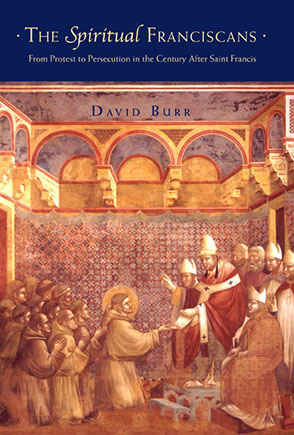
The Spiritual Franciscans
From Protest to Persecution in the Century After Saint Francis
David Burr
The Spiritual Franciscans
From Protest to Persecution in the Century After Saint Francis
David Burr
“The need for a new history of the Spiritual Franciscans has been pressing for a long time. With its impeccable scholarship and breathtaking erudition, David Burr’s book is not only a major contribution to the field but also the capstone of decades of scholarship.”
- Media
- Description
- Reviews
- Bio
- Sample Chapters
- Subjects
Winner of the 2003 Gründler Prize for the best book in Medieval Studies awarded by The Medieval Institute
Winner of the 2002 John Gilmary Shea Prize
Winner of the 2002 Howard R. Marraro Prize Awarded by the American Catholic Historical Association
In this book, David Burr offers the first comprehensive history of the so-called Spiritual Franciscans, a protest movement within the Franciscan order. Burr shows that the movement existed more or less as a loyal opposition in the late thirteenth century, but by 1318 Pope John XXII and leaders of the order had combined to force it beyond the boundaries of legitimacy. At that point the loyal opposition turned into a heretical movement and recalcitrant friars were sent to the stake.
Although much has been written about individual Spiritual Franciscan leaders, there has been no general history of the movement since 1932. Few people are equipped to tackle the voluminous documentary record and digest the sheer mass of research generated by Franciscan scholars in the last century. Burr, one of the world's leading authorities on the Franciscans, has given us a book that will define the field for years to come.
“The need for a new history of the Spiritual Franciscans has been pressing for a long time. With its impeccable scholarship and breathtaking erudition, David Burr’s book is not only a major contribution to the field but also the capstone of decades of scholarship.”
“Within 100 years of St. Francis's death in the early 13th century, his ideal of apostolic poverty was condemned as heresy, and Spiritual Franciscans were all too frequently burned at the stake. Criticisms of laxity in the order spurred accusations that the popes were forerunners of the Antichrist, while papal authorities found Franciscan extremists to be heretical and disobedient to ecclesiastical authority. Burr (emeritus, Virginia Polytechnic Inst. & State Univ.) brings to this project a long acquaintance with both primary materials and secondary sources. Broader in scope than Alan Friedlander's The Hammer of the Inquisitors (Brill Academic, 2000), Burr's book recounts a century of events leading up to the persecution and suppression of the Spirituals. The passion behind the events and characters often takes a backseat to a careful analysis of what historians can (and cannot) know from extant sources, but Burr's case histories of Inquisitorial defendants are gripping. Burr writes for an informed reader well aware of the medieval context but nevertheless offers a reliable overview of the development and outcomes of the controversy. A required addition to all academic libraries.”
“Burr’s forte lies in the analysis of doctrinal statements. He skillfully exposes the evolution of the often subtle debates between the Spirituals and the majority of Franciscans who opposed them, taking particular note of the deeper implications of points which might have otherwise seemed academic. . . . In place of blood and thunder, he offers measured reflectiveness, a wry style and disarming wit. He has a gift for startlingly original similes, and he seems incapable of writing a trite phrase. There has long been a need for a good book on the Spiritual Franciscans; now we have one that is authoritative and beautifully written.”
“Burr’s narrative is a complex one involving theology, church institutions and politics, lay spirituality, and volatile apocalyptic expectations. . . . Burr is able to tie all these disparate threads together in a gripping and compelling narrative.”
“The central virtues of this book are its clarity, its comprehensiveness, its closeness to the sources, and its measured judgments. Scholars familiar with the material will find new insights and neglected sources such as a questio of Henry of Ghent on Joachim's third age, or a petition from the city government of Narbonne of 1309 in behalf of Olivi. Students coming to the material for the first time will find a treasury of instruction. Burr is one of America's finest medievalists and is here at the pinnacle of his accomplishments.”
“It is also a very useful contribution to our understanding of the remarkable vitality of Christian idealism among the faithful in the face of the obstacles and condemnations by the hierarchy.”
“No other scholar has carried off so masterful an analysis of such disparate figures and movements; no other could. The fruit of a lifetime of careful study of its subject, this examination of the Spirituals will not soon be surpassed. In fact, it is done so well there may well be no need, or possibility, of surpassing it.”
“He has succeeded, nonetheless, superbly in pulling together what has come before and equally in adding to it new and individual insights. He has constructed, with seamless artisanship, a work that offers the comprehension of a survey and the penetration of an analytical study. In the process he has performed a service for all those who will come after.”
“Burr is one of America’s finest medievalists and is here at the pinnacle of his accomplishments.”
“This is a rich and thought provoking study, the product of great learning and of many years’ reflection. It deserves to be widely read.”
“The present work has much to recommend it. However, readers might give greater attention to the appendix material, had it been published separately. The detailed endnotes are exquisite and provide commentary on other reputable scholars’ work. The bibliography is impressive, demonstrating the use of the a treasury of sources.”
“This admirable study forms a bridge between the events following the deposition of Elias of Cortona at the general chapter of Rome and the emergence of separate communities approximately a century later, which contained the seeds of the Observant reform.”
“David Burr presents an important addition to the study of the Franciscans in a pivotal century.”
“Burr has produced a book that illuminates not only the spiritual Franciscans, but papal administration, lay piety, apocalyptic thought, and Occitan heterodoxy.”
“David Burr’s The Spiritual Franciscans is an illuminating study of conflict within the Franciscan order during the later Middle Ages. . . . Burr has taken great care with every aspect of this study, including the definition of his topic.”
“Because David Burr opens new questions about this period of history, his lifetime study will open new doors for future scholars. His careful examination of primary sources and all-embracing survey of contemporary studies is liberating. It frees the reader from the oversimplification that has long determined the historiography of the early Franciscan movement.”
“What a pleasure to announce that with the publication of this latest book, Burr’s sparkling, luminescent prose is now poised to reach a broader public.
The Spiritual Franciscans is a masterly book by a masterly writer and a consummate scholar. Peter Olivi and the Spirituals could not have wished for a more eloquent and faithful biographer.”
David Burr is Professor Emeritus of History at Virginia Tech. He is the author of numerous other books, including Olivi's Peaceable Kingdom: A Reading of The Apocalypse Commentary (1993).
Chapter 1: The Franciscan Dilemma
In the spring of 1317, the Franciscans at Narbonne received a letter from Pope John XXII. It was not the sort of message that they would have wanted to read. John ordered them to appear at the papal court in Avignon within ten days and explain why they had violently seized control of their house, ejecting their superiors in the process. The friars at Beziers, who had done the same thing, received the same letter.
When the erring friars arrived at Avignon, what they faced was not so much a hearing as an ultimatum. John told them to obey; most did, and those who did not were burned at the stake. The first executions took place on May 7, 1318. Victims and inquisitor alike were Franciscans. It was very much a family affair.
How did Saint Francis's order manage to work itself into this situation? That is a very complex story and will take a long time to tell. It is essentially the story of a movement that grew up within the order. We think of them as the "spirituals," and by John's time they were actually called such, yet the problem they addressed was much older than the name itself.
Francis and His Order
It was, in fact, as old as the order. Around 1210, when Francis of Assisi sought approval for his nascent group, what he hoped to achieve with it included poverty, but only as one aspect of a more complex, more evanescent quality of life. The word "humility" brings us closer. Poverty was important as a manifestation of humility, just as obedience was. But in the final analysis, even "humility" is insufficient as a description. Francis's basic goal was the sort of self-emptying he saw in Christ, a behavior that involved not only humility but also love. Thus, in Franciscan legend, the final stamp of approval on Francis's project was given not by the pope but by Christ himself on Mount Alverna when, toward the end of Francis's life, he was granted Christ's stigmata.
All of this sounds straightforward enough, and it can be at least relatively so if one manages to follow Christ into sacrificial death. That was at times Francis's intention. Twice he attempted to seek martyrdom at the hands of the Moslems, and when five Franciscans actually achieved it in 1220, Francis was reported to have exclaimed, "Now I can truly say I have five brothers!"1 The problem comes when one tries to translate the ideal into an administra-tive structure. The difficulty was less obvious at the beginning, because there were, after all, only twelve Franciscans. It was a like-minded group that could submit directly to Francis's charismatic leadership. Its original rule could be a short document consisting mainly of quotations from the gospels.2
Unfortunately, that situation changed rapidly. As the order grew numeri-cally and spread geographically, Francis was forced to produce something more substantial. He attempted to do so with the rule of 1221, which never received papal approval, and then with the rule of 1223, which did. The difference between the two rules says a great deal about what was happening. In 1221 Francis admonished the brothers to study their superior's conduct carefully and, if they found it unedifying, to denounce him at the next general chapter meeting. They were to withhold obedience if told to act in violation of the rule or their own souls.3 That may seem an odd way to show humility, but it has a certain logic. Francis was concerned about leaders as well as followers. In the 1221 rule and elsewhere he emphasized that, like the Son of Man, they should want to serve rather than be served.4 He explicitly rejected the word prior as a title, despite the fact that it was traditionally used in monasticism and would soon be adopted by the Dominicans.5 Instead, he chose words such as "minister," "guardian," and "custodian," all of which implied not superiority but com-mitment to caring for others. Francis's call for fraternal surveillance was consistent with this perspective. It decreased the distance between leaders and followers.
There is still a problem, of course. There is little point in preventing arro-gant, domineering leaders if the price is encouraging fractious, contentious fol-lowers. Francis's solution, insofar as he offered one, was to observe that those who refused to obey orders they considered harmful to their souls should humbly submit to any resultant persecution rather than separate themselves from their brothers. In other words, their resistance should assume the least self-assertive form possible. Nevertheless, it is hard to ignore the extent to which Francis's emphasis on the duty of refusal highlighted individual responsibility.6
Even by 1221, the order had grown to the point where such surveillance activities seemed disruptive and therefore dangerous. The rule of 1223 elim-inated them, although even there, obedience was limited to "those things which [the brothers] have promised the Lord to observe and which are not against their souls or our rule."7 Nevertheless, the rule of 1221, though not the offi-cial one, remained available for consultation. So did the example of Francis himself, who embodied some of the resulting tensions in an intensified form once he stepped down as head of the order.
In Francis's Testament, dictated shortly before his death in 1226, these ten-sions were presented for the consideration of later generations. The document reveals a man who, in his final days, was anxious about the future of his order and wanted to state his position one more time as forcefully as possible. Since he was now, administratively speaking, simply one more Franciscan, his Testament highlighted the tension between juridical and charismatic authority within the order, between the power that stemmed from holding the job of minister gen-eral and that which flowed from being the divinely inspired archetype of Franciscanism. Francis punctuated his instructions with the observation that he wanted to obey those who had been given the former sort of power; that observation, however, did not erase the fact that he was giving instructions and expected them to be followed, not because he held a high administrative position, but because he was Francis, the man who knew what God wanted the order to become. "And when God gave me brothers, no one showed me what I should do, but the Most High revealed to me that I should live according to the form of the holy gospel."8 Francis insisted that his Testament should not be taken as another rule, but he then announced that "the general minister and all other ministers and custodians are bound by obedience not to add or subtract from these words. And they must always have this writing with them in addition to the rule. And in all chapter meetings held by them, when they read the rule, they must also read these words."
Francis's Testament created a problem for the order because a number of his instructions accorded ill with what was already beginning to happen. He told them not to seek papal intervention on their behalf and, if the clergy in some town prevented them from preaching or even settling there, to move on to some other town.9 He forbade them "to place glosses on the rule or say, ’This is what it means.' " These were serious limitations. In a world where many clergy did try to keep them out, how could Franciscans carry out their preaching and teaching mission without papal protection? In a world of bewildering com-plexity, how could they interpret the rule to an army of new recruits unless learned theologians were allowed to determine how it applied to the varied situations in which they found themselves? In 1230, leaders of the order asked Pope Gregory IX whether the Testament was binding and were told that it was not, since Francis had not consulted the ministers and since he had no power to bind future leaders, his equals.10
New Responsibilities
However much or little sense Gregory's decision made, it avoided what would have emerged as a major crisis had the Testament been recognized alongside the rule as a basic document. The order was evolving. It was growing rapidly- the number of Franciscans by midcentury has been estimated at as many as thirty thousand-and it was taking on a series of new functions. As educated men joined the order, they were tapped to fill roles that would have been unsuitable for Francis and his original colleagues. Some brought the roles with them. Alexander of Hales was already a master at the University of Paris when he became a Franciscan and needed only to stay where he was to become the first Franciscan master at the university. In other cases, the roles slowly devel-oped out of a coalescence of societal need and Franciscan ability. For exam-ple, the cities were growing rapidly, but the urban parish system was not, so when Franciscans entered the cities to preach, they encountered a substantial population in need not only of preaching but also of pastoral care.
Of course, it is one thing for the need to exist and another for those in authority to recognize it. That is where the pope came in. Franciscans-and Dominicans, who arrived concurrently-soon discovered that the university masters were not entirely happy to see them, and bishops were often hesitant to allow them a foothold in the cities. Thus they needed papal support, and the popes were normally willing to give it. They recognized that the mendi-cant orders were a positive influence in both contexts and that, being directly loyal to the pope, the friars offered a way of exerting influence on university and diocese alike.
Once they recognized mendicant virtues, the popes could reward and utilize the new orders in a variety of ways. Friars became not only teachers, preachers, and pastors, but also inquisitors, bishops, and cardinals.11 Secular leaders found them equally useful.12 When, in 1247, King Louis IX of France decided to appoint investigators (enquïteurs) whose task it was to travel through the kingdom hearing and adjudicating complaints against royal administra-tors, he entrusted the task largely to Franciscans and Dominicans.13 When, in 1260, the Florentine exile Farinata degli Uberti was conspiring with Siena to lure his native city into the military campaign that would result in Florentine defeat at Montaperti, he sent two Franciscans to bait the trap with false infor-mation; when the credulous Florentines began to prepare for war, Farinata sent two more friars-whether they were Franciscan or Dominican is unclear-to enlist Florentine Ghibellines in the plot.14 On a more peaceful note, by that date we find the city of Perugia entrusting Franciscans with various govern-mental functions, and in 1266 we read of one being consulted as an expert on financial affairs! That same year saw the Perugians, who had decided to con-struct a series of new fountains, enlist the aid of "friars minor known for their skill in that task" and beg the pope to throw his considerable weight behind their attempt to bring one Brother Deodato, magister fontium, to town.15 By the second half of the thirteenth century, then, well-placed friars were exerting power in many contexts all over Europe.
1. Passio sanctorum martyrum, in AF, 3:593.
2. I Celano, 33. Francis confirms this in his Testament. See Francis of Assisi, Opuscula, ed. Kajetan Esser (Grottaferrata: College of Saint Bonaventure, 1978).
3. Regula non bullata, chapter 5, in Francis of Assisi, Opuscula.
4. Ibid., chapter 4; Admonitio 4 in Francis of Assisi, Opuscula.
5. Regula non bullata, chapter 6.
6. This element is noted by Thophile Desbonnets, De l'intuition l'institution (Paris: Editions Franciscaines, 1983), 60-63.
7. Regula, chapter 10, in Francis of Assisi, Opuscula.
8. Malcolm Lambert and others argue that this statement is aimed not at the church, but at those "among the ministers who wished him to affiliate the order more closely to some exist-ing rule." See Lambert, Franciscan Poverty (St. Bonaventure, N.Y.: Franciscan Institute, 1998), 29. Even so, that would not lessen the impact of an appeal to direct revelation from God.
9. Privileges by Pope Honorius III in 1222 and 1224 inaugurated the process through which the order would eventually gain a remarkable degree of independence, enabling it to chal-lenge hostile parish and diocesan authorities (ibid., 81).
10. BF, 1:68. The phraseology, like that of the 1223 rule, assumes that Francis technically remained the leader of the order throughout his life, with Peter Catanii and Elias simply acting as vicars.
11. On Franciscan inquisitors, see Mariano d'Alatri, L'inquisizione francescana nell'Italia cen-trale nel secolo XIII (Rome: Istituto Storico dei Frati Minori Cappucini, 1954), and d'Alatri's numer-ous later articles, now published as Eretici e inquisitori in Italia, ed. Clement Schmitt (Rome: Istituto Storico dei Frati Minori Cappucini, 1986-87). On Franciscan bishops, see Williell Thomson, Friars in the Cathedral (Toronto: Pontifical Institute of Mediaeval Studies, 1975). The first Franciscan cardinal dates from 1273; the first inquisitors, from the 1250s; the first bishops, from even ear-lier. (Thomson, Friars, 27 suggests a date as early as 1226.)
12. For a good survey and bibliography on the relationship between the friars and Italian cities, see Antonio Rigon, "Frati minori e societ locali," in Francesco d'Assisi e il primo secolo di sto-ria francescana, ed. Maria Pia Alberzoni et al. (Turin: Einaudi, 1997), 259-81. For examples of Franciscan political involvement in Umbria, see Stanislao da Campagnola, Francesco e frances-canesimo nella societ dei secoli XIII-XIV (Assisi: Edizioni Porziuncula, 1999), 65-118.
13. William Jordan, Louis IX and the Challenge of the Crusade (Princeton: Princeton University Press, 1979), 51-64.
14. Giovanni Villani, Cronica (Florence: Sansone, 1844), 1:297, 300. Two years earlier, when the Aretines entered Cortona by night and sacked it, the signal to open a gate and admit them had been given by a bell-ringing Franciscan friar. MS Cortona, Biblioteca Communale 423, fol. 231-32, quoted in Maria Caterina Jacobelli, Una donna senza volto (Rome: Edizioni Borla, 1992), 52-53.
15. Anna Imelde Galletti, "Insediamento e primo sviluppo dei frati minori a Perugia," in Francescanesimo e societ cittadina, ed. Ugolino Nicolini (Perugia: Centro per il Collegamento degli Studi Medievali e Umanistici nell'Universit di Perugia, 1979), 21-23.
page 1
Also of Interest
Mailing List
Subscribe to our mailing list and be notified about new titles, journals and catalogs.