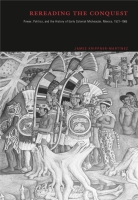




Rereading the Conquest
Power, Politics, and the History of Early Colonial Michoacán, Mexico, 1521–1565
James Krippner-Martínez
Rereading the Conquest
Power, Politics, and the History of Early Colonial Michoacán, Mexico, 1521–1565
James Krippner-Martínez
“Rereading the Conquest is a charmingly written account of the relatively neglected area of Michoacán, not far from the Nahua-speaking regions geographically but distant from them in cultural terms. Krippner-Martínez’s work should appeal to anyone interested in understanding the complexities of conversion in the sixteenth-century Americas and will be especially valuable to those interested in reading an intellectual engagement with the leading Catholic intellectuals of Latin America.”
- Description
- Reviews
- Bio
- Subjects
The book offers a fresh look at religion, politics, and the writing of history by employing a poststructuralist method that engages the exclusions as well as the content of the historical record. The moments of doubt, contradiction, and ambiguity thereby uncovered lead to deconstructing a coherent conquest narrative that continues to resonate in our present age.
Part I, "The Politics of Conquest," deals with primary sources compiled from 1521 to 1565. Krippner-Martínez here examines the execution of Cazonci, the indigenous ruler of Michoacán, as recounted in the trial record produced by his executioners; explores the missionary-Indian encounter as revealed in the Relación de Michoacán; and assesses the writings of Michoacán's first bishop, the legendary Vasco de Quiroga, and their complex interplay of authoritarian paternalism and reformist hope. Part II, "Reflections," looks at how the memory of these historical figures is represented in later eras. A key text for this discussion is the Crónica de Michoacán, written in the late eighteenth century by the Franciscan intellectual Pablo de Beaumont.
Krippner-Martínez concludes with a critique of the debate that initiated his investigation—the controversy between Latin Americans and Europeans over the colonialist legacy, beginning with the Latin American Bishops Conference in 1992.
“Rereading the Conquest is a charmingly written account of the relatively neglected area of Michoacán, not far from the Nahua-speaking regions geographically but distant from them in cultural terms. Krippner-Martínez’s work should appeal to anyone interested in understanding the complexities of conversion in the sixteenth-century Americas and will be especially valuable to those interested in reading an intellectual engagement with the leading Catholic intellectuals of Latin America.”
“Krippner-Martínez is heavily influenced by postmodernist theory and well versed in recent literature on cultural history. Those familiar with his theoretical base and the historiography of colonial Michoacán will find this work stimulating for the methodology it employs and the insights it provides.”
“(T)he book is a welcome addition to the historiography of this region and should stimulate lively debate in the coming years.”
“The corpus of regional studies on colonial and independent Mexico has been expanding significantly. Krippner-Martínez's is a recent addition, which tackles some common aspects of the history of early colonial Michoacan with a refreshing perspective.
Many aspects of the book stimulate reflection and analysis; here I have chosen to concentrate on two figures that could symbolize, in my view, the early history of Michoacan itself.
Through these five essays the author places some well-known written records in a better understood historical context, a most worthy undertaking. Moreover, he leaves us needing to rethink on the one hand the image of Quiroga as a successful missionary beloved by the natives, and one the other the image of the natives as limited to being recipients or active opponents. Stimulating debate over too-easily-accepted paradigms is one of the achievements of a good book.”
“James Krippner-Martínez's present study is complex, and his rich discourse is delightful indeed.”
“James Krippner-Martinez's book, Rereading the Conquest, is a brief collection of five essays, most of which offer a fresh reading of various writings from colonial Mexico about the political and spiritual conquest of Michoacan.”
James Krippner-Martinez is Associate Professor of History at Haverford College.
Also of Interest
Mailing List
Subscribe to our mailing list and be notified about new titles, journals and catalogs.