


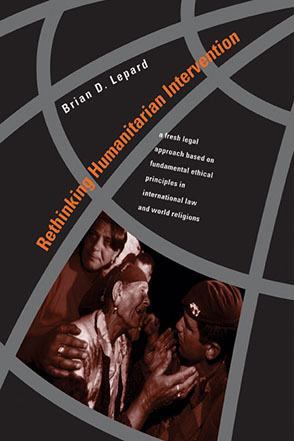
Rethinking Humanitarian Intervention
A Fresh Legal Approach Based on Fundamental Ethical Principles in International Law and World Religions
Brian D. Lepard
Rethinking Humanitarian Intervention
A Fresh Legal Approach Based on Fundamental Ethical Principles in International Law and World Religions
Brian D. Lepard
“To stop history from repeating itself, Brian Lepard's guide offers a clear legal road map for humanitarian intervention. He draws principles from international law and religious texts to help interveners solve ethical conflicts between human rights and national sovereignty, the use of force and peaceful conflict resolution, or effective intervention and remaining impartial.”
- Description
- Reviews
- Bio
- Sample Chapters
- Subjects
A special feature of the book, which avoids the charge of ethnocentricity brought against other approaches, is that Lepard shows how passages from the revered texts of seven world religions may be interpreted as supporting these ethical principles. In connecting law with ethics and religion in this way, he takes a major step forward in the effort to formulate a normative basis for international law in our multicultural world.
“To stop history from repeating itself, Brian Lepard's guide offers a clear legal road map for humanitarian intervention. He draws principles from international law and religious texts to help interveners solve ethical conflicts between human rights and national sovereignty, the use of force and peaceful conflict resolution, or effective intervention and remaining impartial.”
“The outcome of Prof. Lepard’s considerations is enormously significant.
In making an explicit connection between international human rights law and religion, Prof. Lepard has taken this trend to the next level.”
“A monumental accomplishment. . . . The strength of the book . . . is Lepard’s analysis of ethical and religious traditions, and his meticulous connection of these traditions’ imperatives to key provisions in the UN Charter.”
“This treatise is methodologically sound, informative, and well-researched.”
“Lepard’s timely book touches on . . . the role religion might play in resolving conflicts involving human rights violations.”
“Overall, Lepard’s book represents a major and creative effort to come to terms with complex legal and ethical dilemmas posed by humanitarian intervention. The analysis will be of considerable interest to anyone seeking insights into these dilemmas.”
“This is a work that is really not like anything before and that should be read to be appreciated.”
“Brian Lepard brings a massive research effort to bear in support of his fresh approach to humanitarian intervention. By relying on a blend of ethics, religion, and law, this study challenges the validity of both realism and liberalism as the basis for policy and interpretation in international relations. An excellent book that deserves a wide readership and much discussion.”
“Lepard provides a fresh exploration of legal and moral justifications for humanitarian intervention. . . . He opens new analytic vistas and provides a foundation for resolving conflicts over the content of the law. He applies the framework in masterly examinations of intervention in Bosnia, Somalia, Rwanda, Haiti, and Kosovo. Rarely do we see an author sustain as much sensitivity to opposing arguments while constructing a strong ethical basis for shaping diplomacy, ethics, and international law. This is a ground-breaking and, in its moral sweep, even a breath-taking book.”
Brian D. Lepard is Associate Professor of Law at the University of Nebraska.
The Need for a Fresh Approach
1.1. Humanitarian Intervention and International Law at the Turn of the Century
Few foreign policy issues during the last decade of the twentieth century elicited as much controversy as the use of military intervention for ostensibly humanitarian purposes, with some degree of force beyond the self-defense of military personnel authorized to help achieve these purposes—what I will call humanitarian intervention. Most often, but with notable exceptions, including the bombing of the Federal Republic of Yugoslavia (Serbia and Montenegro) (which I will refer to as “Yugoslavia”) in the spring of 1999 by forces of the North Atlantic Treaty Organization (NATO), such intervention was conducted with authorization by the U.N. Security Council.
Much of the controversy over humanitarian intervention has involved important issues under international law, including the legality of various forms of humanitarian intervention, with or without a U.N. blessing, and the extent to which international law regulates or ought to regulate how humanitarian intervention is conducted. The debate over these international legal issues is likely to persist in the new century, as humanitarian crises continually flare up and policymakers and lawyers are forced to grapple with them.
This book attempts to develop a new approach to some of the difficult problems raised by humanitarian intervention under international law. Because the pattern established during the last decade of the twentieth century was for most states or regional organizations to seek Security Council authorization for humanitarian intervention operations, or for the U.N. itself to undertake such operations, the book devotes proportionately greater attention to such forms of Council-authorized intervention, which I will often refer to as “U.N. humanitarian intervention.” But it also addresses the legal problems associated with intervention not authorized by the Security Council. One reason that humanitarian intervention has proven so controversial from a legal perspective is that it has underscored significant conflicts among legal norms in the U.N. Charter and contemporary international law. Some norms tend to support humanitarian intervention, while others tend to oppose it.
ction, nonintervention, the pacific settlement of disputes, the nonuse of force, self-determination, and (in the case of U.N. humanitarian intervention) U.N. impartiality. For example
Legal norms tending to support humanitarian intervention include the norms of international human rights law, international humanitarian law, and international criminal law. The U.N. Charter itself proclaims as a fundamental purpose of the U.N. the achievement of “international cooperation in . . . promoting and encouraging respect for human rights and for fundamental freedoms for all without distinction as to race, sex, language, or religion.”1Under Article 55, the United Nations “shall promote . . . universal respect for, and observance of, human rights and fundamental freedoms for all.”2 And under Article 56 “all Members pledge themselves to take joint and separate action in cooperation with the Organization for the achievement” of this purpose.3 In 1948, the U.N. General Assembly adopted the Universal Declaration of Human Rights, which in turn was followed by the promulgation of numerous international human rights treaties, many of which have been widely ratified by U.N. member states. In keeping with these human rights norms, the international community has adopted a number of treaties relating to the conduct of war and providing protections for civilians and other vulnerable individuals, the most important of which being the Fourth Geneva Convention of 1949. And certain treaties, including those on genocide and torture, as well as the four Geneva Conventions, now require states to prosecute and punish individuals who commit particularly egregious violations of international human rights law and international humanitarian law.4
The existence of this expanding corpus of legal norms guaranteeing a minimal level of respect for human rights and human dignity suggests that in some cases military intervention in defense of these norms may be legitimate, and perhaps even required, under international law. Indeed, Chapter VII of the Charter empowers the Security Council to take economic or military enforcement action without the consent of the state or other parties involved when it determines the existence of a “threat to the peace,” “breach of the peace,” or “act of aggression”5—language that has been used by the Council to encompass certain human rights violations and to be the basis for authorizing humanitarian intervention.
At the same time, however, various norms in the U.N. Charter and contemporary international law appear to disfavor humanitarian intervention. These include the norms of state sovereignty, domestic jurisdile, Article 2(1) of the U.N. Charter affirms that the U.N. “is based on the principle of the sovereign equality of all its Members,”6 and Article 2(7) declares that the U.N. may not “intervene in matters which are essentially within the domestic jurisdiction of any state,” with the exception of enforcement measures taken by the Security Council under Chapter VII of the Charter.7 Article 2(3) and Chapter VI of the Charter encourage states to settle their disputes peacefully and counsel against the resort to force.8 Moreover, Article 2(4) of the Charter specifically declares that members of the U.N. may not threaten or use force against the “territorial integrity or political independence of any state, or in any other manner inconsistent with the Purposes of the United Nations.”9 This provision might be interpreted (as we will see in Chapter 11) as prohibiting humanitarian intervention by states without Council authorization. The Charter also establishes as a purpose of the U.N. the development of “friendly relations among nations based on respect for the principle of equal rights and self-determination of peoples.”10 Humanitarian intervention by outside forces may be seen as interfering with the exercise of such a right of self-determination. Finally, humanitarian intervention may be perceived as violating a principle of U.N. impartiality, which is reflected in many Charter provisions.11
Before I embark on an elaboration of the fresh approach proposed in the book, which can help to reconcile these conflicting legal norms, let us survey the history of the current debate on humanitarian intervention. When the Cold War suddenly ended, optimism at first abounded. The way appeared to be clear for greater East-West cooperation and the thawing of the icy gears of the U.N. Security Council, whose peace-making role under the U.N. Charter had been subverted by the Cold War deadlock. The military success of the 1991 Gulf War, however fleeting, only reinforced the view shared by many observers that the world stood at the threshold of a new era—an era in which the U.N. would at last become an effective guarantor of world peace and even human rights.
Hopes that the end of the Cold War would usher in a period of relative peace and stability in world affairs were, however, quickly dashed by a veritable explosion of national, ethnic, religious, and tribal conflicts in numerous corners of the globe. Despite the intensity of these political upheavals, the U.N. appeared to be a promising instrument for containing their destruction, saving human lives, and safeguarding the human rights of civilians. The Security Council launched major new peacekeeping operations in these troubled regions. The number and scope of U.N. operations quickly mushroomed and placed an unprecedented strain on the U.N.’s meager financial, human, and military resources.
Traditional peacekeeping operations began in 1956, when Secretary- General Dag Hammarskjöld formulated a plan for the United Nations Emergency Force in the Sinai (UNEF I) and defined the mission of U.N. peacekeeping as the interposition of U.N. troops between parties to a conflict to supervise an agreed truce or police a cease-fire line. As envisioned by Hammarskjöld, cardinal principles of peacekeeping were that the troops would remain only with the consent of all parties, that they would act impartially, and that they would use force only in self-defense. They were to be lightly armed, and they were not intended to engage in enforcement action.12 In contrast to this traditional peacekeeping paradigm, the new post–Cold War peacekeeping operations were not limited to the military function of monitoring a cease-fire line. Instead, they involved the coordination of a broad array of nonmilitary tasks, including humanitarian relief, electoral monitoring, and civilian policing. These multifaceted missions are often referred to as “second-generation” peacekeeping operations.13 In addition, in many cases the Security Council exercised its powers under Chapter VII of the Charter to mandate large-scale economic sanctions against states committing gross human rights abuses.14
Perhaps most significantly, many Security Council–endorsed military operations, whether under U.N. command or consisting of multinational coalitions, attempted the use of military force in more robust ways that went beyond the self-defense of the troops involved to achieve these humanitarian objectives. These forays into military enforcement again invoked the Council’s jurisdiction under Chapter VII of the Charter.15
The new U.N. humanitarian intervention arguably was born from the ashes of the Gulf War and as a result of the Security Council’s precedentsetting decision to authorize a coalition of U.N. member states, spearheaded by the United States, to use “all necessary means” to dislodge Iraqi forces from Kuwait.16 In the war’s immediate aftermath, attempted revolts by Kurds in northern Iraq and Shi’ite Muslims in southern Iraq were cruelly repressed by Iraqi troops, driving hundreds of thousands of refugees across the borders into neighboring Turkey and Iran. Allied governments soon decided in the face of international popular pressure to establish “safe havens” for the Kurdish refugees and protect these enclaves with the threat or use of military force. They took the position that their action, dubbed “Operation Provide Comfort,” was authorized by Security Council Resolution 688.17
The Kurdish operation was the precursor for many experiments with humanitarian intervention during the 1990s. I examine six representative cases here. In five of these cases the Security Council endorsed the use of force other than in strict self-defense for primarily humanitarian purposes. These involved the safeguarding of humanitarian efforts and the deterrence of attacks against “safe areas” in Bosnia-Herzegovina (Bosnia); the delivery of humanitarian relief, and the promotion of national political reconstruction, in Somalia; the maintenance of public order and the protection of civilians in Rwanda following the devastating outbreak of genocide in that country in early 1994; the restoration of the democratically elected government of Haiti in late 1994; and the deployment of the multinational Kosovo Force (KFOR) in Kosovo in June 1999 following the NATO bombing campaign to allow a safe return of Kosovo Albanian refugees and to assist in rebuilding Kosovo’s civilian institutions. In the sixth case—the NATO bombing campaign—humanitarian intervention was conducted without authorization by the Security Council. In the next section I review these six cases, discussing the last two, involving Kosovo, together. I follow up on this review with a brief survey of certain developments after the deployment of KFOR, including events in East Timor, Chechnya, Sierra Leone, and the Democratic Republic of the Congo.
1.2. Representative Cases of Humanitarian Intervention
1.2.1. Bosnia
Following the outbreak of war in the former Yugoslavia in 1991 after the Yugoslav Republics of Slovenia and Croatia declared their independence, as well as the subsequent imposition by the Security Council of an economic and arms embargo that was gradually strengthened in subsequent resolutions, the Security Council deployed a United Nations Protection Force (UNPROFOR) first to Croatia. In early 1992, the fighting spread to Bosnia, which also claimed independence, with Serbia and Croatia each supporting military efforts by Bosnian Serbs and Croats against the Bosnian government. In April 1992, Serbian forces initiated a major military campaign involving the terrorization of Bosnian Muslim civilians. In response to this brutal fighting, the Council authorized the extension of UNPROFOR into Bosnia.18
The U.N. soon recognized Croatia, Slovenia, and Bosnia as independent U.N. member states in May 1992—a recognition that converted the conflict in the former Yugoslavia from a “domestic” one to an “international” one over which the Council could exercise jurisdiction under Chapter VII if it so chose. As noted earlier, the Council’s jurisdiction under Chapter VII extends only to situations that constitute a “threat to the peace,” “breach of the peace,” or “act of aggression.” The first two expressions are understood to refer only to “international peace.” U.N. member states were clearly more comfortable dealing with the conflict as an international war, which unquestionably would not be covered by the domestic jurisdiction limitation in Article 2(7) of the Charter.
UNPROFOR’s mandate was quickly expanded to include protection of the Sarajevo airport and the delivery of humanitarian relief in Bosnia generally. 19 Concerned about increasing attacks against UNPROFOR personnel, the Council instituted a ban on all military flights over Bosnia.20 In February 1993 the Council called for the strengthening of UNPROFOR’s security by providing it with “the necessary defensive means.”21 About a month later, the Council extended the ban on military flights to include all nonmilitary as well as military flights over Bosnia and authorized member states, acting nationally or through regional organizations, to take “all necessary measures” to enforce the ban.22 NATO agreed to provide air support for this purpose as of April 1993. These bans were violated routinely without any adverse consequences.
In April and May 1993, after it had long become apparent that the Bosnian Serbs were engaging in a calculated and large-scale effort to eradicate the Bosnian Muslim population, the Council strongly condemned the Bosnian Serb atrocities (euphemistically dubbed “ethnic cleansing”) and established so-called safe areas for the beleaguered Muslims, drawing in part on the earlier precedent of safe areas for Iraq’s Kurds.23 While UNPROFOR did not have a mandate actually to protect the safe areas through the use of deadly force, it was empowered in Resolution 836 to “deter” attacks on the safe areas, monitor a cease-fire, promote the withdrawal of non-Bosnian government forces, and occupy key points on the ground, as well as to continue to participate in the delivery of humanitarian relief. The Council also authorized UNPROFOR in carrying out this mandate to take necessary measures when acting in self-defense, “including the use of force, in reply to bombardments against the safe areas by any of the parties or to armed incursion into them or in the event of any deliberate obstruction in or around those areas to the freedom of movement of UNPROFOR or of protected humanitarian convoys.” The Council further authorized all member states, again including regional organizations, to take “all necessary measures, through the use of air power, in and around the safe areas” to support UNPROFOR in its extended mandate.24
To implement this more ambitious mandate UNPROFOR developed an often uneasy relationship with NATO. As noted above, NATO supplied air power for use in enforcing the Council-declared “no-fly zone” and also in conducting sporadic attacks on Serbian military positions in an attempt to enforce compliance with Council resolutions calling for the withdrawal of heavy weapons from the perimeter of the safe areas. This was the first time the U.N. enlisted the assistance of a regional organization in undertaking enforcement action, even though such action by regional organizations at the Council’s direction had been provided for in Chapter VIII of the Charter.25
The British and French governments, which provided the bulk of UNPROFOR’s peacekeepers, were far less keen than the U.S. government on air offensives out of concern for the safety of their troops and in keeping with their view of the conflict as primarily a civil war rather than a war of Serbian aggression. They, and the U.N. secretary-general, were convinced accordingly that UNPROFOR should, as a general rule, adhere to traditional peacekeeping doctrine and use force only in self-defense. At the insistence of the United States, however, on several occasions air strikes were either threatened or conducted.
The Council attempted to deal with the abhorrent practices of mass murder, torture, and rape that characterized the conflict in Bosnia primarily through judicial means rather than through the use of the military instrument. The Council established an ad hoc International Criminal Tribunal for the Former Yugoslavia (ICTY), again acting under the authority of Chapter VII, to try individuals accused of violations of international humanitarian law.26
NATO’s unpredictable “pinprick” air strikes were unsuccessful in deterring the Bosnian Serbs from overrunning the safe areas of Srebrenica and Zepa in the summer of 1995 and committing mass killings of Muslim civilians. 27 The reluctance of U.N. contingents to use force against the Serbs contributed to a public perception of U.N. “humiliation,” especially after these attacks. In December 1999 Secretary-General Kofi Annan issued a highly self-critical report on the U.N.’s failure to prevent the massacre of thousands of Muslim men and boys at Srebrenica after UNPROFOR troops abandoned the safe area.28 In August and September 1995, NATO, under U.S. pressure, launched a massive bombardment of Serb military positions around Sarajevo, which, together with Croat and Bosnian government military successes, finally brought the Serb party to the negotiating table and paved the way for the Dayton Peace Accords. The Accords authorized the deployment of a multinational Implementation Force (IFOR) led by NATO.29
The entire UNPROFOR operation was frustrated by deep divisions among U.N. member states (including members of the Security Council and NATO) concerning the scope of UNPROFOR’s mission and the proper strategy for dealing with the conflict. Member states and U.N. organs took very different views of how to resolve the legal and ethical30 tensions between concern for the human rights of civilians, on the one hand, and the goal of facilitating an early settlement by refraining from “excessive” uses of force and remaining “impartial,” on the other. For example, members of the General Assembly sympathetic to the Bosnian Muslim cause succeeded in having a number of resolutions adopted urging the secretary-general to direct UNPROFOR to protect the safe areas and the Council to take stronger action to put a stop to ethnic cleansing and to close down the detention camps immediately. 31 On the other hand, Secretary-General Boutros Boutros-Ghali consistently maintained that UNPROFOR did not have a mandate, under relevant Security Council resolutions, to use force to protect the civilian population should civilians come under direct attack.32 Many observers outside the U.N. system argued that the Council was legally entitled to adopt, and should have adopted, much stronger military measures to stop the practice of ethnic cleansing. They viewed the U.N.’s abandonment of the safe areas as a dereliction of legal and moral duties of catastrophic proportions. IFOR’s mission pursuant to the Dayton Peace Accords manifested greater agreement among participating U.N. member states than that of UNPROFOR.
Because the fighting had ceased and the parties had granted consent to the deployment, contributing states were willing to give IFOR a strong mandate and put significant military resources at its disposal. As a result of the disagreements that marred UNPROFOR and U.S. perceptions of U.N. military incompetence, the United States insisted on a coalition model for the IFOR operation rather than a Security Council-controlled mission. However, President William Clinton and the parties sought a U.N. blessing for the operation, which was duly provided by the Security Council.33 Nevertheless, IFOR raised challenging legal and ethical issues of its own about the proper functions of U.N.-authorized military operations. One of the most controversial issues was the potential responsibility of IFOR (and its successor, the Stabilization Force, or SFOR) to apprehend persons who had been indicted by the ICTY, including Bosnian Serb leader Radovan Karadz i´c and military chief Ratko Mladi´c. Participating states showed reluctance to do so out of concern for the negative impact on continued peaceful implementation of the Accords—a position that drew much criticism from nongovernmental organizations (NGOs) and the media. As of June 30, 2001, neither Karadz i´c nor Mladi´c had been apprehended, although pressure was growing for their arrest after the transfer of former Yugoslav president Slobodan Milos evi´c to the Hague on June 28 (see subsection 1.2.5).34
1.2.2. Somalia
The U.N.’s excursions into Somalia raised boldly the issue of whether U.N.- authorized military operations legally can or ethically should attempt to secure the delivery of humanitarian supplies in the middle of a “hot” conflict between warring parties within a state without their consent or pressure parties in a civil conflict to achieve a political settlement.35 The collapse of the government of President Mohamed Siad Barre on January 26, 1991, resulted in fighting between rival political movements, including those led respectively by Ali Mahdi and General Mohamed Farah Aidid. Civil war tore the country apart and left it without any effective government whatsoever. Marauding soldiers from the various factions seized food supplies from an already-starving civilian population, contributing to a famine crisis of tremendous proportions, which in turn precipitated large-scale population movements into neighboring Kenya, Ethiopia, and Djibouti.
Following appeals for action by various regional organizations, in January 1992 the Council expressed its grave alarm “at the rapid deterioration of the situation in Somalia and the heavy loss of human life” and the Council’s awareness of the “consequences on stability and peace in the region.” It declared that “the continuation of this situation constitutes . . . a threat to international peace and security,” and accordingly acted under Chapter VII to establish a mandatory general and complete weapons embargo.36 Three months later, the Council decided to establish a U.N. security force to protect humanitarian activities, the United Nations Operation in Somalia (UNOSOM I).37 Initially UNOSOM I was to deploy fifty unarmed military observers to monitor a cease-fire agreement between Mahdi and Aidid, and eventually, after consultations with the Somali factions, it was to put in place a larger force of five hundred to provide security for humanitarian operations.
The Somali factions agreed to the presence of unarmed observers but not the envisaged armed security force. Nevertheless, in Resolution 767, the Council warned that if the parties failed to cooperate with a view to deployment of the force it did “not exclude other measures to deliver humanitarian assistance to Somalia.” In the same resolution the Council endorsed a comprehensive and urgent airlift operation.38 At the same time, Secretary- General Boutros-Ghali was pursuing various diplomatic efforts through Under Secretary-General for Political Affairs James Jonah and a special representative, Mohamed Sahnoun.
In August 1992, the factions finally agreed to the deployment of a security force consisting of a contingent of five hundred Pakistani peacekeepers, but disagreements among the factions in the ensuing months slowed the full deployment of the peacekeepers. By November 1992, the situation had continued to worsen. The secretary-general persuaded the Council to act decisively. After he presented the Council with five options, three of which involved military action under Chapter VII (including either Council authorization of a multinational force or establishment of a U.N.-commanded force, the latter of which he preferred in principle despite its practical problems),39 the Council opted to accept an offer from President George Bush of the United States to send troops to protect the delivery of food supplies.
In Resolution 794, adopted on December 3, 1992, the Council determined “that the magnitude of the human tragedy caused by the conflict in Somalia, further exacerbated by the obstacles being created to the distribution of humanitarian assistance, constitutes a threat to international peace and security.” Acting under Chapter VII, the Council authorized a multinational coalition led by the United States, known as the Unified Task Force (UNITAF), “to use all necessary means to establish as soon as possible a secure environment for humanitarian relief operations in Somalia.”40 This diplomatic formulation was clearly understood as permitting the use of force other than in self-defense and constituted a significant departure from traditional peacekeeping practice. The Council believed that such action was warranted in view of pervasive looting, attacks on aircraft and ships delivering humanitarian relief, and “widespread violations of international humanitarian law.”
The Council, evidently concerned about the risk of establishing a precedent for future uses of Chapter VII military operations for purely humanitarian purposes, painstakingly emphasized “the unique character of the present situation in Somalia” and “its deteriorating, complex and extraordinary nature, requiring an immediate and exceptional response.”41 UNITAF was welcomed by the local population and was able to undertake its humanitarian operations with relative success.
At the same time, major disagreements arose about whether UNITAF should attempt to disarm the factions in view of the continuing proliferation of small arms in the country. Initially, UNITAF interpreted its mandate as being limited to the protection of humanitarian relief operations.42 However, cease-fire agreements signed by the factions in January 1993 provided that they would voluntarily hand over their heavy weapons to a ceasefire monitoring group consisting of UNITAF and UNOSOM I personnel.
The militias placed their heavy weapons in weapons sites they declared to UNITAF, and UNITAF carried out routine inspections of the sites.43 UNITAF, believing that its humanitarian mission had been fulfilled, announced its departure. But concern was growing that this short-term improvement would not last without a fundamental restructuring and rebuilding of the political and administrative apparatus of the former Somali state. Accordingly, the Security Council unanimously adopted on March 26, 1993, Resolution 814, which invoked Chapter VII of the Charter and expanded UNOSOM’s mandate to include various proactive tasks designed to facilitate what came to be known as “nation building.”44 These tasks included the taking of enforcement action against factions engaging in hostilities and the seizure of small arms possessed by “unauthorized armed elements.”45 This was the first time troops under U.N. command (rather than the command of a particular state or states, as in the Gulf War) were permitted to use force other than in strict self-defense.
The formal transfer of authority from UNITAF to the enhanced UNOSOM (UNOSOM II) occurred in April 1993. Many countries participating in UNITAF, including the United States, designated portions of their existing troops to serve in the new U.N.-commanded force. Despite the presence of some troops already on the ground, the U.N. faced tremendous logistical difficulties in assembling additional adequately equipped troops and in coordinating the huge operation. Soon thereafter, a tragic incident occurred on June 5, 1993, when Pakistani peacekeepers returning from an inspection of a weapons storage site at Radio Mogadishu were ambushed, stranded, and fired upon for hours. Various relief contingents that ultimately attempted to assist the Pakistanis themselves came under fire and suffered numerous casualties. In the end, twenty-four Pakistani peacekeepers were dead.46
The Security Council reacted immediately and vigorously. The next day, it adopted a resolution authorizing punitive action against those responsible for the June 5 attack, which the Security Council assumed to be Aidid and other leaders of his faction.47 It reaffirmed that the secretary-general was authorized under Resolution 814 to take “all necessary measures against all those responsible” for the attacks “to establish the effective authority of UNOSOM II throughout Somalia, including to secure the investigation of their actions and their arrest and detention for prosecution, trial and punishment.”48
UNOSOM II attempted to implement its mandate to capture General Aidid and fellow leaders of his political faction, and to disarm the factions, by unleashing offensive attacks against faction strongholds, culminating in what amounted to a state of war. UNOSOM II ceased to be concerned about maintaining any perception on the part of the factions of its “impartiality.” Numerous Somali civilians were killed, apparently, at least in many cases, as a result of fire by UNOSOM II forces. Moreover, there were confirmed reports of the torture and murder of civilians by certain contingents.49 On October 3, 1993, U.S. special operations forces that were not under the command of UNOSOM II attacked the Olympic Hotel in search of Aidid and were ambushed. Eighteen U.S. soldiers perished in the operation, which marked a turning point in UNOSOM II’s fortunes. The U.S. government, subject to intense congressional pressure, decided to withdraw its forces by the end of March 1994, and numerous other countries followed suit. The Security Council, in a number of resolutions, authorized the reduction of UNOSOM II’s force level and decided that its mission would be completed by March 1995.
1.2.3. Rwanda
In April 1994, U.N. member states were called upon to decide whether legally or ethically they could or should—or indeed, were required to—use military force to oppose one of the worst outbreaks of genocide since the Holocaust. That outbreak occurred in Rwanda.50
In mid-1993 the U.N. had deployed an observer mission in Uganda to monitor the border between Rwanda and Uganda, which had been the scene of incursions by the mainly Tutsi Rwandan Patriotic Front (RPF). The Security Council had also authorized, in October 1993, the establishment of a United Nations Assistance Mission for Rwanda (UNAMIR) to assist Rwanda in constituting a new government in accordance with a peace agreement negotiated in Arusha, Tanzania. Since 1973 Rwanda had been governed by a single party headed by Major General Juvénal Habyarimana, who was Hutu. Ethnic violence between Tutsi and Hutu had plagued Rwanda sporadically since its independence from Belgium in 1962.
Government forces, including the so-called interhamwe militias, unleashed an orchestrated campaign of genocide against the Tutsi population and moderate Hutu in April 1994, following Habyarimana’s death in a mysterious plane crash.51 UNAMIR’s force commander, Romeo Dallaire, had warned U.N. headquarters even before the plane crash that a planned massacre was imminent, but his superiors directed him not to take the more robust preventive steps he had requested.52 Moreover, problems of command and control hampered UNAMIR’s ability to respond to the situation in the midst of the turmoil.53 The Security Council’s initial reaction was substantially to cut back UNAMIR’s strength from its existing size of approximately 2,000 personnel to a token force of about 270, apparently believing that UNAMIR could play no useful role in the face of a bloodbath on such a massive scale.54
There is evidence, too, that some U.N. officials were concerned about maintaining an image of U.N. impartiality.55 Opposition from the United States delayed efforts to revive UNAMIR, while U.S. officials were directed to refrain from characterizing the situation as one of “genocide” for fear of triggering obligations under the Genocide Convention.56
Eventually, on May 17, 1994, following the recommendations of Secretary- General Boutros-Ghali, the Security Council adopted Resolution 918, which approved an expanded mandate for UNAMIR, including the deployment of 500 Ghanaian peacekeepers, and an eventual increase in its size to 5,500 personnel to enable it to assist in the protection of displaced persons and refugees and to provide security for humanitarian areas and relief operations. 57 On June 8, the Council adopted Resolution 925, which formally authorized UNAMIR II and affirmed that UNAMIR II would contribute to the protection of displaced persons, refugees, and civilians at risk, including through the establishment of secure humanitarian areas, and would provide security for humanitarian relief operations.58 However, continued foot-dragging by the United States and other countries, including African states, delayed efforts to launch UNAMIR II. Secretary-General Boutros-Ghali called this situation a “scandal.”59
In the face of such equivocation, France expressed its concern about the urgent plight of civilians and offered to insert its own troops with the purpose of protecting civilians in designated areas from further attacks pending UNAMIR II’s full deployment. The Council, although some members were wary of French political motivations based on its historical ties with the Hutu government, and despite the vehement opposition of the RPF to the French plan, nevertheless accepted France’s offer to send in troops for a period of two months. In Resolution 929, adopted on June 22, 1994, the Security Council acted under Chapter VII to authorize France and other participating states to use “all necessary means”—the now common formulation denoting the use of nonconsensual force—to achieve the humanitarian objectives the Council had previously established for UNAMIR II in Resolution 925.60 France invited others to join its intervention, but no other countries aside from Senegal offered to provide personnel. Assessments differ over whether the French troops carried out their mission with impartiality. 61 They did succeed in establishing a “safe zone” in the southwestern corner of the country in which primarily Hutu refugees, many of whom had actually participated in the massacres, sought protection.
France made it clear that its troops would stay for only two months, and in August 1994 they departed after the victory of the RPF forces, despite the pleas of U.N. officials for the troops to stay. The French withdrawal accel- erated a massive exodus of largely Hutu refugees into Zaire and other neighboring countries. The United States agreed to send troops to eastern Zaire to assist in the delivery of food and medical aid and help prevent the spread of disease in overcrowded refugee camps. As the refugee crisis intensified, Secretary-General Boutros-Ghali attempted to persuade member states to establish a force to stem violence in the Zairean refugee camps, which were populated by Hutu militants as well as “innocent” refugees, but to no avail.62 Zaire eventually closed many of the camps. Meanwhile, the Rwandan government insisted that UNAMIR be withdrawn, which occurred in early 1996.
Armed attacks by Hutu supporters of the deposed government in the remaining Zairean refugee camps continued to wreak havoc, and in November 1996 it was reported that armed gangs were preventing refugees from returning to Rwanda and disrupting the flow of humanitarian aid. Many relief organizations pressured member states to send some type of force to eastern Zaire to prevent another catastrophic round of starvation. Eventually Canada led an effort to put together a coalition force, which was duly approved by the Council in Resolution 1080 of November 15, 1996.63 However, the refugees were suddenly released, and they swarmed back into Rwanda, apparently relieving the immediate crisis.64 The multinational force was never deployed.
As in the case of Bosnia, the Security Council responded to the atrocities by creating bodies to engage in criminal investigations and impose criminal sanctions after the fact. It established first a commission of experts to examine allegations of violations of international humanitarian law, including genocide, and later a Rwandan war crimes tribunal on the model of the ICTY to prosecute individuals responsible for the massacres, the International Criminal Tribunal for Rwanda (ICTR).65
In hindsight, many observers believe that a prompt and forceful U.N. response to the initial episodes of violence in April 1994 could have prevented the ferocious spread of the slaughter, which ultimately claimed up to approximately 800,000 lives.66 President Clinton admitted during a trip to Rwanda in 1998 that the international community had failed adequately to respond to the crisis there, and he candidly characterized the atrocities as “genocide.”67 And an independent commission appointed by Secretary- General Annan produced in December 1999 a report on the U.N.’s conduct with respect to Rwanda that was harshly critical of all involved actors.68 In May 2000, the Organization of African Unity (OAU) released a report by an International Panel of Eminent Personalities that also concluded that the international community had failed the people of Rwanda.69
1.2.4. Haiti
In July 1994 the Security Council took the unprecedented step of authorizing, for the very first time, the use of force to depose, in Haiti, a government that had overthrown a democratically elected government.70 Soon after Raul Cédras seized power in September 1991 in a military coup that displaced the government of Father Bertrand Aristide, who had assumed office in December 1990 following elections supervised by the U.N. and the Organization of American States (OAS), the OAS imposed economic sanctions against Haiti. The U.N. secretary-general and the General Assembly made a number of attempts, in cooperation with settlement efforts by the OAS, to encourage Cédras to depart voluntarily. In early 1993 the General Assembly authorized the deployment of a mission to monitor human rights violations in Haiti.71
As the situation festered, a representative of the Aristide government, with the approval of the OAS, called for the imposition of mandatory economic sanctions under Chapter VII, which the Council duly imposed in Resolution 841, adopted on June 16, 1993.72 The Council expressed its concern “that the persistence of this situation contributes to a climate of fear of persecution and economic dislocation which could increase the number of Haitians seeking refuge in neighbouring Member States.”73 In July 1993, Cédras and Aristide signed an agreement for Aristide’s return on Governors Island in New York, and the Council accordingly lifted the economic sanctions.74 It also authorized the deployment of a United Nations Mission in Haiti (UNMIH) to support implementation of the agreement.75
After armed gangs prevented the docking in October 1993 of the USS Harlan County, which was carrying U.S. and Canadian personnel, and other attempts by the Cédras government to obstruct the deployment of UNMIH, the Council unanimously reimposed economic sanctions.76 In a subsequent resolution it authorized states to use necessary measures to ensure compliance with the sanctions, including the halting of inbound maritime shipping. 77 Although the sanctions created great hardship for Haiti’s poor, the Council later tightened them.78 After the Haitian leaders expelled the UNOAS human rights monitors in July 1994, the United States, believing that military intervention was necessary to implement the 1993 Governors Island Accord and finally dislodge the illegal Cédras government, asked the Security Council for permission to deploy armed force there, apparently with the encouragement of President Aristide. Although many Council members had misgivings about the operation, they acquiesced. In Resolution 940, adopted on July 31, 1994, by a vote of twelve to none, with two abstentions (Brazil and China), the Council authorized the United States and other member states to use “all necessary means” to facilitate the departure of Haiti’s military rulers, the “prompt return of the legitimately elected President and the restoration of the legitimate authorities of the Government of Haiti, and to establish and maintain a secure and stable environment.” 79 In the succeeding months the United States apparently attempted to scare the Haitian leaders out of power by threatening an impending invasion, which was to begin in September. Fortunately, thanks to an eleventhhour agreement with Haiti’s rulers secured by a team led by former U.S. president Jimmy Carter, U.S. troops entered peacefully. Although the peaceful nature of the occupation generally won international approval, the U.S. government’s perceived insistence on acting unilaterally without effective consultation with the U.N. (other than seeking Council approval) provoked the resignation of the U.N. envoy to Haiti, Dante Caputo.
In March 1995 the U.S.-led coalition handed over responsibilities to a U.N.-commanded force, UNMIH, pursuant to Security Council Resolution 975.80 Although formally under U.N. command, at the insistence of the United States UNMIH was commanded by a U.S. national. Following the completion of municipal and parliamentary elections in June 1995 and the election of a new president, René Préval, in early 1996, UNMIH was reduced to a token presence and succeeded by a variety of smaller and primarily civilian police operations designed to help develop a fully functioning and professional Haitian national police force.81
The apparent success of the Haiti operation concealed a number of underlying problems. While the international community viewed a possible military invasion led by the United States as expedient, many states harbored serious reservations about the precedent being established for great power orchestrated intervention to restore democracy. They were particularly concerned about the legality of such intervention in the absence of an internal or international armed conflict, or widespread violations of the right to life on the scale of Somalia, Bosnia, or Rwanda, and about the apparent disregard of the Charter’s scheme for U.N.-commanded military operations in favor of delegating control to a single, and powerful, member state.
1.2.5. Kosovo
Kosovo provided another litmus test during the late 1990s of the international community’s attitudes toward the legality and ethics of humanitarian intervention.82 Kosovo, a province of Serbia, had been the home of ethnic (and primarily Muslim) Albanians, who constituted 90 percent of the population. Nevertheless, Kosovo had been considered by the Serbs to be an integral part of Serbia and contained numerous sites regarded as holy by the largely Orthodox Serb community. After the rise of Yugoslav president Milos evi´c to power in the late 1980s, the Serbian government stripped Kosovo of the limited autonomy it had been allowed and launched a systematic campaign of discrimination against Kosovo Albanians, depriving them of jobs and reasserting firm Serb control over the province. At the same time, many members of the Albanian community pressed for independence from Serbia, and the Kosovo Liberation Army (KLA) undertook a violent campaign of “self-determination.”
The Yugoslav and Serbian governments responded to these political stirrings in Kosovo with force. In March 1998, as attacks by Serbian troops against Kosovo Albanian civilians, as well as alleged members of the KLA, intensified, the Security Council imposed a mandatory arms and weapons embargo with the purpose of “fostering peace and stability in Kosovo.” It expressed its support for a political solution to the claims of Kosovo Albanians for independence that would grant Kosovo a “substantially greater degree of autonomy and meaningful self-administration” while respecting the “territorial integrity of the Federal Republic of Yugoslavia.” The Council further urged the prosecutor of the ICTY to begin gathering information related to the violence in Kosovo that might fall within its mandate and noted that the Yugoslav authorities had an obligation to cooperate with the ICTY.83 As the situation in Kosovo continued to deteriorate, Secretary-General Annan, in a June 1998 speech, suggested that some form of U.N.-authorized military intervention might be warranted.84 In September 1998, the Council indicated its concern at persistent reports of violations of human rights and of international humanitarian law. Again acting under Chapter VII, it demanded the cessation of hostilities, insisted that the Kosovo Albanian leadership condemn all terrorist action, called upon the parties to enter into a meaningful dialogue and to reach a negotiated political solution, and endorsed steps taken to establish a diplomatic monitoring mission.85
In October 1998, the United States was able to facilitate the negotiation of agreements between Yugoslavia and the Organization for Security and Co-operation in Europe (OSCE) and NATO allowing the OSCE to establish a ground verification mission in Kosovo and permitting NATO to undertake an air verification mission. The Security Council endorsed and demanded full implementation of these agreements, and further called for the prompt investigation of all atrocities committed against civilians and full cooperation with the ICTY.86 It welcomed Yugoslavia’s commitment to guarantee the safety and security of the missions and affirmed that “in the event of an emergency, action may be needed to ensure their safety and freedom of movement”—thus hinting at the possible use of force to protect the observers.87 The OSCE deployed observers, but the observers continued to report the commission of various atrocities by Serbian armed forces, including the massacre of Kosovo Albanians in the village of Racak in January 1999. Yugoslavia also expelled the head of the OSCE mission and refused to allow access by the prosecutor of the ICTY.88
In the wake of these disturbing developments, a Contact Group consisting of the governments of France, Germany, Italy, Russia, the United Kingdom, and the United States intensified efforts to achieve a political settlement. These efforts resulted in negotiations at the Rambouillet château in France in February 1999 between representatives of Yugoslavia and representatives of the Kosovo Albanian community. The draft so-called Rambouillet accords would have allowed substantial autonomy to Kosovo and permitted the deployment of a multinational NATO-led force to monitor their implementation. However, the talks ended inconclusively. A follow- up attempt was made at a Paris conference in mid-March 1999 to reach a similar agreement. The Kosovo Albanian delegation signed the document, but Yugoslavia’s representatives refused, even with looming threats of NATO air strikes.89
Following these diplomatic failures, on March 24, 1999, NATO launched, without Security Council authorization, an air war against Serbia designed to deter attacks against ethnic Albanians living in Kosovo and to pressure the Serbs to agree to the text they had rejected at Paris. President Clinton declared that doing so was a “moral imperative.”90 He and other NATO leaders apparently believed that Security Council authorization was not possible because of threatened vetoes by Russia and China. Instead of deterring attacks, the massive NATO bombardment was followed by an evidently systematic campaign of terror, rape, murder, arson, and expulsions perpetrated by Yugoslav and Serbian forces, precipitating a massive refugee and humanitarian crisis in the region.91 NATO countries declined to send ground troops and instead intensified the air campaign, which lasted nearly two and a half months.
At the beginning of the air campaign, which Russia bitterly opposed, Russia, Belarus, and India introduced a draft resolution in the Security Council that would have condemned the bombings.92 The Council rejected the draft resolution by a vote of three in favor (China, Namibia, and Russia) and twelve against, with no abstentions.93 Meanwhile, Secretary-General Annan suggested that NATO had violated the U.N. Charter by acting without Security Council authorization.94 At the same time, he insisted that the Yugoslav authorities immediately end their campaign of terror against the civilian population of Kosovo, withdraw their forces, allow the return of refugees and displaced persons, and accept the deployment of an international military force to provide a secure environment. When the Yugoslav authorities accepted these conditions, he said, he would then urge NATO to suspend its air bombardments. He also called for a lasting political solution following the cessation of hostilities.95 In May 1999, the Council was able to muster agreement on a resolution urging increased humanitarian assistance to Kosovo refugees, calling for free access for U.N. and other humanitarian personnel, and pressing for continued work toward a political solution consistent with principles that had been adopted by the so-called G-8 countries (Canada, France, Germany, Italy, Japan, Russia, the United Kingdom, and the United States).96 At the end of May, the prosecutor of the ICTY indicted Milos evi´c and four other Serb leaders for violations of the laws or customs of war and crimes against humanity, including the murder, forced deportation, and persecution of Kosovo Albanians on political, racial, or religious grounds.97
In the course of the air war, NATO targeted many mixed- or civilian-use structures, including bridges, a heating plant, and the Serbian television and radio headquarters, which resulted in numerous civilian deaths. It used cluster bombs in populated areas as well as depleted uranium projectiles, and was alleged to have illegally caused damage to the environment.98 Moreover, apparently accidental bombings took the lives of many more civilians, including occupants of the Chinese Embassy in Belgrade in May 1999. It was determined by a number of studies that by the end of the air campaign approximately five hundred civilians had died as a result of the NATO action.99 Reputable human rights organizations concluded that NATO was responsible for violations of international humanitarian law.100 On the other hand, it was also generally recognized that NATO had taken many precautions to reduce the number of civilian casualties. A committee appointed by the ICTY prosecutor concluded in a report released in June 2000 that there were no justifications for commencing an investigation by the Office of the Prosecutor of individuals acting under NATO’s authority for possible prosecution for war crimes, crimes against humanity, or genocide, even though the committee admitted that the selection “of certain objectives for attack may be subject to legal debate.”101
In early June 1999, Yugoslavia acceded to NATO demands, and the Security Council in Resolution 1244, adopted on June 10, 1999, 102 endorsed an agreement negotiated with Milos evi´c by Finnish president Martti Ahtisaari and Russia’s special representative Viktor Chernomyrdin, and also developed with the participation of U.S. deputy secretary of state Strobe Talbott. The agreement and the Security Council resolution called for the deployment of a multinational force, KFOR, “under United Nations auspices,” and with “substantial [NATO] participation.”103
Resolution 1244 authorized member states and relevant international organizations (such as NATO) to establish KFOR and to give it “all necessary means to fulfil its responsibilities.” These responsibilities included deterring renewed hostilities, enforcing a cease-fire, ensuring the withdrawal of Serb and Yugoslav forces, demilitarizing the KLA, establishing a “secure environment in which refugees and displaced persons can return home in safety, [an] international civil presence can operate, a transitional administration can be established, and humanitarian aid can be delivered,” and ensuring public safety and order. Resolution 1244 also authorized the secretary- general to establish a United Nations Interim Administration Mission in Kosovo (UNMIK), which would effectively take over the civil administration and economic reconstruction of Kosovo until such time as democratic self-governing institutions could be developed. The resolution further called for the promotion of “substantial autonomy and self-government” for Kosovo, in keeping with the draft Rambouillet accords.104
KFOR’s deployment, however, was accompanied by a number of new disputes and problems. Tensions arose between NATO forces and the Russian contingent, which originally sought to control a sector of its own.105 Many Kosovo Albanians protested the deployment of Russian troops, which were viewed as partial to the Serbs and as unwilling to support war crimes investigations.106 Yugoslavia alleged, for its part, that KFOR did not adequately protect Serbs remaining in the province from attacks by ethnic Albanians, leading to a massive exodus of Serbs.107 Violent clashes between Kosovo Albanians and Kosovo Serbs continued to erupt, as in Mitrovica in February 2000.108 A number of incidents involving violations of human rights by KFOR personnel occurred, including the rape and murder of a Kosovo Albanian girl by a U.S. soldier.109 And in early 2001, tensions spilled over into neighboring Macedonia, where ethnic Albanian extremists, apparently taking advantage of illegal arms shipments from Kosovo, launched a military campaign against the Macedonian government and the government responded strongly. These new tensions prompted the U.N. and NATO members to consider whether and when military intervention in Macedonia was appropriate.110
Finally, some commentators faulted the peace agreement for failing to require the surrender of Milos evi ´c himself. Indeed, the agreement and Resolution 1244 generally did not permit KFOR access to territory outside Kosovo, including access to Belgrade, where Milos evi´c consequently had a potential safe haven. After Yugoslav elections in September 2000, which brought opposition leader Vojislav Kostunica to power as president and forced Milos evi´c’s resignation, pressure intensified on the new government to turn Milos evi´c over to the ICTY, despite Kostunica’s pledge not to do so.111 And according to press accounts, the secretary-general of NATO asserted that KFOR troops would apprehend Milos evi´ c if he visited Kosovo.112
Subject to pressure to arrest Milos evi´c before a March 31, 2001, deadline established by the U.S. Congress by which the president had to certify that Yugoslavia was cooperating with the ICTY in order to continue receiving U.S. economic aid, Yugoslav authorities stormed Milos evi´c’s residence on March 31 and eventually obtained his surrender.113 Despite initial intentions to prosecute Milos evi´c in Serbia, on June 28, 2001, the Serbian government, still under the influence of a threatened loss of Western economic aid, transferred Milos evi´c to the ICTY for trial. The transfer contravened a Yugoslav constitutional court ruling holding a government decree requiring his transfer unconstitutional.114
With the deployment of KFOR, the U.N., which during the air campaign had been completely shut out from NATO decision-making, again assumed an important political and supervisory role in a humanitarian intervention operation. KFOR raised many of the same contentious legal and ethical issues as other U.N.-authorized humanitarian intervention operations during the 1990s. Moreover, the legality and morality of the original NATO intervention, without U.N. authorization, continued to elicit sharp disagreement among commentators.
1.2.6. Subsequent Developments
While many observers viewed the NATO intervention in Kosovo as unlikely to be repeated in other parts of the world, global events continued to challenge political leaders to consider the need for military intervention to avert potential humanitarian disasters. World leaders decided to intervene militarily in response to a number of crises and decided against military intervention in response to others.
For example, on August 30, 1999, the U.N. supervised a “popular consultation” of the East Timorese people. After the East Timorese overwhelmingly voted for independence from Indonesia, pro-government militias, with the apparent complicity of the Indonesian army, launched violent attacks against East Timorese and U.N. personnel. They began a widespread campaign of slaughter and arson, resulting in the displacement of hundreds of thousands of East Timorese civilians, many of whom fled to West Timor.115
Pressure increased on political leaders to respond to the slaughter and protect East Timorese from further attacks. However, the U.N. Security Council failed to authorize any military deployment in the immediate aftermath of the rampage. Members apparently were reluctant to deploy a force without the consent of the Indonesian government, which balked at giving its approval, despite entreaties by a five-member delegation from the U.N. Security Council.116 Eventually, in mid-September, Australia acquiesced to the secretary-general’s request that it lead a multinational (but predominantly Australian) coalition. The deployment of the coalition force, referred to as the International Force, East Timor (INTERFET), was approved by Indonesia 117 and was authorized by the U.N. Security Council under Chapter VII of the Charter. 118 At its peak, INTERFET comprised approximately 11,000 soldiers from eighteen countries.119
The Security Council also approved the establishment of a United Nations Transitional Administration in East Timor (UNTAET), which was given overall responsibility for the administration of East Timor pending the organization of an elected Timorese government and included both an international civilian police force and military personnel.120 INTERFET, which operated alongside UNTAET before it transferred complete authority to UNTAET in February 2000, was relatively successful in deterring further significant violence in East Timor, but pro-Indonesia militias continued to harass refugees in West Timor, and ruthlessly murdered three staff members of the United Nations High Commissioner for Refugees (UNHCR) on September 6, 2000.121 The Security Council condemned the murders and insisted that the government of Indonesia take additional steps “to disarm and disband the militia immediately.”122 It further reiterated that those responsible for grave violations of international humanitarian and human rights law “should be brought to justice,” with a role for the U.N. in that process.123 In January 2001 the Council expressed its continuing concern about militia activity, underlined that “UNTAET should respond robustly to the militia threat in East Timor,” and emphasized the need to bring to justice those responsible for serious crimes.124 Despite the Council’s call for justice, in May 2001 an Indonesian court gave six former militiamen convicted in the killing of the three UNHCR staff members extraordinarily lenient sentences. Pressure intensified on the U.N. to establish an international tribunal to try serious crimes committed in East Timor in view of Indonesia’s apparent lack of determination to do so.125
The East Timor crisis erupted just as the U.N. General Assembly was convening for its fifty-fourth session in New York. Both the East Timor and Kosovo crises prompted an extended debate on the subject of humanitarian intervention. Secretary-General Annan spoke in favor of a general right of the international community, through the Security Council, to intervene to prevent grave humanitarian disasters. He affirmed that “the core challenge to the Security Council and to the United Nations as a whole in the next century” is “to forge unity behind the principle that massive and systematic violations of human rights—wherever they may take place—should not be allowed to stand.”126 President Clinton likewise called upon the international community to strengthen its capacity “to prevent and, whenever possible, to stop outbreaks of mass killing and displacement.”127 At the same time, many governments, including that of China, expressed serious misgivings about the recognition of any right of humanitarian intervention.128
As the General Assembly convened in September 1999, Russia mounted another effort to suppress the simmering independence movement in the Russian republic of Chechnya. Russian troops surrounded the Chechen capital, Grozny, and began a systematic effort to oust, and in some cases apparently to terrorize, the civilian population. As Russian troops used more aggressive tactics, Western governments protested, but never seriously considered the option of military intervention, given their desire not to alienate an important power. The Russian action eventually quashed the Chechen independence fighters and subdued the civilian population, at least temporarily. But many accusations were made that Russian troops had acted wantonly and committed serious violations of international humanitarian law.129
Meanwhile, violence on the continent of Africa also continued to escalate. For example, in July 1999 a peace agreement was signed between the government of Sierra Leone and rebel forces led by Foday Sankoh. That agreement was reached with the diplomatic assistance of the Economic Community of West African States (ECOWAS) after two years of fighting following a military coup in May 1997 that ousted the democratically elected president, Ahmad Tejan Kabbah. The fighting involved government and rebel forces as well as a Nigerian-led multinational force, the Military Observer Group of ECOWAS (ECOMOG). ECOMOG was deployed under the aegis of ECOWAS, and with the after-the-fact endorsement of the Security Council, 130 to help put an end to the unrest and to restore the authority of the democratically elected government. In July 1998 the U.N. Security Council had authorized the deployment of the United Nations Observer Mission in Sierra Leone (UNOMSIL) after the apparent restoration of the government to power.131
The July 1999 agreement quickly broke down, however, and rebel forces resumed an unprecedented campaign of terrorism against civilians that included attacks on, the abduction of, and the physical maiming of, children. 132 Rebel troops also took UNOMSIL and ECOMOG personnel as hostages. These acts, and the collapse of the July 1999 accord, prompted the Security Council to decide to replace the small UNOMSIL observer force with a peacekeeping force, the United Nations Mission in Sierra Leone (UNAMSIL), which was initially to consist of up to six thousand military personnel. 133 Acting under Chapter VII of the Charter, the Council decided that UNAMSIL could take “the necessary action to ensure the security and freedom of movement of its personnel and, within its capabilities and areas of deployment, to afford protection to civilians under imminent threat of physical violence, taking into account the responsibilities of the Government of Sierra Leone and ECOMOG.”134 In February 2000, following the decision of Nigeria, Guinea, and Ghana to withdraw their ECOMOG contingents from Sierra Leone, the Council expanded UNAMSIL’s military component and provided for a transition from ECOMOG to UNAMSIL.135
After clashes between the rebels and UNAMSIL forces, and the continued abduction of UNAMSIL personnel, the Council reinforced the military arm of UNAMSIL in May 2000, 136 and the United Kingdom deployed its own force outside of U.N. command to assist UNAMSIL. In July 2000, UNAMSIL conducted a successful military operation to rescue 222 surrounded peacekeepers and 11 military observers.137 In response to this and other incidents, the Council in August 2000 decided to strengthen UNAMSIL’s mandate, further reinforce its military component, and endorse reforms in its structure and command designed to address internal frictions among commanders and contingents that had emerged.138
Concerned about reported massive violations of international humanitarian law, the Security Council also asked the secretary-general to negotiate an agreement with the government of Sierra Leone to establish an independent special court to try persons accused of committing crimes against humanity, war crimes, and other serious violations of international humanitarian law as well as crimes under relevant Sierra Leonean law.139 The sec- retary-general successfully negotiated such an agreement. 140 In November 2000 the government of Sierra Leone and rebel forces signed a cease-fire accord at Abuja. In March 2001 the Council expressed its concern that the accord had not yet been fully implemented. 141 It also imposed economic sanctions against Liberia for providing support to the rebel forces in Sierra Leone. 142 However, the secretary-general reported that as of June 2001 there had been a significant improvement in the situation in Sierra Leone and the region, including the release of many abducted children.143
Alongside the civil war in Sierra Leone, the former Zaire, now known as the Democratic Republic of the Congo after the ascension to the presidency of Laurent Kabila in 1997, became the scene of an intense war involving troops from many African states, including Angola, Burundi, Namibia, Rwanda, Uganda, and Zimbabwe. 144 In a number of statements and resolutions, the Security Council implored all involved parties to seek a peaceful solution to the conflict and to respect international human rights and humanitarian law.145 After the signing of a cease-fire agreement in Lusaka in July 1999, the Council authorized the deployment of U.N. military liaison personnel to assist the parties in implementing the agreement. 146 The Council subsequently expanded the U.N. mission to include a multidisciplinary staff of civilian personnel, together constituting the United Nations Organization Mission in the Democratic Republic of the Congo (MONUC). 147 However, the Council indicated that it would not deploy additional U.N. military observers or personnel unless certain conditions relating to their security and freedom of movement as well as respect by the parties for the cease-fire agreement were satisfied. 148 After the assassination of President Kabila in January 2001 and the ascension to the presidency of his son, Joseph Kabila, who pursued more vigorous negotiations with relevant parties and political reform efforts, the Council, noting the secretary-general’s conclusion in February 2001 that the above-mentioned conditions were being met, authorized the gradual enhancement of MONUC’s military strength in early 2001, and MONUC troops began to be stationed in various parts of the country.149
During the year 2000 the United Nations and its members continued to examine and debate the problems they had experienced in undertaking humanitarian intervention missions as well as peacekeeping missions in general and whether and how they could improve their capacity to do so.
Secretary-General Annan wrote a report on the occasion of the turning of the millennium (“2000 Millennium Report”) in which he generally supported the concept of humanitarian intervention under U.N. auspices.150 In August 2000, the secretary-general released a report by a high-level Panel on United Nations Peace Operations, chaired by Lakhdar Brahimi, the Algerian foreign minister.151 The panel recommended many important reforms, which will be referred to in later chapters, and in November 2000 the Security Council adopted a number of decisions based on the recommendations in the panel’s report.152 In addition, in September 2000, the U.N. General Assembly held a “Millennium Summit” at which heads of state and government debated these and other proposals for enhancing the U.N.’s abilities to maintain and restore peace and security, and adopted a “Millennium Declaration.”
1.3. Challenging Legal and Ethical Questions in the Debate on Humanitarian Intervention
The Security Council’s bold experiments with humanitarian intervention in the five representative cases of U.N.-authorized intervention outlined in some detail above, NATO’s unauthorized bombing of Yugoslavia, and recent events have raised a variety of challenging questions under international law, many of which involve the legal norms surveyed at the outset of this chapter. When can the Security Council lawfully declare human rights violations to constitute a threat to or breach of international peace, thus empowering it under Chapter VII of the Charter to authorize military action to redress those violations? Are there ethical principles related to legal norms that ought to guide whatever legal discretion it may have? Under what circumstances should the Security Council insist on the consent of involved states and parties, and when can it legally act without such consent? Again, what ethical principles are relevant in determining what degree of consent it ought to require before authorizing humanitarian intervention? Does humanitarian intervention with a U.N. blessing violate a norm of impartiality, thereby placing in jeopardy the U.N.’s traditional peacekeeping role? What other legal norms or ethical principles are relevant in defining “impartiality” for this purpose? What legal or ethical restraints exist or ought to exist on the Security Council’s decision to authorize the use of force for various human rights-related purposes, and where it has legal discretion, are there any legal or ethical limitations on the type or degree of force it can authorize?
Indeed, one might ask whether or not the Security Council has a legal obligation to authorize force to put an end to human rights violations, such as genocide in Rwanda. Further, what ethical responsibilities does it have, and how is the determination of its legal obligations affected by such responsibilities? What command and control arrangements are legally permissible or required for forces engaged in humanitarian intervention with the Council’s authorization? Again, where the Council has legal discretion in deciding on command and control arrangements, are there any ethical principles that are relevant to the exercise of this legal discretion? In particular, are any such principles helpful in providing guidance to the Council on the choice between the use of U.N.-commanded operations, like UNPROFOR or UNOSOM II, and the delegation of enforcement tasks to regional organizations or to ad hoc coalitions, as in the cases of UNITAF, NATO’s air role in Bosnia, French intervention in Rwanda, U.S. intervention in Haiti, and KFOR in Kosovo? What legal rules or principles govern or ought to govern the Council’s decision- making procedure regarding humanitarian intervention, including use of the veto? How, if at all, should ethical principles affect the Council’s decision- making procedure? And finally, is unilateral or regional intervention without Council authorization, as in the case of NATO’s bombardment of Yugoslavia, legal under the U.N. Charter or contemporary international law? How do ethical considerations affect this legal problem? And when, if ever, can they override any legal restrictions on unauthorized intervention?
Notes to Chapter 1
1. U.N. Charter, art. 1, ¶ 3.
2. Ibid., art. 55.
3. Ibid., art. 56.
4. See the analysis of international criminal law in subsection 3.4.5 of Chapter 3.
5. U.N. Charter, art. 39.
6. Ibid., art. 2, ¶ 1.
7. Ibid., ¶ 7.
8. See generally ibid., art. 2, ¶ 3, and arts. 33–38.
9. Ibid., art. 2, ¶ 4.
10. Ibid., art. 1, ¶ 2.
11. See the analysis of impartiality in Chapter 6.
12. See generally Hammarskjöld, Second and Final Report, ¶¶ 4–12.
13. The unique characteristics of second-generation U.N. peacekeeping operations have
been described in a number of studies, including Daniel and Hayes, Beyond Traditional
Peacekeeping; Ratner, The New U.N. Peacekeeping; Warner, New Dimensions of Peacekeeping; and Woodhouse, Bruce, and Dando, Peacekeeping and Peacemaking.
14. See generally U.N. Charter, arts. 39, 41.
15. See generally ibid., arts. 39, 42, and the discussion of Chapter VII in Chapter 3.
16. See S.C. Res. 678 (1990), ¶ 2.
17. See S.C. Res. 688 (1991). For a more detailed account of the origins and conduct of
the Kurdish operation, see generally Murphy, Humanitarian Intervention, 165–77, 182–98.
18. On the conflict in Bosnia and the former Yugoslavia, and U.N. involvement in it, see
generally, e.g., Economides and Taylor, “Former Yugoslavia”; Murphy, HumanitarianIntervention, 198–217; and Steinberg, “International Involvement in the Yugoslavia Conflict.” The following discussion draws in part on these sources.
19. See S.C. Res. 743 (1992); S.C. Res. 758 (1992); S.C. Res. 761 (1992); S.C. Res. 764 (1992); S.C. Res. 770 (1992); and S.C. Res. 776 (1992). See the discussion in Steinberg, “International Involvement in the Yugoslavia Conflict,” 43–44, and Economides and Taylor, “Former Yugoslavia,” 67–68.
20. S.C. Res. 781 (1992).
21. S.C. Res. 807 (1993), ¶ 8.
22. S.C. Res. 816 (1993), ¶¶ 1, 4.
23. See S.C. Res. 819 (1993), ¶ 1, and S.C. Res. 824 (1993), ¶¶ 3–4.
24. S.C. Res. 836 (1993), ¶¶ 5, 9, and 10.
25. See U.N. Charter, art. 53, which is discussed in more detail in Chapter 11.
26. See S.C. Res. 808 (1993), and S.C. Res. 827 (1993). On the jurisprudence of the ICTY,
see generally, e.g., Jones, The Practice of the International Criminal Tribunals, 39–459.
27. On the capture of Srebrenica, see, e.g., Annan, The Fall of Srebrenica, ¶¶ 239–317.
28. See generally ibid.
29. On the negotiation of the Dayton Peace Accords, see generally, e.g., Holbrooke, To
End a War.
30. Throughout this book I will use the terms “ethical” and “moral” synonymously.
31. See, e.g., G.A. Res. 48/88 (1993), ¶¶ 6, 21.
32. See, e.g., Report of the Secretary-General Pursuant to Security Council Resolutions
982 (1995) and 987 (1995), U.N. Doc. S/1995/444 (1995), ¶ 40.
33. See S.C. Res. 1031 (1995), ¶ 14.
34. See, e.g., Amnesty International Press Release, “Bosnia-Herzegovina: Srebrenica.”
35. For more detailed accounts of the U.N.’s involvement in Somalia, see, e.g., Hillen,
Blue Helmets, 183–223; Makinda, Seeking Peace from Chaos; and Murphy, Humanitarian
Intervention, 217–43. The following review is based in part on these accounts.
36. S.C. Res. 733 (1992), preamble, ¶ 5.
37. See S.C. Res. 751 (1992).
38. S.C. Res. 767 (1992), ¶¶ 4, 2.
39. See Letter Dated 29 November 1992 from the Secretary-General to the President of
the Security Council, U.N. Doc. S/24868 (1992).
40. S.C. Res. 794 (1992), preamble, ¶¶ 7–10.
41. Ibid., preamble.
42. On the disagreements over disarmament between Secretary-General Boutros-Ghali
and the U.S. commander, see Makinda, Seeking Peace from Chaos, 71–72.
43. See United Nations, Report of the Commission of Inquiry, ¶ 40.
44. See generally S.C. Res. 814 (1993).
45. See Further Report of the Secretary-General Submitted in Pursuance of Paragraphs
18 and 19 of Resolution 794 (1992), U.N. Doc. S/25354 (1993), ¶ 57(b), (d).
46. See United Nations, Report of the Commission of Inquiry, ¶¶ 94–124.
47. See S.C. Res. 837 (1993).
48. Ibid., ¶ 5.
49. See the sources mentioned in Chapter 7, note 87.
50. On the international community’s response to the genocide in Rwanda, see generally,
e.g., Murphy, Humanitarian Intervention, 243–60; OAU, Rwanda; and United Nations, Report of the Independent Inquiry on Rwanda.
51. On the campaign of genocide against the Tutsi and its aftermath, see generally Des
Forges, “Leave None to Tell the Story”; Destexhe, Rwanda and Genocide; Gourevitch, We Wish to Inform You; Prunier, The Rwanda Crisis; and OAU, Rwanda.
52. See United Nations, Report of the Independent Inquiry on Rwanda, 10–12.
53. See ibid., 35–36, 45–46.
54. See S.C. Res. 912 (1994), ¶ 8(c); Special Report of the Secretary-General on the United Nations Assistance Mission for Rwanda, U.N. Doc. S/1994/470 (1994), ¶¶ 15–18. See also the account in United Nations, Report of the Independent Inquiry on Rwanda, 20–22.
55. See United Nations, Report of the Independent Inquiry on Rwanda, 19 (reporting on
a cable sent to the force commander from U.N. Headquarters emphasizing the importance of not compromising UNAMIR’s impartiality); OAU, Rwanda, ¶ 15.19 (noting that the “daily media briefings in Nairobi by UN officials routinely carried the message of the UN’s ‘need to be seen to be neutral’ or that ‘we must not be seen to be taking sides’”).
56. See Destexhe, Rwanda and Genocide, 35; OAU, Rwanda, ¶ 15.13.
57. See S.C. Res. 918 (1994), ¶¶ 3–6.
58. See S.C. Res. 925 (1994), ¶¶ 1–4.
59. “Transcript of Press Conference by Secretary-General Boutros Boutros-Ghali Held at
Headquarters on 25 May 1994,” U.N. Press Release SG/SM/5297 (1994), 3–4.
60. See S.C. Res. 929 (1994), ¶ 3.
61. For a relatively positive assessment, see Murphy, Humanitarian Intervention, 256–60.
By contrast, the Report of the OAU International Panel of Eminent Personalities is generally critical of French hostility to the RPF and the refuge the French safe zone provided to many Hutu leaders involved in the genocide. See, e.g., OAU, Rwanda, ¶¶ E.S.43, 15.53–15.85.
62. See, e.g., “U.N. Chief Asks Troops for Rwandans,” New York Times, November 22,
1994.
63. S.C. Res. 1080 (1996).
64. See, e.g., James C. McKinley, Jr., “Turmoil in Central Africa: The Overview; Zairean
Rebels Rout Foes, Freeing Refugees in Camps; Aid Mission Now Uncertain,” New York Times, November 16, 1996.
65. See S.C. Res. 935 (1994) and S.C. Res. 955 (1994). On the jurisprudence of the ICTR, see generally, e.g., Jones, The Practice of the International Criminal Tribunals, 463–643.
66. See, e.g., Dallaire, “The Rwandan Experience,” 23; United Nations, Report of the
Independent Inquiry on Rwanda, 3.
67. See, e.g., James Bennet, “Clinton Declares U.S., with World, Failed Rwandans,” New
York Times, March 26, 1998.
68. See generally United Nations, Report of the Independent Inquiry on Rwanda.
69. See generally OAU, Rwanda.
70. For more detailed accounts of U.N. involvement in Haiti, on which the following
summary is based in part, see Kumar, Building Peace in Haiti, 41–50; Malone, Decision-Making in the UN Security Council; and Murphy, Humanitarian Intervention, 260–81.
71. See G.A. Res. 47/20B (1993).
72. S.C. Res. 841 (1993).
73. Ibid., preamble.
74. S.C. Res. 861 (1993).
75. S.C. Res. 867 (1993).
76. S.C. Res. 873 (1993).
77. S.C. Res. 875 (1993).
78. S.C. Res. 917 (1994).
79. S.C. Res. 940 (1994), ¶ 4.
80. See S.C. Res. 975 (1995).
81. See, e.g., S.C. Res. 1063 (1996); S.C. Res. 1086 (1996); S.C. Res. 1123 (1997); S.C. Res. 1141 (1997); S.C. Res. 1212 (1998); and S.C. Res. 1277 (1999).
82. For a more comprehensive account of the NATO action with respect to Kosovo, and
of the deployment of KFOR, see Murphy, “Kosovo: Air Strikes Against Serbia” and “Kosovo:Deployment of Peacekeeping Force.” See also, e.g., Ignatieff, Virtual War, and Schnabel and Thakur, Kosovo and the Challenge of Humanitarian Intervention.
83. See S.C. Res. 1160 (1998), preamble, ¶¶ 5, 8, 17.
84. See United Nations, “Secretary-General Reflects on ‘Intervention.’”
85. See S.C. Res. 1199 (1998).
86. See S.C. Res. 1203 (1998), ¶¶ 1, 14.
87. See ibid., ¶ 9.
88. See, e.g., Jane Perlez, “Defiant Yugoslav Orders Expulsion of U.S. Diplomat,” New
York Times, January 19, 1999.
89. See Craig R. Whitney, “Talks on Kosovo Wind Up As Only the Albanians Sign,” New
York Times, March 19, 1999.
90. See “Address to the Nation on Airstrikes Against Serbian Targets in the Federal
Republic of Yugoslavia (Serbia and Montenegro),” March 24, 1999, in Clinton, Public Papers, 1:451.
91. Evidence about the systematic nature of the campaign, and the Serbian government’s attempts to hide the bodies of murdered Kosovo Albanians, began to surface in mid-2001 thanks in large part to investigations by the new Serbian authorities. See, e.g., Carlotta Gall, “Serbia Finds Where Bodies Are Buried, and Investigates,” New York Times, July 31, 2001.
92. See U.N. Doc. S/1999/328 (1999).
93. See U.N. Doc. S/PV.3989 (1999), 6.
94. See, e.g., Tom Bowman and Mark Matthews, “NATO Pummels Yugoslavia; Allied
Ships, Jets Unleash Cruise Missiles and Bombs; ‘Moral Imperative,’ Clinton Declares; Scores of Military Targets Hit in First Day of Campaign; War in Kosovo,” Baltimore Sun, March 25, 1999. Secretary-General Annan had earlier affirmed, in June 1998, that “only the Council has the authority to decide that the internal situation in any State is so grave as to justify forceful intervention.” United Nations, “Secretary-General Reflects on ‘Intervention,’” 7.
95. See Letter Dated 9 April 1999 from the Secretary-General Addressed to the President of the Security Council, U.N. Doc. S/1999/402 (1999).
96. See S.C. Res. 1239 (1999).
97. See “President Milosevic and Four Other Senior FRY Officials Indicted for Murder,
Persecution and Deportation in Kosovo,” ICTY Press Release, JL/PIU/403E, The Hague, May 27, 1999.
98. These aspects of the NATO operation were analyzed in independent reports by
Amnesty International and Human Rights Watch. See Amnesty International, “Collateral
Damage” or Unlawful Killings? and Human Rights Watch, Civilian Deaths in the NATO Air
Campaign. They were also reviewed in the report by the committee appointed by the ICTY prosecutor to determine whether prosecutions should be brought against individuals acting under the authority of NATO, discussed below. See generally ICTY Office of the Prosecutor, Final Report to the Prosecutor.
99. See ICTY Office of the Prosecutor, Final Report to the Prosecutor, ¶¶ 53, 90 (summarizing the findings of the Human Rights Watch report and a report by the Federal Republic of Yugoslavia Ministry of Foreign Affairs).
100. See, e.g., Amnesty International, “Collateral Damage” or Unlawful Killings? and
Human Rights Watch, Civilian Deaths in the NATO Air Campaign.
101. See ICTY Office of the Prosecutor, Final Report to the Prosecutor, ¶¶ 90–91.
102. The resolution was adopted by a vote of fourteen in favor, none against, and one
abstention (China). See U.N. Doc. S/PV.4011 (1999), 9.
103. See S.C. Res. 1244 (1999), ¶ 5, and annex 2, ¶ 4.
104. See S.C. Res. 1244 (1999), ¶¶ 7, 9(a)–(d), 10, 11(a).
105. See, e.g., Robert Burns, Associated Press, “Bid for Peacekeeping Sector Snags Talks; Crisis in Kosovo, Russia’s Role,” Boston Globe, June 18, 1999, and Mitchell Landsberg, Associated Press, “NATO Blocks Russian Flights,” Des Moines Register, July 5, 1999.
106. See, e.g., Roy Gutman, “Fearing the Russians: Albanians Oppose NATO Agreement
to Turn Area Over,” Newsday, July 8, 1999.
107. See, e.g., Carlotta Gall, “Belgrade Sees Grave Site as Proof NATO Fails to Protect
Serbs,” New York Times, August 27, 1999.
108. See, e.g., Carlotta Gall, “7 Killed and 9 Hurt in Kosovo Rampage, Worst Since War,”
New York Times, February 5, 2000.
109. See, e.g., Kim Sengupta, “Apocalypse Now,” Independent (London), November 3,
2000, and Dave Clark, “OSCE Condemns Human Rights Violations by Kosovo’s UN Justice
System,” Agence France Presse, October 18, 2000.
110. In March 2001 the Security Council condemned the extremist violence, urged the parties to reach a peaceful resolution to their disputes, and called upon KFOR to strengthen its efforts to prevent illegal arms shipments. See S.C. Res. 1345 (2001), ¶¶ 1, 5, 6, 7, 10.
111. See, e.g., Rory Carroll, Ian Traynor, and Ian Black, “West Split on New Push to Get
Milosevic: US and Hague Prosecutors Twist Belgrade’s Arm to Hand Over Indicted War
Criminal—But Italy Hints at Amnesty,” Guardian (London), October 9, 2000.
112. See Michael Evans and Richard Beeston, “Britain Expands Kosovo Force to Quell
Poll Violence,” Times (London), September 18, 2000.
113. See generally Murphy, “Resumption of U.S. Diplomatic Relations with the FRY.”
114. See, e.g., Marlise Simons with Carlotta Gall, “The Handover of Milosevic: The
Overview; Milosevic Is Given to U.N. for Trial in War-Crime Case,” New York Times, June
29, 2001.
115. See, e.g., Barbara Crossette, “U.N. Says a Quarter of East Timorese Have Fled,” New York Times, September 8, 1999. For the results of a U.N. inquiry into the events in East Timor, see United Nations, Report of the International Commission of Inquiry on East Timor.
116. See, e.g., Seth Mydans, “Indonesia Says No to Timor Peacekeepers,” New York Times, September 9, 1999.
117. See, e.g., Seth Mydans, “Indonesia Invites a U.N. Force to Timor,” New York Times, September 13, 1999.
118. See S. C. Res. 1264 (1999), ¶ 3.
119. See, e.g., Michael Richardson, “East Timor Peace Force Is Held Up as a Model,”
International Herald Tribune, February 28, 2000.
120. See S. C. Res. 1272 (1999), ¶¶ 1–3.
121. See, e.g., Christopher S. Wren, “Summit in New York: Indonesia Rampage; 3 U.N.
Aid Workers Killed in Attack in West Timor,” New York Times, September 7, 2000.
122. See S. C. Res. 1319 (2000), preamble, ¶ 1.
123. Ibid., ¶ 3.
124. See S.C. Res. 1338 (2001), preamble, ¶¶ 7–8.
125. See, e.g., Kathy Marks, “Anger As Mob Gets 20 Months for Killing Aid Workers,”
Independent (London), May 5, 2001.
126. United Nations, “Secretary-General Presents His Annual Report.”
127. “Remarks by the President to the 54th Session of the United Nations General Assembly in New York City,” September 21, 1999, in Clinton, Public Papers, 2:1563, 1565.
128. See, e.g., Barbara Crossette, “China and Others Reject Pleas That U.N. Intervene in Civil Wars,” New York Times, September 23, 1999.
129. See, e.g., Michael R. Gordon, “Russia Blockades Chechnya to Isolate Rebels,” New
York Times, November 10, 1999 (reporting that the U.S. State Department had alleged that Russia’s military tactics were indiscriminate and violated Geneva Convention IV); Margaret Coker, “Killings of Civilians Alleged; Chechen Refugees Accuse Russian Soldiers of Committing Atrocities,” Atlanta Journal and Constitution, February 5, 2000; and Michael Wines, “Rebels Destroy a Convoy Outside Chechnya,” New York Times, May 12, 2000 (reporting that the Council of Europe dropped a threat to suspend Russia’s membership based on allegations of human rights abuses by its troops).
130. See, e.g., S.C. Res. 1132 (1997), ¶¶ 3–4, 8–10, 18. I analyze the legality of military intervention for humanitarian purposes by regional organizations such as ECOWAS without the prior approval of the Security Council in Chapter 11.
131. See S.C. Res. 1181 (1998).
132. Such atrocities and acts of hostage-taking were condemned in a number of Security Council resolutions and statements. See, e.g., S.C. Res. 1231 (1999), ¶ 3; U.N. Doc. S/PRST/1999/13 (1999).
133. See S.C. Res. 1270 (1999), ¶¶ 8–9.
134. Ibid., ¶ 14.
135. See S.C. Res. 1289 (2000).
136. See S.C. Res. 1299 (2000), ¶ 1.
137. See, e.g., Associated Press, “Peacekeepers Are Rescued in Sierra Leone,” New York
Times, July 16, 2000. The Security Council expressed its support for this operation. See Statement by the President of the Security Council, U.N. Doc. S/PRST/2000/24 (2000).
138. See S.C. Res. 1313 (2000), ¶¶ 3–5.
139. S.C. Res. 1315 (2000).
140. See Report of the Secretary-General on the Establishment of a Special Court for Sierra Leone, U.N. Doc. S/2000/915 (2000).
141. See S.C. Res. 1346 (2001), ¶ 7.
142. See S.C. Res. 1343 (2001).
143. See Tenth Report of the Secretary-General on the United Nations Mission in Sierra
Leone, U.N. Doc. S/2001/627 (2001), especially ¶¶ 2, 56, 70 .
144. See generally the description of the war in OAU, Rwanda, ¶¶ 20.42–20.70.
145. See, e.g., Statement by the President of the Security Council, U.N. Doc. S/PRST/1998/26
(1998), and S.C. Res. 1234 (1999).
146. See S.C. Res. 1258 (1999), ¶ 8.
147. See S.C. Res. 1279 (1999), ¶ 4.
148. See, e.g., S.C. Res. 1291 (2000), preamble; S.C. Res. 1304 (2000), ¶ 6; Statement by the President of the Security Council, U.N. Doc. S/PRST/2000/28 (2000).
149. See S.C. Res. 1341 (2001), preamble, ¶ 19; S.C. Res. 1355 (2001), ¶¶ 29–41; Eighth Report of the Secretary-General on the United Nations Organization Mission in the Democratic Republic of the Congo, U.N. Doc. S/2001/572 (2001).
150. See Annan, “We, the Peoples,” 47–48.
151. See United Nations, Report of the Panel on United Nations Peace Operations.
152. See S.C. Res. 1327 (2000). In June 2001, Secretary-General Annan issued a report on implementation of the Panel’s recommendations as well as those of the General Assembly’s Special Committee on Peacekeeping Operations. See Annan, Report on the Implementation of Peacekeeping Recommendations.
© 2003 The Penn State University
Also of Interest
Mailing List
Subscribe to our mailing list and be notified about new titles, journals and catalogs.