


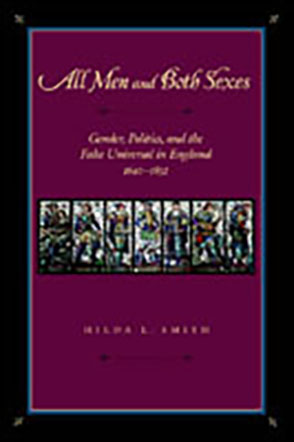
All Men and Both Sexes
Gender, Politics, and the False Universal in England, 1640–1832
Hilda L. Smith
All Men and Both Sexes
Gender, Politics, and the False Universal in England, 1640–1832
Hilda L. Smith
“In this important book Hilda Smith explains how women were marginalized long before they were confined to a separate sphere. We see precisely how women disappeared from the political discourse and why it proved so difficult for them to win recognition even among radical reformers. So long as the male experience was equated with citizenship and adulthood, women had only limited and specialized roles to perform in public.”
- Description
- Reviews
- Bio
- Subjects
All Men and Both Sexes explores the use of such universal terms as "people," "man," or "human" in early modern England, from the civil war through the Enlightenment. Such language falsely implies inclusion of both men and women when actually it excludes women. Recent scholarship has focused on the Rights of Man doctrine from the Enlightenment and the French Revolution as explanation for women’s exclusion from citizenship. According to Hilda Smith we need to go back further, to the English Revolution and the more grounded (but equally restricted) values tied to the "free born Englishman." Citing educational treatises, advice literature to young people, guild records, popular periodicals, and parliamentary debates, she demonstrates how the "male maturation process" came to define the qualities attached to citizenship and responsible adulthood, which in turn became the basis for modern individualism and liberalism. By the eighteenth century a new discourse of sensibility was describing women as dependent beings outside the state, in a separate sphere and in need of protection. This excluded women from reform debates, forcing them to seek not an extension of a democratic franchise but a specific women’s suffrage focused on gender difference.
“In this important book Hilda Smith explains how women were marginalized long before they were confined to a separate sphere. We see precisely how women disappeared from the political discourse and why it proved so difficult for them to win recognition even among radical reformers. So long as the male experience was equated with citizenship and adulthood, women had only limited and specialized roles to perform in public.”
“This is an important book that shows how falsely universal language was pervasive and enduring. It hints at the damage that this has done to women, and the difficulty of achieving change.”
Hilda L. Smith is Professor of History at the University of Cincinnati. She is the author of Reason’s Disciples: Seventeenth-Century English Feminists (1982) and two edited volumes, Women Writers and the Early Modern British Political Tradition (1998) and Women's Social and Political Thought: An Anthology (2000), coedited with Berenice Carroll.
Mailing List
Subscribe to our mailing list and be notified about new titles, journals and catalogs.