



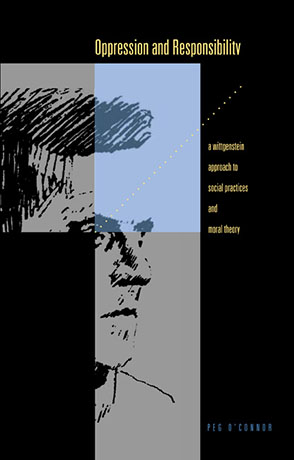
Oppression and Responsibility
A Wittgensteinian Approach to Social Practices and Moral Theory
Peg O’Connor
Oppression and Responsibility
A Wittgensteinian Approach to Social Practices and Moral Theory
Peg O’Connor
“O’Connor draws on the later Wittgenstein’s philosophy of language to offer accounts of oppression and responsibility that are more adequate than existing accounts both empirically and morally. . . . [Her] work goes beyond what is already available, in several respects. First, she delineates more clearly than any previous philosopher the indissoluble links between specific acts of violence and normative social practices. Given this analysis, she is able to reveal the full moral significance of occurrences so far neglected by philosophers, such as church bombings and barroom brawls, as well as to shed new light on much debated issues, such as hate speech. In addition, O’Connor implicitly demonstrates that Wittgenstein’s brilliant insights in the philosophy of language do not justify his meta-philosophical pronouncements. This is a well-conceived, insightful, and highly readable book.”
- Description
- Reviews
- Bio
- Subjects
First sketching a nonessentialist view of rationality, and emphasizing the role of power relations, Peg O’Connor then examines in subsequent chapters the relationship between a variety of "foreground" actions and "background" practices: burnings of African American churches, hate speech, child sexual abuse, coming out as a gay or lesbian teenager, and racial integration of public and private spaces. These examples serve to illuminate when our "language games" reinforce oppression and when they allow possibilities for resistance. Attending to the background, O’Connor argues, can give us insight into ways of transforming the nature and meaning of foreground actions.
“O’Connor draws on the later Wittgenstein’s philosophy of language to offer accounts of oppression and responsibility that are more adequate than existing accounts both empirically and morally. . . . [Her] work goes beyond what is already available, in several respects. First, she delineates more clearly than any previous philosopher the indissoluble links between specific acts of violence and normative social practices. Given this analysis, she is able to reveal the full moral significance of occurrences so far neglected by philosophers, such as church bombings and barroom brawls, as well as to shed new light on much debated issues, such as hate speech. In addition, O’Connor implicitly demonstrates that Wittgenstein’s brilliant insights in the philosophy of language do not justify his meta-philosophical pronouncements. This is a well-conceived, insightful, and highly readable book.”
“This eminently readable book has the unusual aim of showing the previously unappreciated significance of Wittgenstein’s work on epistemology and language for a collection of moral problems involving race, gender, and sexual preference. O’Connor, writing with clarity and rigor while avoiding needless technicality, shows that the development of a social or communal conception of linguistic meaning, when applied to these moral problems, yields a new awareness of issues of collective responsibility and the sometimes unwitting complicity of a social collective in making immoral acts (racism, oppression, and exclusion) possible within a larger social fabric. But the Wittgensteinian characterization of the background context of society’s discriminatory practices that O’Connor offers here is not only focussed on the social: her discussion also illuminates related and hotly contested problems in individual morality, for example, whether intentional action does or does not circumscribe conspiratorial action (she argues, by analogy to Wittgenstein’s linguistic philosophy, that it does not); and how self-description and consequent self-understanding—in some personal contexts, as she shows, matters of great urgency—are made possible within expanding Wittgensteinian language-games. This cogent and utterly unpretentious book, written with a human seriousness and sense of personal engagement that is in places moving, should attract considerable attention among scholars and students of gender, politics, culture, and ethics. Its readers will find here a vigorous, stimulating, and provocative contribution to our growing awareness of the linguistic and epistemological practices that undergird moral action, both good and bad.”
“Both Feminist Interpretations of Ludwig Wittgenstein and Oppression and Responsibility provide tantalizing examples of the ways in which feminist scholarship benefits from close and careful readings of Wittgenstein’s work through a feminist lens.”
“It goes without saying that despite the worries I raised in this review, this book needs to be read by anyone who is interested in the possible connections between Wittgenstein’s thought and normative moral and political issues. It is a book that will be important scholarship for those who are doing work on these connections.”
“Because she successfully demonstrates that words are tools that only find meaning in their uses, O’Connor’s Oppression and Responsibility is itself a valuable tool for locating possibilities for transforming meanings obscured in the ossified landscapes of those people whose meanings they oppress.”
Peg O'Connor is Professor of Gender, Women and Sexuality Studies and Philosophy at Gustavus Adolphus College and is coeditor of Feminist Interpretations of Ludwig Wittgenstein (Penn State, 2002).

Mailing List
Subscribe to our mailing list and be notified about new titles, journals and catalogs.