


The Quattro Cento and Stones of Rimini
Adrian Stokes, Introduction by David Carrier, Stephen Kite, and Foreword by Stephen Bann
The Quattro Cento and Stones of Rimini
Adrian Stokes, Introduction by David Carrier, Stephen Kite, and Foreword by Stephen Bann
“‘Poeta che mi guida’: I can think of no better words, the words of Dante about Virgil, to describe Stokes as a critic of the arts.”
- Media
- Description
- Reviews
- Table of Contents
- Sample Chapters
- Subjects
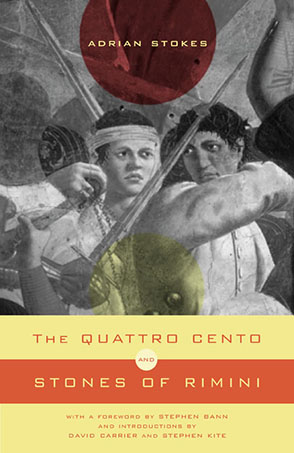
Winner of the 2003 PRINT Design Award for cover design.
Written as parts of an incomplete trilogy, The Quattro Cento and Stones of Rimini mark a crossroads in the transition from late Victorian to Modernist conceptions of art, especially sculpture and architecture. Stokes continued, even extended, John Ruskin’s and Walter Pater’s belief that art is essential to the individual’s proper psychological development but wove their teaching into a new aesthetic shaped by his experience of psychoanalysis with Melanie Klein and recent innovations in literature, dance, and the visual arts.
Few writers have been able to invoke the material presence of works of art in the way Stokes does in The Quattro Cento and Stones of Rimini. They combine travel writing with acts of looking spun out so as to reinterpret the imposing legacy of the Italian Renaissance through an aesthetic of the direct carving of stone, which has parallels in the sculpture of Brancusi, Henry Moore, and Barbara Hepworth but was for Stokes the discovery of artists in fifteenth-century Italy. To his way of thinking, there then arose a realization that the materials of art "were the actual objects of inspiration, the stocks for the deepest fantasies." During the Renaissance, Stokes maintained, stone accordingly "blossomed" into sculpture and buildings, such as the Tempio Malatestiano, that throw "inner ferment outward into definite act and thought."
This new edition of Stokes’s pivotal books will be of interest to those concerned with art criticism, aesthetics, psychoanalysis and art, and the art and architecture of the Renaissance and Modern periods.
“‘Poeta che mi guida’: I can think of no better words, the words of Dante about Virgil, to describe Stokes as a critic of the arts.”
“The republishing of these books is much to be welcomed. In them, Stokes examines fifteenth-century Italian sculpture and architecture from a point of view that has a particular resonance today. He achieved an unusual and compelling integration of art historical, art critical and aesthetic analysis. He also thought more deeply and wrote more eloquently about the aesthetics of sculpture and about the relation between sculpture and the architecture than any other writer on art of his time.”
“Adrian Stokes's thought runs counter to all the orthodoxies of the present. He believed in Art. It was the antithesis of mass culture. He believed that it was our fate to see the inner life, our emotions good and bad, mirrored in the outside world; and that in very complex ways art symbolized that mirroring. The only thing that distinguished art from other useless activities was Form. He used that word in a way that was his alone. Art was present to him all at once, not qualified in an important way by precedence or chronology. Insisting on Art’s outwardness, his starting point was material: the sculptor’s stone or clay, the painter's color and canvas. He assumed that the viewer would summon to the contemplation of art, body-memories of hard and soft, texture and light, holes and solids, near and far, as well as the fantasies that attend those memories. The power of art was reparative. It projected wholeness.
Stokes wrote about these things with the passion of a great teacher and with the imaginative insight of a poet. His was a unique voice.”
“This welcome reissue prints both texts and photographs in as generous as a format as the originals, with illuminating introductory essays by Stephen Bann, David Carrier and Stephen Kite.
This reprint offers a world of insight that most contemporary writing about art still keeps at a distance.”
“This is an important work in the history of ideas, and essential reading for any student of Adrian Stokes. A very rewarding book.”
“Yet the greatest accolade that can be given to this new paperback edition and the scholars who contributed introductions to it is the fact that the intention is that of getting Stokes’s writings read. And this handsome edition, which retains the original illustrations, does precisely that.”
“Recollected in tranquillity, Renaissance sculpture shines more brightly because Adrian Stokes polished the stone.”
Contents
Publisher’s Preface
Foreword
Stephen Bann
Introduction to The Quattro Cento
David Carrier
The Quattro Cento: A Different Conception of the Italian Renaissance
Adrian Stokes
Part 1: The Italian Scene: Introductory Notes to Florence and Verona
I. Jesi
II. Venice
III. South Opposed to East and North
IV. Plastic and Music
V. Roman Architecture and the Quattro Cento
VI. Genoa
VII. Representational and Non-representational Art
VIII. Oriental and Northern Art in Italy
IX. Verrocchio’s Lavabo
Part 2: Florence and Verona
I. Florence and Verona
II. Florentine Reserve
i. The Atmosphere
ii. Early Florentine Architecture
iii. The Statuesque
iv. 15th-Century Gothic in the Rest of Italy
v. Ghiberti and Elegance
vi. Ghiberti and ‘Finish’
vii. Bronze Statuettes and Clays
III. The Monumental, or Seeds of the Baroque
i. Etruscan Brutality
ii. Brunelleschi
iii. Reckless Tameness
IV. The Quattro Cento in Florentine Art
i. Donatello
ii. Michelozzo
iii. Desiderio da Settignano
iv. Pollaiuolo and Verrocchio
V. In Conclusion
Part 3: Outline of the Quattro Cento: An Appendix to Florence and Verona
I. Quattro Cento Architecture in General
II. Francesco di Giorgio
III. Quattro Cento Architecture in Rome
IV. The Tempio Malatestiano
V. Alfonso’s Arch and Static Sculpture
VI. The Palace at Urbino
VII. Lombard Architecture and Sculpture
VIII. A Quattro Cento Use of Terra-Cotta
IX. Quattro Cento Works by Florentine Artsits
X. Other Aspects of Lombard Sculpture
XI. Quattro Cento Gothic in Palermo
XII. Some Carving at Siena
XIII. At Brescia
XIV. At Verona
General Index
Index of Architecture and Sculpture Described in the Book as ‘Quattro Cento’
Stones of Rimini
Adrian Stokes
Introduction to Stones of Rimini
Stephen Kite
Part 1: Stone and Water
I. Stone and Water
II. The Pleasures of Limestone: A Geological Medley
III. The Mediterranean
Part 2: Stone and Clay
IV. Carving, Modelling and Agostino
Part 3: Stone, Water and Stars
V. The Tempio: First Visit
VI. Chapel of the Planets
VII. The Final Picture
Index
Suggested Further Reading
Index
Preface to Stokes volume
By Stephen Bann
There is one expedition to see a work of art that never fails to recall to me the early writing of Adrian Stokes, and, in particular, the first of the two books republished in this volume. The Church of Sant’ Anastasia in the centre of Verona is not much favoured by visitors. Nevertheless it exhibits at the entrance to a small chapel off the right aisle, just before the transept, what Stokes called “the finest of all Quattro Cento incrustation effects”, exemplified by two “sculpted candelabra reliefs, the one figuring sea-horses, the other sea-bulls”. This pair of panels in relief provides Stokes with an opportunity to restate without undue repetition, in the very last paragraphs of The Quattro Cento, the distinctive qualities that he has discerned in early Renaissance Italian carving. It also gives him an opportunity to protest politely against the misapprehension of those qualities which he detects as endemic in contemporary art historical scholarship. “The Victoria and Albert Museum possesses a Victorian photograph of one of the reliefs, the date of which is given as 1585. They are at least a hundred years older.”
I do not suppose that much energy has been expended, over the years that have elapsed since Stokes’s visit to Verona, in vindicating or challenging his claim. “They have been little noticed”, he concedes when he singles out these two preeminent reliefs. Confident that he has already thoroughly covered the ground in his marvellous extended description of “Verrocchio’s Lavabo” in Florence, he himself makes very little attempt to remedy this lack of attention. It is probably the same, misdated Victoria and Albert photograph, showing no more than the central section of one of the reliefs in question, that is featured as the last illustration in the book. Consequently, if you visit the Cappella del Crocifisso today, you may well be surprised by the important architectural role performed by these two symmetrical (but far from identical) marble panels framing the original Gothic Chapel, which was given its new appearance as a result of the benefactions of the noble Francesco Pellegrini in the late 15th century. These exquisite reliefs are, however not specially lit, or singled out for the visitor in any fashion. If you insist on pooring over what Stokes calls the “intricacy of [their] composition”—the absorbing méllée of writhing land and sea creatures—you will probably not be disturbed.
One of the pleasures of reading Stokes is, then, that it leads you to places where you feel empowered to reenact the discoveries that he once made, and to do it with having to rely on that ostentatious signalling of great art that is the bane of our contemporary tourists trails. David Carrier is quite right to stress in the following Introduction that the present volume will serve to “make his writing accessible to travelers” once again. It will certainly lead them to sites that remain, astonishingly enough, “little noticed”. Perhaps that is not as true as it was a few years ago of the greatest of all the architectural and sculptural ensembles celebrated in these two books: the Tempio Malatestiano at Rimini. Here it would be churlish to quarrel with the work carried out in the recent spectacular restoration which has had the effect of placing that extraordinary building more firmly on the map than it was a decade or two ago. But it remains broadly true of the only great Italian city that he selects to describe in a single, detached section in The Quattro Cento, which is of course the still largely unspoiled and tourist-free city of Genoa. It is, moreover, unquestionably true of the marble panels in the Cappella del Crocifisso, of the “Lavabo” in San Lorenzo (as David Carrier testifies here), and of innumerable other objects and places mentioned in the course of these two studies.
Yet I would not wish to begin by giving the impression that Stokes is just tracing out an esoteric circuit, designed to separate the sophisticated traveler from the rest. If I agree with David Carrier that this is a type of writing that cries out to be followed by a visit, I would also insist on foregrounding the depth of the cultural and literary tradition to which Stokes belongs. As it happens, the family that endowed the Cappella del Crocifisso was called “Pellegrini” ñ that is, “Pilgrim” ñ and if you avert your gaze from the marble reliefs, you will see the main Pellegrini chapel next to the Choir, where Pisanello”s fresco of St George has now been reinstated. The pilgrim figure featured on their coat of arms, visible in both chapels, bears witness to the age-old ritual of travel throughout Northern Europe and the Mediterranean World to visit sacred sites. However the tradition of writing about the journey to such sites, one that involves adapting self-consciously to the accounts of predecessors who have already traced out part of the field, is a much more recent one. I believe that when we recognize Stokes”s close but conflictual relationship to his literary predecessors in this domain, we can also appreciate how broad and pervasive a cultural context his writings occupy.
Here I should also refer the reader to what is surely the most ambitious attempt to locate the development of Stokes”s literary reputation within the intellectual cross-currents of the period following his death in 1972. Richard Read (whose official biography of Stokes is currently awaiting publication) recently published the hitherto unknown correspondence with Ezra Pound between 1927 and 1934, and accompanied it with a convincing analysis of the way in which Stokes was “extricate[d] from the heritage of Pound” by critical writers (such as myself) in the course of the 1970s. Read deftly unpicks the tensions that existed between Stokes and Donald Davie, who was however one of the first writers of the period to devote detailed attention to Stones of Rimini. He also demonstrates through the evidence of the correspondence that Stokes”s relationship to Pound in the 1930s was far from being an equable and easy one. The substance of this argument cannot be recapitulated in a brief preface. But the implications of no longer seeing Stokes “merely as the intermediary for or commentator on Pound”s masculine ideas” are germane to my theme, as they are to the approaches of David Carrier and Stephen Kite in the two introductions that follow.
To place these two books by Stokes in the tradition of travel writing is thus to associate him with a complex heritage which precedes the rise of modernism, though it later becomes irretrievably associated with modern cultural trends. Stephen Kite comments in his introduction to Stones of Rimini on the variety of sources that Stokes would have consulted to supplement the essential Baedeker: such writers as Charles Yriarte, Edward Hutton and (very prominently in the English context) John Addington Symonds. It may be suggested that Symonds was the first author writing in English to diffuse the lore attaching to turbulent condottieri such as Sigismondo Malatesta and his arch-rival Federigo da Montefeltro of Urbino. Yet it is interesting to note that, in his three travel books extensively dealing with Italian themes and places, Symonds hardly infringes at all on what will be the special sites of The Quattro Cento and Stones of Rimini.
Indeed Rimini features in Italian Byways, oddly enough, as no more than a staging post to Urbino. “At Rimini,” writes Symonds, “one spring, the impulse came upon my wife and me to make our way across San Marino to Urbino”. What Symonds then proceeds to find noteworthy in Urbino, however, reminds us how far the artistic preoccupations of Stokes are allied to those of the previous generation, when Symonds and Walter Pater had competed in their aesthetic readings of Renaissance sculpture, especially with regard to Michelangelo. It is “the profusion of sculptured rilievo” that strikes Symonds as the most prominent vestige of the beauty of Federigo”s palace, and he seems almost on the point of investing a Stokesian subject with a Stokesian vocabulary when writing of “a little chapel encrusted [my italics] with lovely work in stucco and marble; friezes of bulls, sphinxes, sea-horses, and foliage; with a low relief of Madonna and Child in the manner of Mino da Fiesole.” This is, however, a delusory promise. If Symonds recognizes the importance of sculptural relief in the Renaissance, it is his rival Pater who, in his essay on Luca della Robbia, takes on the considerable challenge of writing about it.
In this connection, David Carrier is fully justified in emphasizing the crucial relevance to Stokes”s achievement of a tradition of English “art writing” which is also, in essence, associated with travel writing. This is so right from its origin, with William Hazlitt, whose lively description of his entry to Venice Carrier notes ñ and whose brilliant recollection of visiting the collections of the Dulwich Gallery is perhaps the first English text about works of art which incorporates an evocative description of how he arrived at his destination. Yet there can be little doubt that the chief precedent and, in a literary sense, the main antagonist with whom Stokes had to settle accounts in his early writing was John Ruskin, whose looming presence is signalled unmistakeably in Stokes”s troping title: for The Stones of Venice, read Stones of Rimini. In thinking of the significance of that “finest of all incrustation effects” in the Capella del Crocefisso, I cannot dismiss from my mind the point that the omnivorous Ruskin had made an equally grandiose claim for a Gothic tomb “standing over the small cemetery gate of the Church of St. Anastasia at Verona”. This was, claimed Ruskin in the 11th chapter of Book I of The Stones of Venice, “the most perfect Gothic sepulchral monument in the world”. Ruskin goes so far as to call this simple Gothic canopy, which he illustrates with a line engraving, “my most beloved throughout all the length and breadth of Italy.” How probable it is that Stokes would have pondered that work, and that egregious judgement, before passing into the church and thinking of his own lateral swerve from a system of aesthetics based on the Middle Ages to one rooted in the early Renaissance!
Yet the relationship between Ruskin and Stokes cannot be reduced to the simple notion that the latter rescued and comprehensively reevaluated the period style that the former had vituperated. Ruskin also represented for his age, as the French writer Robert de la Sizeranne astutely realized, a conclusive change in the relation of the mass public to great works of art, based on the ever widening access that derived from cheap travel and increased leisure. Ruskin had become, as La Sizeranne neatly put it in the 1890s, “the archangel of Cook”s Tours and the prophet of the Terminus”. His writings were the holy writ for a new culture of pilgrimage:
In former times, when lives were sedentary and destinies rooted in the earth, no one would have understood this function of an aesthetician leading the people. But now that wandering humankind has thrown down its household gods, put out the fire on its hearth, and goes off to every strand, to the foot of every mountain or again into dead towns transformed into reliquaries, so as to get better acquainted with this earth that it finds too small and this past that it finds too short; today when uncertain of a future life we seek to prolong our existence rather inside of itself, to relive centuries already lived through by identifying ourselves with the painted lives in museums or experiencing something of the multiple lives of the cities and crowds that we pass by, - this aesthetic guide has become, like the priest, a purveyor of the infinite.
The mission that La Sizeranne credits to Ruskin is phrased grandiloquently, and its rhetoric hardly squares with the more modest persona that Stokes adopted in The Quattro Cento and Stones of Rimini. All the same, it is worth bearing in mind ñ and extrapolating to the course of Stokes”s career as a whole the exceptional breadth of the cultural concerns that animate these two works, and so justify the ambition of the self-appointed “aesthetic guide”. For Stokes, the new Humanism will ultimately prove to be a humanism informed by the self-knowledge that accrues from psychoanalysis, and thus decisively avoiding the insuperable psychic struggles that beset his nineteenth-century predecessors. But, already in the early 1930s, it is clear how acute is his insight into the saving role that art must play in supporting this new humanistic process.
In the same years that he published the two works included in this new volume, Stokes also brought out two books concerned with music and dance, To-Night the Ballet (1934) and Russian Ballets (1935). These were not included in the collected Critical Writings of 1978, and so have attracted little recent attention. They are however complementary to the two Italian studies, almost in the sense that ballet stands for what we must content ourselves with, when we are obliged to stay at home in Northern Europe, far from the light and space of the Mediterranean world. Stokes emphasizes this element of compensation when he writes with insight of the special role of music in an age of “mechanical” reproduction:
The man who is enjoying his wireless concert sees his room, however dreary,
no longer as a dead or dying mist of hard things, but as something definite
if unpleasant, no longer crouching but upright, a mise-en-sc”ne in which
the music takes place. Think how the streets spring to life when the bolder
kind of barrel-organ grinds its tune!
In the contemporary world, though we have far fewer barrel-organs, we now have the Walkman to animate the public street in the way that Stokes describes. He himself also paid tribute in To-Night the Ballet to the transformative power with which music had endowed the public experience of the cinema, and wrote memorably of the effect of the Czech composer Smetana”s Moldau on the sound-track of Robert Flaherty”s epic of the North, Tabu. Music possesses the power to “ennoble” the “dark navigators” of Flaherty”s documentary:
Their smallest movements are heroic as they go full of eagerness, full of
freedom, to perform their ritual. And, in this movement of men, illuminated
for us by the clear southern day, we see the redemption of those unattended
northern streams.
Stokes's impassioned writing on music and the dance thus hints at the way in which the inner life can be sustained by aesthetic experiences, even in the unresponsive environment of the North. But The Quattro Cento and Stones of Rimini assert in resonant counterpoint that our ritual journeys to the Mediterranean World have not ceased to be necessary. “[D]o we all need light in place of lighting Ömust we always turn South?”, asks the final sentence of The Quattro Cento. By the end of Stones of Rimini, our guide has left us in no doubt.
Mailing List
Subscribe to our mailing list and be notified about new titles, journals and catalogs.