


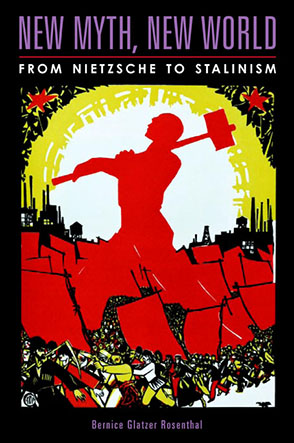
New Myth, New World
From Nietzsche to Stalinism
Bernice Glatzer Rosenthal
“New Myth, New World is an original and provocative reinterpretation of Nietzsche's central impact on Soviet culture. Rosenthal has read widely and deeply in primary sources running from philosophy, religion, and poetics to political ideology, architecture, and street theater. In addition, she seems to know all the relevant scholarship, not just in English and Russian but also in German and French and other languages as well. This is a model of wide-ranging, well-informed historical research.”
- Description
- Reviews
- Bio
- Table of Contents
- Sample Chapters
- Subjects
Nietzsche made a difference. He furnished intellectual ammunition for a prolonged conflict about culture, society, and politics that began around the turn of the century. His first Russian admirers were poets, philosophers, and political activists. They responded to the changes transforming their society by espousing new values and seeking a new faith by which to live and work. This response resulted in new aesthetic and political amalgams, such as Symbolism, Futurism, Nietzschean Christianity, and Nietzschean Marxism. The ensuing debates between and among their partisans reverberated throughout the wider culture and therefore also into Bolshevism, becoming the subject of an uninterrupted polemic between Bolsheviks and non-Bolsheviks, and among Bolsheviks, that continued into the 1930s.
In Stalin's time, unacknowledged Nietzschean ideas were used to mobilize the masses for the great tasks of the first Five-Year Plan and the Cultural Revolution, which was intended to eradicate "bourgeois" values and attitudes from Soviet life and to construct a distinctly Socialist culture. Nietzsche's belief that people need illusions to shield them from reality underlay Socialist Realism, the official Soviet aesthetic from 1934 on. In the aftermath of de-Stalinization, the government cast Nietzsche as the personification of "bourgeois" nihilism and "bourgeois" individualism. Soviet intellectuals wishing to reappropriate their lost cultural heritage discovered the Nietzsche-influenced intellectuals of late Imperial Russia and reopened discussion on the issues they had posed.
More than an exercise in historical rediscovery, New Myth, New World offers a new interpretation of modern Russian history. By uncovering the buried influence of Nietzschean ideas on Soviet culture and politics, Rosenthal opens new avenues for understanding Soviet ideology and its influence on the twentieth century.
“New Myth, New World is an original and provocative reinterpretation of Nietzsche's central impact on Soviet culture. Rosenthal has read widely and deeply in primary sources running from philosophy, religion, and poetics to political ideology, architecture, and street theater. In addition, she seems to know all the relevant scholarship, not just in English and Russian but also in German and French and other languages as well. This is a model of wide-ranging, well-informed historical research.”
“New Myth, New World: From Nietzsche To Stalinism by Bernice Glatzer Rosenthal is a thoughtful and scholarly reinterpretation of Nietzsche’s lasting influence upon Soviet culture.”
“Rosenthal’s mastery of the often intricate details of Russian and Soviet political thought is truly impressive and contributes dramatically to the credibility of her thesis. Her work will force scholars to reevaluate not only Nietzsche’s influence on twentieth-century thought but also the origins of Soviet culture. Anyone who wants to understand the evolution of Marxist-Leninist thought, in all of its manifestations, would do well to read New Myth, New World.”
“In New Myth, New World: From Nietzsche to Stalinism, Bernice Glatzer Rosenthal proposes a refreshing, unconventional approach to Nietzsche’s heritage, and demonstrates how ideas have a life of their own, influencing, in arcane ways, trends that may be the opposite of what their proponents claim.
Professor Rosenthal’s book is an exercise in cultural archeology: she excavates long-forgotten or neglected themes, symbols, ideas that have permeated various trends of the Russian tradition from the populists to the Bolsheviks.”
“In her third book on Nietzsche and Russia, Rosenthal documents the persistence of Nietzsche in Russia’s history in a recondite and kaleidoscopic way. Her command of the topic shows. . . . Highly recommended.”
“Rosenthal’s exploration of the ‘psychopolitical utility to myth’ (113) in New Myth, New World serves as a timely and thought-provoking guide through a key portion of this new territory. The reader will have to work through Rosenthal’s dense prose, close reasoning, and occasional bursts of associative analogy, but the reader will not be disappointed. This is an excellent work.”
“The author’s scholarly intuition, which sometimes cuts across the work’s declared aims, notes and delineates a tendency, a set of problems which are obviously going to dictate the pattern of Nietzsche reception in Russia during the next few years.”
Bernice Glatzer Rosenthal is Professor of History at Fordham University. She is the editor of three prior books that have paved the way for this study—Nietzsche in Russia (1986), Nietzsche and Soviet Culture: Ally and Adversary (1994), and The Occult in Russian and Soviet Culture (1997). She is also the co-author of A Revolution of the Spirit: Crisis of Value in Russia, 1890-1924 (1990).
Contents
List of Illustrations
Acknowledgments
Works Frequently Cited
Introduction
Section I: The Seed-Time: The Russification of Nietzsche, 1890–1917
1. Symbolists
2. Philosophers
3. Nietzschean Marxists
4. Futurists
Summary: The Nietzschean Agenda in 1917
Section II. Nietzsche in the Bolshevik Revolution and the Civil War, 1917–1921
5. Apocalypse Now: Bolshevik Fusions of Marx, Engels, and Nietzsche
6. Beyond Bolshevism: Visions of a Revolution of the Spirit
Section III. Nietzschean Ideas in the Period of the New Economic Policy (NEP), 1921–1927
7. Concretizing the Myth: New Cult, New Man, New Morality
8. New Forms, New Language, New Politics
Section IV. Echoes of Nietzsche in Stalin’s Time, 1928–1953
Part I: Dionysus Unleashed: The Cultural Revolution and the First Five-Year Plan
9. "Great Politics" Stalin-Style
10. Cultural Revolution in the Arts and Sciences
Part II: Art as a Lie: Nietzsche and Socialist Realism
11. Nietzsche’s Contributions to the Theory of Socialist Realism
12. The Theory Implemented
Part III: The Lie Triumphant: Nietzsche and Stalinist Political Culture
13. The Stalin Cult and Its Complements
14. Cultural Expressions of the Will to Power
Epilogue: De-Stalinization and the Reemergence of Nietzsche
Index
Introduction
The worst readers. The worst readers are those who behave like plundering troops; they take away a few things they can use, dirty and confound the remainder, and revile the whole.
—HH, 2:245
All the aphorisms of Zarathustra
And the virgin soil of paradoxes.
Elegantly subtle sophistries—
All turned into blood.
—Nikolai Bukharin, "The Mad Prophet (Nietzsche)" (1937)
Some of the most powerful ideas are those that are hidden. This book excavates the long-obscured trail of ideas influenced by Nietzsche that entered into and helped shape Bolshevism and Stalinism. The excavation begins in late Imperial Russia, goes through the thickets of the revolutionary and early Soviet periods, and culminates in Stalin’s time. Throughout, Nietzsche’s thought was mediated by Russians who picked up the aspects of it that appealed to them and reconfigured them for their own purposes until they were transformed in ways that obscured their provenance. Without knowledge of Nietzsche’s thought, and Russian appropriations, modifications, and embellishments of it before the Bolshevik Revolution, the trail of Nietzschean ideas we will be following is virtually invisible, because for most of the Soviet period, either his name was unmentionable or it could be used only as a pejorative. By Nietzschean ideas, I mean ideas indebted to Nietzsche directly or at one or more removes. One did not have to read Nietzsche to be influenced by him. The pollen of his ideas hung in the atmosphere for decades, fertilizing many Russian and Soviet minds.
Nietzsche’s brilliant style and compelling images appealed to people everywhere, Russians included. His quotable aphorisms could be detached from their context and deployed in a variety of ways. "Tell me what you need," Kurt Tucholsky, a German writer, quipped, "and I will supply you with a Nietzsche citation." The bi-polar and complex nature of Nietzsche’s thought accommodates contradictory ideas and changing circumstances. Its open-endedness and ambiguity enables people to read their own meanings into such concepts as the Superman, the "will to power," and "great cultural projects." Nietzsche’s works provided intellectual ammunition for a prolonged conflict that was conducted in all areas of Russian life—culture, society, politics—a conflict over whose will, values, and ideals would prevail, in whose image the society of the future would be shaped.
The works of the "philosopher with a hammer" touched deep cultural chords, reverberating with, reinforcing, and reactivating ideas indigenous to Russia. His striking slogans and memorable images stayed with people long after they read him. Nietzsche was the spark that fused discrete, seemingly contradictory, elements into new amalgams, such as Nietzschean Marxism and Nietzschean Christianity. Some of these were unstable and transitory. Others endured and evolved, but one idea remained constant: art can create a new consciousness, a new human being, a new culture, and a new world. Nietzsche imbued radicals of various persuasions with visions of total transformation against which liberalism and evolutionary Marxism seemed pallid. Nietzsche enthusiasts seized on the eschatological and voluntarist aspects of Marxism to commandeer the existing Russian apocalypticism and to revitalize the voluntaristic and "heroic" aspects of the intelligentsia ethos.
Bolshevik intellectuals did not confine their reading to Marxist works. They knew Russian and European literature and philosophy and kept up with current trends in art and thought. Aspects of Nietzsche’s thought were either surprisingly compatible with Marxism or treated issues that Marx and Engels had neglected. Nietzsche sensitized Bolsheviks committed to reason and science to the importance of the nonrational aspects of the human psyche and to the psychopolitical utility of symbol, myth, and cult. His visions of "great politics" (grosse Politik) colored their imaginations. Politik, like the Russian word politika, means both "politics" and "policy"; "grosse" has also been translated as "grand" or "large scale." The Soviet obsession with creating a new culture stemmed primarily from Nietzsche, Wagner, and their Russian popularizers. Marx and Engels never developed a detailed theory of culture because they considered it part of the superstructure that would change to follow changes in the economic base.
Nietzsche’s influence operated below the surface of events, accelerating the repudiation of established authorities and values, nourishing a panoply of utopian doctrines, reinforcing the Promethean aspects of Marxism, and contributing (along with other factors), to an eschatological mood and a free-floating radicalism that worked to the Bolsheviks’ advantage in 1917. Nietzsche’s thought affected aspects of Stalinism that explanations based on class conflict, rationally calculating "economic man," or modernization theory cannot account for.
Focusing on culture, rather than political events or social structure, I highlight a set of issues that I call the Nietzschean agenda. This agenda was established by his Russian admirers between 1890 and 1917, when Nietzsche could be discussed openly and his thought was russified and absorbed into the culture. Responding to the changes transforming their country, Nietzsche enthusiasts espoused new values and sought a new ideal (in Nietzschean terms, a new myth) by which to live and on which to base their work and transform their world. The other items on the agenda—a quest for a "new word," a new art form, a new ideal of man (and woman), a new morality, a new politics, and a new science—were related to the quest for a new myth. Nietzsche’s popularizers shaped the wider culture, disseminating their renditions of his ideas, and raising issues that were debated by Bolsheviks and non-Bolsheviks, and among the Bolsheviks, until the mid 1930s when the Communist Party resolved these issues. For close to half a century, then, the Nietzschean agenda thus passed from one generation to another, each generation offering new answers to the same questions and issues.
O N E
Symbolists
For the sake of the new beauty,
We will break all laws,
We will trespass all limits. —Dmitry Merezhkovsky,
"Deti nochi"
For the symbolists, the key Nietzsche text was The Birth of
Tragedy, even though much of their imagery stemmed from
Zarathustra. They were dazzled by Nietzsche’s aesthetic justification
of the world and human existence, his celebration
of the Dionysian, and his belief that myth is essential
to the health of a culture. Their primary interests were art,
culture, and the "inner man" (the soul or the psyche).
Spiritual radicals, they interpreted the "will to power" as
creativity, detested the quotidian aspects of life (byt), and
unlike Nietzsche, held that empirical reality is but a symbol
of a higher reality that can be apprehended intuitively.
Opposed to positivism, rationalism, and materialism, they
imagined "other worlds than ours" and plumbed the depths
of the human soul. Rejecting the "slavish" kenotic values
of humility, altruism, and asceticism, they hailed Nietzsche as
a proponent of self-affirming individualism and enjoyment
of life, a trespasser of forbidden boundaries and established moral codes,
and highlighted his paeans to laughter and to dancing. Later on, however,
they denounced individualism as atomistic or decadent and restored one or
more of the kenotic values (which ones depended on the symbolist), defending
their turnabout with different quotations from Nietzsche. Their myths
featured a leap from necessity to freedom in the cosmic, rather than the
Marxist, sense, and the transfiguration of man and the world through art.
The symbolist poet would articulate the salvific "new word."
The leading symbolists were Dmitry Merezhkovsky (1865–1941), the initiator
of the movement; his wife Zinaida Gippius (1869–1945); Valery Briusov
(1873–1924); and Konstantin Bal’mont (1867–1942).1 A "second generation"
emerged around 1902—Viacheslav Ivanov (1866–1949), Andrei Bely
(Boris Bugaev, 1880–1934), and Aleksandr Blok (1880–1921). Symbolism
began as protest against realism, naturalism, the moral and socio-political
didacticism of populists and Tolstoy, and vulgar mass culture. Symbolist
works bypass the intellect to address the psyche directly and were crafted
to evoke chains of subliminal associations and a mysterious, otherworldly
mood. The poetry suggests rather than states, sometimes in arcane or vatic
language, and attempts to replicate music. The paintings depict divine and
demonic subjects, archetypal events (such as the Apocalypse), and incarnations
of the "eternal feminine." Early symbolism was vehemently apolitical
and asocial, but the aesthetic was intertwined with issues of philosophy and
religion from the start. Most symbolists became Godseekers (Bogoiskat’eli)
another movement that Merezhkovsky initiated. The Revolution of 1905
politicized the symbolists; they perceived it as the start of the Apocalypse
that would culminate in the establishment of the Kingdom of God on Earth.
Symbolism as a Surrogate Religion
Merezhkovsky learned about symbolism and Nietzsche in Paris. French symbolism
was more indebted to Wagner than to Nietzsche and invited introspection
and a mystical withdrawal from the world. Nietzsche’s thought
helped Merezhkovsky give Russian symbolism its fighting edge and (with
Soloviev and Fedorov) was an inspiration for the later symbolist concept of
"life-creation" (zhiznetvorchestvo).
Russian symbolism started out as a religion of art. Merezhkovsky mingled
romanticism and idealism with a Nietzschean aestheticism and accused
populists and positivists of ignoring the "eternal questions" of human existence.
Aesthetic creativity gives life meaning, he argued in the early 1890s,
and art leads to higher truths (note the plural). Only a "new idealism" could
unite the intelligentsia and the people (narod) (a populist goal).2 Yet only a
few years later, Merezhkovsky turned his back on the people and insisted
on the autonomy of art. Using Nietzsche as a battering ram to smash the
old Christian/populist "tables of values," Merezhkovsky championed an aesthetic
individualism in which self-expression and beauty were the highest
values. The artist was a hero, a warrior for a new culture, and the people
were rabble. The artist was not obligated to serve them.
Merezhkovsky’s aesthetic individualism was short-lived, because art alone
proved insufficient as a guide to life, and it failed to enable him to overcome
his inordinate fear of death. In his essay "Pushkin" (1896), Merezhkovsky
asserted that paganism (really Nietzscheanism) and Christianity were two
halves of a yet undiscovered greater truth. Paganism sanctioned self-affirmation
and worldly pleasures; it was the "truth of the earth" ("remain true to the
earth," Z, 42). Christianity preached personal immortality and love; it was
the "truth of heaven." Merezhkovsky resolved to reconcile the two truths,
so that people could enjoy the worldly pleasures prohibited to Christians
and still be assured of eternal life. In the same essay, he exalted Pushkin as
the perfect combination of Apollo and Dionysus. This essay became the subtext
of discussions about Pushkin from then on.3 Elsewhere, Merezhkovsky
praised Goethe as a pan-European writer, as Nietzsche did (TI, 102), and
discussed the Apollonian and Dionysian aspects of Goethe’s life and work,
thereby linking Goethe and Nietzsche.
In 1900, Merezhkovsky embarked on a "revaluation of all [Christian]
values," based on the assumption that "historical Christianity" (Christianity
as preached by the churches) was obsolete. Jesus Christ Himself would grant
humankind a Third Testament (Zavet, sometimes translated "revelation")
that would reconcile all dualisms: Christianity and paganism, Westernism
and Slavophilism, spirit and flesh, Russia and Europe, God-man and Man-
God, Christ and Antichrist. From then on, Merezhkovsky cast all problems
in terms of an eschatological dualism that only the Second Coming could
resolve. The distinction between institutional Christianity and Christ is an
old one but, in Merezhkovsky’s case, the distinction was informed by Tolstoy
and Nietzsche. Tolstoy attacked the state-controlled Orthodox Church and
preached a Gospel-based Christianity. Nietzsche wrote: "I shall now relate
the real history of Christianity—The word ‘Christianity’ is already a misunderstanding
—in reality there has been only one Christian and he died on
the Cross" (AC, 151). Merezhkovsky did not quote the good things Nietzsche
said about Jesus, lest he blur the eschatological dualism. Rather, he challenged
Nietzsche’s anti-Christian statements. Authentic Christianity is not a slave
morality, Merezhkovsky proclaimed, but a new and higher supramoral phenomenon
beyond good and evil. Christianity is not life-denying; personal
immortality is the supreme affirmation of life. God is not dead; He lives and
will come again. Jesus Christ is the Superman Nietzsche sought in vain.4
Arguing that people need religious faith as much as they need food,
Merezhkovsky proselytized his "new religious consciousness" in novels and
essays, in the Religious Philosophical Society of St. Petersburg (founded by
him and Gippius in 1901), and in their revue, New Path. The Society featured
debates between clergymen and lay intellectuals on burning issues of
the day, including the Holy Synod’s excommunication of Tolstoy, Christian
attitudes toward sex, and whether or not new Christian dogma was needed,
and if so, who would create it. Outraged at Tolstoy’s excommunication (even
though he disagreed with Tolstoy), Merezhkovsky challenged the subordination
of the Orthodox Church to the state and tried to found a new church
a few years later. In the debates on sex, Merezhkovsky championed the idea
of "holy flesh," not realizing that he was advocating transfiguration. One
of the Society’s most prominent figures, the writer Vasily Rozanov
(1856–1919) extolled the holiness of sex and the family, praised Judaism’s
positive attitude to sex, and claimed that Christianity was a religion of death
because it was fixated on celibacy. Because of his diatribes against Christianity
and his unabashed amoralism, Rozanov was called the "Russian Nietzsche."5
Unlike the other "Russian Nietzsche," Leontiev, Rozanov idealized domesticity.
In private life, he was a pillar of the Church, which he regarded as a
haven of beauty, warmth, and spiritual succor. He found supreme beauty in
the visage of Jesus and in Orthodox rituals.
The unprecedented spectacle of clergymen and lay intellectuals debating
one another on equal terms attracted capacity audiences. The government
shut down the Society in April 1903, lest it provide a forum for heresy, but
repression could not squelch the revaluation of all Christian values that the
Society had provoked. It was a major stimulus to the early-twentiethcentury
religious renaissance. The Society was revived in 1907, and branches
were founded in Moscow, Kiev, and other cities. The members of all the
religious-philosophical societies were called Godseekers, even though many
were already believers, because they were seeking answers to questions raised
in the original Society or in the writings and lectures of its leading figures.
Most symbolists were Godseekers, but not all Godseekers were symbolists.
The Moscow branch was called the Religious Philosophical Vladimir Soloviev
Society, after Russia’s greatest philosopher. Soloviev (1853–1900) preached
an activist Christianity that would transfigure the world and establish the
Kingdom of God on Earth, a realm of pure joy and love. He considered art
a form of inspired prophecy and had a special regard for lyric poetry, which
he associated with Sophia (Divine Wisdom) and romantic notions of "the
eternal feminine" (Goethe’s phrase). He believed that the poet’s task was to
bring Sophia down from heaven by love and find forms to suit her essence.
He considered Beauty to be the carrier of the Idea, not in the Hegelian sense,
the reflection of an eternal Idea upon fleeting phenomena, but that which
incarnates a spiritual or divine principle in matter. He saw nature as the
body of Sophia and the flesh as something that should not be denied but
transfigured. In The Meaning of Love (1892–94), Soloviev separated procreation
and sexual pleasure and sanctioned sexual pleasure as a means of
overcoming egoism. His ideal human being was androgynous, a tenet that
can be interpreted either as recommending bisexuality or as calling for the
transcendence of sexual relations in a transfigured world.
Soloviev’s most fundamental concept was "Godmanhood" (Bogochelovechestvo),
the incarnation of the divine idea in man (in other words deification)
and the salvation and transfiguration of all humankind, not just
righteous individuals. The antipode of "Godmanhood" was demonic
"Mangodhood." (Dostoevsky also contrasted Godman and man-god.)
Although Soloviev disapproved of Nietzsche, he considered the Superman a
religiously significant idea, because it expressed a yearning to be more than
human. "Godmanhood" was related to Soloviev’s concept of "total unity"
(vseedinstvo), the unity of being central to Orthodox ontology. He rejected
abstract Western philosophy, represented in his early works by Hegel, in
favor of an integral worldview, an all-encompassing synthesis of philosophy,
religion, science, and art. In the 1880s, Soloviev advocated "free theocracy,"
a variant of the Slavophile ideal of sobornost’, to be instituted by the tsar
and the pope, for one of his goals was the reunion of the Christian churches.
In the 1890s, dismayed by the failure of his theocratic project, Soloviev
espoused a kind of liberalism. (The symbolists ignored this aspect of his
views.) Throughout, he advocated an activist Christianity, one that would
really change the world.
In the last year of his life (1900), Soloviev predicted the imminent advent
of the Antichrist in a tale that portrayed him as a composite figure with
Nietzschean traits. Indeed, says the narrator, "many called him a Superman."6
Dazzlingly beautiful, the Antichrist uses science, magic, and technology to
control nature (an allusion to Fedorov) and ends the age-old scourges of
hunger and war. But he abolishes the distinction between good and evil,
loves only himself, and presumes to replace Christ, for his real motivation
is power. After the political and social problems have been solved, the religious
question comes to the fore. The Jews revolt when they learn that he
is not the Messiah after all (note the importance of human agency); evil is
vanquished; and the Millennium begins. Soloviev’s apocalypticism and his
prophesy of pan-Mongolism (the rule of the "yellow" races over the "white")
influenced symbolist political thought during the Russo-Japanese War, merging
with other apocalyptic visions, especially Merezhkovsky’s Third Testament,
Wagner’s Götterdämmerung, and Nietzsche’s "great noontide": "One day
they shall proclaim with tongues of flame: It is coming, it is near, the great
noontide!" (Z, 192).
Ivanov, Bely, and Blok combined Nietzsche with Soloviev, "correcting"
Nietzsche’s misogyny with visions of Sophia or the "eternal feminine." All
three were Wagnerophiles (Merezhkovsky was not). Ivanov regarded man
as a religious animal (animal religiosum) and since ecstasy is the "alpha"
and "omega" of the religious state, as an ecstatic animal (animal ecstaticum).
In "The Hellenic Religion of the Suffering God" and "The Religion of
Dionysus" (1904–5) Ivanov underscored the interrelated religious and sexual
aspects of the cult and the role of the maenads.7 He believed that "mad"
intoxication and oblivion were the outward manifestations of a state of
ecstasy that was intimately connected with sacrifice and suffering in an eternally
self-renewing cycle of birth, death, and rebirth. Dionysian ecstasy
enabled the celebrants to accept the reality of death by providing them with
the certainty of mystical unity with the "suffering god," who was both priest
and sacrificial victim. Viewing the myths and rituals of the cult as expressions
of a primordial mystical idea, Ivanov emphasized the common elements
in Christianity and Dionysianism—passion, death, and resurrection
—and argued that Dionysus was a precursor of Christ.
Ivanov’s Nietzschean Christianity differed from Merezhkovsky’s. The latter
believed that the reconciliation of paganism and Christianity lay in the
future; Ivanov held that they were once one, but then tragically separated.
Ivanov’s orientation was almost purely Dionysian; he exalted loss of self in
mystical ecstasy and assimilated Dionysus to the kenotic Christ. His eschatology
was attuned to immanent transfiguration. Merezhkovsky’s apocalypticism
posited grand historical schemes along the lines of a Hegelian
dialectic, which he sometimes he conflated with Nietzsche’s idea of eternal
recurrence, misunderstood as historical cycles. Merezhkovsky’s Christianity
centered on Jesus; Ivanov’s was part of an amorphous "new religious synthesis."
Merezhkovsky’s writing style was clear and simple, as befit his proselytizing
orientation; Ivanov’s was turgid, esoteric, and replete with neologisms
that had Greek or Latin roots. Between 1904 and 1912, Ivanov’s salon
eclipsed Merezhkovsky’s salon as a gathering place for the literary and artistic
intelligentsia. Ivanov was more important as a theorist of symbolism, but
Merezhkovsky’s writings reached a larger audience. Indeed, Merezhkovsky’s
historical novels were bestsellers.
Bely tried to make symbolism the basis of a integral worldview that encompassed
science, philosophy, religion, and art (Soloviev’s idea). The Nietzschean
aspects of Bely’s aesthetics were derived primarily from The Birth of Tragedy.8
Soloviev shaped Bely’s concept of the redemptive role of the poet, his conviction
that religion, rather than unformulated mystical feeling, must be the
basis of art, and his emphasis on ethics, which he merged with a Nietzschean
aestheticism. Like Ivanov, Bely reworked Nietzschean images of ascent and
descent in Christian terms. Blok tried to integrate Soloviev and Nietzsche
intuitively and poetically, wavering between them all his life. At Ivanov’s
suggestion, he re-read The Birth of Tragedy in 1906. From then on, Blok
viewed the Dionysian rites as the origin of all drama, and the Dionysian
principle as the foundation of all art.9
Idealization of human sacrifice is the dark side of symbolism. The
Dionysian dithyrambs that accompanied the ritual sacrifice of the god in
ancient Greece were not only erotic but frenzied, bloody, and cruel. The original
Dionysian rites were not just sexual orgies, they were orgies of cannibalism
(which Ivanov recognized). For the celebrants, it was Dionysus himself
who was sacrificed. He was literally torn to pieces, pieces which the celebrants
ate, thereby becoming god, or god-like, or so they believed. To Ivanov,
Dionysus’s dismemberment and resurrection symbolized the cycle of birth,
death, and rebirth. Eroticization of suffering and fascination with violent
death are obvious in his cycle of poems "To Dionysus" (1903).10 One of
Blok’s greatest poetic cycles, The Snow Mask (1907), ostensibly about a love
affair, is ordered around the lines of the Dionysian ritual described in Ivanov’s
essays. In Edith Clowes’s words, "The poet becomes a Christ figure who
rebels, affirms his own will, invokes the god, and finally gives himself up to
Dionysian androgynous chaos. Out of chaos emerges a new mystical-creative
consciousness. This resurrection lasts only a short time." In the end the poet
realizes that he is only human and accepts his final sacrifice on the "snowy
pyre."11 Years later, Nadezhda Mandelstam contended that the symbolist
attempt to combine paganism and Christianity implied an apologia for cruelty
that conditioned people to accept terror, giving as an example Ivanov’s
statement, "Cruelty is distinguished by a serene expression while the victim
drinks in the radiant energy of the tormenter."12
Symbolist reinterpretations of Christianity included visions of a new man—
an artist-hero, a creator of a new culture and new values—the polar opposite
of rationally calculating, self-interested "economic man." In addition,
he was depicted as young, daring, forever striving, and a transgressor of
established norms. Merezhkovsky depicted such figures in his trilogy of historical
novels, Christ and Anti-Christ—Death of the Gods (Julian the
Apostate) (1895), Resurrection of the Gods (Leonardo da Vinci) (1900), and
Antichrist (Peter and Alexis) (1904). The protagonists illustrate Merezhkovsky’s
tendency to make individuals into symbols. Julian, Leonardo, and
Peter each have Nietzschean and Christian traits, combined differently as
Merezhkovsky’s views changed. In his study of Tolstoy and Dostoevsky
(1900–1902), Merezhkovsky compared the Russian literary giants to each
other and to Nietzsche (to Tolstoy’s detriment) and posited a polarity within
Christianity between "the flesh" and "the spirit." Tolstoy represents "the
flesh" (on which he was fixated, according to Merezhkovsky), while the tormented
Dostoevsky represents the yearnings of "the spirit."13 In the new
man "flesh" and "spirit" would be harmoniously combined. And he would
have wings, literally, because they signify freedom from nature’s law.
Merezhkovsky took the Wright Brothers’ airplane flight to mean that if
human beings could ascend to heaven, then heaven could descend to earth.
Bely used "new man" and "Superman" interchangeably to denote his ideal
of the new human being of the future.14
The symbolists’ revolt against "necessity" included gender issues and, in
some cases, rejection of procreation and the nuclear family. Dionysus was
an androgynous god, but Nietzsche did not say so. The symbolists took that
idea from Soloviev, who probably took it from Plato, and/or occult doctrines,
and the Bible: "There is neither male nor female for ye are all one in
Christ Jesus" (Galatians 3:28). Some symbolists interpreted bisexuality in
terms of a mystique of the Trinity, which they used to justify triadic sexual
arrangements.15 They spoke of the "feminine" element in man, but except
for Gippius, who signed some of her articles "Comrade Herman," they
ignored the "masculine" element in woman. Rozanov called homosexuals
"people of the moonlight" and argued against persecuting them.
Symbolist revaluations of Christian morality extolled liberation of the
passions and instincts repressed by Christianity, made beauty and creativity
into virtues, and extolled "Nietzschean" individualism, self-realization, and
emotional liberation. Merezhkovsky claimed that Tolstoy’s invocations of
celibacy, even in marriage, exemplified the hatred of the flesh preached by
"historical Christianity." Dostoevsky exemplified the spirit and was Nietzsche’s
precursor.16 Pointing out the many parallels in their thought, Merezhkovsky
explained them as responses to the exhaustion of "historical Christianity."
His treatment of Dostoevsky and Nietzsche as kindred spirits was crucial in
shaping the Russian reception of Nietzsche.
Political Myths and a Dionysian Theater
The symbolists interpreted the Revolution of 1905 as primarily a religious
and cultural crisis, and as the beginning of the Apocalypse that would inaugurate
the Kingdom of God on Earth, a new world of freedom, beauty, and
love. Hoping to shape a still-fluid situation, they created new political myths
and concentrated their efforts on the theater as the best way to reach the
people (narod). Once politicized, symbolists inclined to anarchism, utopian
socialism, and neo-Slavophilism, for they detested Marxist (and liberal) materialism
and claimed that Marxism suppresses "individuality," using that term
much as Herzen, Lavrov, and Mikhailovsky did, as opposed to "individualism,"
which they defined as self-affirmation apart from or against the community.
All of them considered Nietzsche an anarchist.
Merezhkovsky’s political myth was a "religious revolution" that would
culminate in a "religious society" characterized by sobornost’, in which the
"truth of anarchism" (unlimited personal freedom) and the "truth of socialism"
(belonging to a loving community) would be reconciled. He proclaimed
that Jesus was a revolutionary and a warrior, who brought humankind "not
peace but a sword," and came to turn the whole world upside down. After
the revolution, Jesus would be the sole ruler and His only law would be love.
Merezhkovsky’s revolutionary Christ was an implicit response to Nietzsche’s
contempt for "slavish" Christianity and Tolstoy’s pacifism. He ignored, at
least publicly, Nietzsche’s view that Jesus was in rebellion against the "Jewish
church":
"Church" taken in precisely the sense in which we take the word today.
. . . This holy anarchist who roused up the lowly, the outcasts and
"sinners," the Chandala within Judaism to oppose the ruling order—
in language which, if the Gospels are to be trusted, would even today
lead to Siberia—was a political criminal in an absurdly unpolitical
society. This is what brought him to the Cross. . . . He died for his
guilt [not] for the guilt of others. (AC, 139, 140)
The censor would not have passed such an inflammatory statement. Moreover,
Merezhkovsky wanted to found his own church.
In Griadushchii Kham (The Ham of the Future, 1906), Merezhkovsky
imagined the Beast of the Apocalypse with three faces: Autocracy, Orthodoxy,
and meshchanstvo, a word that originally pertained to the lower middle
class, but came to mean philistinism and vulgarity. Since Autocracy and
Orthodoxy were in their death throes, the boorish Ham (son of the biblical
Noah) was the real victor of the Revolution. The title of the English translation,
The Menace of the Mob, captures Merezhkovsky’s fear of the rampaging
mob, but obscures his aristocratic contempt for the middle class. The
same year, he called Dostoevsky "the prophet of the Russian Revolution."
In his essay, "Revolution and Religion" (1907), Merezhkovsky "revalued"
Dostoevsky, Tolstoy, and other Russian writers for their "religious-revolutionary
significance," returning to the didactic tradition of Russian literature
he had previously opposed. In Le Tsar et la revolution (also 1907), he
treated Russia and Europe as two halves of an eschatological dualism—
Russians are Dionysian and Europeans Apollonian—invoked Russian messianism,
and predicted that Russia and Europe would both go up in flames.
In other essays, he praised the revolutionary intelligentsia as "Christians
without Christ."
Ivanov supported Mystical Anarchism, a doctrine concocted by Georgy
Chulkov (1879–1939) that purported to combine personal freedom with
membership in a loving community, for which Ivanov used the Slavophile
term obshchina. The doctrine was a mish-mash of Nietzsche, Herzen, Bakunin,
Merezhkovsky (Chulkov was a former editor of New Path), Ibsen, Byron,
utopian socialism, Tolstoy’s Christian anarchism, and Dostoevsky’s rejection
of necessity.17 Ivanov’s slogan "nonacceptance of the world" stemmed
from Ivan Karamazov’s refusal to accept the world God created, as did more
remotely, Ivanov’s concept of "struggling with God" (Bogoborchestvo). The
latter concept was also informed by Nietzsche’s depiction of Prometheus
defying the Olympian gods. Turning Nietzsche’s aestheticism into a theurgy,
Ivanov envisioned a "new organic society" (Saint-Simon’s term) characterized
by freedom, beauty, and love. He ignored the productionist and technocratic
aspects of Saint-Simon’s utopian socialism.
Mystical Anarchism was a politicized Dionysianism that emphasized
destruction and creativity. To be destroyed were all authorities external to
the individual—especially government, law, social custom, and morality.
Ivanov and Chulkov based their doctrine on the "mystical person" who seeks
union with others, as opposed to the egoistic "empirical person," who asserts
his interests and claims his rights. Repudiating "Nietzschean" individualism
and the will to power, Ivanov invoked "powerlessness" as his social ideal.
In the new society, no human being would rule another and dominance and
subordination would cease. The social cement would be the internal and
invisible bonds of love, myth, and sacrifice. Ivanov’s social ideal was a cultic
version of sobornost’, in which eros replaced agape; a "new religious synthesis"
(the new myth) that was Christian but not exclusively Christian
replaced the state religion; a Dionysian theater replaced the state church;
and "inner experience" replaced dogma. He and Chulkov never specified
who or what would be sacrificed and who or what would be worshiped.
The idea of love replacing law is Christian, but it can also be supported
by Nietzsche: "In the entire psychology of the ‘Gospel,’ the concept of guilt
and punishment is lacking; likewise the concept reward. ‘Sin,’ every kind of
distancing relationship between God and man, is abolished—precisely this
is the ‘glad tidings.’ Blessedness is not promised, it is not tied to any conditions:
it is the only reality" (AC, 145). The judgmental aspects of Christianity,
Nietzsche attributed to Paul’s desire for priestly power (AC, 155).
The positive aspect of Mystical Anarchism was a Dionysian theater
(Ivanov’s idea), devoted to "myth-creation" (mifotvorchestvo) and characterized
by "collective creativity." In such a theater the dormant "mystical
person" in everyone would be evoked and developed and a new socially
unifying myth would be collectively created or, more accurately, reformulated.
Ivanov believed that while myths reflect a timeless reality, they change
as circumstances change. The symbolist poet, acting as a high priest, would
articulate the "new word," becoming the progenitor of a "new religious
synthesis" (= new myth), a new cult, a new culture, and a "new organic
society" in that order.18 The "new religious synthesis" would be Christian,
but not exclusively Christian (it would include occult doctrines), and it
would not be dogmatic. By contrast, Merezhkovsky believed that new
Christian dogma was necessary and called for a sobor (church council) to
formulate it. As far as he was concerned, the Mystical Anarchists were
"mystical hooligans"
To Ivanov, the Dionysian rites embodied the essence of the theatrical art—
action. He wanted to abolish the stage and have the crowd dance and sing,
as in a Dionysian dithyramb, and praise the god with words. In the original
Dionysian theater, he explained, there were no spectators; each participant
in the rites had a dual role: to participate in the "orgy of action" and the
"orgy of purification," to make holy and to become holy, to attract the divine
presence and to receive the divine gift. Ivanov’s performance theory modified
Wagner’s Gesamtkunstwerk to emphasize the (Dionysian) chorus rather
than the orchestra, the theurgic aspects of myth, and the spoken word. The
chorus was a mystical entity, an embodiment of sobornost’, in which the
participants shed their separateness to achieve a "living union," which Ivanov
hoped to extend to society at large. The chorus, not the newly created Duma,
was the authentic voice of the people (narod); constitutions and legal rights
were merely "formal freedoms." Note that Ivanov gave the chorus a quasipolitical
function; Nietzsche explicitly denied such a function. Ivanov’s emphasis
on the narod harks back to Slavophilism and populism except that he
and Chulkov added a new element; the narod were the "new barbarians"
destined to revitalize Russian culture.
Ivanov contended that a theater that played to the unconscious and that
included orgiastic rituals that induced self-forgetting in "mystical ecstasy"
would foster the non-egoistic, communitarian psyche required in a society
without coercion. Although he highlighted Eros (sexual love) rather than
Thanatos (death), the idea of ritual sacrifice was embedded in his performance
theory, albeit vaguely. As noted above, he did not specify who or what
would be sacrificed, or worshiped in the Dionysian theater. Mood creation
by techniques that were part of the symbolist theatrical inventory was the
corollary of myth-creation. Techniques are neutral; the same technique can
be deployed on behalf of a range of ideologies.
The Dionysian theater never materialized for lack of funds, but the
Nietzsche/Wagner/Ivanov syndrome (Lars Kleberg’s term) was widely discussed
and taken up in modified forms. Pavel Gaideburov, director of the
Mobile Popular Theater, combined Ivanov’s idea of "collective creativity"
with his own view of theater as festival. Theater-cafes abolished the stage
and experimented with actor-audience dialogue. Nikolai Evreinov
(1879–1953), a long-time admirer of Nietzsche, responded to Ivanov with
his own theory, "theater for oneself," which dropped the sacerdotal trappings
of Ivanov’s theory and introduced Freudian ideas. Evreinov talked
about a "will to the theater" and "will to theatricality." He believed that
human beings are theatrical animals; they act with an audience in mind.
Bely objected to the "orgiasm" (orgiazm) and amoralism of Mystical
Anarchism, but Blok was sympathetic. Around 1908, he superimposed
Nietzsche’s categories of Dionysian and Apollonian onto the Wagnerian categories
of culture and civilization, as Nietzsche himself did on occasion.
Wagner described culture as organic, spontaneous, noncerebral, and residing
in the German Volk, as distinct from and opposed to abstract, rational
civilization, exemplified by the French. Russians could read "Russian" culture
and "Western" civilization or, as Blok did, folk culture and intellectual
civilization. Blok associated Dionysus with the elemental folk, the carriers
of culture in his view, and prophesied the "revenge of the elements," the
flaming lava of revolution breaking through the encrusted "Apollonian" layers
of bourgeois civilization, destroying the cerebral intelligentsia.
The Apocalypse Deferred
Around 1908, disappointed with the outcome of the Revolution, the symbolists
began to reconsider their views. Merezhkovsky and Ivanov blamed
the nihilism and amoralism of postrevolutionary Russian society on Nietzsche’s
influence and repudiated him, or claimed to, but they continued to draw on
his thought. Ivanov proclaimed that "Dionysus in Russia is dangerous." He
stopped talking about "orgiasm" and "ecstasy," condemned self-affirmation
as Luciferan or demonic, and pointed out that Zarathustra was a "lawgiver"
as well as a "lawbreaker." Muting his association of Dionysus and Christ,
Ivanov criticized Nietzsche (as Soloviev did) for his "naturalism," "biologism,"
and "physiologism," and for lacking transcendence. Merezhkovsky
and Rozanov called Nietzscheanism a childhood sickness, fatal to adults.
Merezhkovsky announced that his previous attempts to reconcile paganism
and Christianity were dangerous heresies. As he distanced himself from
Nietzsche, Merezhkovsky’s esteem for Tolstoy grew correspondingly, but it
was always qualified. Occasionally, Merezhkovsky discussed Nietzschean
ideas under other rubrics. In "Lermontov: Poet of Super-Humanity" (1908,
in MPSS, 16:157–205), for example, he criticized individualism. (Mikhail
Lermontov, 1814–41, was deeply influenced by Byron and later regarded as
a precursor of Nietzsche.) Bely depicted the destruction of a naive intellectual
by a (Dionysian) religious sect in his novel The Silver Dove (1909).
Chukholka, a conveyer of evil forces, is a composite of Chulkov and the
Theosophist Kobylinsky-Ellis. Having never championed Dionysianism, Bely
felt no need to disguise his interest in Nietzsche and continued to refer to
him. Nietzschean motifs pervade his novel Petersburg (1916).19
In 1908, Chulkov organized a symposium on the theater of the future.20
Ivanov did not participate, but his views were extensively discussed. The
speakers included Chulkov, Bely, Briusov, Sologub, the future Soviet director
Vsevolod Meyerhold (1874–1970), who had staged symbolist plays, and
the Nietzschean Marxist Anatoly Lunacharsky. Chulkov maintained that as
long as society remained bourgeois, the attempt to abolish the stage was premature,
but the theater could still play a prophetic, countercultural role in
the struggle against "bourgeois individualism" and the spirit of property.
Lunacharsky envisioned an ideological theater-temple as the center of a "free
religious cult" and a locus of collective creativity. Such a theater would be
considered barbarian, he said, but "the salvation of civilization is in its barbarians."
Soon after the symposium, Lunacharsky retracted his views and
stopped calling the people "barbarians," but an ideological theater-temple
remained one of his goals.
Briusov, Meyerhold, and Sologub advocated a theater of pure theatricality,
that is to say, a theater for theater’s sake, as distinct from a theater subordinated
to a religious or a social ideal. In 1902, Briusov had called for a
"conditional theater" (uslovnyi teatr); uslovnyi can also be translated "conventional,"
as in theatrical conventions. He wanted a stylized theater that
required the audience to use its imagination, rather than a theater that
attempted to replicate every detail of reality, like Stanislavsky’s Moscow Art
Theater. (One of its productions included a live frog croaking for verisimilitude!)
Briusov argued that such "unnecessary truths" clutter the stage and
distract from the main thing—the actor’s performance. At the Symposium,
he advocated simplified staging and an actor-centered, rather than a directorcentered,
theater.
Meyerhold and Sologub offered their own versions of a "conditional theater"
that separated symbolist techniques of mood creation and subliminal
communication from attempts to unite art and life, or theater and revolution.
Meyerhold wanted the spectators to be constantly reminded of the illusory
nature of the production and used masks to underscore the performance
aspects of theater. He wanted a theater centered on a director who controlled
utterly submissive actor-marionettes from afar.
Among the sources of their versions of "conditional theater" were the
Austrian symbolist Maurice Maeterlinck (1862–1949), whose plays were
staged in Moscow; the British director Gordon Craig (1872–1966), author
of an influential essay "The Actor and the Übermarionette"; Nietzsche; and
the Russian symbolists. Nietzsche considered the tragic heroes of ancient
Greece masks of Dionysus. Ivanov believed that Don Quixote and the heroes
of Shakespeare and Ibsen were "new masks" of the same "suffering god"
("Novye maski," in ISS, 2:76–82). Some symbolist plays used comic masks
such as the masks of the Commedia dell’arte, which Bely and Blok linked
with Nietzsche’s idea that masks are illusions that shield the spectators from
the harshness of reality. In other symbolist plays, clowns or harlequins represent
the alter ego or the unconscious. Meyerhold associated with the symbolists;
as noted above he had staged some of their plays.
Sologub championed a "Theater of a Single Will," the will of the poetplaywright.
Since drama is the product of a single conception, he argued,
"why shouldn’t the actor resemble a marionette?" There would be only one
hero, both sacrificer and sacrifice. The spectator would become a participant
in the mysterium, a liturgical ritual, in which he could "join hands with
his brother and his sister and press his lips eternally parched with thirst to
the mysteriously filled cup where ‘I shall mingle blood with water.’ To consummate
in a bright public temple what can now be consummated only in
catacombs."21 Sologub wanted the spectators to lose themselves in the hectic
rhythms of a dervish dance, his counterpart to the Dionysian dithyrambs.
But he also invited them to join in the spectacle as they did in the sports
and games of their youth. There was an element of playful "let’s pretend"
in Sologub’s theatrical vision. The political implication of a theater of marionettes
is dictatorship, but Sologub and Meyerhold were not trying to unite
art and life, or present the illusion on the stage as truth.
Bely wanted to transform life itself into theater and his own life into a
work of art. The Birth of Tragedy was being overemphasized, he complained.
"The virtuous Zarathustra . . . walked off stage into life. The third and
fourth parts of Zarathustra are the drama of life in earnest." Instead of freeing
modern drama from the "morbid excesses of the mysterium mania,"
contemporary theorists are perpetuating Nietzsche’s errors and "reject[ing]
his sane protest against mass Wagneritis."22 In other words, the struggle for
a new life must continue outside the theater. Bely wanted "myth-creation"
to be transformed into "life-creation." To Bely, art was the creation of life
and life was creativity. He took Nietzsche’s metaphor of an "artist-god" (BT,
22) literally, but dropped Nietzsche’s amoralism. In Bely’s words: "The ideal
of beauty is the ideal of a human being and aesthetic creation, as it expands,
it inevitably leads to the transfiguration of human personality: Zarathustra,
Buddha, and Christ are as much the artists of life as they are life’s lawgivers;
their ethics merges with their aesthetic and vice versa."23 Bely had mingled
aesthetics and morality before, but not as drastically.
Other symbolists developed their own versions of "life-creation," making
them into great projects of theurgic transfiguration. Challenging Briusov’s
view that art is autonomous, Ivanov declared, "Symbolism never was and
never wanted to be merely art." "Art is not the creation of images [or icons],
but the creation of life [ne ikonotvorchestvo a zhizne tvorchestvo]." Gippius
counterposed the notion of life as creation to quotidian life (byt), which she
regarded as dead matter.24 "Life-creation" was a symbolist rendition of what
Nietzsche called the "will to power as art." On another level, "life-creation"
derived from the Orthodox concept of divine energies permeating the universe,
which the symbolists interpreted in the spirit of deification, making
man a cocreator with God.
Ivanov’s failed attempt to create a Dionysian theater led him to realize that
a myth needs a visual image, Apollo descending from the clouds (see BT,
143–44), and that a new myth had to be couched in terms familiar to the
people. He began to theorize about Apollo and Apollonianism and to treat
Christianity, most unconventionally, as a myth. Describing Jesus as an
Apollonian figure, Ivanov interpreted Apollo as the principle of unity and
reinterpreted Dionysus as the principle of multiplicity or fragmentation. The
symbol became the Word with its explicitly Christian associations; the cultic
community became a transcendental church or nation (depending on the
context); and the passions became the Russian soul. Like Soloviev, Ivanov
distinguished between "nationality," a cultural concept, and "nationalism," an
expression of the will to power. "Nations" were the "persons" of humankind.
In "The Russian Idea" (1909), a term coined by Dostoevsky and popularized
by Soloviev, Ivanov proposed a specifically Christian integrating myth.
Every nation has its own "idea," Ivanov maintained. It is a basic fact of history,
a product of the psychological substratum of the unconscious spheres of the
national soul. "The Russian idea" is a Christian idea because the Russian
soul is Christian. Christianity is a form of "primitive culture" (= organic
culture) that arose in response to the "critical culture" of Ancient Rome.
Christianity prevailed because it was couched in the form of mystery. All
new religious truths must be "hidden in mystery, in the form of myth." As
an example, Ivanov gave the religious innovations of Pisistratus, founder of
the Orphic mystery religion, which were so in tune with the subliminal yearnings
of the people that their novelty was forgotten. Pisistratus was remembered
as a tyrant, not as a renegade from the popular faith. By contrast,
Socrates, founder of critical rationalism, was perceived as a heretic and a
danger to the state. He did not understand the people, nor did they understand
him. Implicitly, the secular intelligentsia was repeating Socrates’ error.
Religious innovations (which Ivanov did not specify) must be expressed in
mythic form and incorporated into Christian mystery. He also emphasized
the intelligentsia’s selflessness, its yearning for "descent" (to the people) and
service, thereby restoring the kenotic virtues of self-sacrifice, humility (visà-
vis the people), and love.25 Self-sacrifice was morally superior to self-preservation,
"the law of Moses and of our culture" (ISS, 2:126). Authentic
Christianity transcends (or negates) natural law.
In other writings, Ivanov rejected the "pagan" Renaissance, as well as the
Enlightenment and "godless" mechanical civilization, subordinated Nietzsche
to Orthodoxy, and redefined the Renaissance to include the High Middle
Ages. He read Dante as a symbolist poet of the divine Sophia, misinterpreted
Dante’s amor as Dionysian ecstasy, and suppressed the moral element in
Dante’s works.26 He saw World War I as the beginning of a new constructive
era and Russia as having a messianic task. In chauvinistic articles written
against "the German spirit" he used terms such as "superbeast" and
compared the German state to Hobbes’s Leviathan.27 At first, Merezhkovsky
opposed Russian participation in the war, but as it dragged on he too came
to see it in eschatological terms.28
In an essay about the Russian poets Fedor Tiutchev (1803–73) and Nikolai
Nekrasov (1825–77), Merezhkovsky blamed Tiutchev’s "chaotic" epistemology
and Tiutchev’s poem Silentium for driving symbolists to unbearable
loneliness and suicidal despair in the 1890s, placing particular emphasis on
the lines "Be silent, conceal yourself, and hide both your feelings and your
dreams . . . learn how to live within yourself." Fedor Tiutchev was indeed
one of symbolists’ favorite poets, but Merezhkovsky’s real target was Nietzsche’s
Dionysian epistemology and solipsistic "Nietzschean" individualism.29 He did
not want to admit to having been influenced by a German. Nekrasov, the
populists’ favorite poet, bewailed the misery of the lower classes. Russia
needs Nekrasov now, Merezhkovsky declared, returning once again to the
social didacticism he had previously opposed.
Symbolist ideas pervaded poetry, prose, music, painting, and theater, providing
a rich store of symbols, images, and slogans, many gleaned from
Nietzsche and Wagner, that were adapted by a broad range of artists and
writers. The Gesamtkunstwerk ideal, symbolist techniques for bypassing the
intellect and appealing directly to the unconscious, and Ivanov’s call for a
Dionysian theater dedicated to "myth-creation" and characterized by collective
creativity and the abolition of the stage, had a wide-ranging influence
on performance theory and practice and were later adapted to Soviet
propaganda. The figures to be discussed in the next three chapters responded
to the symbolists as well as to Nietzsche.
Mailing List
Subscribe to our mailing list and be notified about new titles, journals and catalogs.