


The Valley Forge Winter
Civilians and Soldiers in War
Wayne Bodle
“This important study challenges most of the accepted views of Valley Forge.”
- Media
- Description
- Reviews
- Bio
- Table of Contents
- Sample Chapters
- Subjects
Winner of a 2003 Choice Award for an Outstanding Academic Title and a 2002 finalist for the Distinguished Writing Award from the Army Historical Foundation
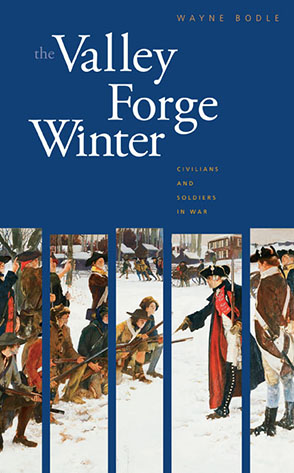
Of the many dramatic episodes of the American Revolution, perhaps none is more steeped in legend than the Valley Forge winter. Paintings show Continentals huddled around campfires and Washington kneeling in the frozen woods, praying for his army’s deliverance. To this day schoolchildren are taught that Valley Forge was the “turning point of the Revolution”—the event that transformed a ragged group of soldiers into a fighting army. But was Valley Forge really the “crucible of victory” it has come to represent in American history? Now, two hundred and twenty-five years later, Wayne Bodle has written the first comprehensive history of the winter encampment of 1777–78.
The traditional account portrays Valley Forge in the 1770s as a desolate wilderness far removed from civilian society. Washington’s army was forced to endure one of the coldest winters in memory with inadequate food and supplies, despite appeals to the Continental Congress. When the mild weather of spring finally arrived, the Prussian baron Friedrich von Steuben drilled the demoralized soldiers into a first-rate army that would go on to stunning victories at Monmouth and, eventually, at Yorktown.
Bodle presents a very different picture of Valley Forge—one that revises both popular and scholarly perceptions. Far from being set in a wilderness, the Continental Army’s quarters were deliberately located in a settled area. And although there was a provisions crisis, Washington overstated the case in order to secure additional support. (A shrewd man, Washington mostly succeeded at keeping his army supplied with food, clothing, and munitions. Farmers from the interior provided food that ensured that the army didn’t starve.) As for Steuben’s role in training the soldiers, Bodle argues that it was not the decisive factor others have seen in the army’s later victories.
The freshness of Bodle’s approach is that he offers a complete picture of events both inside and outside the camp boundaries. We see what happens when two armies descend on a diverse and divided community. Anything but stoically passive, the Continentals were effective agents on their own behalf and were actively engaged with their civilian hosts and British foes. The Valley Forge Winter is an example of the “new military history” at its best—a history that puts war back into its social context.
“This important study challenges most of the accepted views of Valley Forge.”
“Wayne Bodle’s The Valley Forge Winter is the first comprehensive study of the Continental Army’s most famous encampment, despite its prominence in Revolutionary War historiography and popular memory.
Overall, this is an important book that deserves a wide readership. Bodle addresses a rich array of social, political, military, and economic topics that greatly enhances our understanding of Valley Forge and the Revolutionary War.”
“[The Valley Forge Winter] is not a retelling of the quintessential American morality play of military virtue, stoicism, self-sacrifice, and eventual moral and battlefield triumph set against the backdrop of previous defeats and civilian neglect. Rather, it is a model study of war and society that argues convincingly for the Continental Army’s service ‘as a partial proxy for faltering civilian political legitimacy’ in Revolutionary Pennsylvania. . . . This book is a welcome contribution that should be considered seriously by scholars and interested readers.”
“An excellent book by a scholar who has written extensively on the Middle Colonies and served for some years on the staff of the National Park Service at Valley Forge. . . . Bodle rescues Washington and his comrades-in-arms by looking at Valley Forge in the context of a nine-month campaign that began with British General Sir William Howe’s invasion of Pennsylvania in the fall of 1777 and American reversals at Brandywine and Germantown. . . . As Wayne Bodle says, Valley Forge may offer fewer morality lessons for schoolchildren than previously believed, but it ‘forged a temporal—and especially a spatial—template for the rest of the war in the north.’”
“While iconoclastic in one sense, Valley Forge Winter actually makes Washington and the American army look better than does the conventional story of Valley Forge.”
“Wayne K. Bodle strips the Valley Forge account of many layers of legend to craft a carefully researched, well-written, and judiciously argued interpretation that places the Valley Forge experience in political, cultural, and military context.”
“The Valley Forge Winter is not a simple retelling of the oft-repeated story about the famous encampment of the Continental Army during the winter of 1777–1778. Author Wayne Bodle proposes that while it was a difficult experience to endure, the conditions were not nearly as bad as retained in our national memory. He does so with an interesting, informative and well-documented narrative that supports his thesis. Credit must be given to Bodle for a well-researched effort.
Valley Forge Winter may provide different explanations than what some readers may be aware of, but it is a well-crafted history in which the substance and conclusion of the story of the winter of 1777–1778 survives unscathed.”
“The book is a wordy and detailed analysis of the time and events of the period, and should prove worthwhile for readers who want a more accurate picture of the real lessons learned at Valley Forge.”
“What’s fresh about The Valley Forge Winter is the depth to which Bodle’s scholarship goes. It sets the stage both militarily and politically for the encampment, and through reminiscences by those who were there, recounts what really happened among the troops who were coached into shape by Von Steuben.
Bodle takes a look through the patriotic sheen that often blurs the Valley Forge experience. He cites what has become legend, explaining how (even then) the guys at the top saw the need to put spin on facts. Why Washington had to, or thought he had to, is worth knowing. And he didn’t even have a press secretary.
Development of Valley Forge into legendary status was needed to give a potential country something to hang its three-cornered hat on. As this study shows, the reality of citizen soldiers would have been enough.”
“Readers will develop a broader understanding reading The Valley Forge Winter: Civilians and Soldiers in War of life in this area during that winter. It will enhance libraries’ history area and give historians information as they do their own research. The lay historian will enjoy a well presented documentation of that famous winter. History classes in high schools and colleges will find this an outstanding resource for their students.”
“It is hard to say something new about the American Revolution. Wayne Bodle has done just that, turning the Valley Forge winter from myth into history, from legend into lived experience. History buffs will appreciate the fascinating narrative; social historians will admire the formidable research. Read it.”
“Americans, including their historians, think they know the story of Valley Forge. They are mistaken, but Wayne Bodle sets them straight in this highly readable, original, deeply researched and engaging book.”
“One of the best in-depth studies of an army in action that I have seen. Bodle expertly integrates all of the important aspects of war—supply, logistics, battle, interaction with civilians and with civil authorities—and is especially strong on the details of army organization and life in the camp as well as on guerrilla warfare. This is an extremely fine book, one that will appeal not only to scholars but also to anyone interested in the Revolutionary War.”
Wayne Bodle is Assistant Professor of History at Indiana University of Pennsylvania. His articles have appeared in numerous journals, including Pennsylvania History, the Pennsylvania Magazine of History and Biography, and the William and Mary Quarterly.
Contents
Introduction: The Myth and the Map
1. The Seat of War
2. The Campaign for Pennsylvania
3. Doing What We Can
4. Learning to Live With War
5. Starve, Dissolve, or Disperse
6. Trublesum Times for Us All, but Worse for the Solders
7. The Stone Which the Builders Have Rejected
8. The Lord’s Time to Work
9. The Chapter of Experiments
10. As the Fine Season Approaches
11. The Seated War
Notes
Bibliography
Index
Introduction: The Myth and the Map
“Why do people always talk about Valley Forge?” This question arose during a chat with an associate dean of arts and sciences a few years back. The dean, an astronomer, politely inquired about my research during a visit to his office in connection with my job candidacy. When he learned that it was on Valley Forge, he revealed that he had grown up near Morristown, New Jersey—the other great winter encampment site of the Continental Army. His parents still lived there, he confided, and people back home always wanted to know why Valley Forge gets all of the attention from the popular culture, when it was colder at Morristown, the snow was deeper, supply shortages were just as great, and Continental troops even mutinied there?” We both smiled at this paradox, and I admitted that there were no easy answers to his question.
I began studying Valley Forge on a planning project for the National Park Service in connection with that agency’s adoption of the site from the state of Pennsylvania in 1977. Our research team was charged to discover what “really happened” at Valley Forge, in order to allow agency officials to write non-intrusive development plans for the park and to create accurate interpretive programs. Despite the agency’s best intentions, the culturally-charged character of Valley Forge precipitated a few political explosions over what “what really happened?” really meant. A “Golden Fleece Award” nomination was floated by a local newspaper. A shrill protest resolution was passed by a national patriotic hereditary organization. A few angry letters arrived from anonymous taxpayers. Jealous allusions to “Watergate”-style analysis were inserted in an internal peer review document by agency insiders who had hoped to run the project themselves.
At the end of the project I had a much better understanding of how Valley Forge was mythologized than of why it was. Ironically, the “ragged Continentals” may have been the unintended victims of their own commander-in-chief’s political skill or rhetorical guile, because General Washington sometimes exaggerated their weak and vulnerable condition to pressure the Continental Congress into supplying them better. In truth, I told the dean, I would happily surrender all of the florid honorifics that have been fixed on Valley Forge—the “birthplace of an army,” the “crucible of victory,” the “darkest hour of the war,” or the “turning point of the Revolution”—to explore what happens when two armies descend on a diverse population in a divided community with complex and ambiguous historical experiences with war and peace?
Now, two hundred and twenty-five years after the event itself, this is the first comprehensive, book-length study of Valley Forge winter based on extensive research in primary sources beyond the published papers of a narrow circle of “national” political institutions and military leaders. It is not directly concerned with the “mythological” Valley Forge, but it is useful to acknowledge the continued existence of that myth. Who can deny the cultural power of soldiers’ bloody footprints in the snow, or of Washington praying in the frozen woods for his army’s deliverance? Two popular notions about Valley Forge, more abstract than those images, constrain our ability to understand the meaning of the event: the impression that the army spent the winter of 1777-1778 in the wilderness, far removed from civilian society, and that its engagement with both its civilian host society and its military adversary was more metaphorical than material in nature. The pictorial iconography of the encampment has consigned Valley Forge to a hazy place in American memory and resists its recovery by the recent turn toward “social history.” Most popular representations deny Valley Forge any “social” context at all, beyond that of ragged fellow soldiers in an undifferentiated corner of the snowy wilderness. Paintings show Continentals huddled around campfires or shivering in huts on what looks like otherwise-uninhabited terrain. Scarcely a barn, or a road-trace, or a hay wagon, or a corn row, or a domesticated animal, or even a fence line, hints that anyone else has ever lived there.
Early efforts to write the Revolution populated these desolate scenes with an austere human company, huddled in scenes of heroic passivity. In the popular literature of Valley Forge, the Continental Army serves as little more than a giant, gaunt Greek Chorus or a hapless prop in its own passion play. It arrives at Valley Forge “stumbling”over frozen, rutted roads, and then “huddles” there helplessly, before marching from the scene of its ordeal on the road to victory. According to Harry Emerson Wildes’s 1938 account, “the Revolution was won at Valley Forge.” A “defeated, dispirited and tattered array came here hungry, cold and broken,” he observed. “Washington led away the same men, drilled and disciplined into a confident army, in pride to victory.” In Alfred Hoyt Bill’s 1952 narrative, emaciated soldiers “stepped gingerly” over icy paths in the camp. By the next May, they could maneuver “with a speed and precision of which the brigades had been incapable two months before.” Donald Barr Chidsey’s troops hobbled into Valley Forge a “rabble of uncertain, lousy, sick, bleeding men.” Six months later they marched away “with a swinging step, drums beating, fifes loud [and] ready to fight.”
In between these stark poles of capacity and incapacity, Wildes’s “ragged barefoot volunteers huddled helplessly about their smoking green-wood fires.” Chidsey’s “shivering, sick, and red-eyed” troops “clung to that stump-studded hillside.” To judge from this awkward mixture of artistic and literary conventions, American soldiers overcame a deadly combination of climatic hardship and abstract social adversity. The armies were engaged with each other more in an allegorical than a military sense; the one comfortably lodged in Philadelphia while the other shivered in the wilderness. Nor have civilians played compelling roles in these stories, other than as stock figures: the pacifist Quaker farmer; the Tory collaborator; or Washington’s oblivious politicians, writing hypocritical letters “by a good fireside” while his troops suffered.
Such perceptions are reinforced by two providential mechanisms for the army’s deliverance. The supposed arrival in the Schuylkill River in early 1778 of huge schools of American shad offered a secular “bread and fishes” metaphor to end a famine. Then, according to most accounts, a Prussian drillmaster, Friedrich Wilhelm von Steuben, came and forged a “horde” of men into “a real army,” or “created a spirited army out of [a] ragged and demoralized mob.”
Academic historians, of course, have complicated and moderated this florid imagery. Long before there was a “new military history,” they began to recover the colonial contribution to British eighteenth century imperial wars. Today, scholars are more likely to emphasize British difficulties in projecting armed force over a three thousand mile-long supply line, or the advantages accruing to the rebels from terrain and manpower reserves, than to divide American fighters into polar caricatures of “ragged hordes” and “backwoods marksmen” hiding to shoot from behind trees. Historians such as John R. Alden, Howard H. Peckham, Piers Mackesy, and Don Higginbotham, have challenged the providential transformation myth of the Continental Army’s development. Peckham—with specific reference to Valley Forge—has bluntly rejected the ferrous analogy of “forging a stronger army [by] applying heat to metal to harden it.”
Most of these caveats, however, are scattered in articles and book chapters devoted to broader issues. They have not commanded sustained attention within the professional or academic historical communities, or any deference in the popular culture. Indeed, the closer that professional scholars work to iconic elements of the Revolution, the likelier they have been to defer subtly to some of them. Robert Middlekauf’s widely-used synthesis of the Revolution, The Glorious Cause, for example, gives a respectful, or even an admiring, account of the Continental army’s performance during the 1777 Pennsylvania campaign, but then he defers to the old pictorial cliche by concluding that Washington selected Valley Forge for its winter quarters because, in part, “it was remote from settled areas” and “out of the way of civilians.” Middlekauf quotes Dr. Albigence Waldo’s Valley Forge diary—one of two classic texts fixing the army’s reputation as a crumbling horde—without noting that it was illustrated by a map showing that Valley Forge was located in the middle of a densely-settled commercial farmscape.
Similarly, Don Higginbotham, a dean of modern Revolutionary military history, paints an army that was merely “touchy” in late 1777, rather than incipiently mutinous. But as they “huddled in tents and drafty huts beyond the Schuylkill,” he says, the soldiers confronted an “atmosphere” that was “marked by inaction, hunger, cold, and the absence of every necessity.” John. R. Alden acknowledges the resiliency of the American army in the 1777 campaign, but he then veers into romantic allegory by placing its members in “the Gethsemane of Valley Forge.” Piers Mackesy notes that General Howe’s troops “spent the winter comfortably in Philadelphia,” while their adversaries watched them in mere “discomfort” at Valley Forge. But then he adopts conventional imagery imposing a fortuitous passivity on the rebels. “The Americans suffered in their hutments through the harsh winter,” he observes, saved mainly by Howe’s indolence.
Barbara MacDonald Powell, a careful student of Valley Forge imagery, has conceded that the “romantic haze surrounding the winter of 1777-78 will not likely be dispelled by any new historical research pointing out the ‘real facts’ of the encampment.” That may not be a bad thing. Any event protean enough to inspire both a conservative “Freedoms Foundation” and Mao Zedong is probably doing cultural work important enough not to be cavalierly disturbed. This book, however, meets Valley Forge on its own terms and literally on its own ground. Far from being set in a wilderness, the Continental Army’s quarters were deliberately located in a settled area. Anything but the stoically-passive recipients of deprivation and then deliverance, its members were effective agents in their own behalf. In 1777 they learned to perform one mission—conventional combat operations—that is the usual province of soldiers, better than has been appreciated. During the next winter they adapted to another set of functions—serving as a partial proxy for faltering civilian political legitimacy—that armies have since come to dread, with grace and resilience. The army’s relationships to its civilian host society and its British foe—rather than being literary or allegorical—were intimate, material, complex, and fluid.
* * *
One way to retrieve Valley Forge from “mythscape” into social space is to begin on the ground, at the juncture of the Valley Creek and the Schuylkill River in 1777, and to survey the surrounding region in geographical, economic, and demographic terms. Even scholars who do not describe the camp as being in a remote wilderness sometimes imply that it was in a barren area that could barely have sustained a combined civilian and military population in a good year.
This assumption confronts a generation of scholarship depicting southeastern Pennsylvania as an important granary of the Atlantic world. The forge for which the settlement was named was an outlier of a broad band of ironworks extending from the Hudson to the Potomac Rivers. The complex of furnaces, forges, and iron processing facilities on the upper Schuylkill River, was critical to the American war effort. The British threat to them affected Continental tactics in 1777, and the need to protect them contributed to the British ability to capture Philadelphia.
Valley Creek flowed north toward the Schuylkill River between two hills, Mount Joy and Mount Misery, draining a long and fertile floodplain known locally as “the Chester Valley.” Charlestown and Tredyffrin Townships, on whose border Valley Forge was situated—along with Merion Township in Philadelphia County—formed a fan-shaped apron of land sloping gently southeast from the Schuylkill. Below the high ridges along these streams, Chester County was divided into wheat-and-cattle farms averaging about 130 acres each, and owned mostly by English and English-speaking Welsh Quakers. Some Germans, belonging to the Reformed or the Lutheran churches or to one of several “pietistic” sects, lived among the English population, but Germans were more common in northern Chester County. Chester had at least 30,000 residents in 1777, and its population density was almost fifty persons per square mile.
Much of the county was covered by highly-fertile “limestone” soils, and its gentle slopes encouraged commercial farming. A generation before the Revolution, middling farmers in southeastern Pennsylvania sold between a third and half of their crops yearly. By the early 1770s, Delaware Valley merchants were sending vast shipments of wheat, flour, and breadstuffs into the Atlantic market, and dominating the cereals trade with the Mediterranean world and the British West Indies. Farm sizes in the county fell through the eighteenth century as the spread of population from Philadelphia drove up the price of farmland. By about 1760, however, area farms had reached their minimum efficient size for commercial grain production, and local inheritance, migration, and other cultural practices began changing to conform to this reality.
Owners of smaller tracts within a half day’s travel to the city turned to the intensive production of perishable foodstuffs for urban dwellers. A zone extending twenty miles west from Philadelphia sustained a “truck” farming regime for the production of milk, cheese, butter, eggs, poultry, orchard and garden crops, and hay. Farm families brought wagonloads of goods to the city twice weekly for sale on regulated markets. When the Continental Army tried in early 1778 to disrupt traffic to these markets, it turned a long-established pillar of rural prosperity in the region into a deadly contest. The region between Valley Forge and Philadelphia was also the center of a grist milling industry. By 1777, dozens of scattered “country” mills were grinding wheat for domestic consumption, while a smaller number of “merchant” mills produced finer flours for the Atlantic export market. When war descended on the locality, these sites were critical resources in the struggle between two armies and the civilian community for subsistence, and their preservation or control became matters of great military importance. Although livestock were raised on all Delaware Valley farms, their meat was mostly produced for local consumption. Some surpluses were sent to the Philadelphia market, but Pennsylvania was not as critical an exporter of beef or pork to the West Indies as it was for grain and bread. Women on farms in the Brandywine Valley and in the townships along the Delaware River made butter for sale in Philadelphia and for shipment to the Caribbean. Cattle were driven to the area from the Chesapeake and New England for fattening on the river meadows along the Delaware.
In late-colonial America, land near the Atlantic coast began to fill up, land prices rose, and some young people and immigrants either moved west or into seaport cities. Each region was affected differently by this phenomenon, depending on its geographical conditions, cultural characteristics, and relationships to the Atlantic economy. Inter-regional comparisons are difficult, but the Delaware Valley negotiated this transition in ways that sustained its reputation as “the best poor man’s country in the world.” In Chester County, between a third and a half of the adult male residents on the 1774 tax lists disappeared from their townships before 1785.
Southeastern Pennsylvania became “a distributing center [for migrants] to the south and west.” But while population growth fell from five percent a year in the 1750s to less than two percent by the 1760s, population densities continued to rise, and “more persons stayed home or moved only within Pennsylvania than moved out of the province.” To remain at home exacted a real cost in terms of economic adjustment and social stratification. Smaller numbers of people controlled increasingly large shares of the area’s total wealth. Contrary to traditional assumptions about the virtual universality of the “yeoman freeholder,” Pennsylvania was home to growing numbers of landless residents in the eighteenth century. As early as 1753, about 28 percent of the farmers in Marple Township in Chester County rented their land. A leading student of this phenomenon describes tenancy as a “strategy” that let the heads of families productively “bank” temporarily unused tracts that were reserved for the inheritance of children, while giving men who could not otherwise afford productive land access to Atlantic markets. The percentage of rural tenants in Chester actually began to decline between 1766 and 1774.
As rural tenancy began to decay in Southeastern Pennsylvania, another economic regime emerged to address both the land and labor crises. Landed farmers whose children were not old enough to work, but who had seasonal labor needs because of the commercial wheat economy, rented dwellings and small pieces of land to“cottagers”—landless workers who practiced a mix of agricultural and craft occupations. The latter negotiated annual leases that gave them modest housing and garden plots. The laborers agreed to perform specified amounts of agricultural day work, at the discretion of the owners, for customary wages. This system gave landowners a flexible labor force for the planting and harvest seasons, while allowing cottagers to work on their own plots and to trade their craft skills on the local labor market. The system emerged by the 1750s, and it facilitated the growth of farms early in the family life cycle while fueling the region’s participation in the Atlantic grain trade. For cottagers, it held few hopes of land ownership, and it meant frequent renegotiation of leases or relocation. But it checked the migration of workers from the region, and it may have retarded the growth of a discontented rural proletariat, and thus slowed the velocity of revolutionary mobilization in Pennsylvania.
Upper Philadelphia County, across the Schuylkill River from Valley Forge, north to the Berks County line, was hillier and less fertile than Chester. The county had about 55,000 residents in 1777, almost twenty-thousand of them living in the city of Philadelphia. Thousands more lived in crowded suburbs on the “neck” between the Delaware and Schuylkill Rivers.
Population in the upper parts of the county, above the Perkiomen Creek, was more German and less Quaker than that of rural Chester County. Below the Perkiomen, the urban and export markets drove the local economy, as it did in Chester. A historian of Bucks County on the eve of the Revolution calls it “one of the most English, most Quaker, most rural, and most politically stable counties in Pennsylvania.” Its population was between 18,000 and 20,000 persons in 1777, living on on farms averaging about the same 130 acres that prevailed in Chester. Quakers dominated the lower half of the county. Coryell’s Ferry was the northern portal to the region, through which most of the Continental Army entered Pennsylvania in the summer of 1777, and by which it left the area a year later. In the upper townships there were many German and Dutch settlers and churches. Farmers practiced wheat-and-mixed-farming culture like that prevailing in Chester. Those near the city carried garden and dairy goods to town, and when the war came to Pennsylvania, they intensified their efforts to defend this practice. This effort threw the local population into often violent conflict with the radical state government.
Western New Jersey had rich loamy soils carved by tributary creeks and wetlands along the Delaware River. Its farmers enjoyed modest self-sufficiency, while sending surpluses of wheat, corn, and meat to urban markets. In 1772, the counties opposite Philadelphia (Burlington, Gloucester, and Salem), had fewer than the 30,000 residents living in Chester County alone, concentrated near the Delaware. The population was mostly Quaker in Burlington County, but it shaded from north to south into a mix of English, Swedish, and Dutch settlers. Across the Delaware River from Salem County, lay New Castle, one of the “Three Lower Counties on the Delaware.” These counties shared a proprietary governor with Pennsylvania, but “Delaware” had its own legislature after 1701. Settled by a non-Quaker English population mixed with Swedes, Delaware was pulled into Philadelphia’s economic orbit by 1776.
The three northern counties on Maryland’s “Eastern Shore” were also part of the “seat of war.” By 1770, local planters had all but ceased growing tobacco and become part of “a vast wheat belt... in the northern Chesapeake, stretching from Kent County on the Eastern Shore through Cecil at the head of the bay across Baltimore [to] Frederick County.” At the northernmost navigable point on the Chesapeake Bay lay the village of “Head of Elk,” which provided the southern portal through which the British Army entered the Delaware Valley. One historian notes that the route between that town and Philadelphia “reminded more than one visitor of the public roads leading to London.” In 1777, British officers desperately wanted to see the corridor in those terms, although one later recalled it as a gateway to “the strangest country in the world.”
Strange or not, we can return by this path to Pennsylvania for a few final observations about the region. The rapid growth of Philadelphia after 1681 suppressed the growth of intermediate urban places within thirty miles of that city, but between 1730 and 1765, town planting resumed in the interior. The creation of Lancaster in 1730 was followed by the rise of York in 1741, Reading in 1748, and Easton in 1752. The planting of Allentown in 174?, and Bethlehem in 1741, were part of this wave of urbanization. These towns ran in a line from northeast to southwest, at twenty to thirty mile intervals, anchoring a tier of interior counties. Berks and Northampton County farmers practiced mixed farming less intensively than those near Philadelphia. The population of each county was about eighty percent German, with many Moravian pacifists settled around Bethlehem. Berks had almost 23,000 inhabitants in 1779, while about 10,000 people lived in Northampton below the Blue Mountains. Reading housed a major Continental supply base. The Lehigh Valley was far enough from the active arena of combat to shelter civilian evacuees of Philadelphia in 1776, sick American troops in 1777-1778, and even the Liberty Bell, but Whig control was precarious enough that the radical state government kept power in the area only by the use of force.
Lancaster County was a larger version of Chester, with a population of 35,000 in 1779. It had more German and Scots-Irish settlers, visible pockets of Mennonites, and fewer English-speaking Quakers than Chester. It contained even more limestone soils than Chester and its agricultural surpluses were thus somewhat larger. Farms were slightly larger than in Chester while settlement densities were lower. About thirty percent of the adult male population was landless by the 1770s and tenancy was common. York County was a newly-settled frontier offering land to immigrants who found the eastern counties filling up. Its 1779 population was fifty percent German and thirty percent Scots Irish, with smaller pockets of English settlers. Local soils were less rich than the best parts of Lancaster and Chester, and the three-day trip to Philadelphia limited access to the Atlantic marketplace and generally isolated the county.
* * *
Having mapped the “mythscape” of Valley Forge, and the terrain on which the episode occurred, it remains to populate the stage with soldiers and to sketch the design of the book. Chapter One begins a year before the Continental Army came to Valley Forge, with the collapse of American military resistance in 1776 and the threatened British invasion of Pennsylvania.
It puts civilians on the stage first, and shows them interacting with soldiers long before any armies arrived in their midst. The visceral panic that seized the Philadelphia region as the American army retreated across New Jersey was not simply a “natural” reaction; how any civilians would rationally have behaved in similar circumstances. Rather, it was an expression of the continued impact of Quaker culture on a plural society in which the Friends had long since become a demographic minority in their own colony while continuing to hold power there. Chapter Two narrates the campaign for Pennsylvania in 1777. Contrary to common belief, it is doubtful that even a small “core” of veterans stayed in the field after the surprise American Christmas victory at Trenton, as a foundation on which a new army could be built. Rather than preventing the “dissolution” of the army, Trenton delayed that event and shifted it to central New Jersey, where Washington could manage it more discretely. While raw new recruits trickled toward Morristown in early 1777, he had to conduct a charade of militias to “keep up the appearances” of still having an army. These new troops fought ably in 1777. They escaped from the jaws of destruction into which Washington’s planning placed them at Brandywine in September, and made the best of his ambitious strategy for them at Germantown a month later. After Germantown, their officers expected more battles in which they hoped to prevail. They were shocked in October when the army was immobilized by the collapse of its supply departments. That collapse was precipitated by organizational changes in those departments that Congress had made in 1777, but many soldiers attributed it to the indifference of Pennsylvania civilians to their welfare. In November, the army’s ranks swelled with troops coming south from the victorious campaign against General Burgoyne at Saratoga. Inevitable rivalries between New Englanders who dominated the northern regiments and the Middle Atlantic and southern soldiers of the “Main Army” over their relative battlefield performances were quickly aggravated by the Yankees’ fears that they now faced starvation in a biblical land of Goshen.
Chapter Three reconstructs the decision in late 1777 for the army to go to Valley Forge.
That decision was a compromise between the army’s military needs and the political interests of Continental and especially Pennsylvania leaders. It deflected the army from a deployment in interior towns that enjoyed support from a narrow majority of the Continental generals and Washington’s approval. The compromise put the army into the position of serving as a proxy for the police functions of civil government. In exchange, Washington insisted on state material support during the winter, and a willingness by Congress to consider extensive military reforms.
Chapter Four examines the Pennsylvania campaign through the eyes of civilians. War was a “learning” experience for civilians, and Pennsylvanians—as the heirs of Quaker culture—had more to learn about it than did most Americans. Civilian responses to the invasion of 1777 were less intense or panicked than they had been to the phantom invasion scare the year before. Having learned that flight was not an effective measure, civilians tried other survival strategies. While they moved prudently from the path of the contending armies, curiosity and resignation kept them from headlong flight. The absorption into civilians’ vocabularies of military jargon suggests their accommodation to war. The understandings of military culture that they forged constituted of a “half-knowledge” that led them into both imprudent and effective behaviors.
Chapter Five accompanies the Continental Army from Whitemarsh to Valley Forge and examines its first weeks in the new camp. This period produced one of two demonstrably grave supply crises during the winter. General Washington openly questioned whether his force could be kept from mutiny or dissolution. While not questioning the severity of the hardships that the American troops faced, this chapter treats the crisis in the context of the compromises discussed above. Washington was provoked to the rhetoric of “dissolution” by his fear that politicians would renege on the conditions that he understood to have been attached to the decision to keep the army in the field. He used a misunderstanding with the civilian leaders of Pennsylvania’s government, the undeniable shortage of supplies to feed the army, and a limited expedition from the city by a large body of British troops, to reassert his own understanding of that agreement.
Chapters Six, Eight, Nine, and Ten divide the winter of 1777-1778 into one or two-month intervals. Each begins by considering conditions at Valley Forge, treating the military situation, relations between the Continental Congress and the army, and questions about army morale, health, and military readiness. Each chapter then swings around the army’s “crescent-shaped” winter deployment, beginning with its southern anchor on the Delaware River at Wilmington. The Schuylkill River divided the Pennsylvania countryside into two zones. The army took responsibility for the west side, where its immediate security interests lay. The state agreed to keep one thousand militia troops on the east side of the river. This arrangement faltered almost from the start. The most valuable evidence of civil-military interactions appeared along this axis. Each chapter also examines the army’s northern “anchor” on the Delaware at Trenton, and surveys the war in New Jersey, from Burlington County in the north to Salem in the south.
Chapter Seven considers the visit to Valley Forge by a committee of the Continental Congress in February of 1778 to discuss with Washington fundamental military reforms. The committee’s charge from Congress was broad and nonspecific, reflecting divisions within that body over military policy at this difficult period. The outbreak at camp in mid-February of 1778 of the worst supply crisis of the winter coincided with the Committee’s visit. It allowed a critical mass of civilian leaders to see how vulnerable the “new” army could be to logistical disruption, owing to its size, its organizational complexity, and its increasing mobility. This coincidence sustained Washington’s effort to achieve organizational reforms. Congress’s approval of those reforms thwarted a competing reform plan that that body contemplated, one that would have given much day-to-day military authority to Washington’s rival, Horatio Gates. This previously-obscure bureaucratic struggle, rather than the celebrated “Conway Cabal,” was the main source of intramural political conflict within the military establishment in 1777-1778.
Chapter Eleven follows the Continental Army from Valley Forge into New Jersey in June of 1778 in pursuit of the evacuating British Army. It questions whether the Battle of Monmouth on June 28 was decisive enough to prove the transformative effects of Friedrich Steuben’s work with the Continental army. While the broad utility of that work is acknowledged, the army never did enough fighting in the north after June of 1778 to test Steuben’s efforts on the battlefield. Their effect, rather, was to give soldiers a deeper identification with and pride in their craft, and thus to make them better able to withstand the rigors of military routine, rather than the terrors of the British bayonet charge. This was appropriate, because Washington’s use of the army in the north for the rest of the war was a loosely-adapted version of its deployment in Pennsylvania.
Mailing List
Subscribe to our mailing list and be notified about new titles, journals and catalogs.