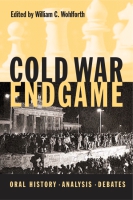




Cold War Endgame
Oral History, Analysis, Debates
Edited by William C. Wohlforth
“This is a first-rate book for anyone interested in the Cold War and international relations theory. William Wohlforth has done an excellent job of compiling and annotating transcripts from an oral history conference that brought together former Soviet and American officials, and he has carefully integrated the transcripts with substantive chapters by well-regarded authors, making a cohesive whole. The book sheds valuable light not only on the end of the Cold War, but on key theoretical issues in the field of international relations.”
- Description
- Reviews
- Bio
- Table of Contents
- Sample Chapters
- Subjects
Taking this testimony as a common reference and drawing on the most recent evidence available, six chapters follow in which historians and political scientists explore the historical and theoretical puzzles presented by this extraordinary transition. This discussion features a debate over the relative importance of ideas, personality, and economic pressures in explaining the Cold War's end.
“This is a first-rate book for anyone interested in the Cold War and international relations theory. William Wohlforth has done an excellent job of compiling and annotating transcripts from an oral history conference that brought together former Soviet and American officials, and he has carefully integrated the transcripts with substantive chapters by well-regarded authors, making a cohesive whole. The book sheds valuable light not only on the end of the Cold War, but on key theoretical issues in the field of international relations.”
“The editor has done a superb job of assembling this collection of oral history transcripts and analytical articles. The result is an indispensable resource for the study of the last two years of the Cold War.”
“Cold War Endgame: Oral History, Analysis, Debates is a fine marriage of diplomatic recollection and theoretical analysis of a momentous three years. William Wohlforth’s book will be advantageous in seminars on Soviet-American relations, the end of the Cold War, and international relations theory.
A terse summary cannot do justice to the richness of either diplomatic or scholarly argument. This good read will energize many a historical and theoretical discussion.”
“It is rare to have a volume that integrates pure primary sources along with scholarly analysis, and much of the pleasure in Cold War Endgame comes from jumping between the participant’s discussions and the analysis that follows. Much more will be written about this period of foreign policy history, but it is likely that Cold War Endgame will provide the foundation for these works.”
“This is a first-rate book for anyone interested in the Cold War and international relations theory.”
“That said, the book has much to commend it, especially for courses focusing on US-Soviet interactions, or on the relevance of various approaches to international politics for an understanding of Cold War dynamics.”
William C. Wohlforth is Associate Professor of Government at Dartmouth. He is the editor of Witnesses to the End of the Cold War (1996) and author of The Elusive Balance: Power and Perceptions During the Cold War (1993).
Contents
Acknowledgments
Introduction / William C. Wohlforth
Part I: Oral History: The Princeton Conference
1. Forging a New Relationship
2. German Unification
3. The Persian Gulf War
4. The Collapse of the Soviet Union
Part II: Analysis
5. Once Burned, Twice Shy? The Pause of 1989
Derek Chollet and James M. Goldgeier
6. Trust Busting Out all Over: The Soviet Side of German Unification
Andrew O. Bennett
Part III: Debates
7. Gorbachev and the End of the Cold War: Different Perspectives on the Historical Personality
Vladislav Zubok
8. The Road(s) Not Taken: Causality and Contingency in Analysis of the Cold War’s End
Robert D. English
9. Economic Constraints and the End of the Cold War
Stephen G. Brooks and William C. Wohlforth
Conclusion
10. Failure or Learning Opportunity? The End of the Cold War, International Relations Theory, and Lessons for Foreign Policy
Joseph Lepgold
List of Participants and Contributors
Index
Introduction
William C. Wohlforth
As the Cold War recedes into memory it is all too easy to forget how potentially apocalyptic it was. For 45 years the two superpowers faced each other across the globe, each dreading the consequences of ceding dominance to the other. To forestall that outcome, each devoted colossal resources to defense—5 to 14 percent of the economy for the Americans, 15 to more than 25 percent for the Soviets—and maintained a deterrence posture that eventually entailed the acquisition of massive nuclear arsenals jointly totaling over 50,000 warheads. Deterrence amidst such an intense rivalry put a premium on the credibility of their commitments, and largely to defend their reputation for resolve U.S. and Soviet leaders periodically undertook policies that ran the risk of escalating to global thermonuclear war, most notably over Cuba.
It staggers the imagination that a conflict that could have ended civilized life on the planet rapidly drew to a close in the three years leading up to the implosion of the Soviet Union in December 1991. How that transpired is partly a result of large-scale tectonic changes in world politics, but it is also very much a human story of leaders engaged in the responsible pursuit of conflict resolution. How did top decision-makers negotiate an end to the Cold War? Why were they able to do it peacefully? What lessons does the experience provide for dealing with other dangerous rivalries? This book is a collaborative effort between scholars and policymakers to answer these questions. Its purpose is to illuminate our understanding of the ending of the U.S.-Soviet rivalry, and also to contribute to the important dialogue between scholarship and foreign policy practice.
Part I presents the record of a critical oral history conference featuring two days of fascinating discussions by former Soviet and American officials of how they managed the tumultuous diplomacy of 1989–91, including German unification, the Persian Gulf War, and the collapse of the Soviet Union. Using the conference transcripts as well as the latest archival and memoir evidence, each of the six scholarly chapters that follow tackles a different aspect of the relation between theory, policy and the Cold War’s end. Part II considers a series of unresolved theoretical and empirical puzzles presented by the events of 1989–91, and Part III presents a debate over the causes of the end of the Cold War. In the concluding chapter, Joseph Lepgold offers a framework for addressing these central questions. While his answers may not persuade all readers, they provide a productive way to summarize and incorporate the new evidence and debates presented in this volume. In the remainder of this introduction, I foreshadow the contents of the chapters that follow.
<1> When did the Cold War Begin to End?
There are as many answers to the question of when to date the Cold War’s end as there are definitions of the Cold War itself. A fully satisfactory explanation for the end of the Cold War would have to deal in depth with the years leading up to the period this book calls the Endgame. The decision to focus on the years between 1988 and 1992 was partly pragmatic: an earlier conference and edited volume dealt with the Reagan-Gorbachev period, which in crucial ways laid the groundwork for the ending of the Cold War. But there are sound historical reasons to study this specific three-year period. The preponderance of participants and scholars concur that the international epoch they knew as the Cold War came to an unambiguous end sometime between December 1988 and December 1991. In designating this period as the Endgame, the contributors to this volume do not mean to imply that the precise nature of the Cold War’s end was foreordained. The oral history and analysis that follows amply demonstrate that decision makers did not know how the Cold War would end, and in particular that it would end so swiftly and peacefully. Nor was there agreement on who the victor would be—or even whether there would be a clear victor.
By "Endgame" we simply mean the period in which policymakers were progressively becoming aware that the superpower rivalry and the bipolar order they had known for a generation were coming to an end. Thus, the analogy to chess is accurate in at least two senses. The endgame was a distinct phase of the Cold War when the termination or fundamental alteration of the rivalry began to seem to many to be within grasp, although the precise moment when it began was arguable at the time and in retrospect. And, though shorter than the opening and middle game of the Cold War, it was just as important. For many participants in the conference and scholarly contributors, the analogy works in a third sense as well; namely, that in the endgame the normal way of assessing the value of pieces may be highly misleading. A pawn may suddenly be more powerful than a rook. By the end of 1988 Mikhail Gorbachev and close advisors like Anatoly Chernyaev were hoping to translate what by some traditional measures was beginning to look like a weak position into a big win for the Soviet Union and, they would stress, for the world as a whole.
To capture the moment when the action in this book begins, consider the December 27–28, 1988, meeting of the Politburo of the Central Committee of the Communist Party of the Soviet Union. Item No. 1 on the agenda was a discussion of Gorbachev’s historic December 7th speech to the United Nations General Assembly in which he stressed that universal human values took precedence over the class struggle and affirmed the freedom of all countries to choose their own destinies, thus implicitly revoking the "Brezhnev Doctrine" that Moscow had a right to intervene to preserve allied regimes in Central Europe. The speech followed a turnaround in U.S.-Soviet relations over the preceding two years: negotiations were proceeding on arms control, regional conflicts, and human rights. In December 1987, Gorbachev and U.S. President Ronald Reagan had signed the Intermediate-Range Nuclear Forces [INF] Treaty, the first Cold War arms agreement that actually reduced (albeit by only 4%) rather than merely limited the growth of the two sides’ arsenals. But the changes in superpower relations were still mainly intangible: the intellectual ferment prompted by Gorbachev’s new political thinking on the Soviet side, a marked softening of the Reagan administration’s anti-Soviet rhetoric, and a burgeoning relationship of collegial trust between the highest-level officials of the two governments.
The transcript of the Politburo’s session captures a crucial moment in the Cold War’s ending when major change was clearly afoot but its precise direction remained deeply uncertain. Gorbachev clearly wanted to go much farther than the deep détente he and Reagan had attained. He stressed to his Politburo comrades that the goal was to undermine the "foundation of the ‘Cold War,’" and to "build a new world." To do that, it was necessary to "pull the rug from under the feet of those who have been prattling . . . that the new political thinking is just about words." At the United Nations, he announced major unilateral reductions in Soviet tanks and troops in Europe and Asia. Would this do the trick? Before his colleagues, Gorbachev remained cautious. The problem was that many in the United States and Europe saw Soviet concessions as the result of increased western power and the "crisis in socialism and communism." They wanted to stick to their hard line and pick up more Soviet concessions. Gorbachev noted that President-elect George Bush and many members of his team appeared attracted to this approach. Further concessions might simply play into their hands. At the same time, the Americans were worried that Soviet initiatives would continue to dominate the international agenda; "they are still concerned lest they might be on the losing side." The U.N. speech had burnished Gorbachev’s already stellar status as the world’s most visionary statesman. Continuing the current policy course might produce a real breakthrough in the relationship by pressuring or convincing western policy-makers of the need for major change. On balance, Gorbachev concluded that it was necessary to carry on with the new approach. "We cannot allow the future [Bush] administration to take a protracted time out and slow down the tempo of our political offensive."
As the conference transcripts and other sources confirm, Gorbachev’s assessment was right. Many officials in the United States and its allied governments were convinced that Gorbachev was driving the global agenda with his innovative policies. They believed that some response was necessary to regain the initiative. If the west responded in kind, Gorbachev hoped, a "tit for tat" dismantling of the Cold War would ensue that would leave all parties—and especially the Soviet Union—much better off. A high-stakes play was underway designed to change the rules of the Cold War game. And competitive impulses (Gorbachev’s fellow reformer Aleksandr Yakovlev spoke at the same Politburo meeting of "pulling the carpet out from under the feet of the [U.S.] military-industrial complex") still mingled with visionary hopes for mutual understanding and cooperation. In hindsight, what stands out about the close of 1988 are the mounting challenges to Gorbachev and the Soviet Union—from the economy, hardliners, and the rising independence movements in East-Central Europe and many of the Soviet republics. At the time, these were balanced by Gorbachev’s spectacular success on the world stage and the hope of domestic renewal inspired by his reforms. As the new Bush administration took office in January 1989, it was still unclear whether the Soviet Union’s international successes would outpace its growing internal and imperial failures, and how the unfolding drama would affect the U.S. role in Europe and the world.
This book represents a joint effort by scholars and policymakers to understand how the uncertainty and contingency that characterized the end of 1988 was resolved over the course of the following three years. Given the diverse backgrounds and perspectives of the participants in this project, as well as the extraordinarily complex and controversial nature of the Cold War’s Endgame, it will come as no surprise that the pages that follow contain more than their share of debates—among practitioners, between practitioners and scholars, and most notably among the scholars themselves. Some debates are the kinds that are generated by any major event—for example, the role of deep economic and social causes as opposed to specific policy choices, personalities, and contingency. Others are specific to the case—such as whether the United States missed opportunities to engage Mikhail Gorbachev earlier in 1989 or stuck with him too long in 1991, or whether Gorbachev missed opportunities to salvage better terms for Moscow during the diplomacy of German unification. Such debates are inevitable and necessary for sharpening our understanding of the end of the Cold War and its implications for general theories of international relations and foreign policy.
Notwithstanding its diversity, this book is unified by four crucial concerns. First is a commitment on the part of all the conference participants and the scholarly contributors to getting the story right—a goal that is advanced measurably by the use of the conference discussions in conjunction with other sources. Second, the chapter authors all share a commitment to the empirical testing of theoretical or policy arguments and a conviction that the end of the Cold War is an event that is unusually instructive for that purpose. Third, the chapter authors all locate their arguments at the level of "middle-range theory" rather than the "grand theories" such as realism, liberalism and constructivism that have framed the scholarly debate thus far. By so doing, they avoid much of the "talking past each other" (i.e., use of incommensurate language and evidentiary standards) that has characterized the academic debate over the Cold War’s end. And, fourth, the debates in the chapters that follow all revolve around the relationship between large-scale tectonic changes, on the one hand, and specific circumstances, perceptions and choices, on the other. In particular, the book is animated by two central questions: What role did personality, interpersonal interactions and the evolution of trust among individual policymakers play in explaining the peaceful end of the Cold War? And how do we evaluate the influence of these factors in a context characterized by powerful domestic and international constraints?
<1> Part I: Oral History: The Princeton Conference
On 29–30 March 1996, Princeton University’s Woodrow Wilson School, in cooperation with the Baker Institute for Public Policy at Rice University, hosted nine former high officials of the U.S. and Soviet governments who played critical roles in the tumultuous diplomacy of the Cold War’s end. Led by former U.S. Secretary of State James A. Baker III and former Soviet Foreign Minister Alexander Bessmertnykh, the conferees spent two days analyzing and reliving the major events affecting world politics from 1989 to 1992: the forging of a new political relationship between the incoming Bush administration and the Gorbachev team in the winter and spring of 1989; the collapse of Communism in Europe in the fall of that year; the new relationship that developed between Bush and Gorbachev at the shipboard summit in Malta in December; the genesis and management of the "two-plus-four" talks on Germany in early 1990; collaboration between the superpowers against Iraq’s occupation of Kuwait, which was cemented by the two leaders at the Helsinki summit in September 1990; and the dramatic domestic developments in the Soviet Union that culminated in the August 1991 coup and the collapse of the Soviet state four months later.
One of the major dividends of an oral history conference is to recreate the intellectual atmosphere that characterized a major event while participants are still able and willing to do so. The format of the Princeton conference, with the two teams of policy veterans seated at tables and able to react to each other, encouraged such recollections. It allowed spontaneous interactions that mirrored what had occurred years before across numerous negotiating tables. The conference, whose sprit is well captured in the transcripts reprinted in chapters 1–4 thus added to our historical knowledge and provided a powerful antidote to the hindsight bias of post hoc, ergo propter hoc.
The discussions were extraordinarily frank. While many of these policy veterans have written memoirs, at the conference they were able to argue with each other, prod each other’s memories, compare recollections, and debate policy options and possible "missed opportunities" as they relived some of the most important years of their careers. The conferees discussed both domestic politics and grand strategy; they debated underlying causes of events as well as the details of statecraft; they recalled specific meetings and decisions as well as the general perceptions that underlay decision making on both sides
Chapter 1 presents the first roundtable discussion, which opened with remarks by James Baker and Anatoly Chernyaev on the causes of the Cold War’s end and the Soviet collapse that frame the subsequent sessions. The first session examines the recasting of the US-Soviet relationship after the new Bush Administration’s inauguration and Gorbachev’s acceleration of reforms in Soviet domestic and foreign policy. It illustrates both the perceptual gap between the two sides that still existed in this period and the complex relationship between international interactions and domestic coalitions. The fundamental question that underlies the discussion is, why were the Americans so much more uncertain of Soviet intentions than vice versa? The perceptual gap and the complex links between domestic and foreign policy are dramatically illustrated by the two sides’ different reactions to Gorbachev’s offer of a "third zero" on short-range nuclear forces, which he conveyed the offer to Baker during the secretary of state’s visit to Moscow in May 1989. The former Soviet officials insisted that this offer was not intended to sow discord in the NATO alliance, while the Americans assumed that is was precisely such a classic Cold-War ploy.
The collapse of communism in Eastern Europe and the reunification of Germany are discussed in the second session (chapter 2). The participants debate the extent to which unification-in-NATO was a consequence of superior western statecraft or the unintended outcome of a chaotic and uncontrolled process, with the former Soviet officials tending to accept the latter view. Soviet policy veterans detailed the reasoning behind Gorbachev’s acquiescence to American and German terms as well as Moscow’s decision not to form a coalition with Paris and London to prevent or slow unification. They contended that Gorbachev and Shevardnadze played a complex, two-level strategic game designed to stave off the polarization of Soviet domestic politics—a game that required unorthodox decision-making procedures. For example, bureaucratic strategems had to be employed to circumvent internal opponents and present them with faits accomplis. Such tactics help account for the erratic character of Soviet policy in this period.
Chapter 3 deals with U.S.-Soviet cooperation in countering Iraq’s aggression against Kuwait and restarting the peace process in the Middle East. The conferees relate how Soviet Foreign Minister Shevardnadze—against the views of most of his ministry and with only partial advance approval from Gorbachev—agreed to a joint statement with Baker that condemned Iraq’s occupation of Kuwait and endorsed an arms embargo; how Moscow came to support U.N. Security Council resolutions on Iraq; how special Iraq envoy Yevgeny Primakov and Shevardnadze battled for Gorbachev’s allegiance; and how First Deputy Foreign Minister Aleksandr Bessmertnykh single-handedly revised a Soviet plan presented to Iraqi Foreign Minister Tariq Aziz by Gorbachev and Primakov that might have derailed U.S.-Soviet cooperation. Chernyaev details Gorbachev’s frenetic efforts to negotiate a diplomatic solution, quoting extensively from heretofore unpublished transcripts of Gorbachev’s talks with Aziz.
Chapter 4 presents the transcript of the final session, which directly addressed the crucial backdrop to all the preceding diplomacy of the Cold War’s end: Soviet domestic politics and the mounting dual crises of the communist system and the Soviet empire. The conferees discussed efforts by Bush, Baker and U.S. Ambassador to the Soviet Union Jack Matlock to warn Gorbachev of an impending coup. Because many of the principals in were present, the conference provided an opportunity to clarify the flow and eventual fate of information in this unusual episode. The discussants also explore the collapse of Gorbachev’s support and the final crisis and dissolution of the Soviet Union. They engage in a sharp debate on the question of whether the Soviet Union could have been saved in some form, and whether U.S. policy could have done more to support Soviet reforms.
<2> How the Conference Transcript was Edited
Chapters 1–4 present verbatim transcripts, only cosmetically edited, of two days of intense give-and-take discussions. Emendations were made only to enhance clarity and stylistic consistency. Some minor editorial changes and clarifications are indicated in brackets; larger clarifications are made in footnotes. In no instance was the meaning of the original test altered, and there were no additions of text after the fact.
My procedure for editing was as follows. First, I checked the stenographic transcript against audio tapes of the conference to catch any speech missed or misunderstood by the typist. I resolved conflicts or names or dates by checking the historical record and, in some cases, checking with participants. Second, I edited the text, omitting some material in instances where the discourse was repetitive, speech was unclear, or references were made to goings-on in the conference hall. In a few instances, I removed text containing digressions unrelated to the subject at hand or invalidated by subsequent discussion. In a very few instances, I altered the order of points when a speaker who was enumerating a series of arguments interrupted himself and added commentary to a point made in a previous paragraph. I made the minor grammatical and syntactical corrections that are inevitable necessary to render spoken English more easily readable. Finally, I added annotations in footnotes where clarification seemed necessary. The only more complete source is the original transcript of the audio tapes, which is available from the editor upon request.
<1> Part II: Analysis
Part II consists of two chapters that analyze central empirical and theoretical puzzles presented by the behavior of each of the superpowers in the Cold War’s Engdame. In chapter 5, Derek Chollet and James Goldgeier explain U.S. behavior during the "pause" of 1989. When Ronald Reagan left office, he and Secretary of State George Shultz were quite clear that they had effected a transformation of the U.S.-Soviet relationship. But at the start of the next administration, despite the presence at top levels of Reagan holdovers, the Bush team declared the need for a pause. Their own assessment that the Cold War was indeed over did not occur until the Malta summit in December 1989. Was this lag due to perceptual bias from officials steeped in a Cold War mindset? Was it a kind of "adaptive error" that results from the strategic imperatives not to get suckered by an adversary in sheep’s clothing? Making use of a large array of memoirs by former U.S. officials, Chollet and Goldgeier explore the role of personal interactions and the phenomenon of trust to explain the gradual acceptance of the Bush team that Gorbachev was for real. In a conclusion that directly reinforces the views of the Princeton conferees, they find that interpersonal trust developed in face-to-face meetings is the best explanation for shifting assessments of the advisability of closely engaging with the Soviets. The authors forward the implications of their strong finding for international relations theory and our understanding of recent history.
In chapter 6, Andrew Bennett develops an integrated explanation for the central puzzles of Soviet behavior in 1989–90: Why did the Soviet Union fail to use force in 1989 to keep together the Warsaw Pact, as it had in Hungary in 1956 and Czechoslovakia in 1968? Why did the Soviet bureaucracy apparently fail even to come up with a coherent option for using force in 1989? Why was Gorbachev unable or unwilling to exact a higher price for German unification in 1990? Why did his acceptance of a unified Germany within NATO survive opposition from his foreign and defense ministries, which in this case did propose and push for alternatives? Incorporating an extraordinary range of new material, Bennett tests the strengths and weakness of four influential middle-range explanations. He concludes by showing which theories perform best for which aspects of the event, and derives critical lessons for further theory development and empirical explanation.
<1> Part III: Debates
Part III presents a debate on the causes of the end of the Cold War: the "Gorbachev factor" (Vladislav Zubok, chapter 7); the role of new ideas and intellectuals (English, chapter 8); and economic constraints on the Soviet Union (Brooks and Wohlforth, chapter 9). The idea underlying this part of the book is that presenting and evaluating arguments over the causal importance of different variables at play in a complex event as clearly and rigorously as possible helps to define the debate for students and scholars alike. This analytical exercise also sets the stage for interpreting future releases of archival or other evidence by setting forth as clearly as possible the case that can be made for the importance of various factors based on the evidence now available. These three chapters each capture a corner of the ongoing debate on these events, and each mines all the most recently-released archival and memoir material that bears on the argument in question. Moreover, each chapter is distinguished from existing literature by the clarity and rigor with which the central concepts—leadership, ideas, and material incentives—are operationalized and tested.
In chapter 6, Zubok provides an original interpretation of the impact of Gorbachev’s personality on the Cold War Endgame. Mining a massive array of Soviet and Russian memoir materials, he paints a dramatically different portrait of Gorbachev than that propounded by both his admirers and critics in Russia and the West. He shows how this "less than great" but nonetheless historical personality decisively influenced Soviet preferences, strategy and negotiating tactics in 1989–90. In particular, he explains why Gorbachev was so easily and deeply influenced by specifically western ideas—an important contribution to the explanation of this case that powerfully complements the work of scholars who highlight the role of ideas in international politics.
One such scholar is Robert English, who in chapter 8 shows how new thinking ideas shaped the Cold War’s end. English seeks to demonstrate the inadequacy of explanations based mainly on material incentives as well as those that focus on ideas merely as instrumental tools that actors use to forward their interests. Exploiting extensive interview and memoir material, he establishes the crucial importance of the normative power of ideas. The new thinking, in his analysis, was more a reflection of non-instrumental values and cultural norms than it was a vehicle for solving political, economic or military problems. The result is a sharp, clean and persuasive case for the causal importance of ideas in a crucial episode of international change—and one with important implications for how scholars study the role of ideas in international relations
In chapter 9, Brooks and Wohlforth take the popular economic explanation for the end of the Cold War and subject it to greater empirical scrutiny than other scholars have generally done. They report on research that shows—in contrast to English and Zubok—that economic constraints strongly biased the Soviet Union towards retrenchment, and thus made the Cold War’s end on mainly western terms the most likely outcome. Gorbachev and the new thinkers were swimming with the current of underlying material incentives, not against it, as stronger versions of leadership and ideas explanations hold. The effect of leaders and ideas was thus to a significant degree endogenous to changing economic constraints. Given that the economic argument is the one against most others are pitched, clarifying that argument useful even to those who ultimately remain unpersuaded by Brooks and Wohlforth’s conclusions. In the interests of further clarifying the issues at stake, the authors systematically consider and respond to five popular arguments against an explanation rooted in economic constraints.
<1> Conclusion: The Search for Synthesis
Debates such as that presented in Part III can clarify explanatory and theoretical issues, but they do so at the risk of overemphasizing differences among analysts or oversimplifying complex and contingent events. In the concluding chapter, Joseph Lepgold uses an informal rendition of strategic-choice theory to suggest a way to synthesize the causal arguments presented in Part III, the contending explanations offered in Part II and the practitioners’ perspectives on display in Part I. Although any such effort to "subsume" a complex and contentious body of scholarship and practical knowledge is bound to be controversial, Lepgold is explicit about the costs of his approach. Moreover, the approach he forwards does have the virtue of inclusiveness, not only with regard to contending academic theories but also with regard to the concerns of practitioners. The gaps that divide scholarly schools of thought as well as the worlds of policy and scholarship will never and probably should never be eliminated. But we do need a language for communicating knowledge across these divides. One way to develop such a language is for a diverse group of scholars and practitioners to join forces in an effort to understand a seminal event. That objective underlies all of the chapters that follow.
Mailing List
Subscribe to our mailing list and be notified about new titles, journals and catalogs.