


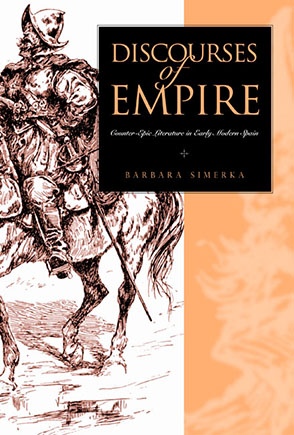
Discourses of Empire
Counter-Epic Literature in Early Modern Spain
Barbara Simerka
“One must applaud the ambitious and far-reaching goals of the study. It is highly suggestive and engaging, with its own rather baroque discourse.”
- Unlocked
- Description
- Reviews
- Bio
- Sample Chapters
- Subjects

An Open Access edition of Discourses of Empire is available through PSU Press Unlocked. To access this free electronic edition click here. Print editions are also available.
Simerka is drawn to literary texts that questioned or challenged the imperial project of the Hapsburg monarchy in northern Europe and the New World. She notes the variety of critical ideas across the spectrum of diplomatic, juridical, economic, theological, philosophical, and literary writings, and she argues that the presence of such competing discourses challenges the frequent assumption of a univocal, hegemonic culture in Spain during the imperial period. Simerka is especially alert to the ways in which different discourses—hegemonic, residual, emergent—coexist and compete simultaneously in the mediation of power.
Discourses of Empire offers fresh insight into the political and intellectual conditions of Hapsburg imperialism, illuminating some rarely examined literary genres, such as burlesque epics, history plays, and indiano drama. Indeed, a special feature of the book is a chapter devoted specifically to indiano literature. Simerka's thorough working knowledge of contemporary literary theory and her inclusion of American, English, and French texts as points of comparison contribute much to current studies of Spanish Golden Age literature.
“One must applaud the ambitious and far-reaching goals of the study. It is highly suggestive and engaging, with its own rather baroque discourse.”
“Focusing mainly on the comedia, reviews counter-epic literary representations as discursive mediations questioning dominant ideologies, ways in which counter-epic texts contest imperialist practice and provide insights into the heterogeneity of early modern society.”
Barbara Simerka is Assistant Professor of Hispanic Studies at Queens College, CUNY. She is co-editor, with Christopher B. Weimer, of Echoes and Inscriptions: Comparative Approaches to Early Modern Spanish Literatures (2000) and editor of El arte nuevo de estudiar comedias: Literary Theory and Golden Age Spanish Drama (1996).
1
Toward a Materialist Poetics of Counter-Epic Literature
Discourses of empire appear in artistic, political, and theological writings of every genre in circulation in early modern Spain—from Lascasian critiques of forced conversion and genocide to the explications of Roman law by three generations of jurists who sought legal validation of Spain’s right to the territory, labor, and mineral wealth of America, from Ercilla’s poetic denunciation of Spanish military practices in Chile to hagiographic dramatizations of the lives of the conquistadores commissioned by their seventeenth- century progeny. This study focuses upon identifying and analyzing literary texts that represent and mediate discourses of imperialism in early modern Spain. It is not my purpose to argue that emergent and residual discourses posed significant material threats—“subversions”—to the prevailing system’s order and stability. Rather, the goal of the materialist, “epochal” analysis of counter-epic texts offered here is to highlight the contestatory ideas against which hegemonic martial imperialist discourses defined and defended themselves—and thus to analyze the negotiation of imperial ideologies within texts that foreground the tensions produced by ideological confrontation. As Anthony Cascardi correctly observes, “What is ‘ideological’ about the historical role of literature in the Spanish Golden Age is that it is not merely shaped by . . . tensions, but articulates a strongly inflected response to them.”1
Many historians, including Anthony Pagden, John Lynch, J. H. Elliott, and Raffaele Puddu, have examined the relationship between unflattering early modern literary representations of European aristocracy and the social tensions that were produced by the shift from the warrior nobility of the feudal era to the courtiers of absolutist regimes. This modification of the nobility’s role was frequently characterized as a loss of masculinity by those who opposed such changes (as well as by those who benefited from them). The critique of courtiers within counter-epic works gives rise to an interesting paradox, for those who do not fight are despised as feminine, while Romans, indigenous peoples, and Numantians are often coded as hypermasculine and thus barbaric. The rise of the merchant class as a significant competitor for economic power, while less pronounced in earlyseventeenth- century Spain than in England or France, nonetheless constituted a related source of social instability and anxiety.2
Over the course of the sixteenth century, Spain experienced the dazzling heights of dominion over both a mineral-rich overseas colony and the Holy Roman Empire. It also endured a series of fin-de-siècle disasters associated with imperialism: the destruction of the Armada, a plunge in the quantity of metals flowing from the New World, and bankruptcy. As a result, the last decade of the century witnessed an intense debate over the relative advantages and liabilities of imperialist practice, a debate that continued well into the 1600s. There followed a period of retreat from imperialism under Philip III and Lerma, who sought to alleviate Spain’s financial problems through truces with the Dutch, French, and English. This period of peace improved Spain’s financial situation, but it also contributed to a sense of decline based upon nostalgia for the previous century’s glory. For this reason (among others), Philip IV and Olivares did not renew the peace treaties when they expired. Instead, they embarked upon a series of relatively unsuccessful military ventures in the 1620s. The consequences of these ventures included not only a worsening of Spain’s much-valued “reputation” but also the permanent loss of Portugal and the northern Protestant sections of the Netherlands known as the United Provinces—as well as twelve years of independence for Catalonia. Doubts about the validity of imperialism during this period extended to a questioning of involvement in European theaters of action and in the Americas, for defending Spain’s trade monopoly with its colonies was a significant factor in many Continental conflicts. In addition to the pragmatic examination of the benefits and costs associated with the Christian imperial mission conducted by political and diplomatic figures as well as philosophers, the ethical dimensions of conquest sparked considerable discussion among theologians. Elliott notes that missionaries such as Antonio de Montesinos and his famous disciple, Bartolomé de Las Casas, who held Erasmian/Utopian views of the American indigenous population as an example of humankind’s innate nobility prior to the debasements of civilization, “found it impossible to square the treatment that was being meted out to the natives with their own fundamental convictions about mankind.”3 This respect for the objects of conquest—though patronizing and Christocentric in its obsession with evangelization—is another important factor in the questioning of imperial warfare found in early modern representations of the battles at Numancia and at Arauco, Chile.
My exploration of the ideological tensions in early modern Spanish literature is consistent with contemporary practices in cultural studies. In a Chronicle of Higher Education article from February 2001 about the status of Golden Age Spanish literary study, Scott Heller states that “after years of notorious conservatism,” Hispanists are “finally catching up” with the changes in methodology that marked a shift in English studies from analysis of the Renaissance from a humanist vantage point to interdisciplinary and postmodern explorations of “early modern” European culture.4 In making this assertion about the novelty of such an approach, Heller overlooks a decade of important ideologically oriented studies of drama and prose by George Mariscal, Margaret Greer, Baltasar Fra Molinero, and William R. Blue, as well as anthologies edited by John Beverly, Mark Millington and Paul Julian Smith, and Marina Brownlee and Hans Ulrich Gumbrecht, to name just a few. His outline of current trends in early modern Hispanic studies, however, sketches the critical and theoretical landscape that this project seeks to explore and enhance. For example, my preference throughout for the term “early modern” rather than “Renaissance” or “Golden Age” Spain is intended, as Heller suggests, to reject traditional notions of sixteenth- and seventeenth-century Spanish society as a monolithic and ideologically conservative entity. And, as many of the scholars Heller interviewed indicated, a deeper analysis of the diverse discourses circulating in early modern Spain is opening areas of investigation and providing new insights concerning canonical texts. My examination of several different forms of (mostly) noncanonical counter-epic writings can be viewed as part of this larger project.
I have chosen the label of “counter-epic” to describe these writings because they deploy a revisioning of epic values in order to examine a particular aspect of early modern martial aristocratic discourse.5 The early modern Spanish counter-epic rewards careful analysis—and my study will take up several prevalent elements of baroque aesthetics, including the juxtaposition of numerous genres, the innovative “redeployment” of generic conventions (including generic parody), and the radical modification of traditional stock characters. But even as this study attends to the “formal” aspects of the counter-epic, it is also grounded in three materialist precepts. First, early modern Spanish culture was not uniquely monolithic and orthodox, but like all cultures, it contained residual and emergent discourses as a source of oppositional voices and ideologies. Second, the study of counter-epic literary representations can provide insights into one form of discursive mediation through which dominant military ideologies were examined and questioned. Third, the questioning of imperialist practice in counter-epic texts provides meaningful knowledge about the heterogeneity of early modern Spanish society. The following sections of this chapter will provide an overview of materialist poetic practice, and subsequent chapters will examine in detail the connections between specific instances of poetic innovation and imperialist ideologies.
Materialist Poetics
Despite post-Soviet and post-structuralist declarations of the death of marxism, continue to play an important role in the development of theories of textuality. By pointing out the class discourses that nineteenth-century theories of universal standards of beauty tried to suppress and by demonstrating that apparently “natural” standards of excellence are also the products of class ideology, Marx provided the foundation upon which scholars engaging with issues of gender and ethnicity could construct their own critiques of dominant aesthetic standards and canons.7 “Cultural materialist” studies, however, have also identified several flaws in Marx’s explanation of the role played by cultural productions—flaws that drastically undermine classic marxism’s usefulness for the study of literary and other social practices. The most troubling weakness in Marx’s model of social and literary relations is the positing of a literature/society dualism, one that sets literature apart from other social activity. In Marxism and Literature, Raymond Williams identifies the source of this problem as the distinction Marx makes between a composer and a piano maker—and his subsequent supposition that aesthetic activity is not a part of material production.8 This separation leads to Marx’s construction of economic and social reality as a base, or referent, and aesthetic production as the superstructure that passively reflects that reality. There is a general consensus among critics and theorists who currently practice marxist-inspired materialist literary study that literature is a mode of production not different in kind from other social modes, one that takes an active role in the formation of social practices and discourses. Cascardi proposes such a stance when he describes the Golden Age literary text as “a social force, actively proposing solutions to historical conflicts” (Ideologies, 1).
Raymond Williams and Tony Bennett observe that the base itself is a process, an activity, rather than an object of study; it cannot, therefore, be the stable referent to which literature points (see Williams, Marxism and Literature, 96; Bennett, Outside Literature, 21). Williams asserts that monolithic views of the base fail to recognize the significance of competing discourses within a period and tend to grant significance only to expressions of the dominant voice (Williams, Marxism and Literature, 121–23). He advocates the practice of “epochal analysis”—the study of the relations between dominant, emergent, and residual formations—in order to provide a more comprehensive vision of the material forces that shape and are in turn shaped by cultural productions. Williams defines “residual” discourse as that which “has been effectively formed in the past, but it is still active in the cultural process, not only and often not at all as an element of the past, but as an effective element of the present. . . . It is crucial to distinguish this aspect of the residual, which may have an alternative or even oppositional relation to the dominant culture” (122). Emergent discourses do not always—or even often—consist of truly novel developments. According to Williams, they also involve a relation with the past, for at moments of “the default of a particular phase of a dominant culture there is then a reaching back to those meanings and values which were created in actual societies and actual situations in the past, and which still seem to have significance because they represent areas . . . which the dominant culture neglects, undervalues, opposes, represses, or even cannot recognize” (123–24).9 A materialist reading of counter-epic texts reveals that the critiques of Spanish imperialist practice launched by Bartolomé de Las Casas, Juan Luis Vives, Furió Ceriol, and many others constitute a meaningful residual discourse as well as a source for the seventeenth century’s emerging anti-imperialist discourses. Both aspects of this critique are relevant for studies of texts written during the century after the famous debates at Valladolid in 1550. Scholars who practice materialist criticism usually do not foreground the stylistic and formal elements of texts. Louis Montrose describes his “cultural poetics” as a practice that replaces diachronic (stylistic) studies of literary texts with an analysis of “the synchronic text of a cultural system.” Gregory Colomb characterizes an alternate “materialist poetics” as a practice that “redefines the notion of particulars, treating poetic particulars (words, images, figures) as parts of an intricate web connecting the social facts of persons and places to the ‘prosaic’ particulars of history.”10
Materialist Poetics of Character and Subjectivity
In early modern Spanish texts, the literary exploration of the “historical particular” of imperialism was not limited to representing actual warfare. The subgenre of indiano drama represents another aspect of military conquest: the role of the “colonial” subject at the imperial court. The term indiano is used by early modern dramatists to signify two types of individuals, both of pure European/Spanish blood: (1) men and women who were born in the New World and travel to Spain as young adults to find mates, and (2) men born in Spain who, lacking the monetary or social resources necessary to marry well in their youth, travel to the Indies to gain riches and return to Spain in middle age in order to “buy” a noble bride and access to higher levels of courtier society. The characters’ social mobility constitutes a significant factor in the liminal status of indianos in these plays and is related to generalized early modern anxieties about the instability of identity and status. Indeed, anxiety about the transformative power of encounters with an “alien” culture plays an important role in all early modern European societies and the texts that represent them.11 Counter-epics offer literary mediations of militant aristocratic values and intensively explore imperial policy, validating Cascardi’s assertion that Golden Age texts serve to “sutur[e] together the various contradictions that in their contemporary world could be attributed to the conflicting value systems of class and caste” (Ideologies, 2).
Edith Villarino has identified more than two dozen plays with indiano characters.12 Chapter 3 will focus upon four plays that feature the conflation of villano and indiano figures: Lope de Vega’s El sembrar en buena tierra (Cultivating in Good Soil) and El premio del bien hablar (Rewarded for Courtesy), Tirso de Molina’s La villana de Vallecas (The Provincial Woman from Vallecas) and La celosa de sí misma (Her Own Rival), and two Tirsian dramas with indiano senex characters, Por el sótano y el torno (Through Nooks and Crannies) and Marta la piadosa (Pious Marta). The chapter highlights the multiple roles played by the liquid, monetary forms of wealth possessed by indiano characters. It will thus contribute to what Carroll Johnson has noted as a frequently overlooked area of study: early modern Spanish textual representations of economic relations.13
Materialist Poetics of Genre
In one of the four essays that constitute his Anatomy of Criticism, Northrop Frye creates a system that organizes all types of literature, from mythology to the modern anti-novel, according to several categories that simultaneously define and cut across generic boundaries. Fredric Jameson’s marxistinspired rejection of this system is based on objections to Frye’s positing of an ahistorical, transcendent notion of literary types, one that fails to distinguish, for example, among medieval chivalric romances, Shakespeare’s late plays (often referred to as romances), and the romantic historical novels of the nineteenth century. Jameson advocates the “historicization” of these differing works through an examination of which aspects of the contemporary social order are marginalized in each instance.14 Shakespearean scholars were among the first to examine the relations between genre and political ideology from this standpoint. Stephen Greenblatt edited a special volume of Genre entitled The Forms of Power and the Power of Forms in 1982, and Jonathan Dollimore’s Radical Tragedy (1984) examined the relationship between Jacobean tragic drama and the overthrow of the Stuart monarchy. These early studies of the relations between ideology and literary formation, however, analyzed the deployment of particular genres without a substantial reconsideration of New Critical definitions of those genres—or of the notion of “genre” itself.
A productive development within genre theory has been a turn away from New Critical visions of genre study as pigeonholing texts into static categories. The acceptance of new classes of writing also enables readers to revision the generic components of works already in the canon, as Wlad Godzich and Nicholas Spadaccini demonstrate in Literature Among Discourses, a work that examines the presence of cultural forms such as traditional proverbs, carnival festivals, and medieval religious drama in canonical early modern literature. The purpose of their volume is not “merely” to expand the canon; rather, it is to identify “the processes and mechanisms by which specific texts or classes of texts came to be differentiated from other discursive entities and given the label ‘literature.’”15 In Outside Literature, Tony Bennett provides one of the most comprehensive theories of genre and ideology. His “sociology of genres,” grounded in the conviction that literary studies are most valuable when literary texts cease to be considered a privileged and “unique” discourse, asserts that the task of genre study is not to define genres but rather “to examine the composition and functioning of generic systems” in order to define the boundaries that separate these systems in terms of “particular, socially circumscribed fields of textual uses and effects” (105, 112). Like Greenblatt and Dollimore, Bennett emphasizes the importance of studying literary texts in the context of other types of writing and other social processes, citing Leonard Tennenhouse’s Shakespearean study, Power on Display, as a model. Bennett highlights the strengths of Tennenhouse’s diachronic practice, in which dramatic representations of the monarchy are studied in the context of “royal speeches or proclamations, [of] ledger reports and parliamentary reports,” so that “the organization of the system of generic differences—conceived as a differentiated field of social uses” may be achieved (110–11). (The social uses that Bennett lists include nation formation, class formation, and guides for rulers.) The materialist reformulation of genre study employed in my book’s analysis of counter-epic poetics incorporates the interdisciplinary research and postmodern conceptions of textuality described here. At the same time, the book breaks new ground by reimagining the relationship between aesthetic analysis and ideological inquiry.
This study explores the redeployment of epic conventions and the creation of new literary forms within the context of early modern Spain’s attempts to come to terms with the discrepancies between its imperial ideals and the changing economic and social realities of the late sixteenth and seventeenth centuries. Chapters 4 and 5 analyze the ways in which the generically indeterminate anti-epic history play redeploys the themes, motifs, and aesthetic strategies of the martial literary tradition in order to evaluate the role of imperialist practices and discourses. Chapter 4 examines two plays, Lope de Vega’s Arauco domado (Arauco Conquered) and La destrucción de Numancia (The Destruction of Numancia) by Cervantes. Chapter 5 analyzes three later revisions of those dramas: Los españoles en Chile (Spaniards in Chile), by González de Bustos, and the Rojas Zorrilla diptych, Numancia cercada (Numancia Under Siege) and Numancia destruida (Numancia Destroyed). These counter-epic texts represent two key moments of imperial conquest and dramatize military and imperialist issues in a serious tone, exploring imperial expansion’s troublesome consequences for the colonizing civilization as well as for its victims.16
Chapters 6 and 7 analyze the burlesque epic mode found in Lope’s La gatomaquia (Battle of the Cats), Scarron’s Virgile travesti (Virgil Travestied), Shakespeare’s Troilus and Cressida, and two sonnets by Francisco Quevedo that parody the Aeneid and Poem of the Cid. The burlesque form of counterepic discourse combines parody and satire in its humorously deprecatory representations of military heroes and battles. These chapters foreground the ways in which burlesque epic texts emphasize the commercial aspects of life to undermine literary idealizations of military and heroic activity. Considering two critically marginalized early modern genres—the indiano comedia and the burlesque epic—as well as the less canonical “late baroque” works of Rojas Zorrilla and González de Bustos does not simply expand the canon by including texts that problematize military heroism and imperialism. And I do not seek to draw ahistorical parallels between contemporary peace movements and the antiwar factions of Hapsburg Spain. Instead, this study demonstrates the significant contribution of innovative generic deployments to the representation of discourses in discord. As Ralph Cohen observes, genre study is central to the recent opening of the canon to writers previously marginalized due to gender, sexual preference, race, or class—and, I would add, due to their representation of ideologies at odds with the hierarchical norms of later ages. An awareness that such marginalized texts were ignored because they “did not fit a conception of education aimed at preparing white males for advancing in social and economic hierarchies” contributes to a more complex understanding of the ways in which the categorization of cultural forms helps shape our perceptions of the world (“Genre Theory,” 90).
Materialist Poetics of Reception
The recognition of heterodox cultural practices is also relevant to a revisioning of early modern reader/audience response. Rather than seeking to establish a univocal reaction to orthodox or transgressive elements within counter-epic texts, I would argue that reception, like production, is significantly influenced by the competition among discourses.17 Thus, in describing the variety of discourses concerning imperialism available to those who wrote about this topic, I am at the same time seeking to delineate expanded parameters of audience response. In fact, critical awareness of discourse-bound heterodoxy in the reception of plays or texts is at least as significant as recognizing its impact on production. I will not seek to identify a single ideology in any counter-epic text, for, as post-humanist criticism has shown, even if authorial intention can be “discovered,” texts are notoriously slippery.
Reception theory can be said to have its origins in Aristotle’s notion of catharsis as the socially beneficial response to the suffering of the tragic hero. Hans Robert Jauss and Wolfgang Iser have developed notions of reader response that center on the reader’s previous textual experiences.
Although the foci and purposes of their projects differ, both agree that the reader’s text-based “horizon of expectations” or “repertoire” is the factor that most strongly determines the reception of a new work. Readers will not produce a cacophony of idiosyncratic textual readings because all readers respond to a text, which itself defines and sets the parameters of what can be read.18 Stanley Fish challenges the notion that the stable nature of texts is the factor that limits interpretive divergence. He argues instead that responses do not vary widely because all reading practices are formed by “interpretive communities” that perform two functions: to educate readers and to monitor scholarly practices.19 The models of these three theorists share the assumption that the reception of a text is first and foremost an aesthetic experience, as can be seen in their explanations both of stability of response and of the way in which the reception of a text changes over time. For Jauss, “literary” texts are distinguished from “popular” ones by virtue of their success in shattering the reader’s horizon of expectations through innovations in form and style. As new literary works modify this horizon, they also enable the reader to modify his or her vision of literary history and to see older works in a new light (“Literary History,” 18–19). Because Iser focuses on the reading process—the gap-filling activities that constitute the mode of interaction between text and reader—his explanation of critical revisions emphasizes the change in the reading process that arose in response to modern works that require a more demanding “structuring activity” (Implied Reader, 205). Fish, on the other hand, highlights the importance of professional critical activity for changing responses to texts.
He identifies archeological findings (new evidence about an author or a genre, for instance) and new theoretical paradigms as the most significant factors for producing changes in the way works are taught (Text, 364). According to Fish, responses to all subsequent works will be guided by the interpretive strategies learned in the classroom; reader response is thus determined by the norms of the interpretive community. All three of these theorists seem to exclude history in their explanations of literary history and to posit a monolithic reading experience, as critics have pointed out.20 I would like to suggest that Raymond Williams’s concept of discursive competition—that is, the contest among dominant, emergent, and residual formations—can serve as a corrective for both of these weaknesses and can provide the basis for a more historicized theory of response. As I have noted, the “base” (to use an old marxist term in a non-marxist sense) inferred by Iser, Fish, and Jauss as the factor that limits the possibilities of reception is almost entirely literary. There are few, if any, references to the nonacademic experiences that might affect response. (This is due in part to the specter of entropy raised by critics of reader-oriented theories, who wrongly supposed that response theory sought to study the individual reader, a person whose horizon was based on a unique combination of psy- chological factors. Despite their misunderstanding of the work of response theory, these critics successfully influenced the development of monolithic reception theories.) By introducing Williams’s “epochal analysis” into the study of how responses to cultural phenomena vary, it is possible to historicize the reader or spectator and also to account for a limited plurality of responses as the result of sympathy for and awareness of residual or emergent discourses. In addition, the expanded “horizon” or “repertoire” of the respondent will include the significant nonliterary discourses in circulation, and the “interpretive community” can be reformulated to take into consideration the “ideological community.” A materialist theory of reception will thus delineate the nonliterary elements of the cultural formations mediated in a text and analyze the dominant, residual, and emergent versions of those formations in order to describe the oppositional as well as affirmative responses available to the contemporary reader or spectator, supplementing the approaches advocated by Jauss, Iser, and Fish.
A materialist approach to reception study may help overcome one further weakness in Iser’s and Jauss’s conceptions of the reading process. Both of these German thinkers were heavily influenced by the Russian Formalist conception of defamiliarization, or estrangement. A reading model that privileges astonished awareness of a previously unrecognized convention— whether literary or sociohistorical—and imagines a dramatic shift in the perception of the world as the ideal response takes for granted a reader who is, in marxist terminology, blinded by a false ideology. And Jonathan Culler’s observation about Fish’s model of interpretive cruxes is also relevant here: he writes that Fish’s description of his own reading process must be false, for if he continued to read each new poem according to his original horizon of expectations, then he learned nothing from the reading process.21 Similarly, a respondent may reevaluate her belief system and adopt some aspect of an emergent or residual formation, or she may reject the insights offered and continue to affirm the dominant discourses. A respondent cannot be continually shocked by defamiliarization into repeated “naive” or “virginal” rejections of the status quo. The defamiliarization model totally ignores the respondent who has already questioned hegemonic formations and therefore cannot even begin to account for that respondent’s reception of the representation of an oppositional discourse. In my analysis of counter-epic texts, reader response will be envisioned along a continuum similar to that formed by the range from Lascasian to Sepulvedan positionalities described in Chapter 2, with counter-hegemonic response seen as a valid position rather than as a rare exception or even an impossibility.
Conclusion
Here, I have sketched an outline of the dynamics between counter-epic poetic practice and cultural inscriptions of imperialist ideology. I should also note that gender study is a crucial component of every chapter in this book. In this, I have benefited from the scholarly efforts of other Hispanists attuned to gender, including Malveena McKendrick’s early study of gender dynamics and the important contributions of anthologies of feminist studies edited by Valerie Hegstrom and Amy Williamsen, Anita Stoll and Dawn Smith, and the critical editions of women writers produced by Electa Arenal, Stacey Schlau, Teresa Soufas, and others. (The translations of early modern women writers by H. Patsy Boyer and others have also enabled feminist scholars in many fields to gain knowledge of and appreciation for early modern peninsular negotiations of gender roles.) My study does not incorporate female writers, for I am aware of no woman-authored counterepic text. But in the counter-epic’s scrutiny of aristocratic and martial values, deviations from supposed medieval norms are often represented as a degraded, effeminate “decline” from a previous idealized masculinity. In addition, certain subgenres, particularly the burlesque epic and the late baroque history play, utilize female characters as scapegoats for social instability and corruption.
These counter-epic texts take on new life and new forms of signification when studied in the context of recent critical examinations of the consequences of imperialism represented in early modern poetry. David Quint’s Epic and Empire offers a comprehensive examination of the questioning of martial discourse in a variety of sixteenth-century “epics of losers,” including d’Aubigné’s Les Tragiques (The Tragic Ones) and Ercilla’s Araucana. In addition, scholarship among Hispanists has provided extensive insights into colonial discourses within Ercilla’s and Pedro de Oña’s poetic narratives of the conquest of Chile, a useful context from which to reexamine dramatizations of the conquests of Arauco and Numancia. Such disparate yet related elements conjoin in this study to form a materialist poetics of the conflicting representations of imperial ideologies in early modern Spanish counter-epic texts.
Mailing List
Subscribe to our mailing list and be notified about new titles, journals and catalogs.