


Down and Out in Early America
Edited by Billy G. Smith
“Billy Smith brings together an impressive group of scholars who examine poverty in a wide range of settings. The resulting essays are remarkable not only for their inclusiveness but also for the way they give a truly human face to the poor. Down and Out in Early America is an important contribution to the scholarship on early America.”
- Description
- Reviews
- Bio
- Table of Contents
- Sample Chapters
- Subjects
The fact is that in early America only an extremely thin margin separated those who required assistance from those who were able to secure independently the necessities of life. The reasons for this were many: seasonal and cyclical unemployment, inadequate wages, health problems (including mental illness), alcoholism, a large pool of migrants, low pay for women, abandoned families. The situation was made worse by the inability of many communities to provide help for the poor except to incarcerate them in workhouses and almshouses.
The essays in this volume explore the lives and strategies of people who struggled with destitution, evaluate the changing forms of poor relief, and examine the political, religious, gender, and racial aspects of poverty in early North America. Down and Out in Early America features a distinguished lineup of historians. In the first chapter, Gary B. Nash surveys the scholarship on poverty in early America and concludes that historians have failed to appreciate the numerous factors that generated widespread indigence. Philip D. Morgan examines poverty among slaves while Jean R. Soderlund looks at the experience of Native Americans in New Jersey. In the other essays, Monique Bourque, Ruth Wallis Herndon, Tom Humphrey, Susan E. Klepp, John E. Murray, Simon Newman, J. Richard Olivas, and Karin Wulf look at the conditions of poverty across regions, making this the most complete and comprehensive work of its kind.
“Billy Smith brings together an impressive group of scholars who examine poverty in a wide range of settings. The resulting essays are remarkable not only for their inclusiveness but also for the way they give a truly human face to the poor. Down and Out in Early America is an important contribution to the scholarship on early America.”
“These essays portend a new, exciting stage in poverty and poor relief studies.”
Billy G. Smith is Professor of History at Montana State University. He has edited two Penn State Press books: The Infortunate: The Voyages and Adventures of William Moraley, an Indentured Servant (with Susan Klepp; 1992) and Life in Early Philadelphia: Documents from the Revolutionary and Early National Periods (1995).
Contents
Acknowledgments
Introduction: "The Best Poor Man's Country?"
Billy G. Smith
1. Poverty and Politics in Early American History
Gary B. Nash
Part I:: Lives of the Poor
2. Dead Bodies: Poverty and Death in Early National Philadelphia
Simon Newman
3. Malthusian Miseries and the Working Poor in Philadelphia, 1780–1830: Gender and Infant Mortality
Susan E. Klepp
4. Slaves and Poverty
Philip D. Morgan
Part II: Poor Relief
5. "Who Died an Expence to This Town": Poor Relief in Eighteenth-Century Rhode Island
Ruth Wallis Herndon
6. Gender and the Political Economy of Poor Relief in Colonial Philadelphia
Karin Wulf
7. Poor Relief "Without Violating the Rights of Humanity": Almshouse Administration in the Philadelphia Region, 1790–1860
Monique Bourque
8. Bound by Charity: The Abandoned Children of Late Eighteenth-Century Charleston
John E. Murray
Part III: Politics, Religion, and the Creation of Poverty
9. Poverty and Politics in the Hudson River Valley
Thomas Humphrey
10. "God Helps Those Who Help Themselves": Religious Explanations of Poverty in Colonial Massachusetts, 1630–1776
J. Richard Olivas
11. The Delaware Indians and Poverty in Colonial New Jersey
Jean R. Soderlund
Contributors
Index
<p>Introduction</p>
<p>"The Best Poor Man's Country?" </p>
<p>Billy G. Smith</p>
<p>No Observation is more common, and at the same time more true, than That one half of the world are ignorant [of] how the other half lives.
Anonymous Philadelphian, 1767</p>
<p>We live in an era of economic apartheid, both nationally and internationally. During the final decade of the twentieth century, many Americans enjoyed immense and growing prosperity, yet others suffered continuing, sometimes intensifying deprivation. The <"overclass" of enormously wealthy Americans expanded considerably. Meanwhile, the size of the <"underclass" waxed and waned, confining millions of people to conditions of destitution from which few escape. From 1980 to 2000, between 11 and 15 percent (approximately 30 to 40 million people) of United States citizens earned incomes below the federally defined poverty level, and a similar number teetered on the threshold of indigence. One of every five children lives in poverty each year, and twice that many children will live in indigent households by the time of their eighteenth birthday. Fortunately, the proportion of impoverished Americans declined slightly during the century's final few years as financial boom times finally benefited some of the needy. Unfortunately, one of every ten American households still suffered food shortages, and 4 million others experienced hunger on a monthly basis, all at a time when public aid to the disadvantaged declined. Poverty has increased again during the economic downturn of the first years of the twenty-first century.</p>
<p>On a global scale, the number of poor throughout the world grew by more than 200 million during the last decade. Currently, 1.5 billion people earn less than one dollar each day—the worldwide benchmark for abject poverty—and nearly 800 million people suffer chronic hunger. One result is that various diseases, many of them preventable with only small sums of money, run rampant in poorer nations. Millions of lives consequently are shortened solely because people are destitute. </p>
<p>Inequality in the distribution of wealth in the United States has increased during the past two decades at a rate previously unknown in the nation's history. The richest 1 percent of citizens now possesses more wealth than the poorest 90 percent; even after the recent decline in his fortune in stocks, Bill Gates is still worth more than at least 80 million Americans. In its level of inequality, the United States has grown more similar to preindustrial nations than to the industrial and postindustrial world. The economic gap among various classes of Americans has never been greater. The recent rapid spread of capitalism around the world has further encouraged similar patterns of economic inequality throughout the globe. </p>
<p>Yet, historical studies of American poverty have declined during recent years. World events, such as the dissolution of the Soviet Union, the intensification of global capitalism, and the deindustrialization of wealthy nations (with the concomitant movement of low-wage employment to poorer countries), along with challenges issued by new academic fashions have all undermined an examination of the past (and present) from a national class perspective. In addition, the existence of a substantial number of indigents often has been denied in America, in part because it contradicts our avowed commitment to equality, in part because it is difficult to explain the toleration of widespread destitution in an extremely wealthy society. People in the United States seemingly rediscover the American poor every few generations, it has been observed cynically, as was the case in the Great Depression and again during the 1960s. We are long overdue for a similar rediscovery in a new century. The essays in this volume are a small part of the effort to reconsider the long, often tragic history of poverty and the poor in early America. </p>
<p>For more than a generation, many historians have accepted the phrase <"it is the best poor man's country in the world," initially penned by indentured servant William Moraley, as an accurate characterization of early North America. Scholars, however, have ignored the context of Moraley's description, the ambivalence he expressed about opportunities for less affluent people, and the particulars of his life, all of which belie his assessment.2 More important, historians, in agreement with Adam Smith, have embraced the shibboleth that because the New World contained a great deal of available land (as long as Indians were dispossessed) and relatively few laborers, the law of supply and demand dictated that most early American working people should have enjoyed high wages and a decent material standard of life. Thus, while the poor may always be with every society, their numbers in early America are believed to have been few. The essays in this volume challenge that contention; explore the lives and strategies of people who struggled with destitution; evaluate the changing forms of poor relief; and examine the political, religious, gender, and racial aspects of poverty in early North America. </p>
<p>Many prominent historians believe that privation was not widespread in seventeenth- and eighteenth-century North America. <"Poverty and economic deprivation," Gordon Wood baldly declares in his Pulitzer Prize-winning volume, <"were not present in colonial America." David Hackett Fischer contends that much of the previous historical analysis of <"social structure" and <"material processes"—including the study of indigence—have distorted our understanding of early North America by causing us to ignore human contingency and individual choice. Both scholars echo the perspective of Bernard Bailyn who argues that revolutionary Americans did not confront the <"predicament of poverty." Two leading economic historians, John McCusker and Russell Menard, at least recognize the existence of indigence, especially among slaves. Yet, they conclude, <"the colonies experienced little if any of the abject poverty found in contemporary Europe." In essays in this volume, Philip Morgan summarizes the major arguments supporting these conclusions while Gary Nash provides a powerful alternative interpretation.</p>
<p>This appraisal of the lack of economic distress is flawed, both logically and by its facile dismissal of many of the conditions that historically have produced poverty. Symptomatic of their misinterpretation of the extent and nature of destitution in early North America, most scholars have misunderstood William Moraley's account of <"the best poor man's country." He used the expression to praise Mid-Atlantic inhabitants for their generous hospitality to impecunious travelers rather than to paint a rosy portrait of early North America. Instead, he criticized the exploitation of and limited economic opportunities available to people without property. While acknowledging the general <"Affluence and Plenty" enjoyed by many land-owning farmers in the Middle Colonies in the 1720s, Moraley recognized that numerous unfree residents did not share this abundance; their labor instead served as a primary source of the wealth for their masters. Purchasing servants and slaves rather than paying wages to free workers enriched farmers, Moraley explained, but it did not benefit bound laborers. As a result, <"the Condition of Negroes is very bad," he observed, and that of <"Bought servants is very hard." Once having gained his freedom, Moraley struggled to survive financially. Because most of the good land in the area had already been claimed, and since he had little aptitude for farming, Moraley was unable to obtain a foothold or establish economic independence. When his watch making and other occupational skills proved in scant demand in the colonies, he was <"reduced to Poverty" and forced to return to Britain. Moraley's story, hardly exceptional for the half of Europeans who migrated to North America as indentured servants in the eighteenth century, does not support an overly optimistic interpretation of the British colonies as a region with limitless possibilities and virtually free of destitution.</p>
<p>In a similar vein, historians often have failed to appreciate the numerous factors that generated widespread indigence in early North America. Gary Nash's essay explains many of these historical forces, but a few others bear discussion here. In preindustrial countries, low productivity (by modern standards) severely curtails the society's total wealth. The grim reality is that under such economic conditions, both today and in the past, limited resources dictate that penury will be extensive and endemic, and that the material lives of many people will be financially nasty and brutish. Because relatively little surplus existed, and since the available wealth was inequitably distributed, a great number of inhabitants of the British colonies necessarily lived close to the fiscal edge. Even in the modern United States, the wealthiest of all nations, approximately one-quarter of citizens are mired in poverty or teeter on the brink of indigence. By contrast, to argue that poverty was virtually nonexistent in a much less prosperous land two centuries ago involves fanciful thinking unsubstantiated by careful analysis.</p>
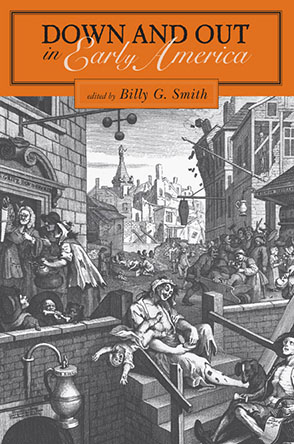
<p>Overly favorable comparisons between early North America and Europe sometimes have clouded scholars' vision. Poverty certainly was more widespread in preindustrial England, Ireland, Scotland, Germany, and France than in seventeenth- and eighteenth-century North America, at least among white Americans. Conditions in American urban centers, for example, did not match the Hogarthian misery of eighteenth-century London. Yet, that city was an anomaly even within its own country. In terms of the total wealth of both societies, the colonies were not as opulent as Britain, and destitution may not have been much more intense in British towns and rural areas than among white inhabitants of comparable North American regions, as Susan Klepp's demographic study in this volume demonstrates. Most important, it is essential not to confuse relative and absolute degrees of poverty. Merely because fewer white Americans than Western Europeans suffered indigence does not therefore mean that destitution was nonexistent or unimportant in early America. As a Scottish <"gentleman" commented in 1774, <"I hear it is affirmed by many, that poor People in general are like to be as unhappy in America as at Home." </p>6
<p>Quick to endorse the notion of an overall labor shortage in early North America which allegedly ensured that few people suffered destitution, scholars have been slow to understand many circumstances that prevented workers from taking advantage of a seemingly beneficial situation. Early British America was constituted by a number of regional rather than a single national economy, which, in turn, was liable to routine cyclical and seasonal variations. The supply of labor correspondingly varied both regionally and over time. During the harvest in wheat-producing areas, for example, laborers were in great demand, and workers, if free, could find employment at good wages. During the winter, however, when the rhythms of both agriculture and maritime trade slowed and even halted, free workers were unlikely to command the pay essential to maintain financial independence for themselves and their families. In addition, European migration, often chaotic and uneven rather than economically rational from the perspective of American employers, frequently skewed local labor markets, creating shortages in some areas while dumping far too many workers in others. Philadelphia is a prime example: the ebb and flow of migrants contributed to boom and bust periods for the city's economy in general and for laboring people in particular.7</p>
<p>Neither impoverished migrants nor penniless colonists could easily benefit from the much-vaunted availability of cheap land by moving to the boundaries of European settlement. It was impossible for many if not most poor people because of the requirements of skill and capital. William Moraley and Benjamin Franklin are instructive on this point. Moraley possessed neither the inclination, nor the expertise, nor the financial resources to begin life anew as a farmer after his servitude was complete. Franklin could not become a successful artisan until he could secure assets for an independent shop—one reason he bargained for a marriage to obtain a dowry to support his ambition. The capital required to establish a farm on the frontier was equally crucial to success and well beyond the means of most laboring people. Of course, even the material successes of Euro-Americans on the borderlands usually came at a high price: the dispossession of Native Americans.8</p>
<p>Exaggerating the general shortage of labor and easy availability of land, some scholars have overlooked the social and economic organization established by white settlers that limited the opportunities for most other early Americans. In assessing poverty, historians frequently have disregarded the predicament of slaves and Native Americans, who constituted a significant proportion of the population. This airbrushing of Africans and Indians can hardly be overemphasized. Approximately one of every five Americans during the revolutionary era was held in perpetual bondage, and, as Philip Morgan argues in his essay, material <"conditions for the vast majority of slaves were far worse than those experienced by white people." Some Indians became refugees, part of the wandering poor in their own land. Many died from disease or violence or were enslaved by Euro-Americans; others either moved westward to escape the European advance or settled on small tracts of land among the colonists, where they often experienced poverty and dependence. (In this volume, Jean Soderlund explores the Jersey Delaware Indians as they adjusted to new social and economic conditions.) Certainly, the lands of the original inhabitants and the labor of African forced migrants considerably enhanced the wealth of European colonists. When slaves and Indians are considered as impoverished people rather than as mere property or as societal <"outsiders," the existence of widespread, permanent poverty in early North America becomes obvious. </p>
<p>Although it has received scant attention from scholars, the lack of life's necessities abbreviated the lives of many early Americans, both directly and indirectly. As Philadelphia's almshouse officials reported, <"most" people admitted to the institution were <"naked, helpless and emaciated with Poverty and Disease to such a Degree, that some have died in a few Days after their Admission." Lydia Landrum was one such victim. She arrived at the almshouse <"in a state of starvation and nakedness, and brought in a Cart . . . being so extremely numb with cold that she was entirely helpless." She expired a few days later. People did die of hunger and exposure in early North America. New York petitioners in 1766 noted, for instance, that the city's poor <"have been in a starving Condition"; in Rhode Island, the poor subsisted on a cheap bread made of potatoes and flour; <"several poor persons" in Boston <"froze even while in bed, being destitute of sufficient covering." Malnutrition and inadequate shelter and clothing claimed a significant number of lives among the homeless population, especially in New England and in urban centers during the second half of the eighteenth century. Constables apprehended dozens of vagrants each day in American cities, while officials perceived beggars to be such a problem that soliciting alms was legally prohibited. For many among both the wandering poor and those living in more permanent arrangements, the physical toll occurred more slowly as the continual deficiency of food and shelter weakened their bodies and increased their vulnerability to the ravages of various diseases—among the primary causes of death in early America.9</p>
<p>The early Americans who expressed fears about poverty, both for their country and for themselves, have been largely ignored by scholars. It is well known that revolutionary Americans were alarmed that Britain's policies threatened to enslave them, but widespread complaints about the possibility of Britain reducing Americans to poverty and distress are less familiar. For example, a Bostonian complained that the Stamp Act was not only <"unconstitutional," but also that it <"must infallibly entail poverty and beggary on us and our posterity." In 1767, a group of Bostonians cautioned that the British trade policies <"threaten the country with poverty and ruin." Three years later, Alexander McDougall warned his fellow New Yorkers that <"the Poverty of the Colony" is <"occasioned by the Restrictions upon our Trade." In 1774, <"A Philadelphian" complained that because of Parliamentary Acts, <"Thousands, accustomed to Affluence, are reduced to the lowest Species of Poverty." Similar anxieties about the future of the country's economy emerged during the debates surrounding Shays's Rebellion and the ratification of the United States Constitution. <"Toryism and Shayism are nearly allied," wrote one newspaper contributor: <"They both lead to slavery, poverty, and misery." Another writer exhorted that <"nothing but the immediate establishment of the Federal Government can save us from. . . poverty." (In this volume, Thomas Humphrey analyzes the political struggles of the poor in New York during the revolutionary era.)10 The personal experiences of laboring Americans and their observations of indigence intensified their awareness and apprehension of economic exploitation. They expressed deep resentment against those who abused the destitute, whether they were usurers who <"grind the faces of the poor," <"monopolizers" and <"engrossers" who drove the price of food and firewood to artificially high prices, or the <"Rich" who exercised <"exorbitant Influence . . . over the Poor."11</p>
<p>Besides worrying about the economic health of their country, early Americans agonized about their personal material well-being, in part because so many of them either knew people who were indigent or experienced destitution themselves. As Philip Morgan notes in his essay, laboring people in preindustrial societies commonly floated in and out of indigence, sometimes bobbing on top of the water, other times slipping beneath the surface. (In this volume, Simon Newman analyzes how working people responded to this continual insecurity.) Officials of the Pennsylvania Hospital for the Sick Poor identified some of the reasons why people suffered poverty in a land of plenty: </p>
In a City of large Trade, many poorer People must be employed in carrying on a Commerce, which subjects them to frequent terrible Accidents—That in a Country where great Numbers of indigent Foreigners have been but lately imported, and where the common Distresses of Poverty have been much increased, by a most savage and bloody War, there must be many Poor, there must be many sick and Maimed—That poor People are maintained by their Labour, and, if they cannot labour, they cannot live without the Help of the more Fortunate—We all know many Mouths are fed, many Bodies cloathed by one poor Man's Diligence and Industry; should any distemper seize and afflict this Person; should any sudden Hurt happen to him, which should render him incapable to follow the business of his Calling, unfit him to work, disable him to labour, even but for a little Time; or should his Duty to aged and diseased Parents, or his fatherly Tenderness for an afflicted Child, engross his Attention and Care, how great must be the Calamity of such a Family! how pressing their Wants!12</p>
<p>Only an extremely thin margin separated those who required assistance from those who were able independently to secure the necessities of life. Many early Americans consequently led lives of continual financial insecurity created by a myriad of factors: seasonal and cyclical unemployment; health problems (in an environment of multiple diseases and poor medical care); alcoholism (in an era of rampant consumption of liquor); insufficient wages (compared to the high cost of necessities); mental illness (where little institutional support existed); a large pool of migrants (including escapees from slavery, Indian refugees from white colonists, and Europeans who fled poverty and oppression); low pay for women (where gender definition limited their earnings); high mortality in some areas (which left destitute the families of household heads); abandoned families (when divorce was nearly impossible); and the inability of many communities to provide much help for the poor except to incarcerate them in workhouses and almshouses. The contingencies that produced poverty and financial despair were simply too numerous for historians to continue to ignore. </p>
<p>In the first chapter of this book, Gary Nash, the premier student of poverty in early North America, summarizes the scholarship published during the past three decades. Because his essay indicates how each of the book's studies relates to his interpretive model, it is not necessary to review the individual essays here. It is, however, important to provide a definition of <"poverty" as used by early Americans and the authors in this book. Early Euro-Americans generally agreed that anyone dependent on aid (excepting wives and children) was poor. (As Jean Soderlund discusses in her essay, Native Americans had different notions of wealth and poverty.) The first dictionary printed in Philadelphia defined the word as a description of <"those who are in the lowest rank of the community, those who cannot subsist but by the charity of others."13 Yet, as the initial phrase of that definition indicates, poverty encompassed people other than merely those who relied on outside assistance. <"The poor," according to Bostonian John Andrew, <"always liv'd from hand to mouth, i.e., depended on one day's labour to supply the wants of another."14 A Philadelphia newspaper reported that a poor person earned <"a living by the work of his hands" and <"must either work or starve."15 Indeed, as discussed previously, the precariousness of life for many laboring people meant that no clear line separated the working poor from the dependent poor. As officials recognized, people were <"poor" even if <"they do not come under the care of an alms house." In this book, <"poverty" and its synonyms are used to describe both types of individuals: aid recipients on the one hand and ordinary laboring people on the other who worked each day for their survival, frequently experienced material standards similar to those who received assistance, and continually risked falling dependent on public or private charity. </p>
Mailing List
Subscribe to our mailing list and be notified about new titles, journals and catalogs.