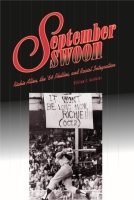




September Swoon
Richie Allen, the ’64 Phillies, and Racial Integration
William C. Kashatus
“September Swoon captures the drama of the 1964 pennant race while shedding much light on the problems the Phillies faced with the racial integration that centered on talented rookie Richie Allen. Any Phillies fan will enjoy reading Kashatus’s interesting book.”
- Media
- Description
- Reviews
- Bio
- Table of Contents
- Sample Chapters
- Subjects
Winner, 2005 Dave Moore Award presented by Elysian Fields Quarterly
More than any other team in Philadelphia’s sports history, the ’64 Phillies saddled the city with a reputation for being a "loser." Even when victory seemed assured, Philadelphia found a way to lose. Unfortunately, the collapse, dubbed the "September swoon," was the beginning of a self-destructive skid in both team play and racial integration, for the very things that made the players unique threatened to tear the team apart. An antagonistic press and contentious fans blamed Richie Allen, the Phillies’ first black superstar, for the team’s losing ways, accusing him of dividing the team along racial lines. Allen manipulated the resulting controversy in the hopes that he would be traded, but in the process he managed to further fray already tenuous race relations.
Based on personal interviews, player biographies, and newspaper accounts, September Swoon brings to life a season and a team that got so many Philadelphians, both black and white, to care deeply and passionately about the game at a turbulent period in the city’s—and our nation’s—history. The hometown fans reveled in their triumphs and cried in their defeat, because they saw in them a reflection of themselves. The ’64 Phillies not only won over the loyalties of a racially divided city, but gave Philadelphians a reason to dream—of a pennant, of a contender, and of a City of Brotherly Love.
“September Swoon captures the drama of the 1964 pennant race while shedding much light on the problems the Phillies faced with the racial integration that centered on talented rookie Richie Allen. Any Phillies fan will enjoy reading Kashatus’s interesting book.”
“September Swoon, by Bill Kashatus, is a great book chronicling the losing streak and the era. It will be released next month by Pennsylvania State University Press. This is a must-read for Phils’ fans. . . . Don’t miss September Swoon. It’s an excellent book.”
“September Swoon: Richie Allen, the ‘64 Phillies, and Racial Integration by William C. Kashatus is important because it not only chronicles how the Phillies disintegrated, but also looks at the racial tension surrounding the Phillies star rookie, Richie Allen.”
“Allen’s 1989 autobiography, Crash, was a toned-down version of what happened to him. In Kashatus's book, Allen now reveals the hatred he faced both in Little Rock, Ark.—where he was the first professional black player in the state's history—and in Philadelphia, where fans threw trash on his lawn. . . . Kashatus did impressive research, interviewing most of Allen’s teammates during that era. But he also faced the challenge of putting it in proper context. . . . [T]his is a notable book about a notable man in a notable time and place.”
“[Kashatus’s] credentials matter because as a historical work on the issues of race, the Phillies and Allen, Swoon is illuminating. . . . As to the baseball, fans know what happened. The strength of this book is that it gives us insight into why.”
“But the book is more than a torturous account of that fateful team. It represents a personalized portrait of Dick Allen, the recalcitrant slugger wielding a 40-ounce bat, who earned National League Rookie of the Year honors in 1964 after hitting .318 with 29 home runs and 91 RBIs. It traces the roots of the organization’s racism to what Kashatus describes as ‘the shameful story of race relations in Philadelphia’s baseball past’ to the painful process of integration during the 1950s and early 1960s, on to Allen, a power-hitting shortstop who was rewarded with a $70,000 bonus—the most ever paid to a black ballplayer at the time.”
“If you were a baseball fan in the 1960s, you’ll never forget the Philadelphia Phillies’ famous collapse at the end of the season. They were leading the National League by 6 1/2 games with 12 left to play and had a magic number of seven, but they lost 10 straight and ended the season a game behind St. Louis. You can relieve it by reading September Swoon: Richie Allen, the ‘64 Phillies, and Racial Integration by William C. Kashatus. . . . If you are a Philadelphia fan, you might not want to read it. It might be too painful to relive it all because Kashatus did his research with a capital R. . . . The 1964 season will never be forgotten by Phillies fans and most baseball fans and an excellent way to relive it is by reading the book.”
“[H]is narrowly defined thesis makes September Swoon a winner for those who read to learn. Tapping into a rich vein for social introspection, the author successfully builds a case for how changes in America at large changed our seemingly timeless National Pastime.”
“There are also dozens of previously untold backstage stories, including an incredibly moving tale of a blind girl befriended by catcher Clay Dalrymple. What sets September Swoon apart from previous ‘64 books is an earnest attempt by Kashatus to craft a parallel narrative about the seismic shifts that were occurring simultaneously in Philadelphia’s sociological landscape. Political figures and civil rights activists carry equal weight with the heroes of Connie Mack Stadium. At the center of everything is Richie Allen, the Phillies’ first true African-American superstar. . . . September Swoon follows the remaining path of Allen’s career, a path that ironically ends up in Philadelphia many years later. How he went from Philadelphia pariah to a beloved Quaker City sports icon is, in its own way, as compelling a story as the team’s tragic collapse of 1964.”
“It was this 1964 summer that the Philadelphia Phillies, who played in a stadium not far from the site of the riot, were contending for the pennant, after years of mediocrity. It was the year that Richie Allen, their muscular rookie third baseman, would become the team’s first black superstar. It is the story of Philadelphia in the summer of 1964, of this particular Philadelphia team, of this particular player, Richie Allen, that William C. Kashatus tells so richly and compellingly in September Swoon. My only surprise is that no one told this story sooner.”
“This is a marvelous little book about a sliver of time in baseball’s history. . . . Kashatus deals with the baseball issues with a seasoned journalist’s eye and with the racial ramifications with a historian’s sensibility (he is both a journalist and a professional historian). Smart baseball fans will want to read this book, though Phillies fans will probably cringe throughout, at both the failings of the team on the field and its even more substantial shortcomings on the question of race. Historians of modern America, race, and urban life will also find much of use in this relatively brief and largely successful treatment of September Swoon and its underlying ramifications.”
“I thoroughly liked his narrative and rate this book as an excellent read.”
“For followers of the Phillies and hardcore baseball fans, this is a recommended book. Mr. Kashatus is a capable writer who has done a good job of documenting the story of that infamous season.”
William C. Kashatus is a professional historian who earned a doctorate at the University of Pennsylvania. A regular contributor to the Philadelphia Daily News, he is author of several books, including Connie Mack's '29 Triumph: The Rise and Fall of the Philadelphia Athletics Dynasty (1999), Mike Schmidt: Philadelphia's Hall of Fame Third Baseman (2000), and Just Over the Line: Chester County and the Underground Railroad (2002).
Contents
Foreword by Gerald Early
Acknowledgments
Introduction
1. A Shameful Past
2. Integrating the Phillies
3. The Spring of '64
4. On Top of the National League
5. September Swoon
6. Seasons of Frustration
7. Breakup
Conclusion
Appendixes
A. What Happened to the 1964 Phillies
B. Individual Statistics for the 1964 Phillies
C. The 1964 National League Race
Notes
Selected Bibliography
Introduction
On Sunday, October 4, 1964, Richie Allen, the Phillies' rookie third baseman, walked into the visitor's clubhouse at Cincinnati's Crosley Field and readied himself for the most important game of a promising career. As he dressed in his gray-flannel uniform, Allen tried to make sense of what had happened to his team during the stretch. Up by six and a half games on September 20 with just twelve left to play, the "Fightin' Phils" appeared to have clinched their first pennant in more than a decade. But the following day they went into a tailspin, losing ten straight before beating the Cincinnati Reds on October 2. Now the Phils were one game behind the Reds and the St. Louis Cardinals, both of whom were locked in a first-place tie.<P>
Allen realized that his team no longer controlled its destiny. Not only would the Phillies need to defeat the Reds again today, but the Cards would have to lose their third game in a row to the lowly New York Mets. Only then would there be a three-way tie for first, forcing a round-robin playoff. On this final day of the season, then, Richie Allen found himself rooting for the cellar-dwelling Mets. <P>
Out on the field, Frank Thomas, a power-hitting first baseman obtained from the Mets in early August as insurance, was taking batting practice. When Allen got to the cage, Thomas reminded his younger teammate, "It's our turn today. The Reds started us on our ten-game skid. It's our turn to get them back." <P>
Friday's victory provided some relief for the team. Suddenly, they were themselves again, confident that they would win a playoff for the pennant. Now, on Sunday, they were seeking vindication, and it looked as if they might very well get it. Jim Bunning, the staff ace and a veteran of postseason play, would get the start. If the Phils could give him a few runs, Bunning could deliver the victory.<P>
The Phillies bats came alive in the third inning when Allen doubled off the center-field fence, driving in Tony Gonzalez for the team's first run. Reds manager Dick Sisler, had Johnny Callison intentionally walked, loading the bases. Wes Covington followed with a two-run single to right. Sisler lifted his starter, John Tsitouris, and called in left-hander Joe Nuxhall to face Tony Taylor, who promptly delivered a broken-bat single for a 3;150;0 Phillies lead.<P>
On the bench, shortstop Ruben Amaro, who had already ordered $1,800 worth of World Series tickets, was praying. "Please, God, give us a shot," he whispered. "Give us one more game." <P>
Allen struck again in the fifth, when he crushed a homer to center and followed it with a three-run blast to right the next inning. When the game was over, Bunning had pitched a six-hit shutout, walking just one batter, as the Phillies went on to a 10;150;0 whitewashing of the Reds.<P>
Afterward, Gene Mauch, the temperamental Phillies manager, sat in the visitors' clubhouse listening to the last few innings of the Cards' 11;150;5 victory over the Mets. It was over for the Phils. St. Louis had clinched the pennant. All that could be heard was the sound of the radio and the hissing spray of the showers as players sat near their lockers, stunned. The Phillies had just suffered the greatest collapse of any team in major league baseball history.
When the sportswriters entered, it was left to Mauch to explain the unexplainable.
"I just wore the pitching out," he admitted, taking a long drag on a cigarette.
"Would you have done anything differently?" asked a scribe, almost apologetically.
"If I knew how it was going to come out, I might've done a couple of things different," Mauch replied. "When you manage the way I want to manage, you don't miss something by a game or two."<P>
Again there was silence. Over the course of the 162-game season, the sportswriters knew when to tread lightly, especially with the Little General, who had a short fuse.
"All I can say is that I wish I did as well as the players did," said Mauch, wanting to end the interview. "They did a great job. That's all I've got to say."<P>
Before he could get away, though, another reporter tried to buttonhole him. "Are you implying you did something wrong?"<P>
"No. 148 snapped Mauch, "I'm implying nothing." And with that he walked away. <P>
Later that night, when the team's chartered plane arrived at Philadelphia International Airport, there were 2,000 fans waiting for them. As the plane stopped at the gate, Mauch, expecting a lynching, stood and faced his players. "I want to be the first one off," he told them. "You guys didn't lose it. I did." <P>
Instead, he and his young club were enthusiastically cheered. Philadelphia had fallen in love with the Phils in defeat.<P>
There would be no "next year"for those Phillies. Despite a lineup of talented young players and two of the era's best pitchers, the team never did recover from the 1964 swoon, instead spiraling downward into mediocrity. In his elusive quest to capture the pennant, Mauch began to overmanage his young team. Frustrated with the results, he then traded away the Phillies' future for proven veterans from other teams, few of whom panned out. Richie Allen, 1964 Rookie of the Year, was the pivotal figure of those teams. He was the Phillies' first African American superstar but he was also his own worst enemy. Although he hit over .300 during the next three seasons and added another 177 home runs through 1969, his off-the-field behavior earned him a twenty-eight-day suspension, a $500-a-day fine, and ultimately a trade to the Cardinals. Johnny Callison was the other half of the Phillies' slugging tandem, and the fan favorite. Voted runner-up to the National League's Most Valuable Player in 1964, Callison almost slugged the Phils into the World Series with his thirty-one homers and 104 RBIs. Once dubbed "the next Mickey Mantle," he finally seemed to realize his enormous potential. But after 1965 he never hit higher than .276 or more than 16 homers or 65 RBIs in a season. <P>
Jim Bunning and Chris Short were the workhorses of the pitching staff in 1964. On three separate occasions during the stretch, Mauch gave each man the ball with only two days' rest. Never did they refuse. Nor could they win, for they were exhausted by that point. Nevertheless, both pitchers continued to be productive after that fateful season. Bunning, who posted a 19;150;8 record in 1964, including a perfect no-hit game against the New York Mets, would go on to win another fifty-five games for the Phils and to see his earned-run average drop over the next three years before he was traded to Pittsburgh. Similarly, Short, 17;150;9 in 1964, would post another sixty-six victories over the next four seasons before his career was cut short by back surgery. If the Phils had had an effective bullpen, both Bunning and Short would have enjoyed even greater success.<P>
Allen, Callison, Bunning, and Short were the nucleus of the team. As they went, so went the Phillies. The supporting cast was solid, but not nearly as talented as the core. It was also Philadelphia's first truly integrated baseball team. Latin American players like Ruben Amaro, Tony Gonzalez, Cookie Rojas, and Tony Taylor provided speed on the base paths and a steady defense. African American players like Johnny Briggs, Wes Covington, and Alex Johnson added some power. Whites dominated the pitching staff as well as the catching. Dennis Bennett, Art Mahaffey, Ray Culp, and rookie Rick Wise were the other starters. Jack Baldschun, Ed Roebuck, and Bobby Shantz were in the bullpen. Clay Dalrymple and Gus Triandos split the catching duties. In 1964 this was a good team having a <i>great</i> year through 150 games. But in the final two weeks of the season, they were unable to jell. Nor would they ever again come as close to capturing the pennant. From 1965 to 1969, injuries, poor trades, and personal conflict among the players prevented the Phillies from finishing any higher than fourth place. Thus, a team that had the potential to contend for the next five seasons became tail-enders for the balance of the decade.<P>
Today, Connie Mack Stadium, where the team played, no longer exists. Most of the players are now in their sixties and live far from Philadelphia. Only one, Jim Bunning, made it into the National Baseball Hall of Fame at Cooperstown. Yet the 1964 Phillies still have a strong emotional hold on the City of Brotherly Love.<P>
More than any other team in Philadelphia's sports history, the 1964 Phillies saddled the city with a reputation for being a "loser." Even when victory seemed certain, Philadelphia found a way to lose. Call it "bad luck" if you will, but the team's infamous reputation became so ingrained in the fabric of the city's sports culture that even when the Phillies managed to win their one and only world championship in 1980, the victory did not evoke as much emotion as the 1964 swoon. But beyond the fact that the 1964 Phillies managed to blow the pennant when it seemed to be theirs for the taking, there is another, more subtle, reason that the team evokes so much emotion among the fans. It was Richie Allen, whose remarkable talent and controversial behavior forced Philadelphians to confront the racism that existed in their city during the most tumultuous period of the civil rights era.
The Phillies' reputation as a racially segregated team in a racially segregated city is not without foundation. During Jackie Robinson's quest to break the color barrier in 1947, the Phillies treated the Dodgers' rookie worse than any National League team did. Pitchers threw at his head, infielders purposely spiked him on the base paths, and—in one of the lowest moments in baseball history—the Phils humiliated Robinson by standing on the steps of their dugout, pointing their bats at him, and making gunshot sounds. The Phillies were also the last team in the National League to integrate. They did not field an African American player until 1957, when infielder John Kennedy appeared in five games for the Phils—a full decade after Robinson broke the color line. Even then the Phillies maintained segregated spring-training facilities, a practice that was finally abandoned in 1962. <P>
To their credit, however, the organization made an earnest effort to integrate during the 1960s. Talented African American and Hispanic players were added to the roster, and their white teammates quickly welcomed them. They were young players, most of them in their early twenties, and their youthfulness as well as their desire to win transcended the racism of the earlier generation. By 1964 the players had created, both on and off the field, a special team chemistry that allowed them to play exceptional baseball for 150 games. It looked to be a team of destiny, the first Phillies squad to capture a pennant since the Whiz Kids fourteen years earlier—until the last fateful weeks of the season.<P>
For myself, those Phillies, the very first team I followed in any sport, provided me with an introduction to the national pastime itself. Like most other passionate fans, I fell in love with the Phillies as a youngster and continue to follow them today. Their successes and failures provide certain benchmarks in my own life. Predictably, some of the most vivid memories of my childhood come from September 1964: hiding under the bed covers at night listening to the games with a transistor radio to my ear; my bus driver delivering an animated play-by-play on the ride to school; and, after the season ended, seeing tears in the eyes of so many fans—including grown men—who had had such high hopes.<P>
Forty years later, I still wonder what exactly it was about that season that made grown men cry. After all, it seems foolish to get wrapped up with anything so insignificant as other grown men playing a child's game. I guess I really did not know until I began writing this book. What I discovered is that while it's easy to glory in a team triumphant, some of us fall in love even with a team in defeat. There is something uniquely endearing about the 1964 Phillies because they lost the pennant after such great striving. But there is something <i>magical</i> about a franchise that has a shameful history of race relations going on to field an integrated team that almost won the first pennant in more than a decade.<P>
What it all boils down to is the business of caring. In 1964 the Phillies got many, many people to care deeply and passionately about the game at a turbulent period in Philadelphia's—and the nation's—history. Just as the Vietnam War, the civil rights movement, the counterculture, and the violence in the streets were beginning to rock the city, so too did an extraordinarily gifted team of young African American, Hispanic, and white athletes. While they were hardly the Brooklyn Dodgers, the Phillies were, for many of us, our very own "Boys of Summer." They provided some stability in a period of great instability, something we could count on night after night, at least for 150 games. We reveled in their triumphs and cried in their defeat, probably because in them we saw a reflection of ourselves. In all these ways the 1964 Phillies won not only our loyalties but also our hearts.<P>
Based on personal interviews, player biographies, and newspaper accounts, <i>September Swoon</i> details the careful cultivation, history, and eventual breakup of Philadelphia's first integrated baseball team as well as the bittersweet season of 1964. Chapter 1 addresses the shameful story of race relations in Philadelphia's baseball past and provides a useful context for understanding the challenges and rewards of integrating the Phillies during the late 1950s and early 1960s. Chapter 2 explores the process of integration itself for both African American and Hispanic players, how the club's white players responded to that process, and the Phillies' discovery and cultivation of Richie Allen, their first African American superstar.<P>
The 1964 season is the focus of Chapters 3, 4, and 5. From the club's fast start in the spring through mid-September, readers will appreciate the summer-long soap opera of close games, influential trades, and key victories that propelled the Phillies into first place and kept them there until the last week of the season. The September swoon may be difficult for many of the more seasoned fans to revisit, but for those who want to understand the collapse there is a game-by-game summary as well as ample explanation for it. Chapters 6 and 7 trace individual and team highlights, as well as Allen's ongoing conflict with management, fans, and the sportswriters, a clash that ultimately led to the team's breakup in 1969. The book concludes with a brief statement about the significance of the 1964 Phillies and Allen's legacy to the history of race relations in Philadelphia baseball. In combination with the statistical material included in the appendixes, the Conclusion reveals the tragedy of unrealized potential for a team that should have been contenders throughout the period 1964 to 1969.<P>
Still, 1964 will forever remain an enchanted summer for Phillies fans. For a team that had lost more games in the twentieth century than any other major league franchise, 1964 was a season to dream—of a pennant, of a perennial contender, and of a city of brotherly love.
Also of Interest
Mailing List
Subscribe to our mailing list and be notified about new titles, journals and catalogs.