



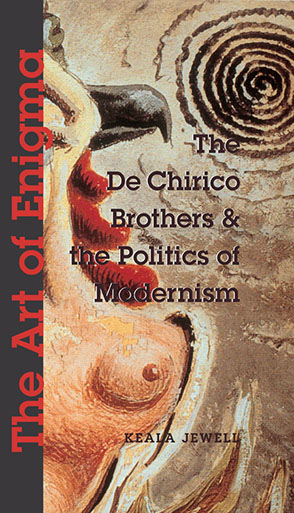
The Art of Enigma
The de Chirico Brothers and the Politics of Modernism
Keala Jewell
“In this fine book, Keala Jewell studies the works of Giorgio de Chirico and his younger brother Alberto Savinio who together produced an oeuvre shrouded in ‘the motif of secrecy.’ The Art of Enigma, an authentically interdisciplinary book, is the first study that considers the brothers together and addresses the important task of defining and characterizing the Metaphysical art that the brothers developed, especially as it differs from Surrealism, and establishes itself as an Italian, rather than a French, art.”
- Description
- Reviews
- Bio
- Table of Contents
- Sample Chapters
- Subjects
Rather than looking for a key to unlock the secrets of the brothers’ recurrent use of dislocated spaces and bizarre hybrid figures, Jewell focuses on assessing the issues of identity and mastery put at stake in the haunting enigmas that characterize their paintings and writings. Deeply impressed by Nietzsche, she argues, they believed the "human" is inherently unstable and must be constantly "rewoven" with analogies and metaphors seized from empowering states of being.
Jewell’s approach to the de Chirico brothers breaks new ground, not only because it brings them together as artists and writers but also because it sets the brothers within the context of myth, history, and Italian culture politics, instead of French surrealism and its aesthetic and psychoanalytic theories. Further, Jewell’s strong readings of little-known paintings and notoriously difficult texts like Giorgio de Chirico’s Ebdòmero will expand and diversify the sources used in modernist studies.
“In this fine book, Keala Jewell studies the works of Giorgio de Chirico and his younger brother Alberto Savinio who together produced an oeuvre shrouded in ‘the motif of secrecy.’ The Art of Enigma, an authentically interdisciplinary book, is the first study that considers the brothers together and addresses the important task of defining and characterizing the Metaphysical art that the brothers developed, especially as it differs from Surrealism, and establishes itself as an Italian, rather than a French, art.”
“By turning her focus away from the familiar Metaphysical canvases of de Chirico’s work of the 1910s, Keala Jewell finds new and exciting relationships between the art and politics of the 1920s and 1930s. As such, this book makes a significant contribution to the field. The Art of Enigma has all the markings of a landmark study in the field.”
“It must be said that Jewell, a prominent scholar in the field of Italian literature, measures up unflinchingly and with penetrating subtlety, so that, although her attention concentrates on the literary output of the two brothers, this in no way diminishes the value of its contribution to a fuller understanding of their painting.”
“What would it mean to look at de Chirico differently? . . . Keala Jewell’s new book The Art of Enigma: The De Chirico Brothers and the Politics of Modernism provides the answer to this question by examining the work of the de Chirico brothers, Giorgio and Alberto (later know as Alberto Savinio) together. . . . What emerges is a new picture of the de Chiricos that refuses easy definitions and is salutary for its protean spirit of inclusiveness and heterogeneity.”
Keala Jewell is Paganucci Chair of Italian Studies at Dartmouth College. She is the author of The Poesis of History: Experimentation with Genre in Postwar Italy (1992), editor of Monsters in the Italian Literary Imagination (2001) and co-editor of The Defiant Muse (1985).
Contents
Acknowledgments
List of Illustrations
Introduction
1. De Chirico’s Cultural Topographies
2. The Cultural Shapes of Space
3. Heroic Cultural Intelligence
4. Inaction Heroes: De Chirico’s Gladiators
5. Isadora Duncan as Metaphysical Heroine
6. Creatures of Difference: Savinio’s Monsters
7. Savinio’s Jewish Hermaphrodite
Afterword: The Brothers Look Back
Bibliography
Notes
Index
Introduction
Infinitude is everywhere, and everywhere is mystery.
—Giorgio de Chirico
The de Chirico Brothers Together
Their names are the first puzzle we encounter when we study the de Chirico brothers. Since they were siblings, they ought to share a last name. Yet they did not, by choice. The more famous of the two was Giorgio de Chirico (1888–1978), a painter, sculptor, set designer, and accomplished writer. His younger brother, Andrea de Chirico (1891–1952), first a composer and subsequently a writer and painter, went from the time he was a young man by another name: Alberto Savinio. The reasons behind the change are unclear, and we have no convenient explanation from Savinio. That he would leave the question a mystery is, however, not surprising. The most striking thing about the work of both de Chiricos is its enigmatic quality. Both chose to use the word “enigma” in painting titles, as in de Chirico’s Enigma of the Oracle and The Enigma of a Day, or in Savinio’s Enigma of the Sea. Cloaks, veils, curtains, and dark corners appear over and over on the brothers’ canvasses as signs of the motif of secrecy. This led one critic to observe that de Chirico was “one of the most complex and contradictory artistic figures of our century.” It is not easy to be such a sphinx, but de Chirico was willing to offer some tips that were born, interestingly enough, out of his experience as a sibling. The best example of an enigmatic effect, he tells us, occurs when two brothers stand side by side. Their similarity throws the observer off balance. One must stop and stare a moment because the two men look alike, yet not exactly. De Chirico’s portrait of himself with his brother Alberto offers a concrete example of this kind of resemblance (fig. 1). Savinio’s name change only adds to the unsettling effect the brothers may have hoped their kinship might produce in others. (I myself may be generating an uncanny effect when I refer to “the de Chiricos” in the plural and use “de Chirico” and “Savinio” when referring to them individually.)
Were it not for their shared love of puzzles, to look at these two men together might seem odd. The art of individuals is always unique. There are, notwithstanding this, advantages in considering the brothers together. Most obviously, their shared thematic interests are worth investigating: both siblings painted mythological subjects and wrote about them; both had a predilection for mannequins, nudes, tools, and toys; and both obsessively depicted oddly skewed platforms and walls replete with windows and niches. Positioning de Chirico and Savinio within one framework, however, yields critical insights that move beyond the mere cataloguing of the innovative subject matter the brothers developed in tandem. When they are examined together, an important, neglected fact is thrown into relief. Alberto Savinio made crucial contributions to the artistic and literary movement known as the “Scuola metafisica” (Metaphysical School) that are too often ignored, especially outside Italy. The result is that de Chirico seems to have achieved his brilliant innovations single-handedly, while Savinio is rarely mentioned in twentieth-century histories of art. In fact, both brothers contributed to and theorized Metaphysical artistic practice. It is interesting to learn that, at the outset, Savinio had the broader reputation of the two, and it was de Chirico who was known mainly as Savinio’s brother—a situation now reversed. One critic wrote, “we now know how much Metaphysical painting owes to Savinio’s thought.” To give just one example of Savinio’s brilliance, it was he who, inspired by Guillaume Apollinaire, first depicted an “homme sans visage” (faceless man), in his poem “Les chants de la mi-mort” (The Songs of Half-Death). The face without features, as though on a tailor’s dummy, later became de Chirico’s hallmark. Looking at the two men together reminds us of the important double genesis of a movement that, according to Jean Clair, was the basis of both Surrealism and magical realism.
Another reason for studying the brothers together is that this book focuses primarily on literary works. De Chirico wrote two novels, both notoriously difficult. Neither has received the critical attention it deserves and both could benefit from a comparative interpretative approach that links them to other literary texts, by Savinio and others. Savinio was a prolific, original, and influential writer. It is therefore natural to focus on him when we consider fiction rather than painting. When we apply a literary framework to the Metaphysical School, Savinio in fact stands out as the more influential brother. Attention to the literary productions of the two men can compensate for an imbalance in critical commentary that has focused a great deal of attention on de Chirico—and on his painting—within the Metaphysical School.
The Double Artistic Biography
The de Chiricos’ shared backgrounds led to a remarkable twinning of artistic and literary motifs, interests, and styles. The brothers grew up abroad, where their father, an Italian engineer, was helping to build modern transportation systems for Italy’s own cultural older brother: Greece. Hellenic figures from Hector to Jason consequently appear throughout the works of both brothers in equal measure. While still young men, the de Chiricos lost their father and soon began a wayfaring life, moving among different artistic capitals in Europe—nearly always together. Needless to say, they shared a mother, one who followed them in their travels and strongly supported her sons’ artistic careers. So close were the men’s outlooks and so strong their solidarity that they took to calling themselves the Dioscuri, after the sons of Zeus and Leda who joined the expedition of the Argonauts in search of the Golden Fleece. Like them, the de Chiricos were on the move and on a quest.
Savinio chose Munich as his first adoptive home after his father’s death in 1905. He studied with Max Reger there during his first career (of several), as a composer and musician. De Chirico soon followed his younger brother to Bavaria and became enamored of German Symbolist art and German philosophy—especially as it engaged Greek thought. Both were great readers of Friedrich Nietzsche. The brothers next moved to Paris, around 1910. There the first hints of a “metaphysical” style emerged in de Chirico’s painting. The epithet “Dioscuri” for Giorgio and Alberto became common in the avant-garde circles in which the brothers moved in France, where Apollinaire, a writer who shared their “international” origins, introduced them to Picasso, Picabia, Brancusi, Jacob, Modigliani, and Cocteau. So close indeed were the ties with Apollinaire that Savinio composed music for his friend’s drama, Les mamelles de Tirésias. A solo concert in Paris using his own compositions caused an uproar when Savinio—in a pre-rock gesture—destroyed a piano on stage, leaving blood on the keys. The brothers had clearly embraced the great movement of artistic experimentation taking place in those years in France.
Savinio soon gave up music altogether (he found it “irrational”), in favor of both a prolific literary effort and an intense, sustained theoretical reflection on aesthetic questions. In tandem, in Paris and then in Ferrara, the brothers articulated the concepts, methods, and practice that would lead to the growth of the Metaphysical School. It was the call to arms for the war that took the brothers from France to Italy. They met up in Ferrara in 1915 with Carlo Carrà and the local artist Filippo de Pisis, both considered major contributors to the Metaphysical School. In Ferrara the de Chiricos also began to forge important ties with the Italian writers Giovanni Papini and Ardengo Soffici—an ex-Futurist. The “Scuola Metafisica” in fact followed after Futurism chronologically and took Futurist stylistic innovations—such as simultaneous spatial perspectives—into account. The de Chiricos were also, however, differentiating themselves from some exponents of Futurism. If Marinetti wanted to sink Venice, ancient and decrepit as she was, neither of the de Chiricos would ever have engaged in such a “physical” undertaking. The “metaphysical” bent of the de Chiricos led them to continue to draw from the “warehouse of the past” in their artistic experimentation. Both brothers insisted on “citing” the past so that well-known images and themes from the artistic heritage might be reshaped into disquieting poetic enigmas. In this sense, we can speak of an “other modernism” whose gaze did not fix itself in the direction of a spanking new future.
The brothers managed to be stationed together in Italy for only a short time. In 1917 Savinio was shipped to Salonika, at the Macedonian front, to be a translator for the Allies. De Chirico stayed on in Ferrara. In Salonika, besides engaging in important correspondence with Tristan Tzara, Savinio produced his first full-length literary work. Written in both French and Italian and renowned for its jarring, “nonsensical,” ironic, playful, and grotesque qualities, Hermaphrodito (Hermaphrodite, 1918) was one of the most extraordinary of wartime novels. A precursor of “surrealist” texts, the novel turned literary traditions on their head by featuring odd juxtapositions of poetry and prose. At the same time it favored “realistic” modes, such as the historical narrative or the journalistic essay.
De Chirico never saw a front or a battle because he remained under “psychiatric care” at the military hospital in Ferrara. He relates in his memoirs how a doctor took one look at his receding chin and classified him as weak-minded. From 1916 through 1918 Giorgio worked to define in his painting and in his theoretical writings just what modern art should be and just what Italian art ought to be. It was in Ferrara, the city he called “highly metaphysical,” that he developed his notion that the Italian cultural tradition was “polymorphic”—just when his brother was writing about a “hermaphrodite” in the Balkans. It should be said, though, that while the brothers’ work often seemed to have been produced in concert, de Chirico’s painting in Ferrara and Savinio’s literary production at the front evince some important differences. Giorgio generally shied away from Savinio’s black humor, and he never became the effective journalist his brother was. De Chirico clearly preferred seamless, elegant, slippery enigmas to puzzling, rough, comic grotesques in gender-blending shapes. Giorgio strove to capture on canvas a luminous Italy reminiscent of the Quattrocento—an effort his brother did not support. Interestingly, de Chirico’s 1929 novel Hebdomeros is the one work most reminiscent of Savinio’s distinctive penchant for the grotesque. It is as though some outlooks repressed in painting can rise to the surface in prose.
After the First World War the brothers’ wayfaring continued. They moved principally between Paris and Rome. In Italy both were influential in what is called, rather simplistically, the “return to tradition”—a tendency associated with the Italian journal Valori plastici (1918–22) and some others. It may be true that an intense period of artistic experimentation was behind them and that classical themes began to dominate (especially in some of de Chirico’s better-known paintings). We should not neglect, however, the de Chiricos’ ongoing rejection of naturalism and traditional realism, which each put into effect in somewhat different ways. This refusal was, in any case, mediated in both brothers by a return to the classics, especially by recourse to a Greek way of conceptualizing nature. The central idea was that the Greeks imbued nature with a “senso archittettonico” (architectural sense) and saw “form” everywhere. Modern art should take a cue from antiquity to consider forms as values; for example, the circle is ideal, the arch harmonious. Forms serve the purpose of edification in both senses of the term. De Chirico wrote in Valori plastici in 1920: “Nature itself was seen by the classical painter with the eye of an architect and builder.” As Pia Vivarelli put it, for de Chirico “recuperating the past is understood . . . as a vector toward modernity.”
The title of the journal the brothers involved themselves with, Valori plastici (Plastic Values), is important in this respect. The brothers continued to explore in Rome, just as they had in Paris, how they might renew the cultural tradition in a modern key. It is therefore not surprising that, despite his postwar “return to tradition,” de Chirico took part in the founding of Surrealism in Paris when he returned to work there. We observe him at the center of Man Ray’s 1925 photograph of artists linked to La Révolution Surréaliste, in whose first issue de Chirico published a prose poem. Numerous Surrealist painters (including Max Ernst, Yves Tanguy, Salvador Dalì, and René Magritte) acknowledged de Chirico’s influence, and Cocteau quipped that the Italian “homme-enigme” was an “honneur de la France” (an honor to France). The writer André Breton provided the most laudatory account of the achievements of both Giorgio and Alberto when he asserted that “Tout le mythe moderne encore en formation s’appuie à son origine sur les deux œuvres, dans leur esprit presque indiscernable, d’Alberto Savinio et de son frère Giorgio de Chirico” (All modern myth that is still evolving relies at its origin on the two nearly inseparable bodies of work of Alberto Savinio and his brother Giorgio de Chirico).
While keeping in mind Breton’s acknowledgment of the inseparability of the brothers, his praise of them, and some affinities between the Surrealist and Metaphysical outlooks, it is also important not to gloss over some differences between the two movements. A dramatic break between Breton and de Chirico took place in 1926. Debate over the “return to tradition” made for complicated, and sometimes bitter, relations. On the Surrealist side, some considered de Chirico a traitor to artistic revolution because of his penchant for antiquity and the epic tradition. In subsequent years, only work done before 1925 or so was considered by Breton—and by numerous other critics of all stripes—to be original and innovative. The de Chiricos had reservations of their own about their counterparts. Both expressed skepticism about the Surrealist theorization of an “automatic” or “unconscious” generation of art, a theme addressed by Savinio much later, in a 1940 article in the journal Prospettive. In a number of other articles, he further articulated his disagreement with the Surrealists on this score by explaining that he admired Freud principally because he peered into the “depths of the human” and stripped those depths of their “idealist superstructure.” For Savinio, Freud was able to demystify the “inner world.” There were also differences with Surrealists on how art might absorb or digest modern ways of circulating objects and images. Though the brothers worked in mixed media, they never came to feel the same fascination for the “ready-made” object that artists such as Duchamp and Ernst experienced.
One result of the parting of the ways between de Chirico and Breton was the emergence of a new and distinct critical terminology for referring to the brothers and distinguishing them from the French movement and even from the Ferrara period. The de Chiricos and a few other Italian nationals, such as Filippo de Pisis, were working in Paris in the later twenties, when Savinio began greatly to intensify his painting activity. The group came to be known in critical circles and in exhibitions as “Les Italiens de Paris.” Although the de Chiricos were not in Paris continually, the appellation stuck. In fact, both artists constantly had one foot in Italy. De Chirico sometimes exhibited his work with the group of painters known as “Novecento” (Nine Hundred), and he and Savinio were also loosely allied with the “Scuola Romana” (Roman School).
Precisely because both brothers moved back and forth between Rome and Paris for a good number of years, they came to be seen as altogether stateless (“apolidi”). This term may have emerged as a form of praise at a time when Paris was drawing avant-garde artists and writers from all of Europe. Already in 1927, however, Carrà irritated de Chirico by calling him an insufficiently Italian “greculo” (little Greek). In a more famous incident, also in 1927, the brothers were called “Jewish” in an article in Il Selvaggio, presumably for having no homeland in their detractor’s chauvinistic and anti-Semitic view. Savinio was sarcastically dubbed in the same piece “l’ineffabile” (the ineffable one). In the thirties statelessness took on meanings of an ever more threatening nature. During the Fascist period, with its cult of the nation, the de Chiricos’ “international” choices began to cause them problems that were hardly “metaphysical.” At a very practical level, de Chirico suffered discriminatory treatment by the organizers of state-sponsored exhibitions that tended to exalt the nation. Ironically, the artist appealed to Mussolini in 1935 to try to remedy the situation. Within a few years, accusations of a lack of patriotism became very serious. In 1938 one critic, Telesio Interlandi, characterized de Chirico’s 1929 painting “Manichini araldici” as “foreign, Bolshevik, and Jewish.” De Chirico’s wife, Isabella Far, was Jewish, and he soon feared for her safety and that of other Jewish artists to whom he was close.
The ironies of this situation were multiple. Savinio had deployed a discourse about Jewishness in his own attempts (in a piece entitled “My Jewish Hour”) to imagine a collective identity beyond what he understood to be “nationalistic” one. Jewish cultural cohesion despite the Diaspora had, he judged, given him a model for such an identity. De Chirico also articulated a discourse on Jewishness, declaring in his writings that he had been inspired by Jewish neighborhoods during the years he spent in Ferrara. He executed a number of paintings with explicit references to Jews, including the well-known Jewish Angel. This fascination with another ancient culture—like his love for the Greeks, Etruscans, and Romans—worked its way deeply into de Chirico’s thinking about style. More than once he attempted to theorize modern art’s bent for abstraction in the context of a presumed Judaic disposition to the nonfigurative. In short, the de Chirico brothers generated a series of analogies between Italian and Jewish culture as they attempted to recast tradition for modernity. The project clearly backfired when they were branded as rootless “Jews.” This irony was compounded by the fact that the brothers had lived and traveled abroad so much that Italy was in a sense truly an enigma to them. Perhaps because it was, both men spent decades exploring the topic of Italianicity and laboring to give substance to their passport identities. They were charged, all the same, with an unpatriotic “internationalism.”
The de Chiricos’ unique “rootlessness” extends beyond biography to their concrete aesthetic opinions on painting and writing. In one sense, when they championed the notion they did so out of a desire for all things “unbound,” out of a desire to be cut loose from what they saw as stifling, narrow bourgeois “forms”—including such “forms” as the “nation.” That desire for political and artistic freedom dovetailed with a modernist rejection of traditional artistic values in favor of experimentalism. Here the term “modernist” does not designate “those who are pro-modern” in the sense that they favor of an all-out modernization of Europe; the term does not imply acceptance of a world marked by industrialization, science, and economic prosperity. All of these things might have been seen by modernists as linked precisely to prosaic bourgeois values. In a different sense, the de Chiricos’ discourse about rootlessness veers away from an association with the emancipatory and shades instead into one about “deracination.” As such, it was not employed in favor of intellectual and artistic liberty but instead in the pursuit of a critique of a modern culture that had brought with it the sense of being adrift, of alienation, of a lack of authentic humanness.
It was typical of the Metaphysical School to engage modernity in this ambivalent and contradictory way. There was a desire to liberate oneself and to cut all ties. At the same time, we hear laments about being unanchored. It was by no means a banal dilemma. But in the process of grappling with the problem of twentieth-century culture, the de Chiricos labored to imagine and define a countermodernity. They gave us in the bargain a new and unforgettable recasting of the classical heritage. Etruscan, Egyptian, Greek (especially the pre-Socratics), and Roman cultures came forward through time to appear as countercultures to modernity. They become available in part through their continued presence in Italy, still replete with ruins of the past. Here again the effort was common to both brothers. Theirs, of course, was not the only way of conceiving national identity. Others had competing views of what an overarching, collective identity might be. The Fascistic exalting of nationhood was one, the Marxist another. Antonio Gramsci argued that Italian identity could be derived througha proletarian class consciousness that could extend to other groups (intellectuals and peasants). But the de Chiricos saw the antidote to both statelessness and its opposite, chauvinistic nationalism, in Italy’s distinctive cultural traits.
The political hot potato of statelessness provides another reason for looking at the de Chiricos’ work together, for both brothers sought to define identity in ways that set their thinking within a panorama of possibilities emerging in this historical period. To imagine a collectivity out of heterogeneous beings was broadly understood to be a task of modernity itself; it was hoped that modernization would be the catalyst for the unifying process. It is important to recall that with their prerogatives of modernization (railways, roads, resources), national states began in the nineteenth century to emerge out of the old overarching empires—and on the Italian terrain there had been several of these (Bourbons, Hapsburgs), not to mention a long period of papal dominion. The First World War, during which the Metaphysical School was developing its poetics, was the climax of a disputed process of national unification in which competing interests were promoting differing notions of identity. Shortly after the war, Fascist ideologues of nationalism claimed that a strong state could forge a strong, modern Italian identity. That identity was imagined in different ways by various concerned parties. The debate that most engaged the de Chiricos came in the later 1920s, when numerous articles appeared in the literary press on how to think of Italy as part of Europe after the advent of the Fascist movement. At issue, among other things, was Italy’s place in a “New Europe” that was supposed to separate itself from what was called, disparagingly, “Eurasia.”
Given this historical situation, the attempt to bring into cultural reality an ever-elusive Italianicity must be seen to have characterized the brothers’ output throughout their lives, and well after both settled down in Rome after the Second World War. Because of this, the subject of cultural politics is exceptionally engaging in their work. The controversies related to the rise of modern nationalist ideologies were in fact ever present in the texts of the de Chiricos. Outraged at not being considered Italian enough, de Chirico would gloat in his memoirs that even when he was living in Paris he understood Italy better than any Italian artist working on the native soil. He lamented that Italian avant-garde artists were the ones “Frenchifying” themselves, while he, in Paris, was “constructing in my paintings a forceful Italianicity unrivaled by our homegrown artists (not just painters) to this day.”
The idea of “Italianicity” that might differ from the “homegrown” variety also engaged Savinio as he tried to define an identity based not on birthright or residence but on a shared sense of the cultural past and a singular cultural “immortality.” In 1933 he assumed the editorship of a journal, Colonna, that set out in that direction. At issue in Colonna was the politics of framing the past, not only of Italy and but of other nations or constellations of nations. In the first issue Savinio wrote an editorial on the “destiny” of Italy. The complicated piece juxtaposes Mediterranean and northern cultures and claims that the latter had displaced Roman culture a thousand years earlier, at the end of the first millennium. By the end of the second millennium northern culture was degenerating—much to his relief: “Il ‘capitale’ della cultura settentrionale ora non fruttifica più: essa spende il capitale” (The “capital” of Northern culture no longer fructifies: it is spending its capital). After a long dominion, Mediterranean Italy had in store a new political destiny and new culture that were not northern but were, as yet, inchoate: “ancora non ha nome” (it still has no name). The piece rather pointedly does not supply the word “Fascist” to name the phenomenon. And it is important to trace some of the nuances in what appears to be a generalized nationalistic fervor in Savinio’s essay.
Colonna did publish decidedly antidemocratic tracts, and one frequently finds racialist formulations in its pages. Savinio himself assumed racialist attitudes when, for example, he expressed his fear of a “pericolo giallo” (yellow peril), an “Oriental” culture that might be powerful enough to replace the declining North. In Fascist Italy in the thirties, the question of how the country’s political destiny would intersect with some framing of its past was not inconsequential. The stakes were enormously high. The Nazis came to power in Germany in the same year that Savinio began to conceptualize his role in cultural politics through his editorship of Colonna. Savinio was certainly no supporter of the Nazis. Hitler had the obvious problem, in Savinio’s view, that he was a northerner. Savinio did not, additionally, believe in the possibility of the straightforward revival of any culture’s past, and thus he could not concur with Mussolini’s re-clothing of Augustan imperial Rome in Fascist garb. While recognizing the power of the past to shape the future, Savinio also did not revere it as an unproblematic heritage. In fact, a supposed lack of reverence toward the national literary tradition led Fascist censors in 1939 to close down a journal for which Savinio wrote regularly; in Omnibus he had asserted that the great Italian poet Giacomo Leopardi died from an overdose of ice cream. During the Second World War the stakes rose even higher, and Savinio had to adopt a pseudonym and eventually go into hiding when he was threatened with confinement.
Enigmatic Italy
To forge their theories of national being (“Italianità”), the de Chiricos certainly drew on their familiarity with tradition, which they considered the supreme nourishment for their work. Italy was understood to be unique because of its abundance of old traditions; it was to them the most “multiplicitous” and heterogeneous of places, possessed of rich layers of culture: Greek, Roman, Christian, and modern. Italianate seaports and shores (evidence of the seafaring spirit of eternal Mediterranean Argonauts), Tuscan, Roman, and Piedmontese plazas and villas, Renaissance arcades, municipal towers, and mythic cities all crowd their painterly extravaganzas, along with icons of ages past in the form of ruins, sculptures, and friezes. De Chirico’s paintings and literary works alike have been called “an instantaneous vision of a long stratification.” De Chirico told of how, gazing at Piazza Santa Croce in Florence, he first understood how the physical Italian landscape absorbs memories and the traces of past outlooks on the world, from pagan times to the present. Italy and an enigmatic “other world” are joined in the Sante Croce narrative. An “impossible” bringing together of disparate temporal elements occurs as a matter of course in the Italian piazza and the Metaphysical text alike. Marcel Duchamp gave an astute explanation of the term “Metaphysical” when he wrote that de Chirico “organized on his canvas an encounter of things that could only be joined in a ‘metaphysical world.’”
The idea that the nation can be conceived of as a unique collection is inseparable from broadly political questions concerning the nature of modern nationalism. The same applies to the uniquely mixed characters that populated Metaphysical texts, both verbal and visual. The Metaphysical School engaged the motif of a hybrid homo sapiens with an intensity equaled perhaps only by Ernst. Spectacular hybrids abound in the de Chiricos in the form of mannequins, dummies, statue-people, ephebes, hermaphrodites, humanoid furniture and architecture, bird people, and human beasts. Pure bodies, pure humanity, pure races, and pure sexes all seem to have disappeared. These characters dwell comfortably within the deformed, dislocated, “impossible” spaces that appear to be connatural with their essence. Savinio’s painting The Departure of the Prodigal Son (fig. 2), which sports giraffe-people, provides just one example. The differences between the oeuvres of the two brothers pale, in fact, when we look at them from the perspective of the thematics of mixture both propounded.
The art historian Waldemar George first drew attention to the stylistic corollary of the theme of multiplicity. He coined, along these lines, the term “écriture picturale” (pictorial writing) for de Chirico’s painting. Both de Chiricos favored the method of mixing media and genres of representation. They strove for mastery of the various arts, like Renaissance men. Metaphysical texts typically combine verbal and visual signifiers at the same time that they depict the shapes or forms born of cultures past: arches, columns, scrolls, the tympanum, and the letters of ancient and puzzling alphabets. Actual verbal texts can appear quite literally in a painting in the form of a trompe l’oeil marble tablet, as in de Chirico’s 1920 self-portrait, which contains the inscription “et quid amabo nisi quod rerum metaphysica.” Highly literary titling for paintings is common, as in the famous Le Muse inquietanti (The Disquieting Muses), which itself evokes multiple inspirations—the plural muses. Visual subjects are often drawn from well-known literary narratives, as when de Chirico depicts Jason, Ulysses, or Hector, or from the Bible (e.g., the Prodigal Son). Both brothers did extensive illustration of modern literary texts (including works of Cocteau and Massimo Bontempelli). In short, both brothers pushed their talents in many directions in order to produce this stunning multiplicity.
If such was their method, what was the purpose? What do these methods and themes do for the de Chiricos or, put differently, what is at stake in their representations? I take the view in this book that there is a purpose. In the first half of this book, on de Chirico, and in the second, on Savinio, I study how and why the brothers produced a puzzling mixedness in an attempt to define Italianicity in modernity. How is a great cultural tradition, rich with its diverse heritage, to be parlayed into a modern national identity? How can that identity avoid the pitfalls of chauvinism? How can artists resist critical norms dictated by ideologues who juxtapose to the “irrreal” styles of the de Chiricos a (supposedly) “classic,” “plastic” art consonant with Italian art and Fascism itself? To answer these difficult questions meant imagining what de Chirico called a “terra nuova” (new world). This had to be done by drawing on the cultural tradition that was to enable the project. For the de Chiricos, some cultures excelled in providing an outlook for the future, and they achieved this because of the way in which they had evolved. Some cultures come to appear heroic for their world-imagining talent, for being highly “Metaphysical.”
Yet is the cultural tradition, even reframed, really all that goes into imagining a “new world?” Through a brief analysis of heroic motifs and the Dioscuri myth, we can see how not only tradition in the abstract but contemporary cultural notions or subtexts went into the making of the “new.” The deployment especially of symbolism, associated in the Western tradition to the two genders, male and female, is essential to the project the de Chiricos undertook.
Binding Tradition and Heroism: The Myth of the Dioscuri
A painting by Savinio done in 1929 tellingly depicts the hard labor, the bravura, that goes into pounding out this new world, which is connatural with a new metaphysics. In his Bâtisseurs du Paradis (Builders of Paradise) (fig. 3) we view spectacularly muscle-bound men laboring up a spiral staircase. The scene is set against a celestial sky and made from what look like puzzle pieces or star points. The active, strong male body stands as the trope for tough cultural effort and achievement, for the hard work of constructing paradise. None too surprisingly in a painting depicting the construction (“bâtisseurs”) of metaphysics, Savinio opts to show labor performed by males who “carry” significance. In doing so, he invokes a Platonic metaphor immortalized in the Symposium and much beloved in the Italian tradition: the male body is the object of an erotic longing that ultimately detaches itself from things bodily and moves instead to embrace moral goodness as its object of desire.
Not for nothing do male heroes, in the form not only of builders but also of combatants and voyagers, constitute a founding trope of the Metaphysical School on several levels. Castor and Pollux, Orestes, Hector, Jason, all abound as subjects. They represent examples of bread-and-butter heroic narratives—tried and true, hardworking, long-lasting and worthy standbys in the West’s cultural project. The Argonauts’ expedition in particular sparked the imagination of the de Chiricos and was selected by them as a kind of personalized myth with autobiographical significance. The Argonauts’ journey became a clear and dominant metaphor for the de Chiricos’ own extensive journeys, from the time they left Greece. The Argonauts were also a select group of intrepid men, and this trait was easily assimilated to the ideology of the artistic avant-garde. (In a letter to de Chirico, Papini once gushed with enthusiasm at attaining “Argonaut” status.)
The heroic motif was fundamental in still other ways. Admirers of Metaphysical art appreciate the brothers for having liberated “moth-eaten” classicism, including heroism, from what Savinio called “domma classicista” (classicist dogma). In fact, the heroic motif is not necessarily a move to pure cultural conservation and should not be associated with Mussolini’s revival of Caesar Augustus. While it is true that de Chirico enrolled himself in the Fascist party in 1930, his “classicism” long predates Mussolini’s initiatives. This is an issue I take up in two chapters on heroic figures in de Chirico’s novel Ebdòmero. The de Chiricos’ male heroes do not ape Fascist aesthetics, which, as George Mosse has observed, used the beautiful male body in representing an ideology of power. Mosse himself has noted that the symbol of the male body cannot in fact be reduced to a singular political content: “The beautiful male body was an important symbol in all European fascist movements. However, significantly, such a body was not merely a fascist symbol, but one which had already been adopted by society at large. . . . The beautiful male body as the eighteenth-century Greek paradigm had it, projected both self-control in its posture and virility in the play of its muscles; it symbolized both the dynamic and the discipline which society needed and wanted.”
The de Chiricos undoubtedly deformed more traditionally harmonious representations of heroes for their own purposes, working to attain an “off” or strange look and style. The painting of the “Bâtisseurs,” with its faceless, big-footed, and tiny-headed men provides one clear example. While their way of representing the male hero does not coincide with the Fascist way of exalting national strength, this does not mean that the grotesque maleness found in both de Chiricos cannot be a form of cultural legitimization. The politics of representation in question must be qualified through close analysis of texts, which I attempt to do in Chapters 3 and 4.
In the de Chiricos, an “off” masculinity and innovative artistic strategy come to the fore together. Chapter 4 addresses the representation of gladiators in de Chirico’s work in the context of the legitimatization of a national identity that stands apart from a Fascist one. It is especially crucial to examine how Metaphysical art aimed to produce the new, “destined” culture in classicizing moves. What kind of modern Italian nation exactly is being imagined through reconceptualizations of classical stories and, in this case, of heroic myths?
As several prestigious art historians have noticed, classical motifs contribute a sense of marvel to de Chirico’s work because echoes of the past persist into the modern world. Past and present are blended. Heroic motifs therefore further the idea of admixture as a trait of modern Italianicity. It is not just that heroes stand with one foot in the mortal and one in the immortal realm but that their deeds make them eternal. Heroes appear in Metaphysical works as ever-present beings that migrate from epoch to epoch in an ever-changing cultural configuration. Hector can appear, for example, in a modern piazza and become the signifier of a multiplicitous and multilayered cultural past that extends to the present and occupies the Italian cultural imagination well into the twentieth century. (Italian cinema capitalized from its beginnings on hero films and continued to do so right through the 1960s with peplum films such as Hercules Unchained.)
The de Chiricos’ use of the Dioscuri myth illustrates this point. In one telling photograph, de Chirico posed alone on the Quirinal Hill before one of the “wonders of Rome,” a statuary group depicting the nude twins with their magnificent steeds. His lone appearance, without the other Dioscuro, is interesting. In later years, the brothers grew apart. The reasons for this cannot be explained in a superficial way, but we can at least say that de Chirico had spent much more time out of Italy, in Paris and in New York, than Savinio had. When in Rome in the same years, the men traveled in different circles. When Alberto died in 1952, Giorgio, despite the estrangement, rushed to his home to place a poet’s laurel wreath around his head. A deep symbolic bond remained. This was perhaps possible because for both brothers the mythical pairing of the divine twins ran in fact much deeper than biographical considerations might suggest.
The Dioscuri are perfect subjects for modern recastings of the Western cultural heritage. Theirs is an established foundation myth ripe with multiple meanings that have journeyed down through time. Their story has come to signify much more than what the Greeks and later the Romans recounted about them in exciting legends: their journey to recapture the Golden Fleece with Jason, their recovery of their kidnapped sister Helen, their immortalization, their supernatural aid to Roman armies in battle. In Rome the twins appear in statuary form in two highly symbolic places. One is the Quirinal Hill, where de Chirico posed for his photographic portrait and where the twins appear as colossal horse tamers. These Dioscuri were probably one of only a few statuary groups from antiquity to have remained continually above ground, rather than buried and then unearthed. Thus the sculpture symbolizes the genius, the longevity, and the continuity of a great cultural and artistic tradition. Unsurprisingly, the group currently occupies the piazza adjacent to the Italian presidential palace, the “Quirinale,” where the statues are of a piece with their public place. The twins’ position of glory there is lost on no observer.
A second enormous Dioscuri group, also marked by its public, political location, appears atop the Capitoline Hill, at the entrance to the piazza and buildings that have for millennia housed the municipal seat of Rome, the Campidoglio. This group has perhaps an even greater resonance in Italian cultural history than the Quirinal group. The colossal Dioscuri stand, in a classical pose of rest, at the entrance to the famous square designed by Michelangelo, at either side of an immense descending staircase. Unearthed in the sixteenth century, Castor and Pollux now welcome millions of tourists to the Capitoline Museums on this most famous of the seven Roman hills. They dramatize the renewal of links, through their rediscovery, between the new and the old worlds. The tourist on the Campidoglio cannot help but stand in awe of the majestic theatricalization and celebration of Roman cultural supremacy of which the twins are an element. They stand serenely at the entrance of an enclosed hilltop site near Michelangelo’s palazzi and among other statues of emperors, pagan gods, heroes, and saints. Did they not seem so natural, they might stand as sharp reminders of how classical works of art are redeployed in new cultural contexts, new places. De Chirico’s paintings and his novel Ebdòmero in fact pointedly put classical architectural and sculptural motifs into new settings and new webs of meanings.
One should not neglect, among these, the mythic twins’ public, civic significance and their role in producing a sense of Italian cultural unity and continuity in the work of the de Chiricos. The political contexts and meanings of Metaphysical paintings may be indirect and difficult to grasp, especially because there are no manifestos. Yet a cultural narrative such as the Dioscuri myth, which evokes powerful fighters and loving, devoted brothers, is connatural with the constitution of a body politic. Thus even some of the most enigmatic works of art to be produced in the twentieth century (Bâtisseurs du Paradis is a case in point) need to be understood as ideologically charged. This may seem difficult when the works in question appear to savor the unworldly and leave history and political ideas behind. The Dioscuri myth is nevertheless part and parcel of a politico-cultural landscape.
What is especially fascinating is how the civic continuity the Dioscuri evoke traditionally is appropriated in ways that make it quintessentially Metaphysical. An analysis of the de Chiricos’ move helps us to understand that not just tradition but specifically multiplicity and enigma figure in the de Chiricos’ representations of the classical heritage. This is done through a knowledgeable rereading of the heroic twins’ narrative. In the literary tradition, Castor and Pollux did not in fact simply represent likeness, simply two young strong men rather than one. In fact their bond was marked as much by separation and difference as it was by likeness and union. Doubleness and twins in the Dioscuri story can signify both the ideal union of two men or the tragic division between two men, for the duo is enmeshed in a complicated set of genealogies and divergent destinies. In some accounts of their origins, the Dioscuri appear as sons of Zeus, who in the form of a swan fathered them by Leda. Other texts, such as the Odyssey, cast them as the sons of Leda and King Tyndareos, while the Iliad ventures nothing about their father. According to Homeric hymn 17 the Dioscuri were sons of Zeus and Leda, but because Leda married Tyndareos, their stepfather’s name led them to be called the Tyndaridai. The confusion over fathers is also confusion over their very natures: are they mortals or immortals?
This split parentage leads to metaphysical ambiguities. Some texts have the horse tamer Castor as mortal and subject to death, while the boxer Pollux, alone fathered by Zeus, is immortal. The ambiguity was only partially resolved when Castor was killed in combat. Because of their brotherhood, Zeus awarded alternate-day immortality to both brothers. However, while it is clear that the two brothers spend some days under the earth and some with Zeus on Olympus, we do not know whether the brothers alternate with each other or together, or if they remain eternally separated or eternally united. The permeability between worlds and the fractured sense of time that we observe in the story of the divine twins are hallmarks of Metaphysical texts.
An important “Dioscuri” painting by de Chirico illustrates an impossible or “metaphysical” permeability between the ancient and modern worlds. Il saluto degli Argonauti partenti (Farewell of the Argonauts, 1921) shows the twins in a beautiful, harmonious space (fig. 4). As one critic noted, we see an “idea of space” rather than a real space. This is because the buildings evince a great diversity of formal architectural elements (windows, arches, and columns). Past styles, architectural and pictorial, appear in this one place in an “impossible” way. In the Campidoglio, similarly, the twins tower up and supply the evidence of pastness in the present. Myths of permeability—in which the Dioscuri travel between realms—produce places where many worlds appear together. This world and the other are specular or, as de Chirico put it, “The way a man or a people sees life can always be judged by the way they see the beyond.” By the same token, what a culture imagines in myths and what it chooses to build in the world are of a piece. Through his own merging of styles, de Chirico followed his cultural calling and at the same time forged a work that flaunts the staying power and presence of a continuous artistic tradition extending from Greek painting and Roman murals to the great Italian Renaissance artists Botticelli and Raffaello. When he evokes cultural plenitude in Il saluto degli Argonauti partenti, he can also counter those modernists—artistic or otherwise—who wish either to dispense with or to destroy the past.
At the same time that Il saluto degli Argonauti partenti evokes the power of a familiar tradition and the privileged place occupied by its heirs, certain deforming elements work in the direction of the unfamiliar. The twins of the past are not the twins of the present, so continuity between past and present is interrupted. It is the spatiotemporal positioning of the two males in the foreground of the painting that creates the telling contradiction. The pair appear to be bidding farewell to the Argonauts, whose sailing ship is on the distant horizon. Yet because they are a pair, the men evoke Castor and Pollux themselves, the only duo of Jason’s expedition. Why are the two men on land and not on the ship? This paradox puts a twist in the original tale.
The trait of “mystery” is magnified in Savinio’s 1929 Les Dioscures (The Dioscuri) (fig. 5). Bereft of their steeds, the twins appear in a fully imaginary space defined by skewed walls that are covered in abstract signs. An off-kilter, trapezoidal window is partially veiled by a curtain in its upper right corner. The folds of material double as the suggestion of a ship’s sail and thus of the Argonauts’ seafaring journey. As in de Chirico’s painting, the nude male heroes are immersed in webs of signs and are themselves enigmatic signs. For example, the chest and abdomen of the figure in the frontal plane inscribe a second, fantastic configuration unknown to torsos: a face with nipples for eyes, belly button for nose, and underbelly for mouth. The men are one thing and something else at once.
In Savinio’s painting, the mythic brothers are at once more separate and more conjoined than the figures de Chirico painted. Twin faceless small heads point in opposite directions. The colors of their flesh create a stark contrast. Yet a point of contact between the two men’s bodies is a grotesque point of fusion, so that the arm of the back figure melts into the neck of the forward figure to forge asymmetrical Siamese twins. The seemingly impossible coming together of ages and styles in de Chirico’s cityscape in Il saluto degli Argonauti partenti is made corporeal in Savinio’s Les Dioscures. The motif of strangely merging bodies is amplified by “impossibly” double sexual traits given by Savinio to the two bodies, for both Dioscuri are androgynous. They are highly muscular yet have womanly waists and hips, and they are devoid of male organs (as in the paintings Le retour and L’astrologue méridien, both executed in 1929). Doubleness multiplies yet again when human flesh is sculptural—hairless and ultra-white—and the two small heads wear a stony mass of perfect curls. The Dioscuri provide much more, then, than a privileged citing of tradition, although that too is crucial. Significantly, the display of tradition is joined to an otherworldly and enigmatic portrait. And we cannot ignore precisely how cultural power and enigma are linked in the de Chiricos.
The Sphinx, Analogy and Method
An example of how a riddle or an enigma “sets up” a solution and therefore also implies a “master of enigma” will be helpful. It is important to see how mystery and mastery are of a piece. The classic myth of the sphinx, the riddler, and Oedipus, the master with the answer, provides a good point of departure, for the sphinx furnished one of de Chirico’s earliest and yet most enduring iconographies, in, for instance, Sfinge (Sphinx) (circa 1909) and the two versions of Edipo e la sfinge (Oedipus and the Sphinx) (1920 and 1968). Savinio also treated the subject many times. Recall the puzzle that Oedipus unlocked. What goes on four legs, then two, then three? The answer is a man in the three ages of his life. He goes on all fours as a child, on two legs as a man, and on three, with his cane, when old. The key to the solution is to recognize the metaphorical meanings of the word “leg,” which is literal only when it refers to the two lower limbs of the adult. In the first part of the riddle, “leg” extends to include the supporting arms of a crawling baby. In the third it includes a cane as a support. This second, metaphorical sense allows the three ages of humanity to be characterized correctly and sequentially. Oedipus can recognize the human despite its changing nature. This is the riddle’s lesson. Oedipus succeeds because he is able to read the human body in its relation to time, and thus he understands that humanity is not one but threefold: child, man, old man. Through his solution, or mastery, of the riddle he saves the city of Thebes. The de Chiricos, in constantly posing riddles, train our attention on the importance of “reading” multiple metaphors and giving a shape or form to what might seem to be nonsense (a being with four, two, and three legs).
If enigma is a method of Metaphysical texts, the specific content of the sphinx narrative is also pertinent. Who is the more multiple being in this riddle, the man with his three different ages or the sphinx with her several animal natures? The relation of the riddle poser and the riddle solver is clearly specular and thus the difference between riddler and master of the riddle difficult to gauge. Metaphysical poetics work from this consciousness that sphinx and Oedipus are like beings, that humans are as multiple as the enigmatic monsters and otherworldly beings produced by the human imagination. The human being is as much the puzzling product of culture as are deities, angels, ogres, the devil, or sphinxes. The human is a representation that comes into being through analogies with other realms of being—the animal, the inanimate, the transcendent. Over the centuries, cultures modify their webs of representations. Metaphysical texts evoke this transformation and flux in their panoply of variable part-humans.
The instability of the human is also seen as a constant destiny, and therefore it can become a sign of continuity. Human nature is continually rewritten by cultures over time. Metaphor making becomes the one essence of human culture, as a passage written by Savinio notes:
L’analogia è una forma di sicurtà. Serve a convincerci che il terreno intorno è sodo (è abitabile, è abitato) e noi non rischiamo d’incamminarci nel vuoto. L’analogia è una forma di civismo, di socievolezza letteraria. Guai se ci mancasse intorno il tessuto delle analogie.
(Analogies are a form of security. They help us convince ourselves that the ground beneath us is firm [it’s habitable, it’s inhabited], and that we are not in danger of stepping into the void. Analogies are a form of civic-mindedness, of literary sociability. It would be disastrous if the weave of analogies that surrounds us were to disappear.)
Here analogy produces a world through a weaving of disparate strands. That weave is necessary to social stability, as is difference. Any web has to have its many threads. Human imagination is constantly reweaving a configuration that serves as a ground (terreno). Just as constantly, it manufactures social cohesion. Analogy building is a “Metaphysical” activity necessary to a comforting “civic-mindedness.”
This outlook is seductive for the sense of freedom it allows: we may always remake ourselves. The project of this book however, is to delve deeply into the choices of analogies and recurring metaphorical textures that appear in Metaphysical works. Can we humans truly frequent whatever world, culture, or tradition we choose, endlessly spinning out dreamy comparisons: like angels, like monkeys, like computers, like something else? The question is not simple. Not every kind of multiplicity is, I shall argue, favored by the brothers, and the associations between one category of beings and another are caught up in a politics of alterity that is fascinating, instructive, and troubling at once.
Enigma and Ideologies of Alterity
A short story by Savinio about a prostitute, “Il rocchetto di Venere” in Hermaphrodito (1918), sheds some light on the question, especially because important critics have noted the “promiscuity” of Savinio’s own art. The text is exemplary because it illustrates a dominant strategy in Metaphysical texts: the admixture of high and low topics. Typically, Metaphysical works invest a lowly, insignificant detail—fruit or a cookie, for instance—with deep meaning in order to create a startling representation. Equally important to the new image, however, is the lowly as it is associated with the marginal and the different—with a certain idea of Africa, or Jewishness, or Woman. Savinio’s text about a prostitute, a figure prevalent in French and Italian modernist texts and studied intensely in recent years, is therefore useful in introducing my own approach to the de Chiricos’ way of imagining a “terra nuova” and mobilizing the idea of cultural and racial differences in the effort.
In this story in Hermaphrodito, the protagonist, Nivasio Dolcemare, is a soldier in Bologna during the First World War (this character returns in Savinio’s prose over a period of more than thirty years). He meets Anita over dinner in a hotel. At the height of passion one night, she asks if he wants to “fare il rocchettone.” Soldier and reader alike are puzzled, as “rocchettone” is not a known word. The protagonist, too proud to ask what she means, begins to imagine all manner of erotic activities. He links the term in his imagination to the “rocchetto” (spool) used in spinning yarn, which only adds fire to his passion:
“Rocchettone,” di certo, doveva essere uno di que’ giochi, complicazioni erotiche, ricerche di depravati, sforzi dei giocolieri del letto per differenziarsi dagli amori orizzontali degli antichi nostri padri palestiniani. Immaginai un rocchetto strano, simbolo d’un erotismo avvolgente, trovata della nostra decadenza afrodisiaca; vidi un nucleo girante, vidi un indotto vertiginoso raccoglitore delle sensualità piú caustiche. E in quel mentre che io creavo le immagini suddette—ma che in fatto era durato un attimo—trovai campo di sublimare quell’oggetto misterioso, gli creai una ragione storica, lo feci risalire ai tempi eroici, gli assegnai un posto nelle mitologie, lo classificai primo fra i piú gloriosi fasti dell’amore e gli diedi un nome, lo chiamai: “il rocchetto di Venere.” Accettai quindi di petto la nuova combinaison, e, colorendo d’entusiasmo il mio recente sí, aggiunsi con slancio: “Sí, facciamo il rocchettone!”
(“Big spooler” . . . surely it has to be one of those games, those erotic intricacies, a pursuit of the depraved or a bed juggler’s supreme effort. It’s how they set themselves apart from our Palestinian forebears. I began to imagine a strange spool, a symbol of consuming eroticism, an invention of our aphrodisiac decadence; I saw a revolving nucleus; I saw a dizzying rotor gathering up caustic, sensual moves. And the instant I created those images—though it lasted only a second—I discovered a way to sublimate that mysterious object. I created a historical raison d’être for it. I gave it origins in the Heroic Age. I assigned it a spot in mythology. I classified it first among the most glorious celebrations of love and I gave it a name. I called it the Venusian spool.)
After the protagonist has attempted to live up to these heroic erotic acts and granted them this illustrious Venusian genealogy, Anita quips “non hai capito, bestia” (you don’t understand anything, idiot) (80). The mystery is solved only after the soldier has decamped and a comrade explains that “rocchetto” means pimp. The narrative is set up as a dupe story with a final revelation. Someone else possesses knowledge that is unattainable but has, because of its elusiveness, generated a dizzying world of fantasy for the sorry fellow who must puzzle out its meaning. The protagonist, a knowledge seeker Savinio spoofs, goes on to assume the role of apprentice to an assortment of other marginalized characters who are also possessed of insider knowledge—the knowledge that the “different” purportedly have. He courts a Jewish woman in the novella “Isabella Hasson” and experiences a “Jewish hour.” In another work, Vita di Enrico Ibsen, Savinio describes how he, like Ibsen, is a “feminist” who tried to make a career of learning about women, to learn about them as you learn a language: “sul luogo” (in the country).
In “Il rocchetto di Venere,” one “trip” to Anita opens the door to all travels in the mythic imaginary. Anita’s womanly body takes her lover on a tour that is exquisitely cultural. All ages, all places, all arts converge in one locus: Woman. Anita’s black hair is “architecture” (75). Her rhythmic gait recalls dances of the Iberian peninsula—the bolero and farandola (75). Her Etruscan blood makes “Anita l’egiziana” (Anita the Egyptian) a cult worshipper and a lover of death (78). When the protagonist deserts her, Anita bares her teeth and gums like a dog with a bone (82). Woman, a veritable conglomerate, is the perfect Metaphysical object. She is at once pure animal materiality and a warehouse of signs.
Savinio very consciously drew together “difference” and established cultural forms, such as architecture and dance, in this story. That kind of association was a foundation of his aesthetic practice. In an important essay entitled “Origini e fini di unico e diverso” (Origins and ends of oneness and difference), he described a conflict between dominant and marginal cultures in which “oneness” tries to repress “difference.” The latter is associated with “reality” over both the ideal and the rational. It comes with a desire for richness and augmentation of the “world” (mondo). Recognition of the reality of difference is supposed to lead to “una più vasta e più rapida appropriazione del mondo” (a vaster, more rapid appropriation of the world). Diversity is a strategy for gaining power: “L’unico ci conduce alla morte, il diverso alla potenza. A noi sta scegliere. Noi abbiamo, in questo momento, nelle nostre mani, le sorti del mondo” (Oneness leads us to death, diversity to power. The choice is ours. We have, in this moment, the fate of the world in our hands.)
The stakes are enormously high. While Savinio expresses his fervent desire that his fellow citizens will chose difference and multiplicity over illusory, repressive ideals handed down from the past, he falls into a classic trap. Does anyone choose their status as “different”? When Savinio makes a prostitute a metaphor for a potential cultural admixture and fecundity, he makes a show of rejecting the norms of the dominant culture, aesthetic and moral. He moves from the center to the margins in search of alterity and deploys that alterity in his story of “enigma” (what is “il rocchettone”?). The marginal personage provides the stuff of renewal. She is the negation of the dominant and the normative both in her animalistic sexual behavior and in her near monstrosity. However, her negativity is defined by dominant culture. The margin is a margin by virtue of its banishment from the center. The “different,” not quite fully human characteristics Savinio bestows upon Anita consequently end up mirroring the supposed defects that misogynists had always attributed to women: they lack rationality and are not totally human. In fact, Anita’s character, like many others, is difficult to digest, so that one critic called Hermaphrodito a “bubo.”
Each time a multiplicitous figure is put into play, there is an ideology at work. Behind every jarring effect there is a “politics of hybridity.” At the time that the de Chiricos began to deploy a gendered politics of mixedness, it was clear to all that the battle lines had been drawn. There were those who despised the blurring of once clear lines of demarcation and there were also those for whom hybrid figures came to embody a transgressive, liberating breakdown of restrictive social definitions. Where might we place the de Chiricos? Savinio’s texts lend themselves to an analysis of the thematics of difference, and de Chirico’s must also begin to be approached in these terms, for these issues also inform his works. Familiarity with the more outrageous, troubling work of Savinio only helps us to recognize in de Chirico’s opus some aspects that have been too long ignored. The sexual grotesque is no stranger to his work, especially the prose fiction. Students of the Metaphysical School must begin to map the ways in which an important, powerful aesthetic movement is forged out of ideologies of difference that sometimes are imbricated with forms of intolerance.
Ways of Reading: The Example of Hybridity Theory
Modernity does not of course have a corner on mixedness. The de Chiricos themselves drew inspiration from traditions of representation in which hybridity and monstrous thematics are common. Giorgio felt that Quattrocento painting bore clear signs of Italy’s perpetual polymorphism. In Beato Angelico and Piero della Francesca he discovered “tutti le fatali complicazioni e deformazioni e aggiunte” (all the fatal complications and deformations and additions). Savinio’s prose recalls another, more grotesque mixed tradition, namely the “macaronic” one—in which Latin and Italian combine to form a comic artificial language. It is useful, nonetheless, further to narrow the sense of the term “hybridity” in order to deploy it in discussions of the literature and arts of the twentieth century. If we consider the abundance of figures of mixedness there, hybridity can be seen to have an enormous weight as an ideology.
One way of understanding the weight given to hybridity by the de Chiricos is to see their texts as mirroring—if in complex ways—the historical changes wrought by modernization. Beginning in the last four decades of the nineteenth century, after the unification of Italy, the cities and countryside were being reshaped. Vast landscapes in parts of the world both near and far were dramatically altered when great public works, such as the Sempione tunnel or the Panama and Suez Canals, were completed. Such projects undoubtedly transformed people’s sense of distance and mobility. The world looks different from an automobile than it does from a buggy. In more than one way, a new world was emerging.
The “deforming” process only intensified during the First World War, when the first mass mobilizations of the male citizenry were organized. We read in Savinio of young soldiers ripped from their familiar localities to combat in distant zones. Savinio’s 1918 La partenza degli argonauti (The Departure of the Argonauts) treats the plight of an Italian solider shipped by train and then boat to Salonika, where Allied armies were fighting on the Macedonian front. The semi-autobiographical novel is an accomplished treatment of the incongruities experienced by military conscripts and the perverse operations of the modern state: thwarted logistics, strange roommates, difficult rationing, continual detours, and hiccoughing trains. Trains had revolutionized the transportation system, and railroad stations had changed the face of cities, creating a sense of displacement and unfamiliarity. In a later book, Ascolto il tuo cuore città, Savinio wrote an entertaining history and typology of the first railway stations in Italian cities. This development so divided public opinion that Savinio makes it a watershed separating “nuovi mondini” and “vecchimondini” (new-worlders and old-worlders). Hybrid figures in the Metaphysical School suggest, in short, the strangeness of this “new world.”
Filled with ambiguities, “mixed” modernity delivers ambiguous messages connatural with its essence. For example, it holds out the promise of prosperity through modernized economies, yet it threatens the past with a frightful annihilation. Such fears turned out to be well founded. In the name of modern hygiene and rational urban planning, historic buildings and neighborhoods were coming down throughout Italy because they were said to lack hygiene and rational structure. Urban displacement became common. In Rome, old neighborhoods were demolished when the city became the capital and began to grow quickly. Sixteenth-century urban complexes around the Forum and the Ara Pacis were demolished later, in the 1930s, when Mussolini himself wielded a pick-axe in the effort. The de Chiricos’ singular representations of space gave expression to the experience of such traumatic change. In them, human space is deformed, human measure altered by the machinations of modernity. As Wieland Schmied put it, “With his metaphysical painting de Chirico had found emblems worthy of a universe of alienation and reification.”
Just as the way of inhabiting space was changing, so was the nature of work. One facet of modern alienation appears to haunt the Metaphysical School: the changing pattern of labor in industrial work. With the advent of capitalist modes of production (the factory, the assembly line), the loss of a quintessentially “human” craftsmanship certainly motivated the Metaphysical fascination with a particular hybrid character: the faceless wooden “mannequin.” Kin to the mindless robot, this human/thing is the modern monster par excellence. Justifiably, the mannequin has been important in theorizations of the Metaphysical School’s critique of modernity.
When we look at representations of hybridity as a mirror of the deformity of modern times, other complexes of meaning can fruitfully be drawn into the equation. If, for example, modernity may turn people into objects and skew their vision, it also often appears in Metaphysical works to unsex them, for the mannequins evince a unique androgyny. In a painting such as de Chirico’s Hector and Andromache, we do not distinguish between the two mythic mannequin characters because of their sexual anatomy or gendered dress, but almost solely on the basis of their size and stance. Yet the sense that the viewer is to attribute to androgyny in the many Metaphysical works in which it appears (de Chirico’s 1921 Ermafrodito, to name just one) is slippery. Like the facelessness of the mannequins, unclear sexuation helps the de Chiricos to build an argument about the monstrosity of the modern, but it also fuels the fire of enigma and thus allows the brothers to show the marvelous and the unexpected characteristics of modernity as well.
How does the motif of androgyny help the de Chiricos to establish their politics of hybridity? We know that women in this historical period (by the time the Metaphysical School emerged) began not only to insist on emancipation and the vote but also began to live independently and to work outside the domestic sphere. Some moved into male trades. Literature on mixed sexes and “third sexes” began at that precise point in time to garner great public attention. In Italy the work of Scipio Sighele comes to mind. Sighele used the accusation of hybridity to brand as monstrous any “mannish spinsters” who did not submit to the social regulation of gender and could for that reason be disparaged as “amphibians.” This example demonstrates that hybridity is deployed in political ways—in Sighele to uphold and preserve distinct gender binaries. If that is so, then androgynous beings in Metaphysical texts that embrace hybridity as a form of richness and wonder are political too.
How so? Can we assume that the brothers invoked hybridity in the hope of breaking down norms rather than preserving them? What gender politics exactly are at work? What do the de Chirico brothers have to say in their essays on the subject of sexedness, gender, and modernity? Do Metaphysical texts attempt only to reveal that an inalienable human essence may be robbed from us by modernity? We must consider the possibility that their mannequins are associated not so much with despair over what modernity takes away from the “human” as with what modernity takes away from male domination. Is it really that modernity subtracts an inalienable characteristic of humans—represented in the trope of sacrosanct, inalienable sexedness? Or might we speculate that sexual hybrids are deployed in negotiating a frightening transfer of power away from males? Some critics have overemphasized the thingness of Metaphysical mannequins and have not considered carefully enough the gendering and the sexuality of the human body as it is represented in Metaphysical art. To give just one example, de Chirico did a series of paintings to which he gave the title Archeologists. They show faceless, stony white human creatures sitting side by side. These marble people are also, significantly, degendered people whose innards are on view. The bellies are not filled with any visceral or organic matter but with landscapes of buildings and trees, all ready, seemingly, to be either born or digested. There is a deformation of biological reproduction at work that subtracts generative power from females.
Just how might the de Chirico brothers use hybridity in the work of identity building? Hybrids bind, we know, two or more elements into a composite figure. As a result, a wealth or abundance of components is bound up with the novelty of “difference.” The texts that depict mixedness accrue the power of abundance and the cachet of transgression at once. Yet what is included in some hybrid mixture is not an immutable, a priori building block—a male trait here, a female trait there. What if the building blocks that go into the mixed being retain in their new configuration their standard, not so transgressive connotations? What if in making an androgyne you simply use long eyelashes to add the female bit? You add a male-defined femaleness. The texts accrue a conservative function. A similar process is at work when Italy is cast as multiplicitous. How does a supposedly new Italy inscribe received notions of the nation and of collectivity itself?
The chapters to come draw on advances in postmodern theory in examining these issues. Feminist theories of gendering have led me to focus on the “uncertain” masculinity de Chirico furthers in his unique representations of heroic men in visual and literary texts. I present a chapter on Savinio’s representation of a female avant-garde artist, Isadora Duncan, so that I may treat the author’s way of deploying gender constructs to create a transgressive artistic stance. I delve into related attempts by Savinio to “undo” the myth of the nation as a monolith. In this vein, in Chapter 7 I study how Savinio deploys his idea of Jewish identity in the essay “L’ora ebrea” (My Jewish Hour) to figure the possibilities of an imaginary—or Metaphysical—“transnational” culture for Italians and Europeans. The nation theory I have adopted studies how texts produce ideologies, and how, conversely, the nature of cultural identities is distinctly “textual.” An influential example comes in Homi K. Bhabha’s view that “nations” are a “narration.”
Postmodern de Chiricos?
Our response to this question mark depends on the frames of reference we apply. If we look at the historical unfolding of Giorgio de Chirico’s work and consider its whole depth, one fact stands out: de Chirico’s early opus—through the First World War and into the early twenties—was the part of his production that was most widely appreciated, studied, and circulated through exhibitions and publications. Because of this emphasis, it is easy simply to consider him a modernist, since the early, well-known artistic production coincides with the modernist period historically. A second factor pulls us in the direction of seeing Giorgio as a modernist painter. The very “hybridity” I have just discussed seems experimental and avant-garde. As Roland Barthes pointed out in S/Z, modernist texts differentiated themselves from traditional classical texts by violating their norms of unity with regard to temporality, space, and style. The characteristic mixedness of both de Chiricos’ work may therefore have led critics to consider them modernists. A third factor was that paintings done in the later twenties, the thirties, and later decades were dismissed as degenerate. Anything painted or written after the mid-twenties was discounted. It was as though it did not exist. De Chirico was frozen in his earlier period, the one that coincides most closely with modernism historically.
Why was this the case? There was a critical double whammy. First, de Chirico was ejected from the avant-garde because of a supposed “reactionary” return to tradition that surfaced in his work immediately after the First World War. One set of criticisms came from Breton in France, who believed that de Chirico had become overly classical and too repetitious. It was a perverse criticism, because the artist had drawn themes from antiquity in the prewar years that Breton admired and had painted certain subjects repeatedly from the outset. Why notice this only a decade later? What was actually being attacked was an ideological understanding of the past that Breton did not share because it did not fit his conception of aesthetic revolution twinned with political revolution. The charge that de Chirico’s work had become repetitious stuck, with the result that any “late” work was continually disparaged as uninspired or, as Clement Greenberg said, “bankrupt.” In point of fact, de Chirico’s painting changed a great deal over the years. A second, rather different set of criticisms came from Italian quarters: some of de Chirico’s contemporaries found that paintings executed after the supposed glory years lacked the innovative forms appropriate to the culture of modernity, especially to a “Fascist” revolution.
In short, for several different reasons, the great bulk of de Chirico’s work fell out of favor until the 1970s and 1980s, when the term “New Metaphysics” was coined for the parts of his career that previously had been slighted. It should be said in the same breath that Savinio’s writings were out of print for entire decades and only came back into circulation in those same years, when a new market for his paintings grew up and began to flourish.
If we are now able to set aside critical models based on supposed deficiencies of all sorts, then it will be easier to focus instead on continuity across the production of each brother. It will also be easier to focus on the work of the brothers as a pair, as a recent exhibition on Die andere Moderne: De Chirico/Savinio in Düsseldorf, curated by Paolo Baldacci and Wieland Schmied, has demonstrated. One way of focusing on continuity and longevity of experiment has been to invoke postmodern trends and read them back into the early years of the brothers’ work. This backward-looking frame of reference drops the “modernist” label and redefines our understanding of the de Chiricos. Savinio is now hailed in some quarters, for example, as “a great postmodernist” —possibly more postmodern than his brother.
One basis for choosing a default “postmodern” setting is that the term “modernism” had always fit the de Chiricos somewhat poorly when certain characteristics are taken into account. As Rosalind Krauss has pointed out, de Chirico did not embrace modernist ways of representing space on the canvas, specifically the way modernists broke down distinctions between background and foreground. It was also difficult to lump the de Chiricos with Futurism, Cubism, or Dada because of the enormous premium on tradition and classical iconographies. Claude Gintz, in an overview of the politics of labeling de Chirico, noted that his “historicist veneration of the past expresses a hypotrophy of the vital forces of the present and therefore a refusal of modernity.” That was what some Fascists had feared as well because their movement wanted to bill itself as innovative, as representative of change. The de Chiricos were in fact suspicious of the any rhetoric of “revolution,” be it aesthetic or political. To them, ideologies were “masks.”
An antimodern strain in the brothers facilitated shifting them into “postmodern” critical terrain. But moving them there creates other problems. Most important, the de Chiricos were not the only ones to take issue with modernity. Plenty of “modernists” despised modernity—usually for its banal bourgeois homogeneity. If postmodernists are those people who did not embrace the dream of a newly efficient and rational world marked by progress, then we have to say that those postmodernists shared much in common with quite a number of “modernists.”
How may we navigate these muddy genealogical waters? Art historians working on Surrealism have made impressive progress in this area. Susan Suleiman, for one, has studied the modernist rejection of homogeneity and its “pursuit of heterogeneity” in ways that can help us to understand the work of the de Chiricos, and not only as precursors of Surrealism. To pursue heterogeneity meant to attempt to widen artistic discourse away from staid subjects and traditional styles. It also meant a fascination with blending different things into one being, with hybridity. It is important, then, to begin to apply difference theory to the de Chirico brothers, a move undertaken by Rosalind Krauss, Hal Foster, and Suleiman herself. These critics have examined—if in somewhat different ways—Surrealist models of the visual in the context of difference studies in order to shed light on how aesthetic transgression and sexual or gender transgression were twinned in Surrealist thinking. Seen in this way, the de Chiricos also appear as transgressors of established boundaries of various kinds. A basic bent toward heterogeneity is familiar to us in de Chirico’s typical heaping of odd objects in unlikely places. A more subtle form is to be found in his way of representing space, of establishing multiple perspectives within a single painting. In Krauss’s view Ernst learned from de Chirico how to put multiple perspectives into play on a canvas and thus to warp “the classical proscenium of central-point perspective’s stagelike cavity.” Drawing on Krauss, who noticed that spaces in Ernst are oddly “conflated” and that these spatial conflations can be the product of unconscious processes, and on Sigmund Freud, Foster had the insight to look at these same issues outside the confines of “Surrealism” proper and to view de Chirico through the double critical lenses of psychoanalysis and feminist theory. Transgression, failures of transgression, trauma, and difference emerge as key critical concepts to be adopted in de Chirico studies.
It is necessary to move into historical specifics if we are to understand the de Chiricos in the context of debates surrounding the two terms “modernism” and “postmodernism.” It is important to acknowledge, first, that the term “modernism” was ideologically constructed from the beginning and, second, that it was constructed in ways that have meant a devaluing of Surrealist art and of the Metaphysical School. This point has been carefully documented by Hal Foster. Referring to Surrealism, Foster wrote specifically of a “past repression and present recovery” of the movement. In his view, historiographers of an “abstractionist” modernism tended to be repressive, while the postmodernist critique of representation favored recovery. Foster’s insights help us to grasp the complexities inherent in attempting to sketch out a periodization, not only for Surrealism but for the Metaphysical School:
In Anglo-American formalism surrealism was considered a deviant art movement: improperly visual and impertinently literary, relatively inattentive to the imperatives of form and mostly indifferent to the laws of genre, a paradoxical avant-garde concerned with infantile states and outmoded forms, not properly modernist at all. For neo-avant-garde artists who challenged this hegemonic model three decades ago, its very deviance might have made surrealism an attractive object: as an impensé of cubocentric art history, it might have exposed the ideological limitations of this narrative. But such was not the case. Since this formalist model of modernism was staked on the autonomy of modern art as separate from social practice and grounded in visual experience, its antagonist, the neo-avant-garde account of modernism, stressed the two movements, dada and constructivism, that appeared most opposed to this visualist autonomy. . . . Again surrealism was lost in the shuffle.
These same insights might be applied to the Metaphysical School. It was too figurative, narrative, or historicizing to qualify as modernist. Only the coming of postmodernist outlooks brought the advent of “a privileged point for the contemporary critique of this narrative,” and the Metaphysical School was indeed re-evaluated. Although Surrealism is “still often folded into discourses of iconography and style,” de Chirico’s later work and Savinio’s painterly opus did begin to gain new attention. Savinio’s literary works were reprinted and translated into French, German, and English. A spate of major exhibitions began that were inclusive of more styles. New critical approaches were applied. A number of critics started developing critical theories that brought into perspective what Foster called “the imbrication of the sexual in the visual.” A gender-based viewpoint subtends a promising strand of thinking on a “postmodern” de Chirico. Emily Braun has observed, for example, that de Chirico effectively countered “hard-edged” male modernism—a move she associates with the postmodern.
The longer we are out into our postmodern era, and thus the deeper into a recovery of movements obscured by the historiographers of modernism, the more we can begin to see that in fact what we call the postmodern elements in the de Chiricos, in order to differentiate them from modernists, were already present even in nineteenth-century figures such as Nietzsche and Mallarmé. Madan Sarup has written, “Postmodernism cannot be said to be new; after all, most of what it advocates was already present in Nietzsche’s work. We have to admit either that postmodernism has been around for a very long time, or that modernism has contained within itself, for quite a long time, a postmodern dimension.”
The influence of Nietzsche on the de Chirico brothers was undoubtedly considerable, as was German philological thinking in general. It is necessary here to specify, if very briefly, what is it about Nietzsche that we might call postmodern, and therefore what we may also attribute to the de Chiricos. One finds in Nietzsche the consciousness that human thought and knowledge must be understood to be systems of representation. The human being is a metaphor maker, and Nietzsche equates thought itself with “lying,” or making things up according to particular conventions and for self-serving purposes. Representations of the “metaphysical world” and “God” become the central objects of Nietzsche’s critique, where they appear as illusions that, in vampire fashion, drain human vitality and health. What philosophy has called the “real” appears to Nietzsche as a series of rigid masks. Because of this, philosophy in a postmetaphysical epoch must relinquish the dream of perfecting a moral system and instead focus attention on the “strange and problematic.” Nietzsche cast himself in Ecce homo as the thinker who has knocked down the idols, the false gods, of past epochs. In his wake all will become “great politics,” and humanity will only understand itself in terms of its coming after him.
Undoubtedly these Nietzschean notions influenced both de Chiricos, pushing them to reflect intensely on cultural politics. Both de Chirico and Savinio possessed a Nietzschean awareness that any culture’s discourses about the deity, or the supreme human “hero,” or the “natural” woman are always deployed socially and politically. Debunking idols was probably more Savinio’s sport than de Chirico’s, yet both shared the conviction that it was the fate of their epoch to face up to the collapse of Western metaphysics and to turn that passing away into art. Like Nietzsche in Ecce homo, they sought ways of expressing thought poetically through “enigmas.”
The Metaphysical School conceived itself to be, in other words, postmetaphysical. What are the consequences of this paradox for the brothers’ cultural politics? Given my focus on questions of nationalism and identity building, I have drawn from certain thinkers more than from others in attempting to answer this question. My thinking on Nietzsche and on postmodernism has been filtered through a reading of Alain Touraine, who has undertaken a study of how “anti-modernity” is nuanced in important ways. In his Critique de la modernité, Touraine argues that we should revise the ways in which the two terms “modernism” and “postmodernism” are understood. This should be done by revising our concept of modernism first: the term should not be understood as the name for an aesthetic movement and should be used to cover not only the twentieth century but also earlier centuries in which the whole notion of the “modern” was developed. When this is done, the “postmodern” is what comes after several centuries of pro-modern thinking. Touraine usefully expands the historical horizons of the pro-modern/antimodern binary to explore just what the critique of modernity aims to revise, namely, the classic Enlightenment ideology that emphasizes the liberating power of reason. This ideological pro-modernity is inseparable, in his opinion, from modernization and secularization—rational economies and administration of the public good, the critique of privilege, the scientific ordering of the world. Touraine moves next into an analysis of the late nineteenth and twentieth centuries through an accomplished discussion of the modern idea of the nation and its modernizing prerogatives. Touraine asserts that Nietzsche was the first thinker to dissociate the idea of the modern nation from the concept of a “rationalization” of the social. Touraine is able to go on to distinguish kinds of national identity based on a variety of positions vis-à-vis modernization.
I do not want to imply that Touraine embraces a Nietzschean view, for he does not. I do find Touraine’s distinctions useful in my analysis of the intersections of cultural identity, national identity, and international identity in the de Chiricos. For my purposes, Touraine’s particular terminology can usefully highlight the Metaphysical rejection of the idea that national “being” could have as a basis ideologies of rational, material progress. In Chapter 6 I examine Savinio’s spoof of modern doctors in the short novel La nostra anima. Medical, scientific knowledge appears there as wholly inadequate to the job of giving human beings any sense of place or grounding in a world in which “God is dead.” Science, in Savinio’s view, aims foolishly to negate the immaterial or imaginary realms human cultures so lovingly invent for themselves. Though it has no physical place and is purely “metaphysical,” the “imaginary” alone should, according to Savinio, furnish a sense of collectivity, a sense of the nation. In this same context, I examine Savinio’s fascination with Zionism, in which he finds an everlasting desire for an imaginary nation in Israel (he wrote before its actual founding in 1948, obviously).
This move to conceive of the nation as cultural, or “metaphysical,” was not of course the de Chiricos’ alone, and Touraine, writing on Nietzsche, describes the general view we can associate with it:
Contemporary thought is marked by the growing division between those who, in the footsteps of Marx, replace being and the ordering and unifying principle of the world with struggle in the name of the human subject or nature against social domination, and those who, inspired by Nietzsche, turn toward a being-in-the-world which is energy but also the bearer of a tradition, of a culture, of a history, and which is defined above all on the basis of belonging to a nation. Nietzsche is at the same time the first one to have denounced the modernist illusion, the idea of a twin development of the individual and of social unity, and the one to have engaged a sector of European thought in a nostalgia for being that often led to the exalting of a national being and a particular culture. Clearly the texts of the Metaphysical School fall within the latter grouping. Following Nietzsche, the de Chiricos’ texts make national being a terrain of aesthetic struggle.
The term “struggle” is an important one. In fact, nationalistic ideologies were never entirely able to achieve the unifying power they claimed they could wield. For example, Italian colonial wars in the 1930s brought more contradictions than “modern” economic prosperity. In conquering “foreign” lands, as Barbara Spackman has noted, colonial efforts also would undermine the oneness of the “autarchic,” or self-sufficient, nation. For Bhabha, all theorizations of the nation must recognize the “Janus-faced discourse” of nationalism.
Circling back to the idea of hybridity as a way of thinking about national identity, we can see that the de Chiricos had an important role to play in intensive ideological and cultural negotiations of the notion of collectivity in the twentieth century. Do the de Chirico’s themes, spatial representations, characters, and narratives—visual and verbal—work to bring forth a postmodern social imaginary? The chapters ahead argue that their work is as formative as it is exemplary.
Mailing List
Subscribe to our mailing list and be notified about new titles, journals and catalogs.