


The Renaissance Perfected
Architecture, Spectacle, and Tourism in Fascist Italy
D. Medina Lasansky
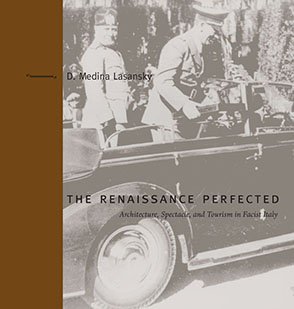
The Renaissance Perfected
Architecture, Spectacle, and Tourism in Fascist Italy
D. Medina Lasansky
“More than simply entertaining the people, these festivals recall . . . the memory of a long lost time that was for us as glorious and memorable as that of Rome.”
- Media
- Description
- Reviews
- Bio
- Table of Contents
- Sample Chapters
- Subjects
2005 Winner of the ISI Henry Paolucci/Walter Bagehot Book Award
The arguments in The Renaissance Perfected are based in fresh archival evidence and a rich collection of illustrations, many reproduced for the first time, ranging from photographs and architectural drawings to tourist posters and film stills. Lasansky’s groundbreaking book will be essential reading for students of medieval, Renaissance, and twentieth-century Italy as well as all those concerned with visual culture, architectural preservation, heritage studies, and tourism studies.
“More than simply entertaining the people, these festivals recall . . . the memory of a long lost time that was for us as glorious and memorable as that of Rome.”
“The Renaissance Perfected is a well-argued and original look at the Italian Fascist appropriation and utilization of the Italian medieval and Renaissance heritage. Lasansky illuminates the functioning and politics of Fascist mass and high culture, architecture, urban design, and tourism. Her treatment of the politics and practices of restoration is superb.”
“Lasansky stands to substantially enrich the field, opening it up to new questions and changing scholars’ perceptions of the place of antiquity vs. the medieval and Renaissance periods in Fascists’ ‘consciousness’ with respect to architectural design, conservation, archaeology, city planning, and the elaboration of civic rituals such as pseudo-medieval festivals.”
“Medina Lasansky’s book, The Renaissance Perfected, should be required reading for anyone in Renaissance Studies. Her study of Fascist Italy shows how the regime promoted civic architecture, how it canonized medieval and Renaissance monuments in Tuscany in particular, and how it manipulated popular festivals all in the service of political ideology. Scholars as well as students are still in the grip of this Fascist vision of pre-modern Italy since our textbooks, monographs and lectures fail to take into account the urban redesign, the ‘edited’ monuments, or the ‘invented traditions’ in cities like Siena, Arezzo or San Gimignano. While Renaissance art history has begun to engage with its origins in nineteenth-century historicism it has yet to grapple with the legacy of Mussolini and Italy’s Fascist period. Lasansky’s book unsettles our basic, cherished assumptions about Renaissance architecture and urbanism. It challenges us to confront the use of the Renaissance in the present as well as in the recent past.”
“This is an engaging study whose prime merit lies in pointing the way to future engagements with this topic; it is a beautifully crafted and well-illustrated study whose images are often surprising and sometimes disconcerting. Lasansky’s reinterpretation of the architectural legacy of Italy’s Fascists certainly appeals to Renaissance and contemporary art historians alike.”
“This is an outstanding example of a deconstructivist approach to history. It is sumptuously produced. The text is generously illustrated in color and black-and-white and is followed by acknowledgments, footnotes, bibliography, and index. This book is for anyone with a special interest in Italian culture.”
“A beautiful book by an architectural historian which will make you think differently about Italian history after reading it. It is an exploration of the ways in which the medieval and early Renaissance Italy beloved by so many of as are, to some extent, a self-conscious creation of the Fascist era. This original book throws a genuinely new light on both the age of Mussolini, and on our understanding of our assumptions about the Renaissance.”
“Lasansky’s is the most recent in a line of fairly smart books on the reception of the Renaissance in the nineteenth and twentieth centuries.”
“One hopes that Lasansky’s book stimulates further interest in this fascinating and quite important subset of the reception of the Renaissance in recent times.”
“D. Medina Lasansky’s The Renaissance Perfected: Architecture, Spectacle and Tourism in Fascist Italy displays the rich possibilities of cultural history.”
“This beautifully produced and readable book is full of insight and interest. But the reader of The Renaissance Perfected should be warned: Tuscany will never seem the same.”
“The Renaissance Perfected . . . is a refreshing and original analysis of the Italian Fascist Regime’s appropriation and political exploitation of the medieval and Renaissance past. . . . The Renaissance Perfected is beautifully written and illustrated. Lasansky makes a major contribution to the study of the relationship between the Fascist regime and Italy’s urban landscape. I would recommend this book to anyone interested in the history, art history, or politics of the period.”
“Lasansky’s study enriches our knowledge of how popular images and beliefs became powerful tools in the construction of reality during the Facist ventennio and afterward.”
“While scholars recognize the ways our perception of the Renaissance was conditioned by nineteenth-century historicism, the same is not true for how this understanding was mediated in the built environment under Fascism. This is where Lasansky makes her greatest contribution. She helps shift attention from modern architecture to a broader perspective encompassing buildings and culture in general.”
D. Medina Lasansky is Assistant Professor of Architecture at Cornell University and co-editor of Architecture and Tourism: Perception, Performance, and Place (2004).
Contents
List of Illustrations
A Personal Meditation
Preface
Introduction: Aesthetic Dissonance
1. The Love Affair with Tuscany
2. Mechanisms of Display
3. Urban Politics: The Fascist Rediscovery of Medieval Arezzo
4. Urban Theater: Performance, Virility, and Race
5. Accelerating Accessibility: Architecture for Mass Consumption
6. History as Spectacle: The Partita a Scacchi in Marostica
Conclusion: Fascist Strategies
Acknowledgments
Abbreviations
Notes
Bibliography
Index
INTRODUCTION:
AESTHETIC DISSONANCE
In 1922 Benito Mussolini and the National Fascist Party seized power from the liberal government of Giovanni Giolitti. (Fig. 3) In the fall of that year Mussolini lead his followers on a march through the city of Rome. The Black Shirts who descended upon Rome for the event ceremonially seized power, reclaiming the city as the capital of a new nation. This was a public proclamation of the birth of a new government and political order.
The new regime quickly gained the support of the industrial working classes, the middle class, landowners, and business through political rhetoric that promised social reform, political power for the people, and a new form of aggressive nationalism. They established a corporate economy that united workers and business leaders within a system of intense productivity. By 1926 Mussolini had transformed the government into a totalitarian state. He gained control of the press, abolished the parliament and eliminated competing political parties. While the Italian monarchy survived during his rule, its power was greatly diminished. The rights of King Vittorio Emanuelle III were in many ways now subordinate to Prime Minister Mussolini and the Gran Consiglio, the governing body of the Fascist party. To emphasize this political division Mussolini was careful to keep his distance from the monarch, even refusing with rare exception to be seen in the company of the King.
The P.N.F. bureaucracy was designed to prevent officials from rising to a position of authority and power equal to Mussolini, known more commonly as the Duce, or leader. Advisors and ministers rotated through a variety of offices, staying in no single position for any length of time and thereby guaranteeing Mussolini’s position not simply as the capo del governo, or head of state, but as the unchallenged dictator. A carefully organized propaganda campaign reinforced this. Mussolini was presented as a charismatic leader; caring and energetic, full of vigor and vitality. The construction of this image was crucial to the stability of the regime. When the P.N.F. assumed power in 1922 it was widely believed that the new regime had inherited a country that was weak and degenerate – ruined by the unchecked liberal reforms of the previous government. As a result rhetorical strategies were deployed to emphasize the strength, discipline, order, and masculine authority of the new government. This was apparent in a range of projects promoted and financed; the utopian dreams of the Futurists, rural reclamation projects such as the draining of the Pontine marshes, new building initiatives, imperialist expansion, as well as countless programs of urban renewal and reform. The latter were particularly important because during the first decade of the regime urban populations increased dramatically. This was nowhere more evident than in Rome itself where the population of the city increased from 691,000 to 1, 415,000 between 1921 and 1931, more than any other city in Italy.
The 1922 march, which traversed the city of Rome, marked the beginning of what became a highly charged relationship between contemporary politics and urban space. Mussolini’s use of the city streets and piazzas as a stage for public proclamations, military parades, rallies, and state ceremonies became increasingly well developed over the next two decades, up until the collapse of his government in the summer of 1943.
The relationship between urban space and Fascist politics was symbiotic. New streets and spaces were designed with political events in mind, just as events were conceived in relationship to specific sites and spaces. An important element of this dialectic was the way in which history was deployed. As I have noted, the built past provided great raw material for Fascist rhetoric. This was the case for Antiquity as well as for the Middle Ages and Renaissance. While the former has been well studied, the regime’s equally comprehensive interest in the medieval and Renaissance past has only begun to attract the attention of scholars. Government officials and party sympathizers promoted, funded, and at times supervised the staging of history in the urban landscape for the purpose of legitimizing the P.N.F. and establishing the perimeters of a modern Fascist culture. Buildings were liberated from surrounding structures, restored, re-constructed, and re-animated as a means of reinforcing Mussolini’s agenda of constructing a stronger sense of a unified Italy. Through these various urban renewal projects particular historical associations were made more emphatic. A historical subjectivity was created that never existed. More simply, history was re-postured.
While the regime’s interest in the medieval/Renaissance past is the focus of this book, it is important to note how it is both distinct from, and similar to, the celebration of Ancient Rome, or Romanità. While one past (the Roman) was privileged in Rome and the other (the medieval/Renaissance) was the focus of attention elsewhere, the historical celebrations took place concurrently, involved many of the same individuals, employed similar strategies of development and propaganda, and ultimately were manifestations of the same agenda. Whether in Rome or Tuscany, the Fascist government was deeply engaged in the process of re-narrating history in physical terms for political ends.
Imperial Aspirations and the Celebration of Romanità
During the 1920s and 1930s Rome’s leading architects, archaeologists, restaurateurs, historians, and urban planners collaborated on a variety of projects that were designed to highlight the buildings of Antiquity. As a result of their efforts to excavate, restore, and reuse the city’s Ancient monuments and sites, Rome was redesigned as a stage for the display of contemporary politics. The various government-sponsored projects simultaneously highlighted both the Ancient Roman Empire and Mussolini's own modern version of imperialism. As Spiro Kostof noted years ago in his study of the Third Rome, the regime's vast urban project "register[ed] as historical scenography," as sites were carefully restored and "their visual forms manipulated to enhance urban perspectives." Discussing the city in terms of urban scenography was in itself an important element of architectural rhetoric during this period. Gustavo Giovannoni, who along with Marcello Piacentini was one of the most influential personalities within the field of architecture and urban planning, was quite conscious of the implications of the various projects and wrote about "sites of scenography;" architectural environments which created a complete, controlled, and visually harmonic experience.
In Rome such a visually controlled environment was comprised of numerous components, many of which were outlined in the city's Master Plan of 1931. A new road linking the Colosseum with the Palazzo Venezia, the headquarters for Mussolini’s government, sliced through the ancient Roman fora necessitating the demolition of numerous apartment buildings and the displacement of hundreds of families. (Fig. 4) This Via dei Fori Imperiali (later renamed the Via dell’Impero), conceived by the art historian and archaeologist Corrado Ricci, provided a path through the core of Ancient Rome, symbolically and physically connecting the governments of the Caesars with that of Mussolini while providing dramatic vistas of the buildings associated with each. (Fig. 5) Tenements surrounding the Mausoleum of Augustus were demolished in order to create the Piazzale Augusto Imperatore designed by G. Q. Giglioli and Antonio Muñoz. This new piazza showcased both the mausoleum and the Ara Pacis. The buildings that flanked the piazza, designed by Vittorio Ballio Morpurgo, were decorated with inscriptions, reliefs, and mosaics linking Imperial activities with Fascist projects, thereby creating a modern frame through which to view the past.
Many Ancient sites were returned to their so-called "primitive" (to apply terminology frequently used during the period) form. In essence, they were, "liberated" from the structures of intervening centuries. For the "isolation" of the Capitoline hill, undertaken by Antonio Muñoz (the city's Inspector General for Antiquities) between 1929 and 1931, a series of houses, a Baroque church and other structures located at the foot of the hill were removed. Buildings adjacent to the Theater of Marcellus and the Pantheon were demolished as were those that obscured the view of the four Republican temples of the Largo Argentina. The Velia was leveled to create a point from which to enjoy a panoramic view of the Ancient forum. The area of the Domus Aurea was re-landscaped. Even the terms used to describe these various projects ("liberation," "reclamation," "reconquest," "rediscovery") were not-so-subtle reminders of the campaign to reconquer Rome. It was as if Mussolini waged war against the remains of intervening civilizations in order to create a more direct and concrete link to the Ancient city. More importantly, it was only through their isolation that these structures could actually begin to appear monumental.
Many of the projects realized during these years had actually been proposed prior to Mussolini’s rule. The idea to imbed the monuments of Ancient Rome within a new urban narrative was by no means new. Centuries before, during a period of church reform in the latter part of the 1500s, Pope Sixtus V (1585-1590) and his architect Domenico Fontana conceptualized a scheme designed to integrate Ancient monuments within a contemporary urban matrix that was designed to draw attention to the Catholic church. A new street connected the Colosseum with the renovated basilica of Santa Maria Maggiore. Ancient obelisks were relocated to punctuate piazzas associated with the city’s important ecclesiastical structures. The columns of Marcus Aurelius and Trajan were reclaimed, crowned with statues of Saints Peter and Paul, and opened to the public. Views from the top provided a panoramic vista of the re-mapped city.
Re-appropriating the Ancient past and reintegrating it within the contemporary city, underwent continuous modulation between the 16th and 20th centuries. Yet, it was not until the Fascist regime that a government was able to gather the resources and supervise a group of engineers, landscape designers, urban planners, architects, and artists to successfully implement a comprehensive city-wide plan. Just as Mussolini and the Black Shirts reclaimed Rome during the 1922 march, the officials involved in re-narrating city history did so on an urban scale. The city was re-cast as a center of Romanità from one edge of the city to the other; from the Foro Mussolini in the north east to grounds of E.U.R., the international exposition planned for 1942, in the south west.
Public perception of these urban renewal projects was carefully monitored by the government. During this process of extensive demolition and new construction, the public was convinced that nothing of merit had been destroyed. For example, the buildings slated for destruction at the foot of the Capitoline and in the vicinity of the Roman forum were dismissed in the popular press as "hovels, huts, shanties, random, tumbled-down, disgraceful, unseemly, miserable, nasty, insignificant, and filthy." The 17th-century church of Saints Biagio and Rita designed by Carlo Fontana was included among these. (Figs. 6 & 7) Muñoz, a specialist in art and architectural history at the University of Rome, dismissed Baroque structures such as the church as "mediocre." Even Corrado Ricci’s well-informed study of Baroque architecture referred to the period’s "conflicting faults and virtues…of…heroism and debasement." As Antonio Cederna noted in his study of urbanism under Mussolini, regime officials were fond of reminding the public that "not everything is a work of art".
In most cases the buildings identified for destruction had no advocates and as a consequence were demolished with little protest. For example, the large housing tenements torn down to make room for the Via dei Fori Imperiali housed thousands of Roman working class residents, a disenfranchised populous that had little authority to challenge the project. This, combined with the fact that scholars such as Muñoz and Ricci claimed that such structures lacked architectural value, allowed the work of regime planners to proceed unchallenged. So while the church of Saints Biagio and Rita was dismantled, moved, and reconstructed in a less conspicuous location behind the Theater of Marcellus, most buildings simply vanished from the urban record. Even today the full extent of the loss of medieval, Renaissance, Baroque, and Neo-classical sites remains unstudied.
Once "liberated," much of the Ancient city served as an outdoor theater for Fascist cultural celebration. The Markets of Trajan held trade shows, fairs, and exhibits. The Baths of Diocletian and the Basilica of Maxentius provided ideal acoustics for concerts. The Colosseum served as an arena for rallies. The Circus Maximus was the site for the large-scale exhibitions mounted by various P.N.F.-sponsored organizations. The Arch of Constantine once again provided a monumental passageway for triumphal parades, this time for the Fascist Black Shirts. (Fig. 8) As scholars have noted, much of the Fascist urban renewal was designed with events in mind. The regime also thought of architecture itself as a spectacle and staged buildings accordingly. The relationship between buildings and people, as well as between buildings themselves, was carefully choreographed. Large piazzas and ample boulevards allowed people to congregate and more fully participate in Fascist life. New construction was designed to communicate with the architecture of Antiquity. The proposed Casa del Littorio for example was projected for a site facing both the Colosseum and the Basilica of Maxentius, two of the most significant monuments of the Ancient city. One of the most resonant new spaces in the city was the Via del Foro Imperiali. The wide avenue provided a highly visible venue for the military parades that had until that point been held at the periphery of the city. Cutting through the Ancient Roman fora, the new street animated a section of the city that had until that point had not been fully mined for its symbolic potential. The street permanently fixed the notion that Antiquity was the backdrop for the new government.
The Fascist interest in Antiquity was also evidenced in contemporary architectural design. Mussolini commandeered resources to erect an extraordinary number of buildings during his 20 and-a-half-year rule: government offices, public facilities, new schools, housing projects, sporting complexes, churches, theaters, bridges, and complete new towns were built throughout Italy as well as the Italian territories in East Africa, North Africa, and the Aegean. Many of these buildings referenced Antiquity on both a formal and functional level. Enrico del Debbio's neo-Roman style stadium surrounded by a series of carved marble neo-classical semi-nude athletes at the Foro Mussolini built along the banks of the Tiber at the outskirts of Rome is one such example. On the opposite side of city, located off of Mussolini's "highway to the sea," the regime began construction of an ideal city for the Esposizione Universale di Roma of 1942 (E ’42), where buildings such as the Palazzo della Civiltà Italica, the so-called "square Colosseum" (G. Guerrini, E. B. La Padula, and M. Romano, 1939), quoted Ancient Roman models. (Fig. 9) The streamlined neo-classic style of these buildings has long been hailed as the epitome of Fascist period architecture.
The massive nature of these public projects provided the venue for Mussolini's public demonstration of imperialism. The campaign to create a grandiose capital for the new empire was patterned after the urbanistic activities of the first Roman emperor Augustus (27 B.C. - 14 A.D.) who was praised for having transformed Rome from a city of brick into a city of marble through a vast building program that included the construction of new temples and a new forum, as well as the restoration of existing buildings. Mussolini’s decision to self-identify with Augustus and associate his urban projects with those of the emperor allowed the dictator to fulfill the self-anointed title of Duce, the Italian variation of DUX, the latin term for leader first adopted by Augustus and utilized by subsequent emperors.
The celebration of Roman Antiquity however, was not wholesale. Clear distinctions were articulated between native (Italic) and non-native Ancient styles. William MacDonald has convincingly demonstrated that there was a clear dialogue between the Ancient Roman architecture being uncovered during the 1930s and contemporary modern construction. He has argued that buildings such as the Casa di Diana, at the Roman port of Ostia Antica, with its unadorned simplicity, provided vernacular Italic examples that were distinct from the Ancient architecture influenced by Greco-classical orders. Buildings of this streamlined neoclassical or "Roman Plain Style," as MacDonald termed it, had simple brickwork, unmoulded window and door openings, uncomplicated arch shapes, emphatic banding, and exterior niches. Absent were the articulated column capitals, ornate decorative reliefs, and polychrome marble, and colorful frescos associated with Roman sites such as Palmyra, Antioch, or Pompeii. As such, the buildings in Ostia provided a stylistic reference point for a regime interested in reinforcing local Italic culture to the exclusion of anything foreign. A similar argument could be made for the preference awarded to the bold and simple black and white mosaics incorporated into the pavement of the Foro Mussolini complex. (Fig. 10) In stylistic terms they imitated the mosaics found at Ostia Antica, rather than the more complex and colorful versions found at sites in Roman North Africa, Turkey and Greece. In the end, this Roman Plain Style was deemed appropriate for modern application and served as a model for hundreds of government-sponsored apartment and office buildings constructed throughout the city.
The public understanding of Romanità was carefully modulated through the use of government-controlled mass media. Photography, film, and the press chronicled the "rediscovery" of the new Rome for the entire country. As a result, the history of Rome emerged as national heritage. L.U.C.E., the regime’s film institute, employed a team of professional photographers and cinematographers to follow Mussolini. They shot official portrait stills as well as documentary footage of daily public appearances. Staged photographs such as those depicting Mussolini wielding a pick-ax to begin destruction of the buildings that blocked the view of the Mausoleum of Augustus or visiting the Ara Pacis with an enthralled Adolf Hitler helped solidify the associations between the imperial aspirations of Augustus and those of the new Dux. The Duce was authoritative and commanding. A wonderful photo-montage that depicts the Duce standing in front of the Colosseum makes this point well. (Fig. 3) Here the dictator is seen as larger than life, his imposing physical demeanor equals that of the colossal structure in the background. Film footage chronicling excavation, restoration, and construction projects at sites such as Ostia Antica, the Pantheon, the Markets of Trajan, the Imperial Fora, the Via dei Fori Imperiali, E.U.R., and the new university was edited into provocative short newsreels and distributed to cinemas throughout the country. Articles in newspapers, journals, books provided an alternative literary venue for the discussion of regime projects. Muñoz's lavishly illustrated Roma di Mussolini (1935) was one such popular example. Another was the 1938 L'Italia d'Augusto e l'Italia di Oggi written by Giuseppe Bottai, the influential minister and one time Fascist governor of Rome. Published during a year of Augustan celebrations the latter provided an annotated map of the city’s Augustan monuments with a parallel res gestae of Mussolini's own building and restoration projects.
Similar to the Emperor Augustus (who used a wide variety of art and architectural forms for self promotion), Mussolini was a media-savvy leader. He used photography, film, the press, radio, and exhibitions to promote regime-sponsored projects in a manner that was unparalleled in modern memory. The scale and scope of government propaganda was unprecedented. It was far-reaching, omnipresent, and enticing. As a result, it successfully accelerated interest in the Ancient city. As an example, over 1,330,000 posters were distributed to advertise the exhibition of the Mostra Augustea della Romanità, which opened in Rome on September 23, 1937 as a part of the two thousandth anniversary celebrations of Augustus' birth. (Fig. 11) Almost four million visitors attended the exhibition, many of whom traveled from as far as Palermo, Padua, and Turin on foot or bicycle. Described by the popular press in quasi-religious terms, the event quickly became a pilgrimage destination for the devout Fascist.
For the occasion the Palazzo delle Esposizione, or city’s primary exhibition hall, was transformed by a team of architects, artists, and historians to display sculptures and inscriptions, models and photographs of Ancient monuments and sites throughout the empire. Attention was given to the engineering feats, state institutional organization, commercial successes, military strength, urban planning, artistic prowess, and cultural domain of the Roman Empire. Mussolini’s own achievements in these areas were compared with those from Antiquity. For example the fourth-century Arch of Constantine was paired with the first Fascist arch designed by Marcello Piacentini for the city of Bolzano. The exhibit also emphasized the role of the Renaissance as the link between the Ancient world and the "New Italy." Within this context men such as Dante, Machiavelli, Petrarch, Leon Battista Alberti, Mantegna, Raphael, and Palladio and Popes Julius II and Sixtus V were celebrated for their contribution to the contemporary understanding of Antiquity.
One of the most innovative aspects of projects such as the Mostra, was the range of individuals involved in their production. Artists and scholars collaborated with government ministers and the press to create events that had wide appeal. As regime officials discovered, the construction of a cult of Romanità was not possible without the efforts of scholars. Individuals such as Carlo Galassi Paluzzi at the Istituto Nazionale di Studi Romani and Pietro De Francisci at the Sapienza lent a sense of scholarly legitimacy to the regime projects while simultaneously drawing in intellectuals. While the uneducated Italian might have been impressed by the monumental scale of construction and the theatrical nature of cultural initiatives during this period, a more systematic and scientific approach was necessary to appeal to and involve, the educated elite. The regime successfully did both.
In Rome, the regime’s interest in the past centered on Antiquity. This bias is understandable. After all, the ruins of the Ancient city made Rome a unique caput mundi. The quantity and quality of surviving Classical sites were unequaled. But perhaps more importantly the scale and form of the Ancient city was an appropriate place to recast modern Imperial aspirations. Defining a capital in neo-classical terms was of course in keeping with the trends of other 19th— and 20th-century cities such as Washington D.C., Paris, Berlin, and London. All had defined themselves with varying degree vis-à-vis the urban concepts of Ancient Rome. Their urban plans featured wide avenues, controlled vistas, vast public spaces, emphatic government complexes, monuments commemorating important historical figures, triumphal arches, and a predilection for neo-classical style and building typologies. It is no coincidence that in the process of re-defining Rome as the center of a new government, the regime chose to focus on sites associated with Ancient government and Augustus, the city’s most famous leader.
Defining an Autochtonous Italic Culture: Italianità
The grandiose and monumental nature of Fascist Romanità, coupled with the fact that the center of this Roman revival was based within the capital itself, has overshadowed the discussion of the regime's pluralistic approach to the past. More specifically, it has obscured discussions of the less familiar, but equally comprehensive use of the Middle Ages and Renaissance. Like Antiquity, the Middle Ages and Renaissance were carefully revived and interpreted by regime scholars and journalists to display contemporary aesthetics and ideology. As we might imagine, the use of this particular past was most pronounced outside of Rome, at a distance from the physical remains of Antiquity.
While Romanità helped to legitimize the imperialist policies of the regime, the celebration of the Middle Ages and Renaissance proved to be an important tool for cultivating a sense of shared national identity. Similar to the regime’s interest in Antiquity, the interest in the medieval and Renaissance past was neither new nor particularly innovative. Indeed, the regime’s interests in the city state, condottieri, the artisan, the poetry of Petrarch and Dante, were interests which had been first defined during the period of Italian unification in the 1860s, if not before. However, the extent to which public accessibility and understanding of this past increased during the Fascist period is most certainly distinct. As in the case of the celebration of Romanità, the successful recovery of the medieval/Renaissance past was dependent upon the use of mass media to construct, mediate, and monitor public perception.
The central government promoted medieval knights such as Francesco Ferrucci in Florence and Renaissance dukes such as Cosimo I de Medici as contemporary heroes. Virile condottieri were hailed as heroes who had fought to free the Italian peninsula from foreign rule. Petrarch's dream for a unified Italian state was celebrated. Medieval guild organization was considered to be an economic ideal. The artisan was deemed a vital member of society and exhibitions of period artists such as Giotto, Botticelli, and Massaccio, were organized as a means of reinforcing Italian genius. The regime revived period festivals and courtly games such as the palio in Siena, encouraged the production of epic film dramas such as Condottieri and redesigned countless town halls. Like Antiquity this particular aspect of Italian history was celebrated as a shared cultural heritage for all Italians, Tuscans, Venetians, and Romans alike. Like the celebration of Romanità, this communal-era past simultaneously allowed Italy to project the image of a strong unified nation abroad.
Perhaps surprisingly, despite the heavy-handed use of the Antique, even in Rome there was the occasional overture to the Renaissance past. Of course this is not the past that has been privileged in a discussion of Rome’s urban identity. Scholarly stereotypes have long taught us to focus on Antiquity in Rome and the Middle Ages and Renaissance in Tuscany. The most noteworthy overture towards celebrating the Renaissance in Rome was the regime’s use of the highly visible Palazzo Venezia. (Fig. 12) Built as a residence for Cardinal Pietro Barbo in the 15th century, subsequently expanded during his papacy, and then again by Cardinal Marco Barbo, the structure was cited during the 1920s and 1930s by the Italian press for exemplifying what were vaguely termed "Albertian" principles of palazzo design. The government remodeled the building in "Renaissance style," according to the principles of both Alberti and Sansovino. The structure was then used to house the Italian Institute of Archaeology and History directed by Corrado Ricci, the National Art History Library, the city's museum of medieval and Renaissance art, and beginning in 1929, Mussolini's office. It was from the balcony of the building's piano nobile that the Duce frequently addressed the crowds assembled below in the piazza. (Fig. 13) The re-location of the Mussolini government to this site was strategic. In addition to being situated in the heart of the old city, the building was in close proximity to the sites of former governments, the Ancient fora and the Capitoline Hill. By creating a powerful presence within the Piazza Venezia area, and focusing the public's attention on the palazzo, the regime successfully diminished the authority of Italy's royal past as embodied most prominently by the neighboring 19th-century monument to Vittorio Emmanuele II. In this case the Renaissance provided a necessary buffer between Antiquity and the post-unification period.
When it came to advocating for the importance of preserving Renaissance architecture within the city of Rome, the most articulate individual was the architect and urbanist Gustavo Giovannoni. Giovannoni was an outspoken advocate of using Renaissance city planning principles as a frame of reference for contemporary urban projects. As a professor of city planning, prolific writer, and practicing urbanist, his ideas influenced many contemporary architects and planners and sustained, as we shall see in subsequent chapters, an important influence outside of Rome as well. In 1931 he designed the Piano Particolareggiato for the city's so-called "Renaissance quarter", the area of the Largo Argentino, Campo dei Fiori, Pantheon, and Piazza Navona In 1935 he, along with other prominent architects formed a special committee to study the threats facing that neighborhood. Giovannoni suggested that contemporary designers and planners could learn from Renaissance examples. He even claimed that the renewed interest in urbanism was itself a revival of a Renaissance practice.
Giovannoni's influential 1931 text on urban history and planning, Vecchie città ed Edilizia Nuova, noted that the urban renovations of Pope Sixtus V had been the first real attempt to redefine Rome on a city-wide scale and in many ways served as an important model for the Duce. The convergence of streets in the triumvia, the accentuation of basilicas with new piazzas, the connection of these piazzas with new straight streets, the location of obelisks as prominent landmarks, the construction of urban vistas, and the emergence of new building types such as schools, hospitals, religious confraternities, and urban and suburban villas, were all projects begun by Pope Sixtus V and subsequently taken up by Mussolini. The best example is of course the seventeen-meter high obelisk (bearing the inscription DUX), (Fig. 14) designed by Constantino Constantini, and erected at the entrance to the Foro Mussolini in 1933. (Fig. 15) Known more commonly as the "Mussolini Monolith" its transportation to the site was recorded in the press as equal to the engineering feat undertaken by Domenico Fontana to raise the Vatican obelisk in 1586. (Fig. 16)
When understood in terms of architectural choreography, Fascist period urban rhetoric sustained striking parallels with the Renaissance examples. In the 15th and 16th centuries it was not uncommon for cities to serve as vehicles and venues for the presentation of political agendas. The town of Corsignano which was transformed into the modern city of Pienza in homage to its native son Pope Pius II, the Via Larga in Florence which was reworked to create a more dramatic view of the Medici palace, and the town halls of Florentine satellites such as Montepulciano which were re-facaded to imitate the Palazzo della Signoria, all confirm that construction and urban planning has long been guided by political objectives. Patrons glorified their authority in physical form.
When it came to strategies of urban planning and inventive self promotion Mussolini learned the most from Sixtus V. The Pope was adept at presenting his urban projects to a wide audience. He publicized new streets, buildings, and improved urban infrastructure in a variety of 16th-century mass media venues. Images of the Sixtus V surrounded by newly restored or constructed sites appeared in prints, maps, books, coins, and medals. Mussolini’s Office Press and Propaganda translated these into modern equivalents. Newsreels chronicling Mussolini at ribbon cutting ceremonies, photo-montages of new building projects printed in popular magazines, and colorful calendars distributed to workers were just some of the ways in which the image of Mussolini was designed to merge with that of the new nation.
Stylistic Dissonance/ Aesthetic Purification
While the celebrations of Romanità and Italianità were distinct, they were not incongruous. Not only did they take place simultaneously, but many of the individuals involved with promoting the image of Romanità, men such as Giacomo Boni, Gustavo Giovannoni, Antonio Muñoz, Ugo Ojetti, Marcello Piacentini, and Corrado Ricci, were also occupied with promoting the Middle Ages and Renaissance. Muñoz for example painstakingly restored the five-story Torre dei Conti and adjacent medieval house located near the Forum of Nerva in Rome as well as the churches of San Giorgio in Velabrio, Santa Balbina, San Cosimato, San Antonio Abate, Santa Maria degli Angeli, and Santa Sabina, stripping each of their post-medieval additions. Their involvement in both types of projects reaffirms the extent to which the interest in the medieval/Renaissance past was an important element of party agenda.
Fascist period Italy has long been associated with cultural hegemony. Although scholars such as Renzo de Felice, Victoria de Grazia, and Phillip Cannistraro have convincingly argued that forging consensus, whether in the case of the working classes, women, or the mass media, was the modus operandi, others have pointed out that when it came to issues of architecture and art, a certain degree of stylistic dissonance was permitted, if not encouraged. As Antonio Cederna has noted in the case of urban planning, there never really was any such thing as consensus. Decisions depended largely upon individuals such as Muñoz, Giovannoni, Ricci, and Piacentini who often openly disagreed. As a result, policy was not always consistent. On occasion these men even undermined their own positions. Giovannoni, who championed of saving the Renaissance center of the city, once proposed laying a new cardo and decumanus, which would have sliced through that very neighborhood.
As is frequently noted in discussions of Italian Fascism, "no one style, school, or monument summarizes the patronage practices of the Fascist State...Fascism is best defined by its diversities, contradictions, and ambiguities." There was no single state art or aesthetic. The Futurists, Rationalists, Novecento members, and neo-historicists, all received government commissions and praise. As a consequence any discussion of Italian Fascist style is nuanced and complex. While this is not what we might expect of an authoritarian regime, it is made apparent again and again in a variety of situations. Within the context of such stylistic dissonance, the regime became increasingly dependent upon various cultural events to, as one scholar has noted, alleviate the tensions between the various strains of fascism. More simply, exhibitions, festivals, and other venues allowed different groups to come together for a shared purpose, that of demonstrating how distinct styles could contribute to state-sanctioned Fascist rhetoric. Within this context it should be of no surprise that the regime could simultaneously sustain an interest in the Ancient past as well as that of the Middle Ages and Renaissance even within Rome itself. These traditions were not only able to coexist within one cultural system but were deployed for the shared purpose of reinforcing a sense of cultural strength and legitimacy. Christian condottieri fighting to save the Italian peninsula, leaders of the independent city-states, and tyrannical Dukes, were in many ways counterparts to the emperors and heroes of Ancient Rome.
While stylistic dissonance thrived, so to did the aesthetic of purification. Similar to the celebration of Romanità, the restoration, reconstruction, and redesign of the medieval/Renaissance past involved a selective re-creation of the period. Whether in Rome, Tuscany, or Rhodes, regime architects and designers were employed to create an ideal cleansed vision of the past. Typically this involved the removal of anything that post-dated the Renaissance. This aesthetic of purification, or "liberation" as it was frequently termed, occurred in buildings, festivals, as well as political discourse. Structures in Arezzo were stripped of what were referred to as their "unaesthetic" post-Renaissance details. Events such as the famed "medieval" Sienese palio were redesigned during the regime so as to eliminate any extraneous Renaissance, Baroque, and neo-classical elements. And by 1938 the government officially began to classify its citizens as either members or non-members of the pure Italian race. This aestheticization of purity conveniently supported ideas of cultural superiority.
Perhaps because of its distinctive political ideology, and troubled association with the Hitler’s Germany, many scholars have interpreted Italian Fascist culture as an anomaly – separate from what came before and after, or an aberration of circumstances. Yet, this is clearly not the case. Many, if not most, of the cultural paradigms of the 1920s, 1930s and early 1940s were inherited traditions, rather than newly invented ones. History had been so thoroughly integrated within the cultural and political identity by the end of the 19th century that it remained virtually impossible to discuss one without the other. The monuments and sites of interest and devotion inherited by the regime had already been established by the itineraries of the Grand Tour. And yet, despite these firmly rooted traditions the regime made the material its own. History was spectacularized and democratized. It was made available to all and invisible to none. More importantly, it was politicized in a manner that was unprecedented.
In the 18h century a visit to Italy was an important component in the education of the largely elite, foreign, male population that understood Italian culture to be the foundation of Western civilization. Accompanied by a highly educated entourage of tutors, translators, and guides, these men stayed for months, sometimes several years, recording their thoughts in their journals, compiling sketchbooks, commissioning and collecting art. By the mid-19th century, with the introduction of the railroad, the audience for visiting these sites changed. The "Grand Tour" was now within the reach of the middle classes. As a result, a wider demographic of men, and now women, eagerly traveled abroad to experience Italian culture. Accompanied by their Baedecker or Murray guidebook, individuals epitomized by Lucy Honeychurch in E. M. Forster’s A Room With a View could now teach themselves what they needed to know about the city’s significant monuments and sites. By the 1930s the residual form of the Grand Tour tradition changed once again. For the first time the Italian government actively targeted working class Italians and encouraged them to visit sites such as Rome, Florence and Siena. Italians were not only encouraged to participate in a culture that that been previously reserved for the foreign-born elite, but they were now expected to do so. In 1930 a visit to an important historic site would have resonated quite differently from that of 1860 or even 1760. Not only would the visit have been sponsored and subsidized by the government through discount train fares and special guided tours, but it would have been actively experienced as a part of one’s patriotic duties. As such Mussolini’s government reclaimed, what had for centuries been, a foreign and elite tradition for the Italian working classes. They redefined the practice of visiting Italian historic sites as an Italian activity.
Also of Interest
Mailing List
Subscribe to our mailing list and be notified about new titles, journals and catalogs.