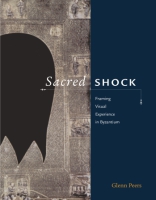




Sacred Shock
Framing Visual Experience in Byzantium
Glenn Peers
“Sacred Shock is a significant and scholarly contribution that will both invigorate and stir controversy within its primary field, and be read and understood by those beyond.”
- Description
- Reviews
- Bio
- Table of Contents
- Sample Chapters
- Subjects
Art did not exist in Byzantium. As Glenn Peers explains in Sacred Shock, there were, instead, a variety of devotional objects—pectoral crosses, church mosaics, icons, and illuminated manuscripts—regarded as infused with divine presence and used in religious practices. What concerns Peers in this provocative book is the means by which the relationship between the divine and the human was made manifest through crafted, material objects.
According to Peers, the devotional objects of Byzantium should be understood as having a detail or place that plays a large part in “framing” their meaning for viewers. After an insightful discussion of pectoral crosses, Peers examines a series of case studies, which includes the depiction of the blood of Christ in the Chludov Psalter, a fourteenth-century icon of St. George, and the Mandylion, a famous relic thought to preserve the traces of Christ’s face.
Sacred Shock combines fine scholarship with close analysis of Byzantine devotional objects and discussion of issues of broad importance to the study of visual experience. It is significant as both an exploration of art-historical methodology and a contribution to our understanding of the medieval world.
“Sacred Shock is a significant and scholarly contribution that will both invigorate and stir controversy within its primary field, and be read and understood by those beyond.”
“This is a book which has the potential to change our understanding of Byzantine art and how it worked.”
“Sacred Shock is a fine book, and one that will stimulate us to rethink the way we look at Byzantine Art.”
“Sacred Shock is impeccably well documented and up-to-date in its references.”
“Like the immaterial angels, Peers’s rather abstract frames mediate the viewer’s experience beyond the facile, more tangible realities of the surface meanings we encounter elsewhere.”
Glenn Peers is Assistant Professor in the Department of Art and Art History at the University of Texas at Austin and author of Subtle Bodies: Representing Angels in Byzantium (2001).
Contents
List of Illustrations
Preface
Introduction: The Great Age of the Frame
1. The Crucifixion Contained and Containing
2. The Bloody Page in the Chludov Psalter
3. Gregory of Nazianzus as Twelfth-Century Paradigm
4. Saint George and His Iconic Bodies
5. Silver Cladding and the Assimilation of Bodies and Faces
Epilogue: The Body Framing
Abbreviations
Notes
Selected Bibliography
Index
Introduction:
The Great Age of the Frame
To label the Middle Ages, even more so perhaps the Byzantine period, the “great age of the frame” is at first glance a paradox. This book argues for the frame’s essential work for understanding Byzantine art, and it aims to make that claim for a “great age” evident in ways it has not been previously. Few studies have yet attempted to examine the role that the space between the inside and the outside of a work of art plays in generating meaning and determining response in a medieval viewer. In fact, such studies are rare in the history of art generally, even though the last decade or so has seen an invigorated study of the conservation, history, and theory of frames. The groundwork for approaching the liminal in art was laid by such forward-looking scholars as Meyer Schapiro and Louis Marin, and framing has been raised as a necessary question by Jacques Derrida. In light of the work of such scholars, this study seeks to examine an almost completely overlooked site of framing, Byzantine art.
The connection between twentieth-century theorists and medieval art of the eastern Mediterranean may not appear obvious, but the modern aspects of Byzantine art have struck sympathetic viewers, like Clement Greenberg. Ironically, this affiliation is due, in part, to the rejection in each period of any defining role that a frame might have in setting off, distinguishing, or distancing the work of art from the world of the viewer. Modern and Byzantine art, to generalize scholarly views in both cases, seek to engage the viewer in a process of integration and absorption. For example, the paintings of Mark Rothko (1903–1970) are often monumental expressions of intimacy. Rothko intended for his paintings of large color fields to absorb and to enclose by putting the edges of the paintings outside a viewer’s visual field. The wrapping of the canvas around the wooden support and the absence of a distinct wooden frame aid in this sense of limitlessness. The frameless canvas is a modernist strategy for forging an unimpeded exchange between viewer and a transcendent reality.
In contrast, a frame in its classic guise attempts to thwart this process in its claim on painting as signifier alone. As Jean-Claude Lebensztejn has remarked, “a frame is necessary not only to protect and enhance the work but also to separate it from the world it imitates.” A frame in the context of easel painting from Europe or America establishes the difference between art and reality by setting off the field of representation—the painting, a flat surface with pigments on it—from the world around it.
A frame for a classic landscape of the Baroque period, to take an example of easel painting from the fifteenth to the nineteenth century almost at random, creates distance in the sense that the frame is an almost-insuperable barrier between two distinct realms, the within and the without. Consider the herculean work being done by the frame in an example like Bartolomeo Guidobono’s Holy Family with the Young Saint John the Baptist (fig. 1). The oval-shaped canvas is surrounded by a raised sighting and a flat rectangular area, articulated by spandrels in the four corners. The inner edging rises to a flaring series of acanthus rolls. Visually traversing these fields means negotiating energetic passages of frame; to do so means leaving one realm for another.
The frame, in other words, is a sign of lack and of distance. The lack arises from the recognition of the artifice or representation inside the frame; the field within the frame is only an imitation of something potentially real. The distance comes from the sense of gazing over an elaborate windowsill into another world, and the viewer is invited to participate with a fictive reality within, like the Holy Family of Guidobono. This double work is performed by a fully articulated frame, as in this Baroque example. The frame’s intervention between viewer and object here reveals painting’s nature as representation, as absence of the real thing.
The Middle Ages was a great age for the frame, not because its art did not declare this lack, but because absence and distance were by no means total. Byzantine frames were sites of access and desire, not of denial, and of partial but meaningful presence and attendance, not of absence. Non-naturalistic art might seem like the place for denying any literal understanding of the object, that is to say, that the art could be understood as so unreal as to be only itself and not be mistaken for the model. Art-historical analysis has established the basic transitions from ancient art’s paradigmatic naturalism to Byzantine art’s expressionistic distortions of natural forms. Just the same, Byzantine viewers knew that their art, despite theologians’ explanations, was practically animate, that it mediated and possessed the power of real presence. By presence, I want to signal—unapologetically for my disinclination to problematize the term—a literal understanding of presence: divinity could work and move in material images. Byzantine art, in its departures from classical art, thoroughly exploited and expressed presence, as this book argues.
As Ernst Kitzinger has shown, play between depth and surface in Late Antique art reveals the emergence of a new sense of framing. His comparison of the framing techniques in the Mausoleum of Galla Placidia (424–50) and the church of San Vitale (consecrated 548), both in Ravenna, is telling of the applications of two dimensionality in the Late Antique period (figs. 2, 3). The north arm of the mausoleum shows Christ in a lunette as the Good Shepherd; the vaulting leading to this lunette at the termination of the arm is covered in a rich carpet of abstract motifs on a blue background. The effect of this contrast between the framed approach and the lunette is striking, as Kitzinger notes. The Good Shepherd scene takes place within a fully realized landscape, in which Christ sits behind a rocky ledge. This leaves an abyss between him and the viewer, as these elements make the scene withdraw into the frame, setting up a window into another, distinct realm. The framing vault underscores this distance in its flat two dimensionality that also creates a threshold before a “real” view. Kitzinger describes this process as an interplay of surface-accepting and surface-denying elements. The carpetlike quality of the vault decoration is fully two dimensional, while the Good Shepherd scene is represented in a more three-dimensional-like space. The tension between vault and lunette helps to intensify the sense of illusion of the lunette and to dissolve “the materiality of the lunette.”
<comp: insert figs. 1–3 approximately here>
The mosaics at San Vitale, about a century later, reveal the beginnings of a Byzantine process of framing. The south wall of the chancel, with mosaics of typological scenes below two evangelists with their symbols, fully embraces the surface-accepting technique. The framing elements for these scenes and figures are opaque, in that they do not offer prospects into the picture plane. The landscape elements, like the rocky ledges behind the evangelists, and the vegetal motifs, like the arching vine at the top of the wall, betray no real perspective and almost press up against the picture plane at the same depth as the figures supposedly before them. These landscape and vegetal elements hint at depth, but they really reveal the material matrix, the wall, on which representation is placed. This sharing of the picture plane by framing motifs and the scene or figures framed is typical of Byzantine art.
The illusionism sought by classically informed art, of which the north arm of Galla Placidia is an example, was no longer apparently a visual goal. Instead, representational spaces, frame and interior, became less differentiated and more interconnected. Consequently, each had responsibilities for meaning and access, and that diminishing of differentiation between frame and framed allowed for the real emergence of devotional reality into the realm of the viewer.
Dale Kinney, in a response to Kitzinger’s book, also addressed this question and brought in her own example to reveal the developing processes that would lead to a Byzantine view of framing. The ivory diptych of Rufius Probianus (ca. 400, 31.8 _ 13 cm, Staatsbibliothek, Preußischer Kulturbesitz, Berlin, MS theol. lat. fol. 323) reveals the new permeability of the frame (fig. 4). The consul is shown twice on the diptych, each time seated and frontal, while his attendants in both registers overlap the outer frame of the ivories. As carefully and beautifully carved as the frames are, they are not fences holding the action in. In fact, they are easily penetrated by the attendants, who stand before the frames and declare the picture to be in front of any inner fields that the viewer might infer. As Kinney states, “the frame defines the space within which the action is not.”
<comp: insert fig. 4 approximately here>
Kinney goes on to disclaim any real originality on the part of the Late Antique artist, as actions taking place before the frame are also found in Roman art. Nonetheless, using the frame as a place around and through which figures circulate became an important, perhaps defining, aspect of Byzantine art. The artificial aspect of representation is easily understood from Kitzinger’s analysis of San Vitale, for example, but Kinney’s insight points to a crucial, new relationship between viewer and representation: the suggestion of real presence and eventually the possibility of a true devotional synthesis of the actual and the virtual, of the viewer and the viewed.
As this book argues, lack or absence was incomplete in Byzantine art. Classic frames around easel paintings in the Western tradition show art as only handicraft and worked matter. Medieval frames not only reveal art’s quality as something made, but they are also active agents that lessened or weakened the sense of absence of the thing depicted. Frames, or simply edges, margins, transitional spaces generally, were sites of interpretation and complementary signifying. Byzantine notions of art were not invested in the same system of closure that post-medieval art needed. The edges of Byzantine art were not only places where multiple interpretations were provided; they were also where the reality of an image was declared, where its emergence and existence as a quasi-animate entity took place. In this sense, the frame was not simply a place where an artist or designer of an artistic program could provide a gloss on a central image.
In this same vein, commentaries on written texts often attest to the ongoing life of manuscripts, since marginal notes show the history of encounters with written texts. As Walter Ong writes, “manuscripts, with their glosses or marginal comments (which often get worked into the text in subsequent copies) were in dialogue with the world outside their own borders. . . . The readers of manuscripts are less closed off from the author, less absent, than are the readers of those writing for print.” Ong’s discussion of the contrast between manuscript and print cultures has relevance for this study generally. Printed texts, he argues, are closed and self-contained, very like the Baroque easel painting discussed above. In contrast, the frames of the medieval world, both textual and artistic, were highly visual and interactive areas. Here encounters between viewer and object of contemplation were dynamically activated in a constant give-and-take of material and divine realities.
This book argues that in devotional contexts Byzantine viewers expected and received an interactive sense of presence from their art, that is, the inhabitation, possession, and manipulation of art by divinity. Such an observation goes against modern scholars who have defended Early Christian and Byzantine viewers from charges of animism in their fierce adherence to the Second Commandment. But Christian ideas of the immanence of divinity and the transformation of the material world through the Incarnation led to frequent breakdowns in the dividing line between the divine and the terrestrial. As several of the chapters of this study argue, Byzantines aspired to and discovered declarations of real presence in their art, and they found it in that area separating them from the center of the attracting pictorial space.
The frame in the Middle Ages was not the wooden support used to suspend, protect, and distinguish easel paintings from their contexts in the way most people understand it now. The Byzantine frame was far more fluid in its forms and lively in its work. This study takes a pragmatic view of what constitutes a frame. In fact, as this book evolved, the shifting and elusive nature of Byzantine framing in both a conceptual and a literal sense became evident. Frames have a way of “evaporating under scrutiny,” as does style in Renaissance and Baroque art in Italy. The more one looks at frames, the less defined or distinct they seem to be: “Thinking the frame teaches us that everything is framed.”
In the Byzantine period, frames were labile, covert, equivocating. They present possible readings according to the viewer’s abilities and situation. As one looks carefully at the margins, edges, details of works of art, the framing devices cease to be liminal and become integral, indeed, central to the communicative processes of Byzantine works of art. Byzantine frames evade the grasp that seeks to consign them to the periphery. The more one contemplates their states and meanings, the more work they seem to do, the more inescapable their presences.
Since I do not believe in frames as stable entities, the choice of subjects in this book was not determined by any essentializing view of framing. That is to say, my view of frames and of the deciding factors for inclusion in this book was closely aligned with the epigraph taken from Derek Walcott. This study assumes the stance, expressed better by Walcott, that “God is in the details.” Here I mean that statement literally: I am looking for ways in which Byzantines understood the presence of divinity in crafted, material objects. And to carry out that search, I was looking, not at what conventionally constitutes a frame, but at an overlooked area quietly asserting itself between the so-called heart of representation and a viewer. That area is often silent when overlooked. However, when it is looked at and thought about, it vanishes, like style, because it is no longer a frame but an active and determining factor in the perception of a work of art. Labile, it retired when the gaze shifts or when the attention wanders. And yet, once seen, the frame is not forgotten. As anyone who has thought about frames knows, many trips to museums and galleries are forever changed by this awareness of how frames work; indeed, museum experiences are sometimes ruined by an infelicitous choice of frame, despite the beauty or importance of what the frame contains. In the same way, Byzantine art is marked by its thoroughgoing reliance on the frame for generating meaning, and once noted, those frames deny a return to a previous way of seeing and knowing.
The idea and notion of frames are manifold, and I have no predisposition to define their form and operation in any precise way. I interpret frames for this study only insofar as they are useful as a “heuristic prism.” The theme of the book is the frame, but more specifically the way in which the frame presents a clear and convenient way to phrase questions about how Byzantine viewers first made apprehensible and then internalized divine presence. Frames, in this way, are really prisms for seeing and sensing divinity, and in this way, too, they become frames for my own framing of Byzantine visual experience.
Three points follow from these statements. One concerns method. I have no methodological ax to grind in these pages, and I have no interest in any method beyond what questions an awareness of method can help me answer. This last point was the only factor that determined my sources. Of course, anyone interested in frames needs to take into account the Deconstructionist approach to the phenomenon, and naturally the attention given here to the literal and conceptual periphery of Byzantine art reveals my awareness of these ideas. But the chapters in this study follow different art-historical methods appropriate to the questions that framing raises. The first chapter relies largely on iconographic analysis to unlock the relationship between viewer and object. Where textual analysis was the means to understand the visual experience, as in the second chapter, the image withdraws for some time and then emerges contextualized in a manuscript culture. Formal analysis unites the method of the final three chapters.
The second point, following on that disclaimer, is the role of the author in this study. Already, the depth of my implication in the way in which contexts and principles are determined ought to be clear. That implication should be seen in contrast to the objectivist discourse that is so prevalent in Byzantine studies generally. The entire project at hand here throws into relief the difficulties of that conventional discourse, as I build contexts according to how I myself “frame” the selected objects. I would like to think that the contexts are self-selected by the objects, that an appropriate theory truly is generated by them, but of course how I frame my discussion is part of the Chinese box or Russian nesting doll aspect of the project. Each frame comes to fit the enclosure, or as Slavoj Zizek, typically gnomic, wrote, “the frame of our view is always already framed (re-marked) by a part of its content.” Put another way, without Kant’s passing mention of a colonnade, Derrida’s dissection of Kant’s enterprise would have had none of its force or persuasion at all. By no means disavowing the need for scholarly rigor, this study at the same time cannot escape the author’s determining role in conjuring the contexts he describes.
The third point that arises is that of selection of objects, especially as it relates to what I call frames. I self-consciously chose case studies in different media, and so whereas manuscript and icon painting and metalwork are featured media, fresco and mosaic are not neglected as comparanda. I also selected the objects to represent the sweep of the period, from Early Christian to Late Byzantine. No claims are made for progressive developments in framing. Each case stands on its own and creates its own theory, as it were, in reaction to the demands of producing a specific work of art in a given period. The objects were chosen, not to reveal an evolution of attitudes and uses of frames, but rather to reveal strategies at work in different periods and media for melting a frozen and artificial divine reality and bringing it to life before Byzantine viewers. Yet no ideal viewer is posited; only the potentials of a work of art, ironically, freed by its frame, are at stake.
For those reasons, I think it useful to indicate the contents of the book, as the title is not clear enough about subject, given the ambiguities of “frames” discussed already. Given the disclaimers above, an honest presentation of just what constitutes this book is in order.
The first chapter deals with the significant conjunction of Crucifixion iconography and the cross-shaped format of pectoral crosses. In these metal objects, the existence of a frame is challenged through the apparent shift in the frame’s paradoxical role in the composition from supplement to completion of the image. The challenging of the frame in these objects, or perhaps the enhancement of its permeability, was in response to a move toward a closer tie between the thing represented and viewer beginning in the sixth century. By making the Crucifixion less discrete in a framed-off space and establishing a continuity between inside and outside, the new format aided the devotional desires, as contemporary texts tell us, for more intense intimacy with the divine. This proximity, too, introduces the possibility of another kind of frame, that is, the body of the bearer of this framed object. In this case, the frame can activate the body of the bearer when it assumes the foundational cross-shaped posture in prayer. The Christian then assimilates him- or herself through that originary posture to a defining element of the Christian cosmos, the crucified Christ.
The second chapter examines the body of Christ as frame in the period around Iconoclasm (720s–87, 815–43). It looks specifically at one folio in the mid-ninth-century Chludov Psalter that depicts the iconoclastic council of 815 framed by blood. Invisible to the participants depicted, the blood parenthesizes the scene, as it is vividly represented for the viewer’s interpretation of the central scene. And because parentheses frame and set off, the blood, invading the represented space of the iconoclasts on the page, belongs to the page and to the interpreting space of the viewer. In this way, it frames the central action and establishes that marginal space where the many layers of reading of the page and its images are produced.
Christ’s Incarnation was the underpinning of all pro-image theory in this period, and so his body became the fundamental defense of making images. But the theological rationalizations did not address all the implications of that premise. Beginning in the sixth century, sources record the appearance of icons that reacted to threat of attack or theft by behaving like a body, that is, they bled. The icons of Christ were models for this phenomenon, and they became the apprehensible proof of his earthly existence and of the imperative to represent. Moreover, the folio in the Chludov Psalter, and by extension the manuscript, is bound up with notions of Christ’s Incarnation and the immanence of his body in this world. Indeed, the very body of Christ is externalized on this page in a fully overt way through his blood. In keeping with a long-standing Late Antique topos, the sixth-century hymnologist Romanus, for instance, described Christ’s blood as ink, his body as parchment. Between text and image, the page brings the body of the viewer-reader into direct communication with Christ.
The third chapter examines the two-dimensional architectural framing of the frontispiece miniature of the twelfth-century liturgical homilies of Gregory of Nazianzus at the monastery of Saint Catherine, Mount Sinai. On this folio the figure of Gregory, dressed as a monk, is surrounded by an architectural ensemble inspired, on one level, by the Pantocrator Monastery in Constantinople. The context of patronage conditioned the presentation of the monkish church father, Gregory, since the architectural surroundings indicate the institutional framework within which Gregory notionally works and by extension all those following the monastic vocation. Monks experienced, in general, great difficulties in the twelfth century; they were castigated on the one hand for their excessive worldliness in their profitable, tax-free enterprises, and on the other for being too exercised by public, individualistic goals of piety.
This chapter argues that the architectural frame established a seemly role for the monk. This frame, then, asserts a position for the viewing monk’s body, like the represented body on the page, sanctioned by church history and contained by institutional checks. The frame in this case again proposes assimilation with, and the presence of, the person represented inside the pictorial space. Gregory is shown within a flattened, two-dimensional architectural ensemble that represents an ideal setting, at once an emblem of monasticism, Jerusalem, and paradise, that brought about transformation in the attuned viewer.
The fourth chapter examines a thirteenth-century vita icon of Saint George in the Byzantine Museum, Athens. A central sculpted figure of George in profile appeals to Christ on behalf of a kneeling donor, and painted scenes from the saint’s martyrdoms appear in the frame. This chapter examines the formal means by which the interior and exterior portions of the icons relate to one another: the sculpted and painted sections, the direction of communications, and most of all the representation of George’s bodies on the icon. Central to George’s martyrdom is the fact that the saint endured seven years of tortures and three deaths before God allowed him to succumb. George’s bodies, then, are the credentials for his intercessory abilities, which the icon states as its reason for existence. Together, the frame and center depict both the inflicted body of the martyr on the edges of the panel and his whole, spiritually pure body in the center. The vita icon is not simply an icon in which one can read, as a text, the saint’s history. The periphery, the vita scenes, also acts in concord with the center to create a narrative of damaged and reconstituted bodies as a demonstration of the advocate’s presence before supplicant and viewer.
The final chapter examines a group of icons from the Middle and Late Byzantine periods to see how the frame continued to realize the idea of real presence. Two panels constituting a representation of the Annunciation to the Virgin Mary by the Archangel Gabriel is the subject of the first part of the chapter, while the Mandylion, a famous touch-relic that preserved the traces of Christ’s face, is examined in the second part. Both cases are united by a material characteristic: they are wooden panels framed, invasively one might say, by metal revetments that irregularly surround and infringe on the central, painted portions of the panels. On one level, the frames offer a commentary on the meaning of the painted areas of the icons, and this analysis considers the iconographic and formal elements that provide interpretative positions for the viewer. But on another level, these frames deny such relatively straightforward approaches. The metal provides a distinct area in which an obvious field was provided for representational glosses, but it also possesses qualities in which other readings were possible on account of its reflective, unstable character. The clad icons were activated in devotional settings of symbolically localized and wavering light. For a culture that held light to be a sign of divine presence, these frames offered possibilities of assimilation in their materialization of God’s attendance.
While much of modern painting eschews the frame of classic easel painting in an attempt to break down barriers between viewer and artifact, Byzantine art maintained this defining area in the work of art. Both Byzantine and modern art sought to lessen the lack or absence that the frame declares. In modern art, however, the dialogue between inside and outside is burdened with irony and metaphysical yearning of a general sort. The Byzantine frame was very often given a difficult task, to make divinity fully contingent on the viewer, and in that sense it shares a metaphysical basis with some modern art. But it was not simply an inarticulate edge, as in a Rothko painting, for example. The form of the Byzantine frame was itself manifold and engaging, and this book examines the way manuscript illustration that appears in the margins, icon borders and coverings, metalwork and even the body of the Byzantine viewer variously work to integrate the believing body with a transcendent reality. The real theme of the book then becomes the assimilation of the viewer with her or his divine counterpart, the body of Christ and/or the saints and martyrs who are with him.
The trajectory of the studies goes from finding that one “epiphanic detail,” to refer to Walcott again, to pressing it to reveal how it delivers on its ambivalent promise. A small detail stands in for an entire epoch, on one level, but on a more modest level, the details examined in this book are simply explained as ways that Byzantine viewers could see and feel God’s presence and ultimately meld with it. Walcott’s “sacred shock” lies in that process for me: in the supposedly secondary aspects of artifacts, seeing, sensing, realizing the immanence and permeability of divinity. This shock is renewable, nonteleological, subjective—all characteristics resistant to very precise historical analysis and prone to authorial intervention. Yet understanding the existence and work of that shock can reveal a new side to the art of this period. As Keith Hopkins writes, “Once the sacred ceases to be shocking, it too becomes part of the unproblematically normal.” Without the sacred being shocking, being revelatory in an uneasy-making way, the art, too, loses much of its compulsion both for us and for them in that distant world.
To understand that which frames the frame is the ultimate purpose here, and it is embedded in the ambiguities of the subtitle. Framing Visual Experience in Byzantium refers to the physical edges of some art objects, to the subsidiary elements of others, to the texts that evoke some of their possible meanings, to the bodies circulating in and around them, and even to the necessarily Postmodernist view from which this book is written. In all cases, framing is an essential part of approaching and understanding this period’s art. For this reason, the Byzantine period clearly belongs to a “great age of the frame,” unlike the twentieth century with its attempts to erase the frame, because the area between Byzantine viewers and the center of pictorial space was heavily burdened and traveled, for this zone was where union with God was found.
Note on Transliteration: Potentially an ideological move, the choice made in this book to transliterate Greek names into their Latin forms is intended to be innocuous. So if Nikeforos becomes Nicephorus, for instance, I have only tried to make Byzantium a little more familiar to Western readers than it normally is.
Also of Interest
Mailing List
Subscribe to our mailing list and be notified about new titles, journals and catalogs.