


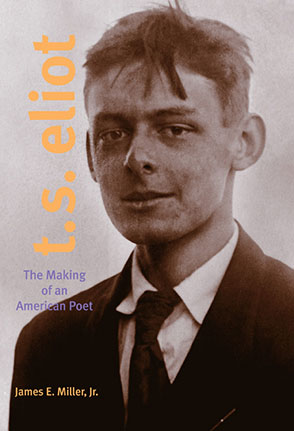
T. S. Eliot
The Making of an American Poet, 1888–1922
James E. Miller Jr.
“Given the importance of James E. Miller's previous work on Eliot for understanding the erotic energies driving his poetry, T.S. Eliot: The Making of an American Poet is an especially welcome event. This biography represents the culmination of decades of research and will be indispensable reading for Eliot scholars.”
- Description
- Reviews
- Table of Contents
- Sample Chapters
- Subjects
Miller challenges long-held assumptions about Eliot’s poetry and his life. Eliot himself always maintained that his poems were not based on personal experience, and thus should not be read as personal poems. But Miller convincingly combines a reading of the early work with careful analysis of surviving early correspondence, accounts from Eliot’s friends and acquaintances, and new scholarship that delves into Eliot’s Harvard years. Ultimately, Miller demonstrates that Eliot’s poetry is filled with reflections of his personal experiences: his relationships with family, friends, and wives; his sexuality; his intellectual and social development; his influences.
Publication of T. S. Eliot: The Making of an American Poet marks a milestone in Eliot scholarship. At last we have a balanced portrait of the poet and the man, one that takes seriously his American roots. In the process, we gain a fuller appreciation for some of the best-loved poetry of the twentieth century.
“Given the importance of James E. Miller's previous work on Eliot for understanding the erotic energies driving his poetry, T.S. Eliot: The Making of an American Poet is an especially welcome event. This biography represents the culmination of decades of research and will be indispensable reading for Eliot scholars.”
“For a figure as elusive as Eliot, whose runic remains no two readers interpret the same way, this makes for a valuable compendium—a kind of do-it-yourself portrait kit.”
“Filled with revelations, assumptions, and recommendations for further research, T.S. Eliot: The Making of an American Poet, three parts meticulous research and one part speculation, is both weighty and intuitive. Easy to access, logically organized, scrupulously referenced, and index-friendly, Miller’s book is a satisfying treat for Eliot scholars who enjoy a coffee spoon of gossip with their literary research.”
Contents
Preface
A Note on Sources
Introduction
Part 1. 1888–1906: Origins
1. Eliot’s St. Louis and “The Head of the Family” ;
2. Sons and Lovers: Sex and Satan;
3. A Frail Youth, a Bookish Boy;
4. Early Landscapes, Later Poems
Part 2. 1902–1914: Early Influences
1. Eliot at Fourteen: Atheistical, Despairing, Gloomy;
2. Poetic Beginnings: Merry Friars and Pleading Lovers;
3. Missourian, New Englander: Double Identity;
4. A Soul’s Paralysis: “Denying the Importunity of the Blood”
Part 3. 1906–1911: Harvard: Out from Under
1. Prologue: A Problematic Student;
2. Bohemian Boston at the Turn of the Century;
3. Bohemian Harvard and Isabella Stewart Gardner (“Mrs. Jack”);
4. A Fellow Poet: Conrad Aiken;
5. “A Very Gay Companion”: Harold Peters;
6. Practicing to Be a Poet: From Omar’s Atheism to Laforgue’s Masks;
7. Poems Written 1906–1910
Part 4. 1906–1910: Harvard Influences: Teachers, Texts, Temptations
Teachers: 1. Irving Babbitt: Human Imperfectability;
2. Barrett Wendell: The Inexperience of America;
3. George Santayana: Philosopher of Reason;
4. William Allan Neilson: Poetic Theorist; Texts:
5. Dante and Eliot’s “Persistent Concern with Sex”;
6. Petronius’s Satyricon: A “Serene Unmorality”;
7. Symons/Laforgue: The Ironic Mask;
8. Havelock Ellis, “Sexual Inversion”;
9. John Donne: Thought as Experience; Temptations:
10. The Lure of Europe: Brooks’s The Wine of the Puritans;
11. “T. S. Eliot, the Quintessence of Harvard”
Part 5. 1910–1911: T. S. Eliot in Paris
1. The Primacy of Paris, 1910–1911;
2. Jean Verdenal: “Mon Meilleur Ami”;
3. Matthew Prichard: A Blurred Portrait;
4. Henri Bergson: A Brief Conversion;
5. Charles Maurras: The Action Française;
6. Finding the Personal in the Poem: Drafts of “Portrait” and “Prufrock”;
7. Poems Written 1911–1914
Part 6. 1911–1914: Eliot Absorbed in Philosophical Studies
1. Prologue: The Rise of Harvard’s Philosophy Department and the Santayana Controversy;
2. The Decline and Fall of Harvard Philosophy in Eliot’s Day and After;
3. Eliot and Oriental Philosophies and Religions;
4. Psychology as Philosophical, Religion as Psychological, Mysticism as Magical;
5. Eliot and the Elusive Absolute;
6. Epilogue: The Eliot Controversy,
Part 7. 1914–1915: American Chaos versus English Tradition
1. Philosophy in Marburg, War in Europe;
2. London Interlude: Pound and Russell;
3. Oxford, 1914–1915: Reconsidering Philosophy;
4. New Friends and Old: Culpin, Blanshard, Pound, Lewis;
5. The Mystery of Emily Hale: “The Aspern Papers in Reverse”
Part 8. 1915: An Inexplicable Marriage and the Consequences
1. A Sudden Marriage at the Registry Office;
2. Who Was Vivien?;
3. A Flurry of Correspondence, a Day of Decision;
4. An Unhappy Visit Home (Gloucester, July 24–September 4), a Disastrous Honeymoon (Eastbourne, September 4–10);
5. “Bertie” Russell’s “Friendship”;
6. “What I Want Is MONEY!$!£!! We are hard up! War!”;
7. Hallucinations, Heavenly and Hellish Poetic Visions: “St. Sebastian” and “St. Narcissus”;
8. Poems Written 1914–1915
Part 9. 1916: Making Do, Finding Means, Expanding Connections
1. “The Most Awful Nightmare of Anxiety”; “Pegasus in Harness”;
2. The Triumph of Poetry over Philosophy;
3. Reviews and Essays, Teaching and Lecturing: Total Immersion;
4. A Widening Circle of Friends and Associates, Writers and Artists
Part 10. 1917–1918: T. S. Eliot: Banker, Lecturer, Editor, Poet, Almost Soldier
1. Eliot the Banker: March 19, 1917–November 1925;
2. Eliot the Extension Lecturer;
3. Eliot as Eeldrop;
4. Eliot the Assistant Editor: June 1917–December 1919, ;
5. Eliot the Poet, ;
6. America Enters War: April 6, 1917–Armistice Day, November 11, 1918;
7. “Writing . . . Again”: The French and Quatrain Poems;
8. Poems Written 1917–1918
Part 11. 1919–1920: Up the Ladder, Glimpsing the Top
1. Death of a Father;
2. Banking, Teaching, Editing, Writing: Money and Power;
3. Friendships and Relationships: Deeper and Wider;
4. A Voice from the Past; “An Encounter of Titans”; Moving Again;
5. Three New Books: Poetry and Prose;
6. “Gerontion”: Return of Fitzgerald’s Omar;
7. Poems Written 1918–1920
Part 12. 1919–1921: Notable Achievements, Domestic Disasters, Intimate Friends
1. Prologue: Paris and the Pension Casaubon, Paris Again in the Spring;
2. “A Long Poem . . . on my Mind for a Long Time”;
3. A Family Visit: Mother, Brother, Sister—Wife;
4. A Room of One’s Own, Wearing Makeup, Confidante Virginia Woolf;
5. Roommates, “Renowned Pederasts”: Kitchin, Senhouse, Ritchie
Part 13. 1922: Over the Top
1. “The Uranian Muse,” The Waste Land, and “il miglior fabbro”;
2. Publication of The Waste Land;
3. “Out into the World”: The Waste Land Reviewed;
4. Pound’s Financial Scheme for Eliot: “Bel Esprit";
5. Birth of The Criterion
Part 14. A Glance Ahead: The Making of an American Poet
1. T. S. Eliot and Walt Whitman;
2. An American Poet Discovers His American-ness
References to Works by T. S. Eliot
References to Works by Other Authors
Index
Preface
The incubation period of T. S. Eliot: The Making of an American Poet is some thirty years, beginning in the early 1970s, and propelled by the publication of, and response to, my first book on Eliot, T. S. Eliot’s Personal Waste Land: Exorcism of the Demons, in 1977. Since that book is out of print, as a sort of prolegomena to a preface, I propose a brief summary of its genesis, reception, and continuing influence.
A Backward Glance at Eliot’s Personal Waste Land
In 1971, when Eliot’s widow Valerie Eliot edited and published the manuscript version under the title T. S. Eliot, The Waste Land: A Facsimile and Transcript of the Original Drafts Including the Annotations of Ezra Pound, she placed as an epigraph Eliot’s own statement: “Various critics have done me the honour to interpret the poem in terms of criticism of the contemporary world, have considered it indeed, as an important bit of social criticism. To me it was only the relief of a personal and wholly insignificant grouse against life; it is just a piece of rhythmical grumbling” (WLF, 1). Although the instinct of many readers was to discount this statement, and even to point to the vagueness of its origins (it was quoted by a professor in a lecture, and recorded by Eliot’s older brother, Henry), it is, in fact, quite in keeping with an entire series of such statements made by Eliot in public and for the record.
In 1931, in “Thoughts after Lambeth,” Eliot comments: “When I wrote a poem called The Waste Land some of the more approving critics said that I had expressed the ‘disillusionment of a generation,’ which is nonsense. I may have expressed for them their own illusion of being disillusioned, but that did not form part of my intention” (SE, 324). When, in his 1959 Paris Review interview, Eliot was pressed on this statement, he in effect reaffirmed it: “No, it wasn’t part of my conscious intention. I think that in Thoughts after Lambeth, I was speaking of intentions more in a negative than in a positive sense, to say what was not my intention. I wonder what an ‘intention’ means! One wants to get something off one’s chest. One doesn’t know quite what it is that one wants to get off the chest until one’s got it off.” It was later in this same interview that Eliot made this astonishing statement (when asked to compare his two long poems): “By the time of the Four Quartets, I couldn’t have written in the style of The Waste Land. In The Waste Land, I wasn’t even bothering whether I understood what I was saying. These things, however, become easier to people with time. You get used to having The Waste Land, or Ulysses, about” (INT, 97, 105).
In his 1951 lecture, “Virgil and the Christian World,” Eliot made perhaps his most intriguing statement about The Waste Land without naming the poem: “A poet may believe that he is expressing only his private experience; his lines may be for him only a means of talking about himself without giving himself away; yet for his readers what he has written may come to be the expression both of their own secret feelings and of the exultation or despair of a generation. He need not know what his poetry will come to mean to others; and a prophet need not understand the meaning of his prophetic utterance” (OPP, 137). In all of these statements, direct and oblique, about The Waste Land, Eliot emphasized more and more the personal, private matter that went into the poem and his astonishment at the way the poem came to be read as a public statement about the modern world.
In the last of the comments quoted above, he has perhaps put his feelings in their most complex language. Could it possibly be that Eliot believed he was expressing only his “private experience” in The Waste Land? That the lines of this most famous poem of the twentieth century were for the author “only a means of talking about himself without giving himself away”? Giving himself away? Giving what away? What was there to conceal? Presumably what nobody had, by the 1951 lecture, discovered, or at least discovered and revealed. Could it be that the 1919 essay “Tradition and the Individual Talent,” with its elaborate and tortured “impersonal theory” of poetry, had been a sophistic or sophisticated defense for someone wanting to write poetry “talking about himself without giving himself away”?
It is of considerable interest that Cleanth Brooks waited until 1989 to reveal that he had sent his 1937 essay in manuscript (“The Waste Land: An Analysis,” later titled “The Waste Land: Critique of the Myth”) to Eliot, hoping to get his approval. Brooks had followed F. O. Matthiessen (Matthiessen, 92–93) in assuming that a Rupert Brooke letter had been an important source for some lines of The Waste Land. Eliot replied that he didn’t recollect ever reading the Brooke letter, and added: “but actually this particular passage approximates more closely to a recollection of a personal experience of my own than anything else, and indeed is as nearly as I could remember a verbatim report [of the personal experience]” (Brooks, Cleanth, TWLPD, 321).
What is the passage in The Waste Land that Eliot described as a “verbatim report” of his “personal experience”? It is the opening lines of The Waste Land. Rupert Brooke described in his letter a friend’s reaction upon hearing that England was at war with Germany. The friend “climbed a hill of gorse, and sat alone, looking at the sea. His mind was full of confused images, and the sense of strain. In answer to the word ‘Germany,’ a train of vague thoughts dragged across his brain. . . . The wide and restful beauty of Munich; the taste of beer; innumerable quiet, glittering cafés; the Ring; the swish of evening air in the face, as one skis down past the pines; a certain angle of the eyes in the face; long nights of drinking and singing and laughter . . . certain friends; some tunes; the quiet length of evening over the Starnbergesee” (Matthiessen, 92–93). Readers familiar with the opening lines of The Waste Land could, like Matthiessen and Brooks, easily believe that this letter was a source for Eliot. But none would be likely to doubt Eliot’s firm statement that the opening lines of The Waste Land were a “verbatim report” of his “personal experience.” And his biography reveals that in 1911, during his academic year in Paris, Eliot did indeed visit Munich and the Starnbergersee nearby.
If there was increasing agreement over time that Eliot had reason to call The Waste Land a personal poem, critics were left with the even more baffling question: what is the nature of this personal dimension? The British poet Stephen Spender published his Penguin Modern Masters volume T. S. Eliot in 1976 and noted: “Eliot once referred to The Waste Land as an elegy. Whose elegy? His father’s? Jean Verdenal’s—mort aux Dardanelles in the war?” Spender’s book does not identify sources; are we to assume that the remark was made by Eliot to Spender personally? Shortly after this passage, Spender wrote: “‘Death by Water’ crystallizes the hidden elegy that is in The Waste Land—hinted at, as we have seen, in ‘Those are pearls that were his eyes’” (Spender, TSE, 111, 114, emphasis added). Although much younger than Eliot, Spender had come to know Eliot in the 1930s, and had included him in his critical work, The Destructive Element: A Study of Modern Writers and Beliefs (1936). Spender’s personal acquaintance with Eliot and knowledge of his poetry renders it quite plausible that Eliot would comment to him in casual conversation on the elegiac nature of his most famous poem.
We might assume that with the publication in 1971 of The Waste Land manuscripts, Eliot’s statements about his poem might have challenged reviewers and critics to find out what he meant, to look for clues for the concealed private experience. By and large the commentators on the poem, many of them a part of the critical establishment with vested interests in the received “public” reading of The Waste Land, found renewed confirmation of the traditional reading, and expressed their admiration for Ezra Pound’s skill in revising and radically cutting the poem. There were some who made limited gestures to define the personal content of the poem as revealed by the manuscripts, but no very persuasive new reading seemed to emerge from the publication.
It was about this time that I came across “A New Interpretation of The Waste Land,” by Canadian professor John Peter, published in the July 1952 issue of the British journal Essays in Criticism. Peter analyzed the poem as a dramatic representation of the speaker’s falling in love with a “young man who afterwards met his death” by drowning. The article did not suggest that Eliot was the speaker, nor that he had based his poem on his own experience. But lawyers for Eliot reported to Peter that their client had read his article with “amazement and disgust” and said it was “absurd” and “completely erroneous”; they threatened to bring a lawsuit against Peter and the editor of Essays in Criticism if they did not withdraw and destroy the issue containing it. Peter offered to publish a retraction, but the solicitors were firm in their decision that he should not, perhaps because a published retraction would likely result in more embarrassment to Eliot. Peter and the journal quickly agreed to the withdrawal, and the matter not only seemed to be settled, but disappeared from public view.
But, after Eliot’s death in 1965, Peter republished the article together with a long “Postscript” in Essays in Criticism in April 1969, in which he added details of what he frankly asserted was a biographical interpretation: the major identification was that of Phlebas the Phoenician as Jean Verdenal, the friend Eliot met in Paris during his year of study abroad in 1910–11. Inspired by Peter’s article, the additional evidence of the facsimile, and Peter’s letter to me that he did not plan to write anew about the matter, I set aside a book I was writing on the American long poem and wrote a short book, mining the Waste Land manuscripts that supported the thesis that the poem was in effect an elegy. I published the book in 1977 under the title, T. S. Eliot’s Personal Waste Land: Exorcism of the Demons, and with an epigraph that would reveal the source of the second half of the title: “he is haunted by a demon, a demon against which he feels powerless, because in its first manifestation it has no face, no name, nothing; and the words, the poem he makes, are a kind of form of exorcism of this demon” (OPP, 107). The source of these lines is Eliot’s “The Three Voices of Poetry,” which is given the date 1953 in Eliot’s volume On Poetry and Poets.
T. S. Eliot’s Personal Waste Land provoked harsh criticism. Writing in the Times Literary Supplement of October 28, 1977, Christopher Butler denounced “the homosexual interpretation of Eliot’s life and work.” Several reviewers felt that the book was persuasive. For example, in The New York Times Book Review, April 17, 1977, Robert Langbaum wrote: “By reminding us of the young Eliot’s anguish, Miller’s book serves as a corrective to the monumental figure Eliot cut in his later years,” but noted that “a responsible biography” would have to be based on further information, especially an edition of the letters.
More than a generation later, the academic context for discussing the homoerotic aspects of literary works had been transformed, almost beyond recognition. The growth of scholarly interest in gay themes has broadened and deepened our understanding of what Eve Kosovsky Sedgwick has suggestively called “the epistemology of the closet.” Wayne Koestenbaum in Double Talk: The Erotics of Male Literary Collaboration (1989) is but one of the many studies that have built on my reading of Eliot in T. S. Eliot’s Personal Waste Land.
Mailing List
Subscribe to our mailing list and be notified about new titles, journals and catalogs.