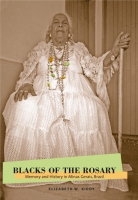




Blacks of the Rosary
Memory and History in Minas Gerais, Brazil
Elizabeth W. Kiddy
“In Blacks of the Rosary Elizabeth Kiddy makes a most welcome addition to the history of the African Diaspora in the New World. She skillfully connects the lives, ceremonies, and celebrations of Afro-Brazilians in colonial Minas Gerais to those of their modern urban descendants in the still racially identified communities of present-day Belo Horizonte. She carefully traces the evolution and development of the brotherhoods and congados from their origins to the present and illuminates a fascinating process of negotiation and adaptation through which Afro-Brazilians sought to establish and define their own community identities.”
- Description
- Reviews
- Bio
- Table of Contents
- Sample Chapters
- Subjects
“In Blacks of the Rosary Elizabeth Kiddy makes a most welcome addition to the history of the African Diaspora in the New World. She skillfully connects the lives, ceremonies, and celebrations of Afro-Brazilians in colonial Minas Gerais to those of their modern urban descendants in the still racially identified communities of present-day Belo Horizonte. She carefully traces the evolution and development of the brotherhoods and congados from their origins to the present and illuminates a fascinating process of negotiation and adaptation through which Afro-Brazilians sought to establish and define their own community identities.”
“This well-researched, thoroughly grounded study on the black Rosary brotherhoods of Minas Gerais is a pleasure to read. . . . Few of the many recent works on black Brazil working within the established historiography have explored such an original theme. . . . Overall this is a welcome read, with excellent maps, out of fashion but convenient footnotes, and a readable font.”
“This fresh and insightful endeavor is of interest to confraternity scholars first and foremost because of its focus on sodalities for non-whites—something that, to my knowledge, is very scarce in scholarship in this field.”
“While her analysis of the twentieth century is less detailed, she raises critical questions for scholars studying the Afro-Brazilian community during these important decades. In general, Blacks of the Rosary is an important book for scholars working on the African Diaspora, the history of Afro-Brazilians, and religious practices.”
“This is an important story, and Kiddy does a fine job of presenting it to an English readership. The range of the book—from early eighteenth century to the present—provides an evolving lens through which the nature of the traditions and the communities that practiced them unfold. Given the importance of lay religious cultural contribution of Central Africans in the Americas, this book is highly recommended to students and scholars of Latin American history.”
“A challenging and rewarding read, the book offers scholars a valuable resource for the understanding of the development of social and religious organization of ‘blacks’ in the African Diaspora.”
Elizabeth W. Kiddy is Assistant Professor of History and Director of Latin American and Caribbean Studies at Albright College.
Contents
List of Illustrations and Maps
Acknowledgments
Abbreviations
Introduction
Part One
1. European Origins of the Rosary Devotion of the Blacks
2. Africans in the Brotherhoods
Part Two
3. Early Formation of the Brotherhoods, 1690–1750
4. The Late Colonial Period, 1750–1822
5. The Brotherhoods in the Brazilian Empire
Part Three
6. Congados and Reinados, 1888–1990
7. Voices of the Congadeiros
Conclusion
Appendix
Glossary
Bibliography
Index
Introduction
Esse Congado vem do princípio do mundo. Ninguem sabe o princípio dele, e ninguem sabe o fim.
[This Congado comes from the beginning of the world. No one knows the beginning of it, and no one knows the end.]
—Dona Maria Geralda Ferreira, Jatobá
Dona Maria said this to me on a sunny, dry day in August 1995 as we sat on her front porch looking out on the yard, where the annual festival for Our Lady of the Rosary was about to begin. Dona Maria, born 4 July 1906, has spent most of her life as part of the Festa do Reinado de Nossa Senhora do Rosário (Feast Day of the Crowning of Our Lady of the Rosary), known in the vernacular as the Congado (Fig. 1). She plays an important role in the festival in Jatobá, a region on the industrial periphery of Belo Horizonte, the capital of the Brazilian state of Minas Gerais. Her brother had been an important and powerful captain of the congado (ritual group) known as the Mozambique; she was the widow of the man who had been the leader, or capitão-mor, of the festival for more than forty years, and she was the mother of the current leader, João Lopes. In her own right Dona Maria has long been a benzedora, or healer, using prayers and herbs to treat the sick, who come from miles around to ask for her help, and during the festival, all the leaders come to ask for her blessing before going out to do the ritual work of the festival. One participant described her as having a “spiritual [force], a knowledge, and she maintains the blood of the brotherhood to not let it fall.” On her porch that day in 1995 we waited for the costumed groups of Mozambiques and Congos to arrive with the King and Queen of Congo, whom they had escorted from their homes to the yard, now a ritual space, in front of Dona Maria’s house and the chapel of Our Lady of the Rosary. When they arrived, the yard filled with the syncopated rhythms, swirling colors, and large and small rituals that make up the annual feast day celebration.
Dona Maria and all congadeiros, as participants in the festivals are called, are heirs of the rosary brotherhood tradition, which dates from the first years of colonization in Minas Gerais. Congadeiros are primarily black, both phenotypically and economically, and live in the working-class and poor neighborhoods of the large cities and small towns of Minas Gerais. During the festivals, congado groups, some using the names of African nations and wearing the colors of the saints, play drums and shakers, sing and dance, and escort their kings and queens. The festivals include the coronations of these kings and queens in the part of the festival known as the Reinado. The festivals open up a ritual space in which the participants can call on Our Lady of the Rosary and the other saints associated with the festival to intercede on their behalf or to thank them for their intercession. In order to ensure the good reunion of the people without any trouble from seen or unseen forces, the participants engage in special rituals at the crossroads and in the privacy of their homes to guarantee the protection of the pretos velhos, the spirits of old, black, African slaves. The festivals are the apex of the ritual year for the communities that celebrate them, and they work to reinforce their links to the unseen world, to the past, and to one another.
Dona Maria in many ways embodies some of the paradoxes inherent in the study of the rosary brotherhoods and festivals in Minas Gerais. She identifies herself as an Afro-Brazilian, celebrates the relationship between Our Lady of the Rosary and blacks, and affirms the link between Our Lady of the Rosary and the emancipation of slaves. “The blacks are the sons of Our Lady, and that is why slavery ended. From slavery there was freedom and from freedom came the Congado, the festival of Our Lady. . . . Our Lady helped everyone and here all of the blacks are very happy with Our Lady of the Rosary.” However, when asked about the personal history of her family, she recounts that her family was not enslaved, but rather had been slave owners in the nineteenth century. Like Dona Maria’s own memory of her family’s history and its devotion to Our Lady of the Rosary, the rosary brotherhoods and their festivals in Minas Gerais blur boundaries erected by scholars to understand the history of Africans in the Americas in general, and in Brazil in particular, in three distinct ways.
First, scholars, for the most part, followed the lead of contemporary commentators who considered the brotherhoods and their festivals to be “slave” organizations, even though through much of their history a majority of the membership was free. The communities, built on both kinship and affective ties, were based on a common heritage rather than a shared legal status. Second, the relationship between the brotherhoods and the church and the state authorities made them appear to be accommodating, in the traditional accommodation/resistance dichotomy. Indeed, there can be no argument that the rosary brotherhoods were Catholic lay organizations that Africans and their descendents enthusiastically joined. Nevertheless, participants have long either ignored or resisted attempts to change or abolish rituals that tied them to their African past, such as the coronations of their kings and queens and the drumming and call-and-response singing that continues to define the festivals. Finally, at the time of independence, and then almost a century later after the abolition of slavery, rosary festivals seemed to fade away in many parts of Brazil, but not in Minas Gerais. There, the festivals only grew stronger as the twentieth century progressed.
How, then, can we understand the brotherhoods of the rosary in Minas Gerais? The current day celebrations, the rituals, and the legends developed from the colonial rosary brotherhood traditions in Minas Gerais in which African- and Brazilian-born slaves and free blacks formed communities, celebrated their saints, and helped one another on to the other world through rituals of death. The formation of communities developed concurrently with the rituals and celebrations and with all activities within groups of recently arrived slaves in Brazil. Joseph C. Miller points out that slaves would have drawn “on differing aspects of their home backgrounds as they searched for a morally restorative sense of humane community among themselves.” The seeming contradictions in the rosary brotherhoods can be understood when they are viewed as a process of the formation and maintenance of transnational and multiethnic communities of the African diaspora. The idea of community that has emerged among these groups is not exclusively one of place, or of neighborhood, but rather of a people who have worked to maintain a group identity through generations—an identity formed by the annual reaffirmation of a shared, remembered history as descendents of Africans and devotees of Our Lady of the Rosary.
The remarkable resilience of the rosary brotherhoods has resulted from centuries of negotiation and compromise with secular and ecclesiastic authorities and within their own populations. Historian Thomas A. Abercrombie in his discussion of the Aymara people of Bolivia argues that “the institutional matrix and cultural meanings of ‘ethnic’ cultural survival in the Andes have been shaped by native peoples’ active and collective engagement with, rather than flight from, the power-infused cultural programs of state elites.” Likewise, Africans and their descendents in Minas Gerais actively participated in organizations that simultaneously linked them to the European power structure while allowing them to continue practices that served as a foundation for their existence and endurance as communities. The strategy of these groups exposes the limitations of the resistance/accommodation model, replacing it with the examination of processes of negotiation, change, and continuity. This book, then, is a history of the descendents of a group of slaves and free blacks who creatively used the cultural materials at hand, who were, in the phrase of historians João José Reis and Eduardo Silva, “between Zumbi and Pai João,” in order to ensure their survival as a community, maintain their devotions and the link to their ancestors, and foster a pride in their African roots.
Identity, Memory, and History
This book explores the long history of the congadeiros through the examination of the main themes of community, devotion, and identity, set into the context of the endemic asymmetry of power in Brazilian society. I do not use the word identity in the sense of an individual’s sense of uniqueness as an autonomous being, but rather to indicate an individual’s sense of belonging in a group. Brazilian anthropologist Roberto DaMatta asks whether “the notion of the individual really has absolute validity in social systems where it is conceived as merely residual if not negative social category.” In both Brazilian and African societies in the eighteenth century, the family or kin group composed the smallest social unit, and autonomy from such a group often meant marginality. Therefore, the identity of individuals was intimately wrapped up in the identification with a group. This certainly would have been the case for Africans, who, as Miller points out, “thought of themselves primarily in terms of social identities constructed out of family and other local communities.” The groups with which many Africans in Minas Gerais chose to align themselves were the brotherhoods of the rosary of the blacks.
The rubric of the blacks brings up the problematic question of “race” in Brazil, where this is a category that has both been fluid and slippery. Max Weber defines race as something that “creates a ‘group’ only when it is subjectively perceived as a common trait: this happens only when a neighborhood or the mere proximity of racially different persons is the basis of joint (mostly political) action, or conversely, when some common experiences of members of the same race are linked to some antagonism against members of an obviously different group.” This definition, which stresses the relativity of race, serves well for the rosary brotherhoods. The antagonism of the groups in Brazil came from the hierarchical social system in which the members of the rosary brotherhoods, both slave and nonwhite free men and women, had the least power within the society. Once they joined the community of the brotherhood, they joined a group of blacks. They sought incorporation with others who shared both “subjectively perceived” common physical traits as well as a common heritage and also shared experiences of slavery, poverty, or both. The brotherhoods provided a forum for the development of identities based on “race,” or being black in the colonial period, that rosary brotherhoods in the following centuries could build upon.
The concept of being black in the rosary brotherhoods was erected on two foundations that brought the community together. The first was the devotion to Our Lady of the Rosary, the patron of the blacks. The second was expressed in the annual festival to Our Lady of the Rosary, in which blackness was reinforced by the constant rearticulation of links to Africa through songs, drums, and ritual action and the calling on the pretos velhos. The participants have continuously constructed a social memory and thus built and reinforced a group identity, through the action, or work, of the festival. Sociologist Maurice Halbwachs argues that through membership in groups people are able to “localize and recall their memories.” Paul Connerton takes this idea a step further by locating the formation of social memory in the action of rituals, both religious and commemorative.
Although sociologists have worked to understand how groups remember their past, the term memory, both because of and despite its recent popularity, has come under fire in the field of history. Kerwin Lee Klein recently critiqued the emergence of the term in the discipline, pointing out that memory is most often paired with identity and with a “clustering of quasi-religious terms.” He warns that the use of memory represents a desire to “re-enchant our relation with the world and pour presence back into the past.” Despite Klein’s discomfort with the term, the use of the links that remembering provide are not only helpful but necessary when discussing a people who perceive their past as inseparable from their beliefs. One of the earliest historians to talk about history and memory, Pierre Nora, poetically identified memory as lived history, as “life, borne by living societies founded in its name . . . a perpetually actual phenomena, a bond tying us to the eternal present.” More recently, Abercrombie articulates Nora’s ideas by juxtaposing memory and history, demonstrating the ways in which social memory is constructed in an Andean village through myth and ritual in relation and opposition to Western historical discourse. History and memory are presented as being on different sides of an unequal equation—an equation that places rational/secular, written history on one side and remembered, ritualized, “sacred” history on the other. Abercrombie exposes the danger in this equation, demonstrating that writing the history of a people “without a history,” using a Western model, ends up producing a history that the people themselves would not recognize, in effect recolonizing the peoples’ past. Understanding nondominant groups involves using all the resources available for discovering that past, including the ways that the groups themselves construct that history.
Analyzing how memory works, however, involves understanding the mechanisms through which the remembering is achieved. Memory, the noun, implies a static concept, a substantive “thing” that may only dwell in the minds of individuals. Yet memory is not a static concept but an active one. People do not simply have memories; they actively remember through ritual and storytelling. Remembering, then, is a practice, and it is both similar to and linked to the act of believing. Marilyn Motz points out that “a belief exists only because people believe it: it is not an attribute or property but the evidence of a process.” In exactly the same way, a memory exists only because a person, or group, remembers it, and like believing, it is a process better defined by the verb than the noun. The processes of believing and remembering are both articulated in the rituals and narratives of the Congados—in fact, they are inseparable. Through the ongoing and intertwined practices of believing and remembering, the congadeiros maintain a strong and positive sense of community identity and their own “blackness” through reinforcing a living link to an African past.
The scope of this book is broad both chronologically and geographically. I divide the book chronologically into three parts. In Part 1, I examine the antecedents of the mineiro (that is, of Minas Gerais) brotherhoods both in Europe and in Africa. The brotherhoods in Minas Gerais, and the devotion that evolved within them, began at the intersection of a cluster of sub-Saharan cosmologies, many of which already included elements of European culture and Catholicism and eighteenth-century Iberian folk practices in the social milieu of a slave society in the interior of Brazil. In Chapter I, I investigate the roots of the devotion and the nature of lay Catholicism in early modern Europe in order to demonstrate the complexity of Catholicism and the importance of lay activity at the time of the explorations of Africa and the Americas. The mentalities of that period served as a cultural backdrop for the Portuguese and as a foil for the Africans who came into contact with it. I explore the development of brotherhoods and specifically the brotherhoods of the rosary and other lay organizations formed for Africans on the Iberian Peninsula. I also address the explorations and settlement of the Portuguese and the beginning of the slave trade. The focus of Chapter 2 is Africa and the primary locations from which slaves destined for the mines were taken. Specifically, I examine the dynamic histories of West and Central Africa during the first centuries of the slave trade, discuss local worldviews and practices from those areas, and explore the emergence of dynamic creole cultures.
In the late seventeenth century, gold was discovered in Brazil, in the highlands region that came to be known as Minas Gerais. In Part 2, I examine the brotherhoods of the rosary of the blacks in Minas Gerais from the time of the arrival of the first Europeans and Africans and through to the end of slavery in Brazil in 1888. Again, the chapters are divided chronologically. Chapter 3 centers on the development of the brotherhoods in the chaotic gold-mining boom that occurred in Minas Gerais from 1690 to about 1750. In that wild, frontier context, brotherhoods, including rosary brotherhoods of blacks, emerged as fiercely independent organizations. The autonomy of the organizations during this formative period would shape the ways they confronted outside pressures in the following centuries. By 1750 the boom had gone bust, the frontier society of Minas Gerais began to settle down, and the first new diocese was created in Minas with the city of Mariana at its hub. Life was changing in the metropolis, too, as the marquis de Pombal came to, then fell from, power and Brazil moved closer to independence. Chapter 4, then, concerns the period from the mid-eighteenth century to 1822 and these external pressures on the rosary brotherhoods, as well as the internal dynamic of the organizations as they confronted increasing oversight by state and church authorities. It was toward the end of this period that travelers began to leave records of the rosary festivals and their coronations and dances. Chapter 5 begins in 1822 and follows the rosary brotherhoods through the transitional period of the Brazilian Empire and to the end of slavery, with another look at both the societal pressures of church and state and the internal reactions of the brotherhood members. Through the colonial period and the empire, although the brotherhoods constantly negotiated with the state and church authorities, little changed in the actual brotherhood structure, and the organizations continued to be based on foundations laid in the early colonial period. By the nineteenth century it was apparent that the Afro-Brazilian devotion to Our Lady of the Rosary had become a customary and accepted celebration among many sectors of society in Minas Gerais.
This relative stability came to an abrupt end in the late nineteenth century, and in Part 3 I examine the rosary brotherhoods and the ongoing methods used by congadeiros to keep their festivals alive from 1889 to 1980. The subject of Chapter 6 is how the reorganization of the church after the abrupt division of church and state at the founding of the First Republic in 1889 affected the brotherhoods. Oral testimony and archival sources recount the evolution of the festivals in the twentieth century and their struggle to survive in rapidly modernizing Brazil. It turns out, however, that the rosary devotion of the blacks had the power to shape and influence popular sentiment in Minas Gerais, and despite changing attitudes of the church, the rosary organizations and festivals survived. Although I bring in the voices of the congadeiros throughout the book, in the final chapter I step away from the historical narrative and allow participants in the Congado communities today to express their own thoughts about their devotion, their history, and their identity as devotees of Our Lady of the Rosary of the blacks.
The scope of the project required me to use a variety of sources. My interest in studying the history of the rosary brotherhoods in Minas Gerais came out of my personal experience with the festivals dedicated to Our Lady of the Rosary. I traveled to Minas Gerais in 1994, 1995, 1996, and 1997 to research the material in this book, and during those years I attended several festivals. I decided to concentrate on two festivals, one in the town of Oliveira in the agricultural region of Minas Gerais southwest of the capital, Belo Horizonte, and the other in Jatobá, located in the industrial periphery of the capital. The participants in these festivals expressed strong ties to an African past and a pride in their “blackness”—both elements also apparent in the rituals that made up the festivals—which seemed to contradict much of what I had learned about attitudes toward blackness in Brazil. Soon the energy of the festivals, the stamina and devotion of the participants, the rituals with the crowns and the rosaries, the lyrics of the songs, and the words of the tales all drew me into the story of the past as lived by the congadeiros themselves.
While not attending festivals, I haunted large and small archives in Minas Gerais. The books of the brotherhoods are not housed in a central location but instead are spread across an array of various archives. The State Archive in Belo Horizonte (Arquivo Público Mineiro) had some of the brotherhood books, especially for the period of the Empire to the present, and also contained valuable correspondence, laws, and other materials that helped to construct the story of the brotherhoods. The most comprehensive collection of documents for the colonial brotherhoods is housed in the Ecclesiastic Archive in Mariana (Arquivo Eclesiástico da Arquidiocese de Mariana), but I also worked with the documents of some brotherhoods in small archives of particular brotherhoods, such as that in the rosary brotherhood of São João del Rei, the Museum of Sacred Art in that city, and the local archives in Oliveira. There is no telling how many small parishes have their own collections of rosary brotherhood documents. Because of the variation in storage techniques, some of the documents had been lost to the corrosive elements of nature, but fortunately many survived. What remained supplied an abundance and variety of documents that enabled me to piece together a picture of the history of the rosary brotherhoods over several centuries. Finally, documents in the National Archive and the National Library in Rio de Janeiro helped to supplement the brotherhood documents and put them in a larger context. For the chapters on Europe and Africa I relied heavily on published primary sources and the work of scholars of those areas. Those works, and the present-day festivals, legends, and stories, shed light on the documents contained in the archives and enabled me to put together this long story. Although some amount of depth has been sacrificed in order to achieve this breadth, my hope is that authors of future studies will be able to look more closely at particular periods, places, and events in order to continue to build a comprehensive understanding of these important organizations and the people who participate in them.
This study as a whole, then, explores the history of the rich and complex religious and social traditions alive in the Afro-Brazilian communities of Minas Gerais. Within the infrastructure set by the dominant sector of society, Africans and their descendants creatively and actively organized and used the brotherhoods to create a community in a new place. Far from being a co-optation of their religion and culture, or simply a conscious form of cultural resistance, a study of the brotherhoods of the rosary offers a look into the messier and less-easy-to-categorize strategies of survival that abounded not just in Brazil, but throughout the Americas wherever large numbers of slaves were taken. The centerpiece of these strategies was the ability to form strong and long-lasting communities. The study of the rosary brotherhoods of blacks in Minas Gerais shows the success of groups in one particular region, and the congadeiros today express their achievement through the vibrancy of their faith and the strength of their communities, in which the devotion to Our Lady of the Rosary continues to flourish.
Also of Interest
Mailing List
Subscribe to our mailing list and be notified about new titles, journals and catalogs.