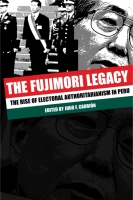




The Fujimori Legacy
The Rise of Electoral Authoritarianism in Peru
Edited by Julio F. Carrión
“The Fujimori Legacy brings together a collection of insightful essays, which collectively document the steady rise of autocratic rule in Peru following the 1992 autogolpe and the ineffectiveness of oppositional actors and institutions in neutralizing this transition. By discussing the role of public opinion, the absence of political parties, state reform, military backing, corruption, and media collusion, among other things, the book sheds new light on the complex and contradictory dynamics of Fujimorismo. This book makes an important contribution to the scholarly understanding of authoritarianism in an era of widespread democratization.”
- Description
- Reviews
- Bio
- Table of Contents
- Sample Chapters
- Subjects
This book offers a comprehensive assessment of Fujimori’s regime in the context of Latin America’s struggle to consolidate democracy after years of authoritarian rule. Setting the regime conceptually in a discussion of alternative forms of government—delegative democracy, neopopulism, and electoral authoritarianism—the essays study it from two different perspectives: external (in its relations with political parties, Lima’s mayors, public opinion, women, the U.S. government) and internal (examining economic policies as determined by governing coalitions, networks of corruption, and Fujimori’s unsavory relationship with his security advisor Vladimiro Montesinos). Overall, The Fujimori Legacy helps illuminate the persistent obstacles that Latin American countries face in establishing democracy.
In addition to the editor, contributors are Robert Barr, Maxwell Cameron, Catherine Conaghan, Henry Dietz, Philip Mauceri, Cynthia McClintock, David Scott Palmer, Kenneth Roberts, Gregory Schmidt, John Sheahan, Kurt Weyland, and Carol Wise.
“The Fujimori Legacy brings together a collection of insightful essays, which collectively document the steady rise of autocratic rule in Peru following the 1992 autogolpe and the ineffectiveness of oppositional actors and institutions in neutralizing this transition. By discussing the role of public opinion, the absence of political parties, state reform, military backing, corruption, and media collusion, among other things, the book sheds new light on the complex and contradictory dynamics of Fujimorismo. This book makes an important contribution to the scholarly understanding of authoritarianism in an era of widespread democratization.”
“The launch of the electoral campaign and the arrival of Peru’s ex-president Alberto Fujimori to neighboring Chile offers us the opportunity to reflect on the legacy of Fujimori’s 10-year administration. This is precisely the title of a book about to be published in the United States: The Fujimori Legacy (The Pennsylvania State University Press), an exhaustive and entertaining analysis of the Fujimori years that focuses as much on the economic and political aspects of his presidency as the sociological and cultural. The thirteen authors, all from universities in the United State and Canada, know Peru well and have ample experience, primarily academic, with our country.
“On the political side, the analysts—headed by Professor Julio Carrión—explain how the crises of the 1980s created the conditions that ultimately enabled an outsider such as Fujimori to become a viable candidate. As the crisis dissipated, thanks to the government’s successes with regards to the economy and security, it became more difficult to maintain the neo-populism that had carried Fujimori to his original victory. To satisfy his electoral aspirations, Fujimori had to depend more and more on manipulating Congress, the media, and opinion drivers. The authors show clearly that such manipulation brought about the 1992 self-coup and that they required a growing dependency on Vladimiro Montesinos’s services.
"In the present day, at a time when the majority of Latin Americans doubt the virtues of democracy, it is necessary to reflect on which is better: open democracy, with its political noise, its at times irresponsible legislatures, and its often rabid media; or authoritarianism disguised as democracy, but with a higher grade of manipulation and corruption? I have never doubted which I prefer, but to convince our citizens it is imperative that we give them a better sense of order and an improved economy.
“On the political side, there is no doubt that the reforms of the first half of the 1990s changed the economic perspectives of Peru, which experienced commercial liberalization, economic deregulation, simplification of the tax structure, privatization of the biggest mines and of the telephone and electricity companies, and the establishment of a private pension system. However, at the same time, the authors of the chapters on the economy and the labor force (John Sheahan, Catherine Conaghan, and Carol Wise) reveal the excesses of this progress: politicization of the tax administration, erratic growth (certainly in comparison with what is happening now), and vulnerability of the economy and the budget to fluctuations in the world economy since 1997–98. Peru is at a point of inflection after the democratic restructuring [?] that began at the end of 2000. President Toledo has paid the cost of this restructuring: he has had to observe (veto) [???] almost 300 laws of populist nature and has had to suffer an acute negativism in the polls and the media. Despite all of this, Peru has experienced economic growth without sacrificing fiscal discipline; exports have more than doubled; and an important infrastructure program has been initiated.
“We now have the opportunity to head towards a more tranquil period. The restructuring is over. With good management, our economy should continue to improve. Will we be able to take advantage of the opportunity, avoiding the ups and downs of the past?”
Julio F. Carrion is Associate Professor of Political Science and International Relations at the University of Delaware.
Contents
Acknowledgments
List of Abbreviations
Introduction
Julio F. Carrión
1. The Rise and Decline of Fujimori’s Neopopulist Leadership
Kurt Weyland
2. An Authoritarian Presidency: How and Why Did Presidential Power Run Amok in Fujimori’s Peru?
Philip Mauceri
3. Fujimori and the Mayors of Lima, 1990–2001: The Impact and Legacy of Neopopulist Rule
Robert R. Barr and Henry Dietz
4. Do Parties Matter? Lessons from the Fujimori Experience
Kenneth M. Roberts
5. The Immoral Economy of Fujimorismo
Catherine M. Conaghan
6. Public Opinion, Market Reforms, and Democracy in Fujimori’s Peru
Julio F. Carrión
7. All the President’s Women: Fujimori and Gender Equity in Peruvian Politics
Gregory D. Schmidt
8. Redirection of Peruvian Economic Strategy in the 1990s: Gains, Losses, and Clues for the Future
John Sheahan
9. Against the Odds: The Paradoxes of Peru’s Economic Recovery in the 1990s
Carol Wise
10. The Often Surprising Outcomes of Asymmetry in International Affairs: United States–Peru Relations in the 1990s
David Scott Palmer
11. Electoral Authoritarian Versus Partially Democratic Regimes: The Case of the Fujimori Government and the 2000 Elections
Cynthia McClintock
12. Endogenous Regime Breakdown: The Vladivideo and the Fall of Peru’s Fujimori
Maxwell A. Cameron
Conclusion: The Rise and Fall of Electoral Authoritarianism in Peru
Julio F. Carrión
Bibliography
Appendix. Peru, 1990–2000: A Basic Chronology
Contributors
Index
The collapse of the presidency of Alberto Fujimori in November 2000 brought an end to one of the most controversial periods in the contemporary political history of Peru. After a decade in power and a contested reelection in 2000, President Fujimori was removed from office on the ground of “moral incapacity” by a vote of Congress. Thus far, Fujimori remains in exile in Japan and has refused to return to Peru to face the myriad investigations about his conduct in office.
Fujimori’s longtime national security advisor, Vladimiro Montesinos, also fled but was later detained in Venezuela and returned to Peru to face justice. In the course of the investigation of his activities, hundreds of videotapes and audiotapes were discovered that recorded the meetings held by Montesinos with an array of public officials and media and business executives. Congressional investigators examined this evidence and made the recordings public. Montesinos is currently on trial, and other members of the regime have been either convicted or are also being tried. The videos provide extraordinary new insights and evidence about the inner workings of the Fujimori regime. The tapes document how the government corrupted the media, manipulated the judiciary, subordinated Congress, and constructed elaborate campaigns to control public opinion and harass political opponents. With the Fujimori era concluded and with a new cache of evidence available, scholars are now in a position to write the definitive history of the Fujimori presidency, reflect on the legacy of Fujimorismo for Peru and for the region as a whole, and draw the necessary lessons.
<1> The Authoritarian Project
Fujimori depicted his political project as one of “reengineering Peru.” This reengineering involved stabilizing the economy through the implementation of neoliberal policies and engaging in a successful fight to end leftist guerrilla insurgencies. But Fujimori’s remaking of Peru also included the 1992 autogolpe (autocoup) that suspended the constitution and shut down Congress. The autogolpe was followed by eight years of governance that frequently failed to live up to the standards and practices normally associated with a democracy, even in a region such as Latin America.
Very few observers doubted that Fujimori was embracing the authoritarian path when, on April 5, 1992, he decided to dissolve Congress, dismiss the judiciary, and rule by decree. International pressure forced him to call for a new election (for a new congress in charge of drafting a new constitution) but the organization and implementation of this election was left in the hands of Fujimori, the one who had broken Peru’s democratic continuity in the first place. Not surprisingly, Fujimori significantly altered the existing rules in order to enhance his electoral chances (Rospigliosi 1994). Even though Fujimori had promised the Organization of American States (OAS) that electoral rules would be coordinated with all political parties, his unwillingness to incorporate differing views forced many parties to abandon negotiations with the government. Moreover, the Fujimori-appointed Supreme Court named new members to the Jurado Nacional de Elecciones (National Election Board [JNE]), including its chair, thus preventing the success of any legal challenges from the opposition. Ultimately, the regime enacted a 147-article decree that arbitrarily set new electoral rules. Elections were to be held for a unicameral chamber containing only eighty members, elected from a single national district. Those elected would be ineligible to run for the next congress. This radical departure from existing constitutional arrangements was set before the people’s representatives had any opportunity to debate them. Most of the traditional parties rejected these new rules and refused to participate in the election, but those who participated—along with the new organizations created for that purpose—lent a false legitimacy to the electoral process. In the meantime, the press was subjected to harassment. Caretas, Peru’s most important political weekly, was ordered by the new Supreme Court to refrain from mentioning the name Vladimiro Montesinos in print, while its editor faced additional governmental harassment. Other journalists were subjected to investigations for their role in uncovering human rights abuses. The new constitution produced by the defective 1992 electoral process allowed Fujimori to run for immediate reelection in 1995. The 1995 presidential election results themselves are not disputed (although the congressional results are; see Chapter 11), but it is not difficult to conclude that the process that led to Fujimori’s reelection was seriously flawed. The 1992 legislative election, the 1993 referendum to ratify the new constitution, and the subsequent 1995 reelection were events that legitimized an authoritarian regime. They played the functional role of “plebiscitary moments” that Fish (2001) describes as part of authoritarian reversals in some postcommunist regimes.
After the 1995 elections, Fujimori engaged in a behavioral pattern aimed at securing his grip on power by all means necessary. In this effort, no representative institution was spared. Fujimori and his chief security advisor, Vladimiro Montesinos, corrupted members of the judiciary and the JNE in order to secure favorable rulings that would allow Fujimori to run again for reelection in 2000. Furthermore, the regime sheltered the military from investigations into human rights violations. Fujimori and Montesinos colluded with prominent members of the establishment and the media to silence the opposition, and Fujimori used his majority in Congress to enact “midnight” laws that paved the way for his second reelection.
Throughout the life of the Fujimori presidency, scholars searched for a term to adequately characterize the regime. To many observers, it appeared to be a new hybrid that combined the formal appearance of a democracy with nondemocratic practices. Elections and institutions were reinstalled after the 1992 autogolpe and there were no formal controls over the press. Yet there were effectively no checks and balances in the system and no real oversight of the conduct of the executive branch. In the view of some observers, the regime was part of a new breed of “delegative democracy” (a term first developed by political scientist Guillermo O’Donnell), although with some special characteristics that made the label “neopopulist” more appropriate (Roberts 1995; Weyland 1996). Cynthia McClintock and most Peruvian scholars argued that the Fujimori regime deserved to be characterized as authoritarian (for a summary of these characterizations, see McClintock 1999), even though many policymakers in the international community resisted the idea of placing Peru in this category because of its obvious implications for multilateral and bilateral relations. As I argue in the Conclusion in this volume, while the term neopopulism can be applied to describe Fujimori’s political strategy, it does not describe the regime’s nature. For this reason, after the 1992 autogolpe, the regime should not be characterized as a democracy—even with delegative or some other adjective used to qualify it—but as a type of authoritarianism quite prevalent in our time, namely electoral authoritarianism. Even under Przeworski and coauthors’ (2000, 16) rather “minimalist” definition of democracy, the Fujimori regime could not be considered democratic, because it failed to provide for full contestation. This regime severely restricted political competition for higher office by failing to provide a level playing field to the opposition and by establishing a secretive and conspiratorial government whose overarching goal became remaining in office and looting the public treasury.
Fujimori and his administration officials, of course, always maintained that the regime was democratic. They insisted, however, that they were developing a new type of democracy—one that privileged results (the delivery of material goods) over abstract procedures.
The arguments about how to characterize the Fujimori regime reflect the ongoing concerns about the future of democratic development in the region, especially the threats posed by popularly elected presidents who interpret their victories as a mandate to ride roughshod over constitutions. The elections of President Hugo Chávez of Venezuela and Lucio Gutierrez of Ecuador, both former coup plotters, and the continuing popularity of Lino Oviedo of Paraguay, another coup plotter, are examples of this trend. Chávez has embarked on an exercise similar in some ways to that of Fujimori, and its consequences have been deleterious for democratic development in Venezuela. Before he was forced to resign in April 2005, Gutierrez had dismissed all members of the Supreme Court, the Electoral Tribunal, and the Constitutional Court in order to replace them with loyalists. These examples, as well as Peru’s experience under Fujimori, certainly underscore that the “authoritarian temptation” still persists and, further, demonstrate how it can be acted on under the guise of elected leadership.
The debate concerning the nature of Fujimori’s regime also highlights the significant policy consequences that a regime characterization entails. The United States government and the international community at large have developed a set of mechanisms aimed at punishing governments that violate democracy in the region. “Delegative” democracies may escape the probing eyes of the international community, but authoritarian regimes will certainly not. The Fujimori administration was intensely aware of this distinction and thus carefully cloaked its authoritarian behavior in democratic forms. “Keeping democratic appearances” was crucial to this project for at least two reasons: first, it allowed the international community, including the United States government, to continue its flow of economic and developmental support to buttress a government that was perceived as being the least of a choice of evils in a country ravaged by domestic insurgency and drug trafficking. In addition, the facade provided a convenient alibi to those members of the Peruvian political and economic elite who wanted to support Fujimori without being accused of consorting with an authoritarian government.
<1> Analytical Perspectives and Themes
This book joins the growing number of recent works in both English and Spanish that examine this controversial presidency. All are valuable contributions; some, however, examine only particular periods or aspects of this regime, while others are written primarily for a Peruvian audience. The Fujimori Legacy is an effort to provide a comprehensive assessment of this controversial presidency. The authors in this book discuss the circumstances that favored Fujimori’s sudden rise to power as well as chronicle the development and fall of the authoritarian presidency. We also examine the regime’s efforts to reduce political competition as well as analyze the runaway corruption of its later years. In addition, we examine Fujimori’s sources of political support, his economic policies, and the regime’s relations with the United States. By offering an in-depth look at this controversial presidency, The Fujimori Legacy illuminates the persistent obstacles that Latin American countries face in establishing democracy.
This much discussed and much debated regime is analyzed from two different yet complementary analytical perspectives. One perspective focuses on the analysis of the regime’s interaction with outside forces such as public opinion, political parties, women, Lima’s mayors, and the U.S. government. The other perspective privileges the examination of the regime’s inner workings and logic, namely, concentration of power in the presidential office, the governing coalitions determining economic policies, the corruption networks underpinning the regime, and the unsavory relationship between Fujimori and his de facto security advisor, Vladimiro Montesinos. This dual approach provides us with a more nuanced understanding of the regime’s evolution, policy choices, and downfall than could an analytical strategy that relied exclusively on one single approach.
In addition to evaluating the impact of the Fujimori presidency on Peru’s political development, the contributors to The Fujimori Legacy raise some broader comparative questions. Why and how was this government, elected with impeccable democratic credentials in 1990, able to evolve into an authoritarian project? Why was the regime able to endure for a decade? What were the regime’s weaknesses that prevented its consolidation? How did Fujimori manage to secure public support as well as collaboration from various media executives and business elites? What can we learn from Peru’s economic policies during this controversial period? What should the United States policy be toward this new breed of authoritarian governments? Are the international mechanisms that have been developed to protect democracy in the region applicable to this type of regime, and are they sufficient to prevent the emergence of new ones?
Contributors were asked to write on their specific fields of expertise, and thus the chapters cover a wide variety of issues related to this controversial presidency and address the questions posed above. Despite this diversity, a set of common themes can be identified. One of the main themes of The Fujimori Legacy is the analysis of presidential leadership in Peru and how it was used to subvert the institutions of democracy. This analysis is, of course, related to the more general theme of how political power is won and exercised in unconsolidated democracies. Although Fujimori catapulted to the peak of the political scene almost overnight—a development few could have predicted—his election and subsequent behavior followed recognizable patterns. His surprising election was a function of the wave of “outsiders” who came to high office in the wake of Latin America’s “lost decade.” Similarly, Fujimori’s governing style, up to the 1992 autogolpe, was consistent with what O’Donnell (1994) describes as delegative democracy. After the autogolpe his regime came to resemble the type of electoral-based authoritarianism found in other developing and transitional societies.
Another theme of the book is the analysis of political support, broadly defined. As is widely acknowledged, Fujimori’s efforts to establish an authoritarian regime could have been unsuccessful if not for the substantial support he elicited from wide swaths of Peruvian society. Broad-based support was required not only to validate his regime in the eyes of the international community but also to keep the opposition subdued. Fujimori could not use the mobilizing power of a political party, because he not only lacked one but also consistently avoided the creation of one, lest his power be constrained. To compensate, he took advantage of the regular release of polling figures that showed sustained (although declining in later years) support for most of his policies, a development made possible by the growth of the polling industry in Peru. Fujimori also adopted specific policies aimed at increasing his support among key constituencies such as the poor, women, business elites, and media executives. Clientelism, corruption, and targeted legislation (such as that stipulating, female quotas for municipal and congressional lists) were some of the instruments used for this purpose.
The final theme of the book revolves around the uneasy relationship between governance and democratization in Latin America. Governance, defined broadly as the capacity to formulate and implement policies in an effective manner, can sometimes clash with the demands of democratization. Governance usually requires resolute leadership; democratization might be better served by consensus-seeking leaders. Governance may require swift institutional and economic reforms; democratization may require slow-moving consultation and compromise. The goals of governance might put a premium on securing domestic tranquillity at all costs; the goals of democratization might be better achieved by a strict adherence to constitutional regulations. Situations of extreme crisis, such as that experienced by Peru in the late 1980s and early 1990s, may exacerbate this uneasy relationship by persuading many to accept the claims of aspiring dictators that the country “cannot afford” democracy. Many of the chapters in this book illustrate how Fujimori’s successful efforts in introducing institutional reform, liberalizing the economy, and pacifying the country—thus strengthening governance—were amply rewarded, both domestically and abroad, despite his penchant for authoritarianism.
<1> Organization of the Book
In Chapter 1, Kurt Weyland analyzes the emergence of neopopulist leadership in Peru. He argues that this type of leadership emerges in contexts of severe crises and that, because of this, neopopulist leaders must attain considerable performance success if they are to establish and extend their political preeminence. The paradox is that when they become successful, as was the case for Fujimori, they then remove the very conditions that made their own ascendance possible. Weyland suggests that regimes such as Fujimori’s are structurally unstable because their institutional precariousness leads to a diminishing capacity to sustain performance and therefore prevents them from routinizing their charisma and institutionalizing their leadership.
In Chapter 2, Philip Mauceri discusses the institutional factors that enabled the establishment of electoral authoritarianism in Peru. He shows how Fujimori took advantage of the strong powers traditionally given by the constitution to presidents and used them to undermine Peru’s democracy. Mauceri describes in detail the manner in which, during the 1990s, institutional and societal checks on presidential power in Peru were weakened to such a degree that an unrestrained, authoritarian presidency emerged under Fujimori’s leadership.
To sustain his authoritarian presidency, Fujimori needed to subdue political competition. This placed him on a collision course with Lima’s mayors, who usually seek higher office. As Robert Barr and Henry Dietz argue in Chapter 3, Fujimori’s determination to dominate the political arena led to a number of obstructionist policies that were aimed at reducing the powers of Peru’s mayors, particularly those of Lima. Barr and Dietz document the different ways in which the regime sought to control or subdue the mayors, including media manipulation, public attacks, and more important, legal maneuvers to shift both resources and responsibilities from the municipalities to the central government.
Kenneth Roberts analyzes in Chapter 4 how the extreme fragility of the party system led to the emergence of independent political personalities in Peru. He identifies three types of independent figures that rose to fill the political vacuum left by the parties: the “defectors,” the “frontperson,” and the “populist outsiders” (of which Fujimori was the most successful example). According to Roberts, neopopulist leaders have short time-horizons and an “all or nothing” mentality because they know that, once voted out of office, they are unlikely to return to enjoy the spoils. Neopopulist leaders, he writes, usually get trapped in a vicious circle because of their fear of displacement, a situation that leads them to adopt a “profit while one can” mentality that in turn undermines their legitimacy.
In Chapter 5, Catherine Conaghan shows the extremes to which this mentality can lead. She presents a mesmerizing account of the corruption and clientelistic networks that supported the regime and details how the regime’s “immoral economy” grew to include significant members of Peru’s elite. Conaghan discusses a number of “greed rings” that have been identified in the criminal investigations of this regime. These rings included (besides Montesinos and Fujimori) high-ranking public officials, top commanders of the armed forces and their family members, owners of major media outlets, judges, prosecutors, members of the JNE, top judicial officials, top managers of private banks, and perhaps even narcotraffickers.
While Conaghan describes how significant members of the Peruvian elite collaborated with the regime, my own analysis of public opinion, in Chapter 6, offers a discussion of why the mass public, while critical of some of Fujimori’s policies, was largely supportive of the regime. Aside from examining the determinants of this strong (albeit declining) support, I chronicle the increasing public dissatisfaction with the regime’s market reforms and with its efforts to secure reelection in 2000. I conclude by arguing that, politically speaking, public opinion played a contradictory role during the Fujimori regime. It was highly influential to the extent that it helped legitimize the authoritarian regime, but powerless in that citizens were completely unable to influence governmental policy in those areas in which their views clashed with those of the regime.
Further examining Fujimorismo’s bases of political support, Gregory Schmidt considers in Chapter 7 the unprecedented role that women played in this regime. As part of his efforts to solidify electoral support, Fujimori strongly supported gender-equity legislation, entailing measures that included the adoption of gender quotas in municipal and congressional slates. Schmidt argues that, although it may look paradoxical, the fact that an authoritarian government adopts progressive policies toward women is not unusual in the Peruvian or wider Latin American context. He correctly notes that many of the gains made my women in Peru (divorce, right to vote, equal rights to common-law marriage) were granted under military regimes. He also mentions that although Fujimori’s leadership was crucial to progress toward gender equity in the 1990s, it was not the only factor that explains those gains.
The book then turns to the analysis of two important policy issues: market reforms and U.S.-Peru relations. In Chapter 8, John Sheahan examines Fujimori’s economic policy, discussing its weaknesses and strengths. Yet his argument goes beyond offering us a balance sheet of the policy. He identifies the structural factors that made it difficult to sustain equitable economic growth in the 1990s, factors that included the unequal educational system, the oversupply of low-skill labor, and the limited competitive capacity of both modern services and the industrial sector. Sheahan also finds that the Peruvian program made some significant gains in terms of gross domestic product, but observes that the gains would have been greater had the regime better managed the exchange rate. Sheahan’s general conclusion is that the potential advantages of economic liberalization can be lost to an exchange rate policy that makes imports too cheap and reduces incentives to enter export markets. As he notes, the regime’s decision to keep an overvalued currency was driven by politics, since this policy translated into lower inflationary levels.
How was it possible to have this combination of relatively successful economic performance with authoritarianism and rampant corruption? Part of the answer has to do with the timing of these events. The bulk of market reforms were implemented during Fujimori’s first administration, whereas the most egregious corruption developed after the 1995 reelection. Carol Wise argues in Chapter 9 that Fujimori’s electoral survivability during his first administration hinged on his ability to deliver good economic performance. This need provided him with strong incentives to overhaul state institutions that were crucial to economic recovery. Relying on an unexpected coalition with Peru’s business class and the military, Fujimori moved quickly to do so. But at the same time, Wise argues, his excessive reliance on the military and the security apparatus, along with a lack of accountability and legislative oversight, prevented the deepening of the economic program or the adoption of much needed “second phase” reforms. As Wise notes, the president’s appetite for reform was greatly diminished after the 1995 reelection as the worst corruption excesses began to occur and Fujimori and his clique established full control of all governmental branches.
One would imagine that a government that gave such ample examples of its authoritarian predilections would have been subjected to public criticism, if not outright condemnation, by the United States. Although U.S.-Peru relations were in general problematic throughout the 1990s, Fujimori—argues David Scott Palmer in Chapter 10—was able to use in his favor the eagerness of many U.S. agencies to support Peru’s efforts to liberalize the economy and stem drug production despite the increasing evidence of his corruption and authoritarianism. Moreover, rarely was the United States in a position to ensure outcomes that it favored in Peru. Palmer contends that the United States’ overriding policy concern in Peru was to maintain order. Even during the regime’s final moments, the United States tried to keep Fujimori in charge.
While the United States may have acted favorably toward Fujimori out of an excessive preoccupation with order and continuity and a mistaken hierarchy of policy goals (stressing market liberation and drug interdiction over democratic governance), it is more difficult to understand the reluctance of the international community in condemning elections sponsored by authoritarian regimes (although it should be acknowledged that Eduardo Stein, head of the OAS electoral mission in Peru, adopted a very principled position). In Chapter 11, Cynthia McClintock argues that, in classifying regimes, analysts should assess not only electoral processes but also the regime’s overall record. Despite the compelling evidence of Fujimori’s prior authoritarianism, claims McClintock, the 2000 elections became a critical test of whether Peru would continue to be classified as partially democratic or would slip under the authoritarian label. She then examines this election in detail to show how close international electoral observers came to accepting it as legitimate because of their failure to examine the regime’s intentions and capabilities. She also discusses the difficult challenges that opposition forces face under electoral authoritarianism, since there are both costs and benefits associated with a decision to boycott elections.
Many of the previously cited authors discuss the changing environment that Fujimori faced in the wake of the 2000 elections. Although his popularity was still impressive by Peruvian standards (as I show in my chapter on public opinion), it had certainly declined in relation to previous years (as Weyland notes in his chapter). After years of relatively complacency, both the United States and the international community were less willing to grant Fujimori complete freedom of action. Although the OAS did reject demands to declare the 2000 elections invalid, it sent a mission to Peru to “strengthen democracy,” effectively introducing a degree of oversight that had previously been absent. In addition, despite the failure of the opposition and civil society forces to dislodge the regime through social mobilization, they were much more active and successful than in the previous years. Finally, although Fujimori had been able to eke out an electoral victory in 2000, a vast segment of the population (significantly larger than in 1995, as I demonstrate in Chapter 6) questioned the legitimacy of the result.
If we rely exclusively on an “outside” approach to analyze the regime’s demise, we may conclude that these factors were crucial in determining the regime’s final collapse. Our understanding of this collapse is greatly enhanced, however, if we examine the regime’s inner logic and evaluate how it affected the final outcome. This is what Maxwell Cameron does in Chapter 12. He asserts that the disintegration of the regime was not primarily the result of societal mobilization or external pressure but was instead the product of forces endogenous to the regime itself. He argues that the release of the videotape showing Montesinos’s bribery of an elected opposition politician was as damaging as it was because it exposed the regime’s many facades. The release created an unsolvable situation because Fujimori was unable to keep governing with Montesinos but, at the same time, was unable to govern without him. The only way out of this dilemma, argues Cameron, was for Fujimori to announce his decision to cut his term short. Once he did so, the regime fell apart.
In the Conclusion, I place the Fujimori regime in a historical and theoretical perspective. I discuss the theoretical connections between delegative democracy, neopopulism, and electoral authoritarianism. In addition, I offer a discussion—drawing on the book’s contributions—of the factors that favored the emergence of electoral authoritarianism in Peru and of those that prevented its consolidation. Finally, I reflect on the most important legacies of this controversial regime for Peru’s democracy.
Also of Interest
Mailing List
Subscribe to our mailing list and be notified about new titles, journals and catalogs.