


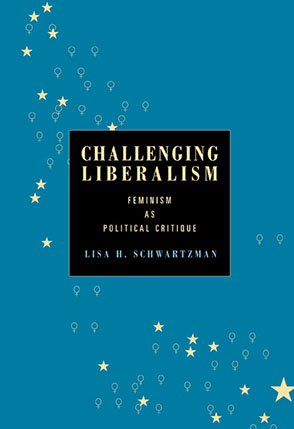
Challenging Liberalism
Feminism as Political Critique
Lisa H. Schwartzman
“In her clear and engaging book, Lisa Schwartzman argues that liberalism fails as a theory of justice because it fails to uncover and resist oppression. Drawing on the work of Catharine MacKinnon, Judith Butler, and Wendy Brown, she offers original, feminist critiques of Nussbaum, Rawls, Okin, and Dworkin. This book will be of interest to political philosophers from both liberal and feminist schools as well as legal theorists.”
- Description
- Reviews
- Bio
- Table of Contents
- Sample Chapters
- Subjects
In Challenging Liberalism Schwartzman explores the reasons why concepts such as rights and equality can sometimes reinforce oppression. She argues that certain forms of abstraction and individualism are central to liberal methodology and that these give rise to a number of problems. Drawing on the work of feminist moral, political, and legal theorists, she constructs an approach that employs these concepts, while viewing them from within a critique of social relations of power.
“In her clear and engaging book, Lisa Schwartzman argues that liberalism fails as a theory of justice because it fails to uncover and resist oppression. Drawing on the work of Catharine MacKinnon, Judith Butler, and Wendy Brown, she offers original, feminist critiques of Nussbaum, Rawls, Okin, and Dworkin. This book will be of interest to political philosophers from both liberal and feminist schools as well as legal theorists.”
“Feminists often criticize liberalism as too abstract and individualistic. Lisa Schwartzman argues, in her balanced evaluation, that the real problems are instead that liberalism has been covertly and concretely patriarchal and ignored the power structures of sexual politics. Seeking to separate what is valuable in liberalism from what is downright oppressive, she examines leading contemporary texts (Rawls, Dworkin) and their feminist critics (Jaggar) and defenders (O’Neill, Nussbaum), differentiating her critique also from postmodernists (Brown, Butler). Her original approach often evokes the response, ‘Of course!’ This is a stimulating text for a seminar or advanced undergraduate course. It deserves to be read by feminist philosophers and by scholars in women’s studies, political science, law, and sociology.”
Lisa H. Schwartzman is Associate Professor of Philosophy at Michigan State University.
Contents
Acknowledgments
Introduction
Part I A Feminist Critique of Liberalism
1. Individualism, Oppression, and Liberal Rights Theory
2. Abstract Ideals and Social Inequality: Dworkin’s Equality of Resources
3. Rawlsian Abstraction and the Social Position of Women
Part II Abstraction, Ideals, and Feminist Methodologies
4. Idealization, Abstraction, and the Use of Ideals in Feminist Critique
5. Feminism as an Alternative Methodology
Part III Feminist Postmodernism: An Alternative to Liberalism?
6. Politicized Identity, Women’s Experience, and the Law
7. Speech, Authority, and Social Context
Conclusion: Toward a Feminist Approach to Political Theorizing
Notes
Bibliography
Index
Introduction
The ideals and concepts of liberalism have been used in feminist struggles for liberation throughout recent history. From the time of the women’s suffrage movement to the more recent battles over abortion, women have formulated their demands in terms of equality, autonomy, and individual rights. Although numerous feminists have demonstrated their value, liberal concepts can work to undermine women’s interests, reinforcing not only sexism, but also racism, classism, and other forms of oppression. Examples of this include cases where men have used the “right to privacy” to argue that the state should not interfere in situations of domestic violence and marital rape, as well as more recent cases in which racist hate speech, violent pornography, and sexually harassing speech have been granted protection under the right to “freedom of expression.” Why is it that these concepts yield such radically different conclusions? When and why do liberalism’s central ideals work to oppress, and when and why do they function as tools of liberation?
In this book, I do not undertake an empirical investigation into the ways that rights, equality, privacy, autonomy, and individualism have been used throughout history, nor do I offer a simple answer to the question of whether liberal terminology should be employed in feminist arguments. Rather, I begin with the question of why it is that liberal concepts function in such seemingly contradictory ways. Part of the answer, of course, is that liberal concepts are indeterminate and thus can be used in different sorts of arguments—arguments by feminists and antiracists, on the one hand, and arguments by those who seek to maintain and uphold structures of power, domination, and privilege, on the other. But this is not the only reason these concepts can function in such radically different ways. Many liberal theorists acknowledge this indeterminacy and are fully aware that “rights” and “equality” (for instance) can be used to uphold oppression and to promote injustices. Although the issue of how one applies indeterminate concepts is important, it is also useful to focus attention on the methodology typically employed in liberal theory. In this volume, I examine (1) the attempted abstraction of liberalism, which leads liberals to set aside or “bracket” important information about particular social structures and (2) the individualism of liberalism, which suggests that people are independent, autonomous choosers rather than members of social groups on which systems of oppression are based. These two related but distinct features of liberalism—abstraction and individualism—are responsible for many of the problems I discuss.
Although their arguments are not always framed as critiques of liberal abstraction or individualism, contemporary feminists often question the role that liberal ideals and concepts should continue to play in feminist theory and practice, and many object to specific aspects of liberalism. In particular, feminists criticize the way in which liberal theorists draw a sharp line between the public and private spheres, a line that relegates women to the “private” sphere of the home and family while allowing men the freedom to dominate the “public” arena. Furthermore, feminists question the liberal view of persons as rational, self-interested individuals motivated primarily by autonomously formed preferences. Some argue that this ideal is “abstract” insofar as actual persons typically do not possess merely self-interested and rational desires, and others claim that the liberal ideal of the rational, economic “man” fails to pay adequate attention to other important human qualities, such as affection, care, and concern for one’s family and community. Noting that care and affection are typically associated with women, some feminists argue that liberal political theory ought to value such qualities more highly.
Without entirely dismissing these problems, some argue that liberalism’s strong emphasis on individualism, autonomy, choice, rights, and equality makes it a promising theory for feminists. For instance, Martha Nussbaum offers a feminist defense of a version of liberal individualism, arguing that “where women and the family are concerned, liberal political thought has not been nearly individualist enough.” In addition to supporting certain forms of individualism, some feminist liberals promote liberal abstraction as central to the pursuit of justice, and some offer feminist arguments for the contractarianism of liberal political philosophy.
Other feminists defend specific aspects of liberal theory, while acknowledging the troubled history of the liberal tradition. For instance, in a recent essay that highlights the problematic ways that “autonomy” has been associated primarily with men, Marilyn Friedman nonetheless argues that this concept holds great potential for feminists. Likewise, some feminist legal theorists argue that “privacy” and “rights” can be refashioned in feminist ways. For instance, Elizabeth Schneider takes what she calls a “dialectical” approach to rights and argues that when rights discourse and rights claims emerge from political struggle, they “can help to develop political consciousness which can play a useful role in the development of a social movement.” Elsewhere Schneider argues that the right to privacy can take on new meaning in the context of feminist struggles for freedom and equality. Although privacy is typically associated with the right to be left alone, this concept has “radical potential” if understood as “affirmatively linked to liberty and the right to autonomy, self-expression, and self-determination.” Situating her analysis in the context of a discussion of domestic violence, Schneider urges feminists to challenge the strict separation between the public and the private and to develop a right to privacy that is not “synonymous with the right to state noninterference” but that instead recognizes the affirmative role that privacy can play in the lives of battered women. Thinking about privacy in this way encourages us to recognize the importance of its social and material preconditions, and it enables us to understand this concept in a more radical and less individualistic way.
Throughout this book, I build on the critical analyses of feminists who have been working to identify and challenge these problematic aspects of liberal theory. My two central charges against liberalism—that it employs a problematic form of abstraction and that it sets out an ideological account of individualism—are certainly not new ones. Moreover, a number of feminist liberals have responded to the charges of abstraction and individualism, claiming either that liberalism is not abstract or individualist in the ways that some critics contend or that the best interpretation of liberalism is one that would not suffer from these problems. What is needed in this debate is an emphasis on method: most versions of liberalism—including those promoted by some liberal feminists who explicitly address these charges—suffer from certain methodological problems. I do not claim here that liberalism cannot be reformed, nor do I suggest that liberal concepts are useless for feminists. Rather, my assertion is that the methods of abstraction and individualism typically employed and often championed by liberals (including feminist liberals) are problematic. Feminist theory and practice embody an alternative methodology, one that does not eschew all abstraction and individualism but reformulates these concepts and situates them in a critical analysis of women’s oppression, thus avoiding some of the problematic aspects of contemporary liberalism.
Defining Liberalism
Although liberalism can be defined in various different ways, contemporary liberal philosophers often focus on three defining features: first, liberalism holds that all persons have an essential interest in leading a life defined in accordance with their own conception of what is valuable—that is, with their conception of “the good.” Liberals debate the extent to which this requires the state to remain entirely “neutral” between individuals’ conceptions of the good, but most endorse some form of state neutrality. Furthermore, although the conception of value that an individual holds at any particular time is not necessarily what is best for that person, liberals generally do not support a situation in which the state, or any other coercive body, tells individuals what is best for them. Rather, liberals typically argue that one’s life is best led “from the inside,” according to one’s own beliefs about value.
A second component of liberalism follows directly from the first: because all persons have an interest in leading life according to their own conception of the good, all persons have an interest in the freedom and liberties that are needed to develop a conception of the good and to deliberate about questions of value. Thus, most liberals emphasize the importance of civil liberties and freedoms, such as freedom of expression, that guarantee the conditions under which individuals can devise and revise their conceptions of the good.
Third, and perhaps most important, liberals hold that all persons are of equal moral worth and that the state must treat persons with “equal concern and respect.” Like other components of liberalism, this central tenet is interpreted in different ways by different theorists, both in terms of its justification and in terms of its implications for social policy. For some liberals, the reason that people deserve equal treatment is that they all have the capacity to form and revise their conception of the good. For instance, according to Martha Nussbaum, the “equal dignity” each person possesses is rooted in the “power of moral choice” within each individual, “a power that consists in the ability to plan a life in accordance with one’s own evaluation of ends.” Nussbaum echoes Rawls’s claim that the basis of equality is the “capacity for moral personality,” which involves the capacity to form a conception of the good and the capacity to have a “sense of justice.” Other liberals, such as Ronald Dworkin and Will Kymlicka, suggest that the basis of equality is not this capacity but rather the interest that underlies it. Kymlicka, citing Dworkin, argues that although the capacities described by Rawls are central, “our interest in them stems from our higher-order interest in leading the life that is good.” In any case, although liberals offer slightly different justifications for the claim that individuals are of equal moral worth, most seem to agree on the centrality of this idea. From this claim about equal moral worth it follows that the state must treat persons with “equal concern and respect,” as Dworkin puts it. How the state goes about treating persons “as equals” is the subject of further disagreement within liberalism, but most liberals contend that the government need not treat each person in exactly the same manner to treat them “as” equals. Furthermore, within liberalism, theorists also debate the question of what is to be equalized in order to ensure that individuals are treated as equals: should the state seek to equalize the welfare of individuals (for instance, as measured by the degree to which their preferences are satisfied)? Or should it seek to measure resources, capacities, opportunities, or some other variable? While I do not engage the details of this particular debate, I do critically examine the theories of two prominent liberals, Dworkin and Rawls, who argue that some version of “equality of resources” is the best interpretation of the liberal principle of equality.
In short, liberalism can be understood as holding that (1) all persons have an essential interest in leading a life in accordance with their own conception of value, (2) all persons have an interest in freedoms and liberties needed to develop and revise their conception of the good, and (3) the government must treat individuals with equal concern and respect.
The Problems of Individualism and Abstraction in Liberalism
Some of the most common objections to liberalism involve claims that liberal theory is too “abstract” and too “individualistic.” Before considering the feminist objections to these aspects of liberalism, it is worth noting that both communitarians and conservative critics of liberalism also object to liberalism’s abstraction and individualism. The substance of these criticisms, however, is very different from that of the feminist critique. Nonetheless, theorists who respond to the feminist objections to liberalism sometimes fail to distinguish feminist objections from communitarian ones. The responses that feminist liberals make to such objections suggest that liberalism is a better theory for feminists than is a traditional, values-based communitarianism. This is a problematic and false dichotomy: feminists need not choose between liberalism and communitarianism. Although some feminist critics of liberalism endorse certain aspects of communitarianism (for instance, some care-based versions of feminism celebrate women’s traditional roles as mothers and as members of families and other traditional communities), placing more attention on traditionally defined “communities” is not the goal of most feminists who criticize liberalism. Rather, many feminist critics of liberalism—and the ones whose work most interests me—call attention to the collective nature of women’s oppression and to the concrete experiences of women’s lives under sexist social structures.
Discussions of the “feminist critique of liberalism” often begin with a consideration of Alison Jaggar’s examination of liberal political theory in her 1983 book, Feminist Politics and Human Nature. Jaggar’s work is cited both by feminists who endorse her critique of liberalism and by theorists (feminist and nonfeminist) who argue against it. According to Jaggar, many problems with liberalism stem from a flawed conception of human nature that involves an individualistic understanding of human rationality. Calling this “metaphysical assumption” of liberalism “abstract individualism,” she explains:
The assumption in this case is that human individuals are ontologically prior to society; in other words, human individuals are the basic constituents out of which social groups are composed. Logically if not empirically, human individuals could exist outside a social context; their essential characteristics, their needs and interests, their capacities and desires, are given independently of their social context and are not created or even fundamentally altered by that context. This metaphysical assumption is sometimes called abstract individualism because it conceives of human individuals in abstraction from any social circumstances.
Defenders of liberalism have responded to Jaggar by claiming that liberalism is not—or need not be—committed to these (or any) metaphysical assumptions. Contemporary liberal equality theorists such as Rawls, Dworkin, and Kymlicka argue that individuals are socially situated and that the social context must be one in which individuals are free to develop their life plans and choose from a range of attractive options. Nonetheless, these liberal theorists continue to emphasize the importance of individual choice and freedom to pursue one’s own conception of the good. The freedom of individuals—and the need for the state to respect individuals’ choices—is central to the theories of Rawls, Dworkin, and other contemporary liberal egalitarians. Thus, I argue that liberalism continues to emphasize “individualism,” though not in the narrow sense described by Jaggar in her 1983 work. The individualism that I criticize does not entail a metaphysical assumption about human nature, but it does involve a commitment to a problematic methodology: the methodology of focusing primarily on each and every individual as an individual, rather than also calling attention to the social context and to the relations of power in which individuals live. Beginning from the assumption that it is the needs and interests of individuals that are primary, liberals have a difficult time detecting and analyzing cases of oppression. Because oppression is based on one’s membership in a social group, understanding how social power and oppression work requires an adequate understanding of the significance of group membership.
In addition to adopting a methodology that focuses on individuals as individuals, rather than as members of social groups, liberal theorists often construct highly abstract models of political and social justice. Although Jaggar describes the individualism of liberalism as “abstract,” abstraction and individualism are separate but related problems. To elucidate the problems with liberal abstraction, I consider the work of two prominent contemporary liberal political philosophers, Rawls and Dworkin, both of whom rely heavily on the use of abstract ideals to illustrate their conceptions of justice. In his groundbreaking Theory of Justice, Rawls argues for principles of justice that would regulate a “well-ordered” society, and he employs the abstract ideal of the “original position” to make his case for this view. Defending his emphasis on an abstract ideal, Rawls writes, “The reason for beginning with ideal theory is that it provides, I believe, the only basis for the systematic grasp of these more pressing problems. . . . I shall assume that a deeper understanding can be gained in no other way, and that the nature and aims of a perfectly just society is the fundamental part of the theory of justice.” Although Rawls’s more recent work in Political Liberalism may seem less “abstract,” insofar as he more explicitly situates this project in the context of contemporary liberal democracies, he nonetheless continues to emphasize the role of abstraction in normative theorizing:
<ext>
The work of abstraction . . . is not gratuitous: not abstraction for abstraction’s sake. Rather, it is a way of continuing public discussion when shared understandings of lesser generality have broken down . . . the deeper the conflict, the higher the level of abstraction to which we must ascend to get a clear and uncluttered view of its roots . . . formulating idealized, which is to say abstract, conceptions of society and person . . . is essential to finding a reasonable political conception of justice.
Thus, throughout his writing, Rawls stresses the importance of abstraction and the need to devise and justify abstract, idealized models of society and of individuals.
Dworkin differs from Rawls in a number of ways, but the former too believes that political theories should be abstract; like Rawls, he constructs an abstract ideal to illustrate and defend his conception of distributional equality, which he calls “equality of resources.” In Dworkin’s ideal, immigrants on a desert island must decide how to distribute the island’s resources. Dworkin argues that people in such a situation would choose to employ an auction, an “envy test,” and a hypothetical insurance market, and he suggests that this idealized model can guide assessment of our current society’s distributive mechanisms and social institutions. For both Rawls and Dworkin, the ideal and allegedly abstract scenarios are intended to illustrate fundamental ideas that we have about equality and justice, and they are supposed to help us clarify our views about what is just and unjust in our own society.
In my critical analysis, I argue that theorists who aim to construct highly abstract models succeed in abstracting only from certain features, while other aspects of our social world remain unchallenged and often unacknowledged. Thus, liberalism’s “abstract” models are not in fact as abstract as they purport to be. Ultimately, the important work of identifying and challenging oppressive structures of social, political, economic, and sexual power is best accomplished by methods that do not aim for this sort of abstraction. Feminist theory, by paying close attention to structures of power and to social context, and by examining the concrete experiences of women living within these structures, suggests a method of theorizing that moves beyond the forms of individualism and abstraction that are prominent within liberalism.
In the first three chapters (Part One), I critically examine the work of Dworkin and Rawls in order to illustrate problems that arise from liberal individualism and abstraction. In Chapter 1, I analyze Dworkin’s liberal rights theory and argue that rights should be reconceptualized so that they focus on the interests of persons who are understood as members of oppressed and oppressor groups, rather than simply as individuals. Although all persons should be entitled to certain rights, rights can conflict with other sorts of claims (including claims to equality), and they can also conflict with other rights. Making decisions about whose, and which, rights should prevail involves a careful, contextual understanding of social power structures, including those of racism, sexism, and classism. Rather than viewing rights as entitlements that can only be possessed by individuals, I argue that many rights should be seen also as “goals” that need to be sought after and achieved through structural changes in social power structures. The efforts of oppressed groups to reconceptualize rights in ways that work to challenge various forms of unjust domination are central to this struggle. Thus, specifically, women may need to obtain certain particular rights (such as the right not to be raped, the right not to be harmed by pornography, and the right to control one’s own reproduction) in order to achieve freedom and equality.
In Chapters 2 and 3, I critically analyze the issue of abstraction in liberal theory, focusing particular attention on Dworkin’s theory of distributional equality (Chapter 2) and on Rawls’s original position (Chapter 3). In both cases, an abstract ideal is supposed to guide assessment of our own society’s distributive mechanisms and institutions. Although one obvious problem with such ideals concerns the difficulty of knowing how to apply them in a nonideal context, the issue of application is not the central focus of my critique. Rather, there are deeper problems with the very models themselves: often, liberal political theories that claim to be abstract are actually concrete and particular in ways that the theorist fails to recognize. Assumptions about individuals, and about the surrounding social context, are often built into the theory and function as background assumptions that the theorist does not acknowledge, articulate, or defend. In other words, what appears to be an abstract ideal may actually embody many of the same relations of power and oppression that are present in our own society. Thus, a critical awareness of oppression is essential to theorizing and attempting to abstract from questions of gender, race, and class will not work to eliminate these oppressive structures.
Having explained in Part One the limitations of a liberal framework, in Part Two (Chapters 4 and 5) I draw on the work of feminist moral, political, and legal theorists to argue for a feminist approach that does not eschew ideals such as rights, equality, and autonomy but rather employs them within a critique of social relations of power. Here I consider two liberal feminist defenses of abstraction and individualism: Onora O’Neill’s suggestion that liberalism must be more—not less—“abstract,” and Martha Nussbaum’s contention that liberalism often fails women when it is not “individualist” enough. Although O’Neill and Nussbaum belong to very different theoretical traditions (neo-Kantian and neo-Aristotelian, respectively), both argue that feminism could be accommodated within liberalism if liberalism more consistently adhered to its principles: employing methods of “mere abstraction” (O’Neill) and paying attention to each and every individual, as an individual (Nussbaum).
Rather than emphasizing the merely individual perspectives of specific women, and rather than attempting to be as abstract as possible, I advocate a feminist methodology that begins by examining the lives, experiences, and interests of women. This feminist methodology is not anti-individualist, nor does it eschew abstraction. It does, however, pay careful attention to the ways that individuals are embedded in social contexts, ones often characterized by power and domination. With this awareness, feminists should employ concepts such as rights, equality, liberty, and autonomy in ways that emphasize women’s perspectives; what women need in order to live free from the oppressive structures of male domination can, to some extent, be articulated through reformulating these ideals and using them in ways that avoid the pitfalls of liberalism.
As examples of the sorts of feminist reformulations I have in mind, I note cases in which an oppressed group argues for a social policy on the basis of its right to equality. For instance, for feminists, women’s right to workplace and educational settings that are free from unwanted sexual attention is a matter of equality. Similarly, antiracist activists demand certain restrictions on hate speech, claiming the right to equality for members of historically oppressed racial groups. In both cases, the experiences of oppressed groups serve as the basis for understanding what is required by such concepts as rights, equality, and freedom. The analyses of sexually harassing behavior as “sexual harassment,” and of certain racial epithets as “racist hate speech,” rely upon a critical understanding of social structures; such analyses do not derive from the mere perspectives of individuals or from abstract ideals. In fact, the development of such critical perspectives often comes about through methods that examine the experiences common to members of a certain social group, such as women or people of color. Viewed separately as the merely personal experiences of individuals, cases of sexual harassment might initially appear to be mere flirtation or “harmless fun,” and incidents of racist hate speech might seem to be “isolated incidents.” Understood this way, neither of these actions seems to have the power to seriously harm an individual or negatively affect the well-being of an entire social group. Considering these incidents in the context of structural and entrenched relations of domination and oppression, however, engenders another analysis. For the right to equality, autonomy, or freedom to be meaningful for members of historically oppressed groups, a liberal approach that attempts to abstract from social relations of power and focus only on individuals is inadequate. Thus, an analysis of social structures of power must supplement discussions of rights, equality, liberty, and autonomy and these concepts must be situated within a more radical social critique than the one provided by liberalism.
In Chapters 6 and 7 (Part Three), I contrast my own analysis with the postmodern feminist critique of liberalism offered in the recent work of Wendy Brown and Judith Butler. In their discussions of rights and hate speech, Brown and Butler criticize liberalism for both its abstraction and its individualism, though their understanding of its inadequacies, as well as their proposed alternatives, differ sharply from my own approach. Specifically, Brown and Butler argue that because liberal concepts such as rights and equality are inherently abstract and inevitably universal, feminists and antiracist activists should avoid these concepts rather than reformulate them to embody the perspectives of oppressed groups. They argue against the sort of analysis I advance, contending that references to social systems of power risk “reifying” and making permanent precisely those structures they wish to overturn. As an alternative, Brown and Butler advocate engaging in open contests for meaning without any recourse to normative claims or to generalized analyses of social and political power. There are, however, a number of ways in which their postmodern alternative ultimately resembles the very liberal theory they set out to attack.
First, Brown and Butler mistakenly contend that liberal concepts actually are “abstract” and “universal.” Although they offer this view as a critique, concluding that feminists should avoid appealing to these concepts, their critique essentially accepts liberalism’s description of itself as abstract and universal. As I lay out in preceding chapters, this claim of abstraction is in fact false: such concepts actually embody the interests of particular groups of people, those who have power in a given social context. Thus, attempts to reinterpret liberal concepts so that they come to embody the interests of the subordinated and the oppressed (such as women, people of color, workers, and lesbians and gays), is one way of shifting their actual content.
Second, Brown and Butler’s approach, in the end, maintains a problematic form of individualism similar to that of liberalism. Although they acknowledge the pervasiveness of power in society, they refrain from describing the systematic ways in which power works, claiming that such an analysis would “pin down” or “reify” current power relations. Despite this position, a critique of oppression requires an examination of social relations of power. While any such account would be subject to change and revision, understanding who has power over whom is essential to theorizing about justice, rights, and equality. Without engaging in systemic analysis, Brown and Butler are left only with individuals, each striving for merely personal goals and attempting to preserve only his or her own individual interests.
Finally, Brown and Butler implicitly endorse the liberal commitment to some kind of neutrality between different conceptions of “the good.” Because they dismiss all “moral” discourse, claim to refrain from “normative” analysis, and leave discussions about the good up to individuals and those who engage in “politics,” they end up with a view that shares certain features with a libertarian version of liberalism. Moral norms, however, are already functioning in the world of politics and attempts to avoid discussion of them can easily result in the implicit endorsement of oppressive and unjust norms, ones that are often not made explicit but nonetheless continue to function and affect people.
Feminist philosophers and social theorists need to critically examine both the social context of male power and the relationship of this context to the development and application of liberal theories. In this volume, I use feminist theory to suggest that certain aspects of liberalism need to be reconceptualized if liberalism is to be useful for feminists and other advocates of justice. Social understandings of power, whether explicit or implicit, are always employed in the articulation and application of normative theories and ideals; feminists must acknowledge and understand the workings of such power structures in order to challenge and change them. By situating discussions of rights, equality, and freedom in the context of a critique of oppressive structures of power, feminists can avoid the problematic forms of abstraction and individualism that plague many liberal theories.
Mailing List
Subscribe to our mailing list and be notified about new titles, journals and catalogs.