



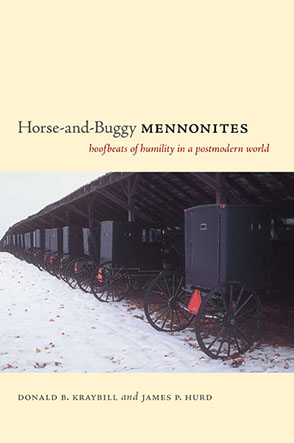
Horse-and-Buggy Mennonites
Hoofbeats of Humility in a Postmodern World
Donald B. Kraybill and James P. Hurd
Horse-and-Buggy Mennonites
Hoofbeats of Humility in a Postmodern World
Donald B. Kraybill and James P. Hurd
“Until now there has not been a comprehensive work on Old Order Mennonite life and culture. With this book Kraybill and Hurd provide not only the first such study, but a first-rate one. Authoritative and accessible, Horse-and-Buggy Mennonites offers rich detail and illuminating comparative analysis. Especially insightful is the authors’ exploration of the connections between mobility and identity.”
- Media
- Description
- Reviews
- Bio
- Table of Contents
- Sample Chapters
- Subjects
Winner of a 2007 AAUP Book Jacket and Journal Show for Jacket and Covers
In the nearly eighty years since the establishment of this church, the initial group of fifty dissenters has grown to a community of 16,000 Wenger Mennonites. They have large families and typically retain 95 percent or more of their youth. For many years their main community was based in Lancaster County, but in recent decades they have expanded into eight other states, with new communities most recently established in Iowa and Michigan. Despite their continued rejection of modern technology, the Wengers—popularly known as horse-and-buggy Mennonites—continue to thrive on their own terms.
In this first-of-its-kind study of the Wenger Mennonites, Kraybill and Hurd—a sociologist and an anthropologist—use cultural analysis to interpret the Wengers both in and outside Pennsylvania. They systematically compare the Wengers with other Mennonite groups as well as with the Amish, showing how relationships with these other groups have had a powerful impact on shaping the identity of the Wenger Mennonites in the Anabaptist world. As Kraybill and Hurd show, the Wengers have learned that it is impossible to maintain a truly static culture, and so examining the ways in which the Wengers cautiously and incrementally adapt to the ever-changing world around them is an invaluable case study of the gradual evolution of religious ritual in the face of modernity.
“Until now there has not been a comprehensive work on Old Order Mennonite life and culture. With this book Kraybill and Hurd provide not only the first such study, but a first-rate one. Authoritative and accessible, Horse-and-Buggy Mennonites offers rich detail and illuminating comparative analysis. Especially insightful is the authors’ exploration of the connections between mobility and identity.”
“The book is superbly written, giving an insightful, thorough, detailed portrayal of Old Order Mennonite life. It is the first of its kind, a monumental contribution.”
“Kraybill and Hurd ask all the right questions and answer them in an unaffected yet authoritative fashion. They guide readers through the thicket of church controversies and divisions that led to the birth of the Wengers, and help explain what otherwise appears to be an arbitrary and uneven resistance to modernity.”
“A few writers have produced books about Old Order Mennonite life, but none as comprehensive as this. This thorough sociological study is the first of its kind of the Wenger Mennonites, the largest of the Old Order Mennonite groups. . . . This book is essential reading for students of American religion and of alternative or sectarian societies. . . . This book belongs in both academic and church libraries, but anyone with more than a casual interest in plain-sect churches will find this book informative and, in places, either disturbing or inspiring, or both.”
“This book is a valuable contribution to the sociology and anthropology of religion, as well as to Anabaptist studies. Furthermore, scholars of communications and rhetoric should also take note of this book as empirical study of how community conflict is engaged and resolved.”
“Horse-and-Buggy Mennonites: Hoofbeats of Humility in a Postmodern World is a welcome addition to Anabaptist studies. The specialist and the undergraduate college student will profit from it.”
“For those of us who study outsider or dissenting religious communities, this volume provides an excellent scholarly model that might be applied in instructive ways to other religious movements.”
Donald B. Kraybill is Distinguished Professor and Senior Fellow at Elizabethtown College's Young Center for Anabaptist and Pietist Studies. He is a nationally recognized scholar on Anabaptist groups and has written or edited more than eighteen books, including The Riddle of Amish Culture (1989; rev. ed. 2001) and Amish Enterprise: From Plows to Profits (1995; rev. ed. 2004).
James P. Hurd is Chair of the Department of Anthropology and Sociology at Bethel University. An anthropologist by training, he has done fieldwork in Venezuela, Nicaragua, and rural Pennsylvania.
Contents
List of Tables and Diagrams
Preface
Acknowledgments
1. Who Are the Wenger Mennonites?
2. The Fabric of Faith and Culture
3. Mobility and Identity
4. The Architecture of Community
5. The Rhythm of Sacred Ritual
6. Passages from Birth to Death
7. Making a Living Together
8. Technology and Social Change
9. Pilgrims in a Postmodern World
Appendixes
Notes
Selected References
Index
Photo Credits
Who Are the Wenger Mennonites?
The more Old Order you are, the more you stick to the old ways.
Wenger farmer
A Horse-and-Buggy People
Martha Shirk, the mother of seven school-age children, lives on a small produce farm in Lancaster County, Pennsylvania, where her family raises vegetables to sell at their roadside stand and at a public produce auction. Shirk’s kitchen is equipped with electricity but not with an air conditioner, microwave, or television. The Shirk family travels by horse and carriage to a simple Mennonite churchhouse for Sunday services conducted in Pennsylvania German.
In the Finger Lakes region of New York, Janet Zimmerman teaches in a one-room private school. Her twenty-five pupils come from eight families in her local community. She knows their parents well because all of them are members of her church. Although she never attended high school, Janet teaches all eight grades. When the pupils “graduate” from eighth grade, they will work in apprenticeships in homes, farms, and businesses operated by their parents or other church members.
Eli Hoover is a farmer in Morgan County, Missouri, where he raises corn and other crops for his herd of dairy cows. Eli farms with steel-wheeled tractors, but he uses mechanical milkers as well as other modern farm equipment. In addition to operating their dairy, his family raises strawberries and asparagus for a local produce market. Eli’s son Reuben operates a small bicycle repair shop that caters to many of the youth in his church who use bicycles instead of cars.
Martha, Janet, and Eli are members of an Old Order Mennonite group known as Wenger Mennonites—named for their first leader, Joseph O. Wenger. The group’s official name is the Groffdale Conference Mennonite Church, because Wenger was a preacher at the Groffdale churchhouse in Lancaster County where the group held its first services. The Wengers are sometimes called “horse-and-buggy Mennonites” or “team Mennonites” because their horse and carriage form a team that provides daily transportation. Although the horse and buggy are widely used for local travel, the Wengers also hire vans driven by outsiders for long-distance trips and business activities.
Not only are the multiple labels—Wengers, horse-and-buggy Mennonites, team Mennonites, Old Order Mennonites, Groffdale Conference Mennonites—somewhat confusing, but the Wengers are also often mistaken by outsiders for Amish or other Old Order Mennonite groups who also use horse-drawn carriages.
When the Wenger Church formed in 1927 in Lancaster County, Pennsylvania, it numbered about five hundred members. Today, the Wengers claim some eight thousand members (baptized adults) and forty-nine congregations in nine states. When children are included in the count, the number swells to nearly eighteen thousand. Sizable families and strong retention have produced robust growth in the twentieth century. Indeed, the Wenger population, growing at about 3.7 percent a year, doubles every nineteen years. Lancaster County, the parent Wenger community, claims one third of the members, but migration to other areas has increased steadily since 1949.
The growth of the Wenger Church, along with the cost and scarcity of farmland in eastern Pennsylvania, has prodded many families to move to other states. Between 1968 and 1998, for example, 45 percent of the families in one Lancaster County congregation migrated to other states. Slightly over half of the Wengers live in five Pennsylvania settlements, but new settlements in other states are booming, as shown in Table 1. A member living in Lancaster County explained, “Almost every family has children who have moved to other areas; there is a lot of excitement about moving.”
Despite the spread of the Wengers to other states, their practices are remarkably similar across the country. Their cultural template, replicated in new settlements, produces fairly uniform practices from New York to Missouri. Ordained leaders from all the communities gather in Lancaster County twice a year for a ministers’ conference. These semiannual meetings harmonize regulations and maintain fellowship among the forty-nine congregations, which are tied together by culture, custom, and the decisions of the ministers’ conferences.
Unlike the Amish, who worship in their homes, the Wengers hold worship services in churchhouses—starkly plain buildings devoid of electricity, carpeting, pulpits, musical instruments, stained-glass windows, and steeples. Although the Wengers have electricity and telephones in their homes, they shun radios, televisions, video players, and computers. Farmers use steel-wheeled tractors to pull modern machinery on their small family farms.
Wenger clothing, plain and simple, is not as distinctive as that of the Amish. Wenger men do not wear beards, for example. Both Amish and Wenger women wear capes (an extra layer of fabric over the upper torso), prayer coverings, and bonnets, but clothing styles differ: Amish women wear plain-colored fabrics, while Wenger women wear dresses with modest prints. The color of their horse-drawn buggy, the core symbol of Wenger identity, also separates them from the Amish. The Wengers drive black carriages, while their Amish neighbors, at least in Lancaster County, drive gray ones. Like the Amish, the Wengers operate private schools and speak Pennsylvania German, commonly known as Pennsilvaanisch Deitsch (Pennsylvania Dutch).
Anabaptist Roots
The Wengers trace their lineage back to the Anabaptist movement, which emerged in southern Germany and Switzerland in the wake of the Protestant Reformation in 1517. The early Anabaptists were young radicals who were chafing at the pace of the Reformation. They pleaded for religious reforms to move faster and to break more sharply with established Catholic patterns. Impatient for change, some of the reformers baptized each other as adults in 1525 in Zurich, Switzerland. This defiant act of civil disobedience laid the foundation for an independent church, free of state control.
Already baptized as infants in the Catholic Church, these free-church advocates were called “Anabaptists” (rebaptizers), because their adult baptism was a second baptism. Adult baptism was a capital offense in sixteenth-century Europe, because it threatened to dissolve the marriage of civil and religious authority that had developed over the centuries. Infant baptism not only conferred membership in both Catholic and Protestant churches but also granted automatic citizenship, which gave authorities the power to tax and conscript. The age of baptism symbolized a central issue of authority in church-state relations. Who held ultimate authority over religious matters—the church or the state?
In the Anabaptists’ view, the authority of the Scriptures towered above civil edicts. Turning their backs on traditional Catholic teaching, evolving Protestant doctrine, and the laws of the Zurich city council, the young upstarts developed their own interpretation of Scripture based on the teachings and life of Jesus in the New Testament.
Known as radical reformers, many Anabaptists paid dearly for tearing asunder the church-state fabric that had been woven together over the centuries. Thousands of them were tortured and killed by religious and civil authorities⎛burned at the stake, drowned in lakes and rivers, starved in prisons, or beheaded by the sword. Many Anabaptists fled to remote areas for safety. Stories of the bloody persecution are recorded in the Martyrs Mirror, a 1,200-page book first compiled by Anabaptists in Holland in 1660.
Memories of the persecution linger in Wenger minds today and temper their relationships with the larger society. The Martyrs Mirror is found in many Wenger homes. Indeed, an Old Order historian says, “The Martyrs Mirror stands next to the Bible” in their community. Preachers often cite martyr stories in their sermons, and lay members recount them as well. A favorite one is the saga of Hans Haslibacher, a Swiss Anabaptist martyr beheaded in 1571 in Bern. A poem by an Anabaptist prisoner describing the execution says that, after hours of torture, Haslibacher dreamed that three divine signs would accompany his beheading: his head would jump into his hat and laugh, the sun would turn crimson like blood, and the town well would fill with blood. All three predictions came true, according to the poet. The poem was later sung as a hymn in numerous Anabaptist communities, and even today the tale of Haslibacher keeps the memories of persecution alive across the generations.
Many Anabaptist groups eventually became known as Mennonites through the influence of Menno Simons, a former Catholic priest who became a Dutch Anabaptist leader in the mid-1500s. A few Mennonites arrived in the Americas as early as 1683, but most of the Swiss–South German immigrants came ashore in the eighteenth century. Because of William Penn’s warm welcome, Pennsylvania became a favorite haven for Mennonites and other persecuted religious minorities. Eventually, Mennonites fanned southward into Maryland and Virginia, as well as westward into Ohio, Indiana, Illinois, and beyond.
The Amish also trace their lineage to the Anabaptist movement of 1525. They were part of the Swiss stream of Anabaptism until 1693, when they formed their own group under the leadership of Jakob Ammann, a Swiss Anabaptist leader who moved to the Alsace region of present-day France. Sharing common theological roots, the Amish and Mennonites branched into separate bodies in 1693 before embarking to the New World. There, Mennonite and Amish immigrants often settled near each other as they searched for fertile soil for establishing new communities.
Mennonites in the Garden Spot
Lancaster County, with its limestone soil, fertile farmland, and favorable climate, is often called the “garden spot” of the world. The skills and hard work of Mennonite farmers have helped rank the county first in the nation in agricultural production among non-irrigated counties. In the early 1700s, Mennonites from various areas of Germany and Switzerland settled in the area that would eventually become Lancaster County. Seeking religious freedom, political stability, and fertile soil, Mennonites founded settlements east and south of the future city of Lancaster. By 1717, some seventy-five families with more than five hundred adults and children had purchased hundreds of acres of land along the Pequea Creek. About fifteen miles to the northeast, immigrant communities also sprouted in the Groffdale area and the adjacent Weaverland Valley.
In 1717, Hans Groff, a Swiss-German Mennonite, bought approximately 1,300 acres and settled his family near a large spring a few miles west of the present-day town of New Holland in Lancaster County. This area eventually became known as Groffdale. About three years later, Hans Weber purchased five hundred acres for his sons along the Conestoga Creek, a few miles east of Groffdale, in a valley that soon became known as Weberthal or Weaver’s Valley and, eventually, Weaverland. The Mennonite communities that sprouted in the Pequea, Groffdale, and Weaverland areas gradually expanded into other areas of Lancaster County during the eighteenth century.
Mennonite churches in the Lancaster area were linked together through the Lancaster Mennonite Conference. The word “conference” carried two meanings: first, a loose network of congregations in common fellowship, and second, a fall and spring ministers’ conference for leaders from all the congregations. The ministers’ conference established common understandings, expectations, and regulations for the ministers and congregations of the Lancaster Conference.
Expectations for how leaders in the Lancaster Conference should “keep house”—i.e., maintain order—in their congregations were not written down until 1881. Nevertheless, many common Mennonite practices during the nineteenth century included the following:
Plain and simple churchhouses. For Mennonites, the body of believers, not a building, constituted the church. Reflecting their rejection of Catholic cathedrals and ornate Protestant sanctuaries in Europe, Mennonites gathered for worship in unadorned churchhouses, without pulpits, steeples, stained-glass windows, or organs.
Lay leadership. Mennonite leaders were called from within their own ranks through a process known as “casting the lot.” Leaders were selected from a pool of candidates nominated by the congregation. Ministers received no theological training and served for life without formal remuneration.
Nonresistance to evil. Following the teachings of Jesus, Mennonites rejected the use of force and violence. They called this lifestyle “nonresistance,” meaning that they would not use force to resist evil. Not only did they typically boycott military service, but they rejected retaliation in daily social relationships as well. Even filing a lawsuit was forbidden because it used the force of law.
Nonconformity to the world. Shaped by religious persecution in Europe, Mennonites taught that the church should not conform to the larger society, which used force and glorified the power of the state. Mennonites prayed for and respected government leaders, but they shied away from participating in politics beyond the local level. They believed that God had called them to live as strangers and pilgrims in the world.
Submission and humility. Members were taught to submit to the church’s authority and to conduct their lives with modesty and humility. These virtues of Mennonite life underscored the power of the church over the individual. The church held the highest authority, followed by the family and then the individual. Although dress standards were not typically codified in writing, eighteenth- and nineteenth-century Mennonites usually wore plain, simple clothing after they joined the church.
In addition to these practices, mid-nineteenth-century Mennonites in Lancaster County continued to speak the Pennsylvania German dialect of their ancestors. Their use of technology was similar to that of their neighbors and, like other rural people, they had little access to education. Nonresistance and nonconformity were the twin distinctions that set them apart from many of their Protestant neighbors. Although they participated in the local economy and had many relationships with non-Mennonites, they were for the most part a rural people ensconced in an ethnic world of family and church. Most of these hardworking German-speaking immigrants were successful farmers, but some became involved in other occupations as well.
Throughout the nineteenth century, the fall and spring ministers’ conference provided a network of fellowship that promoted common practices and a sense of unity among Lancaster-area Mennonites. On several occasions, revivalist movements attracted members who had become discontented with the quiet, sober rhythms of Mennonite life. Those who left often joined more expressive and revivalist religious groups. Twice, however, small clusters of Mennonites left the Lancaster Conference to protest changes and preserve more traditional practices.
In 1812, a breakaway group formed the Reformed Mennonite Church. This conservative, exclusive group declined rapidly in the twentieth century. A second division occurred in 1845, when a dispute in the Groffdale congregation led to the formation of the Stauffer Mennonites (nicknamed “Pikers” because they worshiped in a churchhouse along an old turnpike in eastern Lancaster County). The Stauffer Mennonites drew sharp lines of separation from the world that they thought were more consistent with historic Anabaptist teachings. The Stauffer Church persists today, and many of its Lancaster County members live near Wenger families.
Although the divisions of 1812 and 1845 troubled the waters of the Lancaster Conference, a bigger tempest shook the church in the last quarter of the century. Controversies, some of them simmering quietly for many years, erupted into a major division in 1893.
Sticking to the Old Ways
Under the cover of darkness on 26 September 1889, twenty-two-year-old Eli Zimmerman, accompanied by a brother and sister, slipped into the newly built Lichty churchhouse in eastern Lancaster County. Scheduled for its inaugural opening in two days, the new building sported a small pulpit elevated a few inches off the floor. A progressive building committee had, without congregational consent, placed the new pulpit at the spot where a small, traditional preacher’s table typically stood. This daring act, akin to installing a statue of the Virgin Mary in a Baptist church, offended many people. The simple preacher’s tables standing on the floors of Mennonite churchhouses had, for many decades, stood for all things Anabaptist: humility, simplicity, equality, and the selection of lay preachers from the congregation. The sudden appearance of the pulpit, which opponents feared would surely lead to bigger Protestant-like pulpits, outraged the conservative flank of the community.
Taking the matter in their own hands, the Zimmerman family had decided to challenge the forces of change. Finding their way in the darkness, the youth removed the worldly pulpit and replaced it with a traditional preacher’s table that their father, Martin W. Zimmerman, had quickly crafted for the occasion.
The progressives were incensed by the mischief, but the conservatives contended that it was only fair that what was installed without consent could be removed the same way. The local bishop, Jonas Martin—who was privately pleased to see the pulpit go—soon faced a churning controversy between the pro-pulpit and anti-pulpit factions of his community. Despite numerous investigations and several excommunications, the answer to “who tore out the pulpit” remained a mystery for nineteen years. Finally, Anna Zimmerman confessed the secret to Bishop Martin in 1908, ten years after the death of her husband, Martin W. Zimmerman.
The mischief at Lichty’s in 1889 fanned the flames of discontent that four years later would divide conservative and progressive-leaning Mennonites in eastern Lancaster County. Although the pulpit issue created a public ruckus, it was only one of many factors that drove a permanent wedge into the community. Disagreements over religious innovations and ritual—not technology—splintered the Mennonite community in 1893 into two streams.
The 1893 breach among Lancaster Mennonites was only one of the schisms that divided Mennonite communities in several states into Old Order and progressive branches between 1872 and 1913. The national Old Order movement budded in the 1860s, when conservative-minded members challenged changes that were creeping into churches near Elkhart, Indiana. When the issues were not resolved, Old Order groups emerged in Indiana and Ohio in 1872 and then spread to Ontario, Canada, in 1889, to Lancaster in 1893, and eventually to Harrisonburg, Virginia, in 1901. Although never formally organized, the Old Order movement was well entrenched by the turn of the century and grew alongside the more progressive Mennonite groups.
Flash Points of Contention
What social forces propelled this movement of religious renewal and resistance? Clearly, Mennonite churches struggled with popular religious currents sweeping across the emerging American nation. Great evangelists preached in revival crusades; other leaders started Sunday schools in thousands of churches; religious publishers produced books and articles calling for greater personal piety and holiness. These new trends stirred the imagination of some Mennonite leaders and inspired them to try religious innovations in their own congregations. Others resisted, holding firmly to traditional Mennonite practices.
After the Civil War, industrialization began transforming American society from farm to factory. The progressive mind-set that drove the development of industry quickened the tempo of church life as well. As some Mennonite leaders began borrowing practices from other Protestant churches, those with a more conservative bent, soon known as Old Orders, protested a number of innovations that were changing Mennonite life, including the acceptance of Sunday school, evening church services, revival meetings, the use of English in worship, foreign missions, and higher education. For Old Orders, the springs of spiritual renewal were found in new affirmations of older ways, not in innovations borrowed from outsiders. More than mere reactionaries, the Old Orders sought to renew the church by reclaiming and revitalizing precious patterns from the past.
A Wenger farmer, reflecting on the Old Order movement, described it this way: “The Old Orders stayed put and held onto the old things, while the progressives went after new things.” He added, “The more Old Order you are, the more you think of yourself as sticking to the old ways. You’re on the bottom rung of the ladder. The others are moving up.” The Old Order movement was an alternative renewal movement that reaffirmed traditional Mennonite cultural and religious practices in the face of incipient social change. Its primary focus was preserving religious ritual, not shunning technology. The flash points included language, Sunday school, revival meetings, individualism, and Protestant styles of worship. These issues sparked controversies that spurred Old Order groups to form in several states.
Language
Mennonites of Swiss and German descent who settled in Penn’s Woods spoke a German dialect eventually known as Pennsylvania German. The dialect separated them from non-German groups, preserved their traditional identity, and symbolized their lowly way of life. English was the currency of the larger society—the world of power, prestige, and politics—and this higher, sophisticated language opened doors to the dominant society. As interaction with outsiders increased in the mid-nineteenth century, Mennonites began speaking more English. With more youth learning English in public schools, some progressive church leaders began conducting worship services in English, the language of the rising generation. Conservatives protested. They did not want the sounds of a worldly language intruding into the very heart of sacred ritual.
Sunday School
Protestant-style Sunday schools caused even greater consternation among tradition-minded Mennonites. Progressive Mennonite leaders welcomed the Sunday school as an important means of Christian education. But to cautious conservatives, the Sunday school was an institution carelessly borrowed from worldly churches that did not espouse the twin distinctives of Mennonite faith—nonresistance and nonconformity. Many Sunday schools were also “union” ventures, conducted jointly by cooperating denominations. Separatists to the core, the conservers shied away from ecumenical cooperation. Moreover, the Old Orders feared that Sunday schools would undercut the role of the family in religious education. In their eyes, the Scriptures taught that parents, not church leaders, held the responsibility of teaching children religious values, mainly by example.
What could be more right, more desirable, or more Christian than Sunday school? The tradition-leaning Mennonites were troubled as much by the practices accompanying Sunday school as they were by its content. Song leaders, in individualistic fashion, stood instead of sat, and they taught children songs in English. Small groups sang special music and women took leadership roles. People feared that Sunday school would encourage parents to shirk their responsibility to instruct their children in the faith. Furthermore, progressive-thinking, non-ordained persons taught Sunday school, which not only encouraged pride but also elevated the power of lay leaders. Moreover, Sunday school’s national connections threatened to pull loyalty away from the local congregation and encourage evangelism and foreign mission work. Sunday school, in the final analysis, was a Protestant institution that clashed with the traditional Mennonite values of humility, communalism, separatism, and nonresistance.
On a deeper level, Sunday schools introduced a specialized and rationalized model of religious education. The conservatives worried that faith would become a cognitive exercise—something to study, memorize, and debate. Mennonites had always emphasized the practice of faith, not the study of abstract doctrines. Besides, Sunday school teachers typically taught their classes in English and often displayed a self-confident spirit that eclipsed the traditional habits of Mennonite humility. Sunday school, conservatives argued, would instill pride in young people. Indeed, teachers often expressed “bold, self-assured attitudes” that hardly reflected a meek and quiet spirit. Moreover, if women taught Sunday school, they would disturb traditional gender roles and usurp the authority of men, the interpreters of faith in public settings.
In all of these ways, Sunday schools threatened the time-tested patterns that had preserved Mennonite faith by immersing children in the waters of family and community life without any formal instruction.
Revival Meetings
Conservatives also objected to holding Protestant-style evening services. These emotion-filled meetings were often called “protracted meetings,” because they stretched over a two-week period of time. Patterned after those in outside denominations, the revival-style meetings featured visiting evangelists who emphasized personal experience and stirred emotions. Revivalist preachers often mounted pulpits in a flamboyant style that clashed with the quiet virtues of simplicity, equality, and humility. Protracted meetings challenged the entrenched patterns of authority as well as long-held understandings of salvation. They reflected the values of an expressive and emotional individualism that, conservatives worried, would in time erode the communal foundations of Mennonite faith and life.
Individualism
In all of these squabbles, tradition-minded Mennonites were not quarreling with basic Mennonite beliefs or doctrines, nor were they simply resisting a tide of innovation that might sweep them into the mainstream. Rather, they tried to preserve and renew what they considered the core of Mennonite faith⎛submission, humility, nonconformity, and nonresistance. Beneath the rhetoric swirling around the use of English, Sunday schools, and revival meetings was a clash of moral orders. Old Order sentiments ran against the progressive embrace of individualism, rationalization, and specialization that accompanied the rising tide of industrialization.
The introduction of English, Sunday schools, and revival meetings embodied a confident individualism that mocked the lowly ways of humility. The resisters of change feared that these innovations would eventually wear away the spiritual and social foundations of their redemptive community. Bucking trends that might pull them into a whirlpool of worldliness, tradition-embracing Mennonites in several states, including Pennsylvania, clutched older customs as large numbers of their fellow Mennonites drifted toward the Protestant mainstream.
Jonas Martin: Promises on My Knees
Lancaster-area Mennonites were not exempt from the cultural changes spreading across the country after the Civil War. It became typical for Mennonite young people to dabble with worldly practices before joining the church. Wedding pictures from the era show Mennonite couples dressed in fancy fashions. Women wore trendy hats and jewelry, and men wore tailored suits, all of which they would abandon in a few years when they joined the church.
Despite these changes, some Mennonite leaders worried more about borrowing religious innovations⎛Sunday schools, revival meetings, and “inspirational” singing, to name but a few—from Protestant churches. Some Lancaster Conference congregations began embracing these practices, as well as more formal preaching, singing in English, and using public law to settle church affairs. By 1883, twelve congregations were operating Sunday schools. Disagreements over these “Protestant innovations” threatened church unity more than other cultural challenges from American society did.
Jonas H. Martin feared such innovations. A successful farmer who lived near Goodville in eastern Lancaster County, Martin was ordained bishop in 1881 at the age of forty-two. He agonized over creeping changes that he worried would bring worldliness into the church. Martin, soon the leader of Lancaster’s Old Order movement, wrote to a friend, “I never thought it would happen in my lifetime. Dear Brother, I am of a mind to remain steadfast to those principles I promised on my knees, which I believe will hold out in that everlasting day.” With his oft-quoted phrase, “Once to live, and once to die, and then to appear before an Almighty God,” he urged members to be faithful to the principles of the past.
Martin feared that using English in church services would open the gate to other innovations. He was dismayed that the Groffdale congregation sang, without his approval, an English hymn after church one Sunday in 1884. He also grieved over two other issues: bishops marrying unbaptized couples and the growing acceptance of Sunday schools.
Jonas Martin had been baptized before he was married, and he believed that the church should marry only those who had been baptized. To do otherwise, he feared, would encourage young people to seek non-Mennonite mates. One of his fellow bishops had begun marrying unbaptized couples, hoping that they would later join the church. To conservative leaders like Martin, these marriages violated the biblical command, “Be ye not unequally yoked together with unbelievers” (II Cor. 6:14), and they also violated a historic Anabaptist confession of faith that restricted marriage to members of the same faith. In 1892, against his own conscience, Jonas Martin reluctantly agreed to allow other bishops to marry nonmembers, although he never conducted such a marriage. Nevertheless, he was busy. During his ordained ministry, he conducted 332 weddings and attended 1,136 funerals—preaching at 717 of them.
According to some members, Bishop Martin preached “very hard against pride.” Pride could pop up in many places, but the place that especially troubled him was Sunday school. Worried that some young people were drifting toward the world, change-minded leaders hoped that Sunday school would keep children in the church, give them Bible training, and protect them from non-Christian ideas. To tradition-minded Mennonites such as Bishop Martin, however, Sunday school itself was a worldly, Protestant innovation that would only promote pride among pupils and teachers.
On 7 June 1891, the Sunday school “disease” reached one of Bishop Martin’s congregations. Samuel Musselman, a New Holland businessman, opened a Sunday school in the Weaverland school building adjacent to the churchhouse. So many children arrived that Musselman decided to use the churchhouse instead, but Deacon Daniel Burkholder told the sexton to keep the church doors shut. Bishop Martin sought support from other bishops to close the Sunday school, but to no avail. Eventually, the Weaverland congregation voted 154 to 37 to close the Sunday school, but the issue continued to churn.
Satisfied with the Old Ground: The Division of 1893
In 1893, the tensions smoldering over Sunday school, the marriage of unbaptized people, the use of English, and the pulpit scandal at the Lichty Church burst into flame. Mennonite leaders agreed on one thing—that something had to be done. But what? At the October ministers’ conference at the Mellinger Churchhouse, the “Jonas Martin issue” eclipsed everything else. Martin declared that he would take a stand on the issues that troubled him and other tradition-minded people. “I am one with the old ground and council,” he said, “but not with the new things that have been introduced. I have for a long time already agreed to these things against my conscience and I want to continue no longer in this, or keep house this way.”
During the meeting, the five bishops of the conference retired to a small “counsel room” in the churchhouse. They urged Martin to moderate his objections to the proposed changes. Tension hung heavy in the room. Moderator Jacob Brubacher pulled out his watch and said, “Jonas, we will give you ten minutes to confess your error.” Martin replied, “I want to be understood correctly. I would be satisfied with the old ground [the old way of doing things], but not with the [Sunday] school and not with the giving into marriage of such that are not members.” The die was cast. In a few minutes, the other bishops revoked Martin’s ministry and suspended his membership in the conference. Martin and a few supporters went outside, met under a tree to discuss the turn of events, and then saddled their horses and went home. From that day on, Old Order leaders followed a separate, more traditional path from the Lancaster Conference. There are no exact records, but several hundred Old Order people followed Jonas Martin’s departure from the Lancaster Conference, which numbered about 6,500 members before the division.
Lancaster Conference leaders determined that the churchhouses in Jonas Martin’s Weaverland District belonged to their conference. On some occasions after the division, Martin’s people arrived at the Weaverland churchhouse only to find the doors locked. The same thing happened at the Groffdale and Metzlers churchhouses. Bitterness laced memories of the lockout even a hundred years later, when a Wenger bishop said, “They chased us out of all their churches, except Martindale.” Because most of the Martindale congregation followed Jonas Martin, Lancaster Conference leaders let his people use the Martindale churchhouse every fourth Sunday.
If the division hurt, the lockouts hurt even more. The Old Orders responded not by mounting a lawsuit, but by building new churchhouses near the old ones. Feelings ran so high in the Groffdale congregation that seven bodies were removed from the Lancaster Conference cemetery and reburied in the new cemetery adjacent to the newly constructed Old Order churchhouse. Today, in several locations, Old Order stone or wood-frame churchhouses stand within sight of church buildings owned by the Lancaster Conference. These structures serve as symbolic monuments and reminders of the painful division of 1893.
Because Jonas Martin had been a preacher and bishop in the Weaverland District, the newly formed Old Order church was formally known as the Weaverland Conference. The Pennsylvania Dutch name for Jonas is Yonie; hence his followers were often nicknamed “Yonies” or “Martinites.” By the time Bishop Martin died in 1925, eleven Old Order congregations had been established. After the division of 1893, the Weaverland Conference and the larger Lancaster Conference, like two lanes of a forked highway, gradually drifted apart.
Few people then could envision the long-term consequences for Lancaster’s Mennonite community. At the time, differences primarily focused on religious programs such as Sunday school, but on other practices, the two conferences were similar for some time. Gradually, however, differences emerged in virtually all areas of life. A Wenger man observed, “You couldn’t tell Lancaster Conference people apart from the Yonie Martin people for years, but then they [Lancaster Conference] began to change.” And change they did. Lancaster Conference practices, from personal dress to worship practices and technology, began to move far away from the older traditions.
A century after the bitter breach of 1893, Lancaster Conference leaders extended a hand of conciliation to the Old Order churches. In a 2004 letter to Old Order leaders, the Lancaster Conference board of bishops acknowledged the pain of the division and “the lack of grace and the bad attitudes of some of our forebears. We ask for your forgiveness for the wrongs done to your people by the leaders of our church at that time and to the present day.” The bishops of the Weaverland Conference responded by accepting “the hand of peace . . . extending to you forgiveness for any wrongdoings on your part. We in turn ask forgiveness for the wrong attitudes and responses that we and our forebears . . . may have had over the years.” The great-grandchildren who inherited the memories of the old division could finally reach across the chasm and shake hands.
The Division of 1927
The conflicts of 1893, which split the Lancaster Conference and the Old Order community, had focused on traditional church practices. The Old Orders, however, soon faced some technological challenges of their own. Public telephones, installed in some towns in the 1890s, were used at first by the Yonies with little objection from the church. But when some church members began buying stock in telephone companies and installing telephones in their homes, the issue became contentious.
At the Weaverland ministers’ conference in April 1907, Bishop Martin, in an effort to avert another division, tried to settle the unrest with a delicate compromise. Although the church opposed the phone, it would “bear in love with those who had it,” according to the resolution adopted by the ordained leaders. The wording of the ruling placed the moral burden on the offenders: “If the phone is wrong, they themselves shall bear the guilt.” Moreover, those who used public phones in town were forbidden to “go into hotels to do so.” And most important, no minister could install a phone and prospective ministers had to remove their phones before ordination. This compromise, while frowning on phones, permitted lay members to have them. It pleased Deacon Daniel Burkholder, who had declared, “One division in a lifetime is enough.”
Hardly had Jonas Martin averted a division over the phone when another technological toy—the car—arrived. Indeed, the first marketable car in America was built by Frank Duryea in 1893, the year Martin was expelled from the Lancaster Conference. For the final fifteen years of Martin’s ministry (until his death in 1925), the car disturbed the peace of the Old Order church. And although Bishop Martin compromised on the telephone, he opposed the car until he died.
Martin often said that an automobile reflected a “high and haughty” spirit that was out of step with Old Order life. He cited a Bible verse (Luke 16:15) when preaching against the auto: “That which is highly esteemed among men is an abomination in the sight of God.” The first abomination arrived in the village of Martindale in 1910, when Eli Zimmerman rigged up a homemade horseless carriage by mounting a one-cylinder engine on a spring wagon originally built to be pulled by a horse. Soon tempted to buy a real car, Eli yielded. He was promptly excommunicated, abomination and all.
Within a few years, bishops of the Lancaster Conference, along with other Americans, were buying cars. And by the late teens, some members of Yonie Martin’s Old Order congregations were buying cars, too. On any Sunday, more and more cars arrived at churchyards designed to accommodate horses and buggies. Moses G. Horning, ordained to assist Bishop Martin in 1914, had a more positive view of the car than the old bishop did. Although the car-driving faction had patiently and courteously awaited Martin’s death, it boldly pressed for change after he died in 1925.
The car controversy eventually tore the fabric of love in Lancaster’s Old Order community in 1927. Those who opted for the “machine” became known as the Horning Church, named after Bishop Moses Horning, who had taken charge after the death of Yonie Martin. Those who kept the horse and carriage—about half of the Old Order community—were led by Joseph O. Wenger, who was ordained bishop after the division. The horse-and-buggy people were soon called the Wenger Mennonites.
The Wenger-Horning division was less painful than the breach of 1893. Indeed, the 1927 division became known as “the peaceful split” because it avoided the bitter property disputes of the earlier one. Even some seventy-five years after the schism, the Horning Church and the Wenger Church continue to share five churchhouses every other Sunday. The Wengers drive their buggies to the churchhouse on one Sunday, and the Horning people park their cars in the same horse sheds the following Sunday. This cooperative practice led one tourist to conclude that the congregation had miraculously converted from carriages to cars in one week!
Since 1927, only minor divisions have troubled the Wenger Church. In 1946, some families left because they thought that the church should not permit young men to serve in Civilian Public Service camps as an alternative to military service. Some of the dissenting families returned to the Wenger Church, but others eventually formed a small church known as the Reidenbachs, named for the area of their origin. This group was nicknamed the “Thirty-fivers” because about thirty-five people were in the first wave of those who refused to take communion as a protest against participation in Civilian Public Service camps. The Reidenbach people eventually divided into small family clans and followed more traditional practices than the Wengers. In the United States, the Wengers are the largest and most robust horse-and-buggy group under the traditional Mennonite banner. There are several smaller horse-driving Mennonite groups, but for the most part, they have not flourished like the Wengers.
The Wenger World Today
The social sea of the Wenger world is filled with many other Anabaptist ships, providing continuous points for comparison. Church practices ranging from the size of women’s head coverings to the acceptance of divorce and remarriage are often contrasted with Wenger views. These religious reference groups enable the Wengers to assess their position as they navigate the waters of modernity. Members can quickly identify the location of the Wenger ship regarding the use of computers, the behavior of youth, women’s ordination, and the use of horses. The comparisons and distinctions sharpen Wenger identity, purpose, and solidarity.
Some of the religious communities on the mind of the Wengers living in Lancaster County appear in Table 2. Subgroups within some of the churches add even more complication to the cultural mosaic. Because the points of reference depend on which groups live nearby, the comparisons vary somewhat for Wengers living outside Lancaster County.
Wengers in Lancaster County communicate frequently with Wengers who live elsewhere in Pennsylvania and in eight other states. A continual exchange of telephone calls, letters, and visits reinforces the bonds of solidarity across the communities. This lively communication also pinpoints small differences between settlements: Lancaster Wengers are quick to note that churchhouses in Indiana have clocks, for example.
Beyond their own people, the Wengers see themselves in a larger Old Order world of several dozen groups. Those with the closest ties are the Old Order Mennonites of Virginia and Ontario. These horse-and-buggy groups share many practices with the Wengers and maintain warm fraternal bonds even though they are not formally affiliated with the Groffdale Conference. Old Order ministers from the Virginia, Ontario, and Groffdale conferences preach in each other’s congregations, despite differences among their groups. Virginia Old Order Mennonites use English in their worship services, for example; Canadian Old Order Mennonites permit rubber tires on tractors. Such dissimilarities reinforce the distinctives of Wenger identity.
The Stauffers (“Pikers”) and the Reidenbachs (“Thirty-fivers”) provide the Wengers with a more conservative Mennonite point of reference within the horse-and-buggy groups. These ultra-traditional neighbors, who farm with horses and shun electricity, enable the Wengers to see themselves as more progressive. Lancaster-area Wengers also frequently compare their practices with their Amish neighbors. Ironically, sometimes it is easier for the Wengers to cooperate with their Amish neighbors than with some other Mennonites, because the Amish represent a different stream of Anabaptist heritage. The Amish and the Wengers collaborate in areas such as schools and publications. Although they reflect two different Anabaptist traditions and have many different practices, the Wengers and the Amish share a common Old Order identity.
When they compare themselves to the automobile-driving groups, the Wengers first look at the Horning Church, the group from whom they separated in 1927. Many Wengers have family members in the Horning Church, and in Lancaster County the two groups share some churchhouses. Ex-Wengers often join the Horning Church, and thus its practices offer a frequent point of comparison for Wengers. Other plain-dressing Anabaptist groups whose members drive cars provide additional examples of “plain” worldliness that tempt wayward Wengers. The Beachy Amish, the Eastern Pennsylvania Mennonite Church, and various Amish-Mennonite hybrids illustrate, for the Wengers, the erosion of Old Order practices when groups float toward the outside world. The women’s head coverings shrink, covering strings disappear, traces of lace appear on dresses, more technology is used, businesses expand⎛all of which, in Wenger eyes, signal a capitulation to worldly culture. (The differences among the Wengers and other Old Order groups are explored in greater detail in Chapter 9.)
When the Old Order movement began in Indiana in 1872, John Funk was an influential leader and publisher who championed some of the changes in church life that the Old Orders protested. His name was associated with the more assimilated Mennonites who became further involved in American society. Old Orders continue to use the term Funkeleit (Funk people) as a broad label for various assimilated Mennonite groups. For the Wengers, one of the best examples of Funkeleit—of creeping worldliness in the Anabaptist world—is the Lancaster Conference. Since the division of 1893, their parent body has changed in many ways that Wengers consider not mere worldliness, but outright sin: accepting divorced and remarried people as members, giving women leadership roles in church, and no longer requiring women to wear head coverings. To Wenger thinking, the worldly practices that crept into the Lancaster Conference underscore the critical importance of standing firm on the old ground to protect traditional practices from erosion.
The Wengers also hear reports of other Funkeleit Mennonites who permit divorce and remarriage, military service, the ordination of women, homosexual unions, and other cultural practices that the Wengers believe the Bible calls sin. Although they share a common theological heritage, Old Order and assimilated Mennonites live in different cultural worlds. It would be wrong, however, to assume that the Wengers are a static, change-resistant group. The Wenger people are changing, only at a slower pace and in different ways than their Funkeleit cousins who have moved toward mainstream American culture.
Finally, there are the “worldly” non-Anabaptist churches⎛ Presbyterians, Methodists, Lutherans, and Catholics, as well as independent fundamentalist and evangelical groups. These churches still symbolize, in the Wenger mind, the vain, High Church religion that persecuted Wenger forebears in sixteenth-century Europe. Wengers hold no personal animosity toward these churches or their members. In fact, they may work and trade with them in friendly ways on a daily basis. However, the beliefs and practices of churches with ornate facilities, professional pastors, and tolerance for all things American provide negative reference points that symbolize exactly what the Wengers hope to avoid.
In Lancaster County, the Wengers represent 5.6 percent of the total constellation of Anabaptist-related groups, as shown in Table 3. Yet among Old Order Mennonites, the Wengers hold 45 percent of the membership. Lancaster County has some forty-five different Anabaptist-related groups in 376 congregations. The three largest groups (Lancaster Mennonite Conference, 11,720; Amish, 10,415; Church of the Brethren, 8,060) claim about 60 percent of the total Anabaptist-related membership of 51,000 adults in Lancaster County. These religious lights provide critical points of reference on the cultural waters as the Wengers navigate their way in the postmodern world. The Wengers’ cultural radar tracks these other churches⎛most of which they see drifting toward the larger sea of worldliness—to chart a course that avoids both the worldly currents that, in their mind, have shipwrecked some other groups, and the rigidity of the ultraconservatives.
Four Conceptual Windows
We use four analytical perspectives to interpret the Wenger story. These conceptual windows enable us to see the coherence of Wenger practices that otherwise might appear discrete or even disjointed. Viewing Wenger culture through these windows provides interpretive power for understanding the deep sentiments that lie beneath surface-level descriptions. The four concepts are redemptive community, Gelassenheit, redemptive rituals, and selective modernization.
Redemptive Community
The Wengers fit the definition of a religious group that sociologists typically call “sectarian”—a group that draws sharp boundaries between itself and the larger society. Although Wengers separate themselves from mainstream American culture, that is not their primary mission. Rather, they are propelled by the vision of building and maintaining a redemptive community—Gemeinde in German, Gmay in their dialect—that Wengers typically translate as “church.”
For Wengers, the Gmay encompasses much more than the word “community” does for most Americans. It is not equivalent to “neighborhood,” nor to the people of a particular region. It is not a cultural enclave based on an upscale lifestyle and it is certainly not a virtual community! In the Wenger mind, the Gmay, the redemptive community, includes all the members of their local congregation, which typically includes some extended family and many neighbors. It is impossible to overstate the importance of the local orientation of Gmay. It is rooted in place—in a specific place—where members engage each other daily in face-to-face interactions that build bonds of trust and reinforce Wenger views of the world. The Gmay is not a virtual community of fleeting digital images. In short, Gmay refers to the people and practices that constitute the entire Wenger way of life. Distinctive symbols clarify who is in the redemptive community and who is not.
Membership in the Gmay is a religious citizenship, because the members live under a sacred canopy. It is a redemptive community because salvation is not only an individualistic experience; salvation is also mediated through participation in the life of the community. In the Gmay, members feel and commune with the divine presence. A redemptive community ideally experiences wholeness and oneness. It is a unified, pure, and peaceful community living under the blessing of God. This understanding of Gmay is rooted in the early Anabaptist view that the spirit of Christ in the gathered body transforms it into a holy body, the body of Christ.
The redemptive community merges religion and life, faith and culture, and the sacred and the mundane. In the Gmay, all of life—dress, technology, worship, education—assumes religious significance and consequence. In the words of one Old Order writer, “It is difficult to separate the culture from the beliefs of Old Order Mennonites because the two are so interwoven.” Clearly, in the redemptive community, religious meanings penetrate many crevices of daily life.
Gelassenheit
The German word Gelassenheit captures the deepest root value of Old Order life. The concept of Gelassenheit carries multiple meanings—yieldedness, surrender, submission, humility, calmness. It is a deep and broad disposition that undergirds the entire Wenger worldview. Gelassenheit stands in sharp contrast to the individualism of American culture, which nurtures a bold, assertive self that clamors for individual freedom and choice. Those who embody the virtues of Gelassenheit surrender themselves to God, yield to the authority of the church, and defer to others in authority over them. They exhibit a meek and mild personality, one that is willing to suffer rather than defend itself.
For sixteenth-century European Anabaptists burning at the martyrs’ stake, Gelassenheit meant the literal abandonment of the self into the hands of God. Over the centuries, this meaning has been translated into cultural forms of communal values and simple living. Gelassenheit is the crucial bridge between the individual and the redemptive community; members who are filled with this virtue are willing to deny self, to surrender self, for the welfare of the community. An abstract concept, Gelassenheit has diverse expressions and applications. Although Wengers rarely use the word Gelassenheit, they frequently extol one of its virtues—humility—and contrast it with the vice of pride, or with haughty individualism.
Gelassenheit, however, is more than just an attitude or a personality trait. As a deep cultural disposition, Gelassenheit expresses itself in both values and behaviors, attitudes and practices—not only in individuals but also in the architecture of church buildings, the rituals of congregational life, dress practices, and other aspects of the simple life. One Old Order writer summed up the significance of this keystone of Wenger life in these words: “The Old Order Mennonite community and the Anabaptist ethos of Gelassenheit are synonymous.” In the words of another Old Order leader, “Two old German words, Gelassenheit and Demut, capture for us the special beauty of community better than any English word. . . . Gelassenheit means submission. . . . Demut suggests humility. The opposite of these two words is arrogance and self-assertion. That in a nutshell is how beauty is expressed in an Old Order community.”
Redemptive Rituals
Certain rituals periodically reenergize the redemptive community and reaffirm its worldview. These ceremonial moments, filled with divine presence and blessing, rejuvenate and legitimate the Gmay. They are redemptive rituals because, when they function properly, they bring wholeness, unity, and divine blessing to the community. Not all ritual activities, however, carry the same degree of sacred intensity. The ordination of a new minister is filled with greater collective emotion and intensity than a silent prayer before a meal or the wearing of plain garb on a trip to town. Following the pathbreaking work of Sandra Cronk in her study of Old Order ritual, we apply ritual analysis to a broad spectrum of activities in Wenger society.
The ritual life of the redemptive community can be roughly sorted into formal and informal rites. Although both types carry religious significance, the formal ones are typically performed when the community gathers in the churchhouse and include ceremonies such as Sunday worship, singing, baptism, communion, ordination, and the spring and fall days of fasting. Examples of informal rituals include wearing Wenger garb, working together, participating in mutual aid activities such as a barn raising, offering a silent prayer before a meal, and participating in school activities. In general, the formal rites are filled with greater religious intensity than the informal ones.
Regardless of when or where they are performed, Wenger rituals share several features. They are filled with religious meaning; they are owned and regulated by the community; they are public performances offered to an audience—typically to other members, or in the case of dress, to outsiders. Participation in these redemptive rituals reminds Wengers who they are and to whom they belong, reaffirms their basic values, declares their citizenship in the redemptive community, and recharges their spiritual batteries.
Selective Modernization
Many of the values cherished by the redemptive community—self-denial, humility, simplicity, tradition—stand in sharp opposition to the values of mainstream American culture. In order to keep some semblance of order and purity in their redemptive community, Wengers are cautious about how and when they interact with the outside world. Many facets of the larger society, including immodesty, abortion, vanity, divorce, and violence—sin, in their eyes—threaten their community’s well-being. The Wengers have created symbols and practices of separation to buffer themselves from such wanton worldly influences. Separation from the world does not mean social isolation. Rather, it signifies selective interaction with the surrounding society.
Social scientists often use the concepts of acculturation and assimilation to describe the process of small groups’ merging with larger ones. Acculturation focuses on a small group’s acceptance of the cultural values of a dominant group, whereas assimilation involves greater participation by members of a smaller group in mainstream organizations. The term “selective modernization” refers to the rational decisions a group makes about the degree to which it absorbs outside values and participates in external organizations. Selective modernization focuses on which external values, practices, and organizations are acceptable and which ones are rejected because of their perceived threat to the group. Throughout their history, the Wengers have engaged in selective modernization, accepting some aspects of modern life while rejecting others.
Modernization and modernity are slippery terms. While its roots reach back to the European Enlightenment, the modern period of history can loosely be equated with the rise of industrialization, although the scope and depth of modernity is both broader and deeper than the process of industrialization. The modernizing process has involved transformations of worldviews and values as well as changes in social and economic structures in the transition from a rural agrarian society to an urban industrial one. Greater application of technology to all aspects of social life also permeates the march of modernization.
The Old Order movement that emerged in the late nineteenth century rejected many of the values and structures that were embedded in American society by the early twentieth century. With their roots in the Old Order movement and their own origins in 1927, the Wenger story emerged in the context of major twentieth-century transformations in American society. But given their separatist impulses, the Wengers remained rather aloof from these changes, even though they were influenced by them.
Occupational specialization, a chief characteristic of the modern era, separates many activities that were once integrated in traditional societies. In the transformations propelled by modernity, work moves from home to factory, education is separated from family, religion recedes from daily life, self-identity detaches from ethnic identity, leisure activities leave the local community, and so on. The modernizing process, in short, pulls apart the social bonds of local, geographically based communities.
In order to separate themselves from modernity—itself the “great separator”—Wengers have engaged in selective modernization, accepting some elements of modernity while rejecting others. They accepted electricity, but not higher education, for instance; tractors, but not cars; washing machines, but not television; alarm clocks, but not wristwatches; fax machines, but not computers. By engaging in selective modernization, they have harvested the fruits of progress that enable them to thrive as a community, while keeping a discreet distance from those they consider toxic.
We turn next to an exploration of Wenger faith and culture. Peering through our four conceptual windows, we explore how the Wengers create and perpetuate a redemptive community. Wenger culture provides a grid of values that guide these “strangers and pilgrims,” to use their words, in the contemporary world. What elements of Wenger culture infuse their world with meaning and guide them on their journey in a postmodern society? We examine that question in Chapter 2.
Also of Interest



Mailing List
Subscribe to our mailing list and be notified about new titles, journals and catalogs.