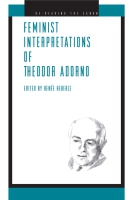




Feminist Interpretations of Theodor Adorno
Edited by Renée J. Heberle
“The essays are uniformly excellent and show exciting possibilities for Adorno’s relevance to feminism.”
- Description
- Reviews
- Bio
- Table of Contents
- Sample Chapters
- Subjects
Theodor Adorno was a leading scholar of the Institute for Social Research in Frankfurt, Germany, otherwise known as the Frankfurt School. With Max Horkheimer he contributed to the advance of critical theorizing about Enlightenment philosophy and modernity. Inflected by Kant, Marx, Nietzsche, and Freud, Adorno’s thinking defies easy categorization. Ranging across the disciplines of philosophy, musicology, and sociology, his work has had an impact in many fields. His Dialectic of Enlightenment (written with Max Horkheimer) was profoundly influential as a critique of fascistic and authoritarian impulses in Enlightenment thinking in the context of late capitalism.
Questions addressed in the volume range from dilemmas in feminist aesthetic theory to the politics of suffering and democratic theory. The essays are exemplary as works in interdisciplinary scholarship, covering a wide range of issues and ideas in feminism as authors critically interpret the many facets of Adorno’s work. They take Adorno’s historical situatedness as a scholar into consideration while exploring the relevance of his ideas for post-Enlightenment feminist theory. His philosophical and cultural investigations inspire reconsideration of Enlightenment principles as well as a rethinking of “postmodern” ideas about identity and the self.
Feminist Interpretations of Theodor Adorno will introduce feminists to Adorno’s work and Adorno scholars to modes of feminist critique. It will be especially valuable for senior undergraduate and graduate courses in contemporary political, social, and cultural theory. In addition to the editor, contributors are Paul Apostolidis, Mary Caputi, Rebecca Comay, Jennifer Eagan, Mary Ann Franks, Eva Geulen, Sora Han, Andrew Hewitt, Gillian Howie, Lisa Yun Lee, Bruce Martin, and Lambert Zuidervaart.
“The essays are uniformly excellent and show exciting possibilities for Adorno’s relevance to feminism.”
“The most successful of the fifteen essays in this volume use the insights of feminism to reread crucial Adornian works . . . to rethink critical terms within these works, such as mimesis, suffering, identity, and aesthetic autonomy. The variety of contributors—political theorists, philosophers, literary and legal scholars—ensures that the re-readings presented here are not monolithic.”
Renée J. Heberle is Associate Professor of Political Science at the University of Toledo.
Contents
Preface by Nancy Tuana
Acknowledgments
1. Introduction: Feminism and Negative Dialectics
Renée Heberle
2. An Interview with Drucilla Cornell
Questions by Renée Heberle
3. Adorno’s Siren Song
Rebecca Comay
4. A Feminine Dialectic of Enlightenment? Horkheimer and Adorno Revisited
Andrew Hewitt
5. “No Happiness Without Fetishism”: Minima Moralia as Ars Amandi
Eva Geulen
6. The Bared-Breasts Incident
Lisa Yun Lee
7. Mimetic Moments: Adorno and Ecofeminism
D. Bruce Martin
8. Intersectional Sensibility and the Shudder
Sora Y. Han
9. An-aesthetic Theory: Adorno, Sexuality, and Memory
Mary Ann Franks
10. Living with Negative Dialectics: Feminism and the Politics of Suffering
Renée Heberle
11. Negative Dialectics and Inclusive Communication
Paul Apostolidis
12. Feminist Politics and the Culture Industry: Adorno’s Critique Revisited
Lambert Zuidervaart
13. Unfreedom, Suffering, and the Culture Industry: What Adorno Can Contribute to a Feminist Ethics
Jennifer L. Eagan
14. Unmarked and Unrehearsed: Theodor Adorno and the Performance Art of Cindy Sherman
Mary Caputi
15. The Economy of the Same: Identity, Equivalence, and Exploitation
Gillian Howie
Contributors
Selected Bibliography
Index
Introduction: Feminism and Negative Dialectics
Renée Heberle
The contributors to this volume look at issues in feminism using insights from Theodor Adorno and reread Adorno using insights from feminism. While Adorno had many thoughts about women, about modern feminism, and about sexuality, he offered little in the way of sustained argument about them. Nonetheless, given the questions feminism raises and the questions raised about feminism, there are good reasons to “go back to Adorno.”1 In this introduction I will elaborate on some of these reasons. I cannot possibly do justice to the scope and complexity of Adorno’s thinking here, nor do I wish to attempt an introductory explanation of his ideas to the reader. The contributors do the work necessary to move the reader into the arguments. However, I do hope to highlight some of his most compelling insights and ideas about the task of philosophy, to show some affinities between Adorno and feminist concerns, and thus entice the reader into an engagement with the chapters that follow.
Feminism is critically reflexive about its status as a protest against conditions that make it possible; that is, it is simultaneously diagnostic and symptomatic. It is a field of inquiry that grows in intensity and effectiveness precisely through its disagreements and resistance to closure. Critically examining the troubled and troubling status of “woman” is among the many projects of feminism and contributes to its vitality as a field of inquiry and politics. And the contingent status of “women” drives the restless, conflictual quality of feminism in theory and in practice. In patriarchy, women are conceptually interchangeable. Concretely, they are not. Conceptually, woman refers to an object of inquiry. Concretely, that object comes diffusely apart as critical attention is paid to the terms of its existence and its particularity. Much of Adorno’s thinking predicts some of these basic conundrums of feminist theorizing.
Adorno was born to a Catholic mother and a Jewish father in Frankfurt, Germany, in 1903. He was raised an only child of privilege in a solidly middle-class milieu. His mother was a professional singer, and his aunt, who helped raise him, was a pianist. It is commonly remarked upon that he was raised by women in an extremely protected environment and that this may have something to do with his sensitivity toward the suffering of women as participants in bourgeois society as well as with his seeming nostalgia for the nineteenth-century ideal of the family as a space of nurturance for the autonomous bourgeois individual. There is little else in the way of biographical information that would tell us in any direct fashion how we as feminists might approach Adorno’s work. His Jewishness plays a profound part in his thinking, for it created the historical circumstances that forced him into exile. It was his experience of exile that inspired some of his famously melancholy works. Rebecca Comay, in Chapter 3, reflects on how the interpretation of the Odyssey in the Dialectic of Enlightenment stands in for Adorno’s own exile and relationship to the feminine. Adorno spent his later life in Germany as a well-established figure in academia. In Chapter 6, Lisa Yun Lee takes as her point of departure an intensely personal experience that has traditionally been interpreted as indicating Adorno’s aversion/distance from the body, particularly the feminine body. Lee shows this interpretation to be wrong, pointing out that Adorno’s work is deeply informed by concern with the body and with somatic suffering and that the body figures deeply in his philosophical work. Apart from these biographical references, it is Adorno’s work in itself with which authors in this volume engage, bringing it to feminism and bringing feminism to it.
While it is clear that Adorno concurs with many feminist sensibilities about Western philosophy and Enlightenment thinking, our goal here is not simply to judge whether his thinking is good for women, as if each were a predetermined object, with one waiting to be applied to the other. Rather, authors in this volume rethink his work in light of historically specific challenges faced by feminism and in light of diverse understandings of our present condition. Adorno himself would protest the “application” of his work—as if we were testing it for feminist purposes. He was famously opposed to instrumentalizing thought. Further, litmus tests of the intent of thinkers regarding the lives of women or analyses of gender relations typically obscure more than they reveal about the possibilities for thinking about women and gender relations offered by Western philosophy. Following the pattern established in other volumes in this series, each contributor rereads Adorno against the grain of his or her own thinking. Adorno’s work may have unintended (by him) consequences for feminism that can only be discerned through open-ended and experimental approaches to his work, which is open and experimental in its own right. The chapters that follow are written in this spirit.
Adorno was criticized, indeed sometimes vilified, for his apparent inattention to the accessibility of his work. However, for him, “[d]irect communication to everyone is not a criterion of truth. We must resist the all but universal compulsion to confuse the communication of knowledge with knowledge itself, and to rate it higher, if possible—whereas at present each communicative step is falsifying truth and selling it out. Meanwhile, whatever has to do with language suffers of this paradoxicality.” These kinds of questions continue to alternately plague and inspire feminists. Judith Butler was recently criticized specifically for using difficult language; the value of her ideas was dismissed as the question of whether her work was or should be accessible to a general readership became the issue. Critics of her work often suggest that it is not feminist of her to use complex language to express ideas. Adorno would have scorned this rhetorical dismissal of critique that demands serious and prolonged attention from the reader. The difficulty of his form and style of writing was inherent in what he regarded as the task of critique: to express the complexity of what only seems simple to the common sense prevalent in the historical moment, to render the familiar strange, and to open pathways to alternative thinking and practice.
For Adorno, critical theory is not about finding final answers or revealing truth. It is about articulating the irreconcilable quality of the movement of thought and experience in history. In Negative Dialectics, he says, “Unlike science, philosophy knows no fixed sequence of question and answer. Its question must be shaped by its experience, so as to catch up with the experience. Its answers are not given, not made, not generated; they are the recoil of the unfolded, transparent question.” Feminism’s questions have been shaped by experience. This is a legacy of the insight that “the personal is the political” in its nonproscriptive, most political (as in opening up new spaces for public contestation) sense. Learning how to ask questions about that which is most taken for granted in everyday life is a crucial concern for feminists.
Adorno was committed to the project of philosophy as interpretation. Further, he considered form to be as important as content to the meaning of any written text. This, he argued, philosophy has in common with art, though the two remain significantly different enterprises. Unlike art, philosophy is about truth, but it does not work with or tell the truth. It is about a truth that challenges history, not one that will presently or ultimately merge with it. Truths, for Adorno, as for Hegel, unfold from within history itself. Thus Adorno is committed to a philosophy that engages in immanent critique, which Susan Buck-Morss explains as “argumentation from within, on the basis of philosophy’s own inherent, historically developed logic, in order to break out of bourgeois idealism and into revolutionary materialism.” However, Adorno departs from Hegel (and Marx) in suggesting that there is no potential reconciliation of subject and object, of self and other, of concept and object. In his materialism the dialectic remains negative. Adorno rejects the notion that any concept is adequate to its object or that the nature of the object could ever determine the truth of the concept. The excessive quality of thought and the instability of the object conditions philosophical inquiry. Thus he supported speculative thinking against positivism, empiricism, and what he called the dogmatics of ontology.
Walter Benjamin was arguably the contemporary by whom Adorno was most influenced. Departing from orthodox Marxism, yet indebted to its insights, both men engaged in a kind of materialism that took the moments of reality as riddles to be solved rather than as given facts to be identified. History does live in the object but is neither determined by nor determines its nature. The following quotation best sums up Adorno’s understanding:
<ext>
The central difference [between science and philosophy] lies far more in that the separate sciences accept their findings, at least their final and deepest findings, as indestructible and static, whereas philosophy perceives the first findings which it lights upon as a sign that needs unriddling. Plainly put: the idea of science (Wissenschaft) is research; that of philosophy is interpretation. In this remains the great, perhaps the everlasting paradox: philosophy persistently and with the claim of truth, must proceed interpretively without ever possessing a sure key to interpretation; nothing more is given to it than fleeting, disappearing traces within the riddle figures of that which exists and their astonishing entwinings.
<end ext>
In common with that of feminists, Adorno’s philosophy challenges the dualisms that structure Western thinking. He did not suppose he would reconcile through theory the contradictory forces of nature and history, culture and social structure, or desire and Reason. Rather, he considered the work of deconstructing these dualisms to be ongoing. They would not be thought away in their immediacy, but worked against each other to show their untruth as independent things-in-themselves. Susan Buck-Morss shows how the use of antithetical concepts provided Adorno with a method, of sorts, of critical cognition. “That which appeared as rational order in bourgeois society was shown by Adorno to be irrational chaos; but where reality was posited as anarchic and irrational, Adorno exposed the class order which lay beneath this appearance. . . . Where nature confronted men as a mythic power, Adorno called for the control of that nature by reason; but where rational control of nature took the form of domination, Adorno exposed such instrumental reason as a new mythology.” This is echoed in feminism. Where some feminists have shown the historicity of presumably natural qualities of sexed existence, others have shown the irrational, mythic, naturalizing force of historically constituted notions of masculinity and femininity.
Further, Adorno tells us, “The task of philosophy is not to search for concealed and manifest intentions of reality, but to interpret unintentional reality, in that, by the power of constructing figures, or images (Bilder), out of the isolated elements of reality it negates (aufhebt) questions, the exact articulation of which is the task of science, a task to which philosophy always remains bound, because its power of illumination is not able to catch fire otherwise than on these solid questions.” This is the materialism Adorno advocates. “Interpretation of the unintentional through a juxtaposition of the analytically isolated elements and illumination of the real by the power of such interpretation is the program of every authentically materialist knowledge.” From Walter Benjamin, Adorno borrowed the term constellation to describe what the latter was doing in interpreting “reality.” Constellational thinking rejects identity thinking and challenges dualistic presuppositions. It is thus significant for feminist purposes.
As it is for feminists, concrete, lived experience is fundamental to Adorno’s work, but not because it tells the truth about oppressive social conditions. For Adorno, access to authentic experience withered with the possibilities of an authentically individualist social order in late capitalism. He considered the popular responses of his time to this decay to be dogmatic; whether they were existentialist (Heidegger, Sartre) or Marxist (Brecht, Benjamin) in orientation, he argued that these approaches obscured the tragic dimensions of lived dialectical tensions between the extremes of mythology and Enlightenment rationalism and between nonhuman nature and inhumane history.
Adorno’s major philosophical work, Negative Dialectics (1966), elaborates his theory of the nonidentical, which speaks to feminist concerns about essentialism and identity politics (see particularly Gillian Howie’s contribution to this volume, Chapter 15). Feminism is concerned with the difference that is “woman” and the differences that constitute the category of “women.” Essentialism became a problem rather than a solution to the question of unity among women as black feminism and feminists of color told white feminists not only that having gender identity in common is partial in its constitutive power, but also that unconditionally identifying women as such obscures as much as it illuminates about the quality and experience of oppression in general. Further, and in part as a response to these criticisms, as some feminists adopted poststructuralist and deconstructionist approaches to interpreting gendered experience, pursuits of origins and causal explanations for oppression were brought into question. Thus feminist theorizing has become increasingly attuned to its contingent, conditional status as a field of inquiry. This is an attunement that should lead not to pessimism or paralysis, but rather to heightened sensitivity of the transformative possibilities offered by not taking anything for granted about one’s object of inquiry. Adorno’s insistence on the primacy of the object encourages this nonidentitarian approach to knowledge.
Adorno’s claim about nonidentity is, at base, fairly straightforward. It is that the object does not go into its concept without remainder and that the space between indicates simultaneously the failure and the hope of Enlightenment thinking.
Contrary to the widely held belief, Adorno was not anti-Enlightenment. He self-consciously used reason to critique the categorical Reason of traditional philosophy. As noted above, his constellatory thought insists on the primacy and many-sidedness of the object. For Adorno, rationality should not be subject centered, partly because we cannot know ourselves completely and therefore will always be obscuring, perhaps irrevocably, parts of the self that are “objectively” conditioned by historical circumstance. He says of constellations:
<ext>
The history locked in the object can only be delivered by a knowledge mindful of the historic positional value of the object in its relation to other objects—by the actualization and concentration of something which is already known and is transformed by that knowledge. Cognition of the object in its constellation is cognition of the process stored in the object. As a constellation, theoretical thought circles the concept it would like to unseal, hoping that it may fly open like the lock of a well-guarded safe-deposit box: in response, not to a single key or a single number, but to a combination of numbers.
<end ext>
Constellations suggest a move away from what have been some defining terms of feminist method: determinist thinking wherein we can know in advance the source of woman’s suffering; social constructionism, which is more historical, but still drops subjectivity from the equation; or essentialism, which will find the truth of “woman” within the subject. My own contribution (Chapter 10) offers insight into how “experience,” a concept crucial to feminist theorizing and one that is often subjected to the forms of thinking just described, might be understood through constellational interpretations. I proffer an alternative to thinking about experience as either an authoritative source of truth or as a construction we can only understand through the conditions of its emergence and articulation, but not as an object in itself.
Adorno writes, “The truth of music is inextricably bound to its transiency.” This claim can be applied to his thinking about the truth of the self and experience. The truth is not in them, but is in their historical movement, not only in forward motion, but in lateral motion as well. Feminism approaches this understanding in many of its modes of theorizing. It can pick up some cues from Adorno in order to take another look at some basic conundrums of feminist work, theoretical and political.
<1> Adorno and Praxis
Adorno died in 1969 at the age of sixty-six. His untimely death came at the height of the new leftist and student movements, and coincided with the burgeoning women’s movement, in Western industrialized countries. His life and work had been profoundly marked by the rise and subsequent violent demise of the Fascist state in Germany and by his own experience of forced exile to England and the United States just before the war. He became a significant, even leading, figure in radical intellectual circles in Germany upon his return to that country in 1949. The Dialectic of Enlightenment, written with Max Horkheimer, served to focus students’ attention on their felt alienation from bourgeois consumer society. It is a founding text of the Institute for Sociological Research, popularly known as the Frankfurt School. It departs from orthodoxies about the necessity of the domination of nature and the inevitability of progress that were found in orthodox Marxist critiques of capitalist administrative society.
However, his critique of progress; his skepticism toward all forms of positive theory; and the profound aura of melancholy, even pessimism, that emanated from his work ultimately made him an unlikely figure to inspire those who came to assert the need for a programmatic critique that would guide radical social action. Adorno did actively avoid association with collective politics and action. But his reasons for doing so deserve our attention. In all his writings he addressed questions about the relationship between thinking and political commitment, between art and political commitment, and the place of critique in contemporary mass society. These questions are addressed by other thinkers, but typically as an afterthought or as an otherwise minor consideration. For Adorno the relationship between theory and practice is a critical point in the constellation of concrete concerns that drove his life and work.
In spite of this wealth of material, critical theorists, including feminists, in the United States have, since the early 1970s, been slow to pick up on Adorno’s work. Herbert Marcuse and, after him, Jürgen Habermas have remained the most visible representatives of the critical tradition spawned by scholars associated with the Institute for Sociological Research. Marcuse’s optimistic use of Freud and Marx to resolve modern forms of alienation from self and other and Habermas’s faith in the potential for transparency in rational forms of communication have been important references for contemporary feminist theorizing of conditions of gendered and sexual freedom. However, interest in Adorno, always at a steady but rather low ebb among critical thinkers, has reemerged as the debates about modern and postmodern theorizing have become somewhat threadbare. I would argue that Adorno’s nuanced theorizing about the constitutive quality of the object; his consequent insistence on the complexly mediated quality of intersubjective relationships; and crucially, his thinking about suffering and memory may, as he is quoted above, help contemporary critical thinking point beyond itself.
<1> The Contributions
We open the volume with an interview with Drucilla Cornell. Cornell is probably best known for her theorization of the imaginary domain as a site of individuation and freedom. The interview with Cornell reveals the ways in which Adorno continues to influence her thinking about legal, cultural, and feminist matters.
The interview shows how she weaves the idea of negative dialectics into her feminist theorizing about ideality as a space of struggle. She discusses the re-presentation of the feminine in the feminist pornography of Ona Zee, showing how Zee demonstrates the concrete materiality of women’s bodies, which always already negates the male fantasy of women as always absolutely knowable as an object. After several minutes of what appears to be a “normal” porn scene, Zee stops the sex acts to show what women who are menstruating must do in order to continue to work on porn sets during their period. This highlights the negativity of women’s bodies against which the male fantasy must always work to sustain a phallocentric ideal of the feminine. For Cornell this is the negative dialectic in action.
Cornell’s conceptualization of the imaginary domain as a never fully constituted space that should be protected by law provides a corrective to the liberal notion of a self that is always already there to be protected. Following the insights of critical theory that it is not only that our preferences as preconstituted subjects are shaped by the culture industry but also that our subjectivity itself is “pounded into a being who has lost the ability to distance ourselves from the bombardment of images that promotes the endless push to consume more and different products,” Cornell recognizes the difficulty of conceptualizing such a space. Her theory of the imaginary domain does rely on the liberal idea of individuality as critical to freedom, but it is indebted to dialectical theory in that for Cornell, individuation is a process that moves within and against the limits of the individual’s own horizons, which are in turn continually shaping and shaped by her relations with others. The interview shows how a critical reading of Adorno can inform contemporary feminist theory and activism and challenge our thinking about the relationship between theory and activism.
Apart from an excellent collection of essays on feminist sociocultural theory titled Adorno, Culture, and Feminism (2001), edited by Maggie O’Neill, there has been little feminist attention to Adorno’s work. In this volume we include only two previously published works, those by Andrew Hewitt (1992) and Rebecca Comay (2000). In Chapter 4, Hewitt allows us to see how the Dialectic of Enlightenment, in spite of its own critique of instrumental thinking, instrumentalizes the “feminine” as a cipher for the deindividuating effects of modernity. Comay, in Chapter 3, rereads the Dialectic of Enlightenment as representative, even symptomatic, of Adorno’s own troubled exile. The vulnerabilities of the bourgeois patriarch are critically elaborated in the excursus on Odysseus, and the melancholy hope for something different is lodged in complex ways in the various deployments of woman as allegory for the seductions of modernity.
Comay draws out the ways in which Adorno’s personal experiences haunt the Dialectic of Enlightenment. Adorno’s volume of aphorisms, Minima Moralia (1947), written shortly after the Dialectic, is purposively personal, even intimate, in tone and content. Eva Geulen, in Chapter 5, looks at this most intimate of Adorno’s works to show the place of love and desire in Adorno’s thinking generally. Love as that which can be most consuming and most particular in human experience has been the subject of much philosophical concern. Geulen argues that “none of Adorno’s theorems—neither those pertaining to art and aesthetic experience or to history and social relations, nor those addressing problems of literary or musical expression—can be sustained at all if their roots in erotic desire are severed.” She shows how Adorno finds his way through and around the traps of existentialist proclamations of authenticity in love as a model for relations between the individual and the social. His references to erotic experience, to the transitory selflessness experienced in the moment of love, tell us about his thinking about mimesis in all its complex guises.
While Adorno’s most intimate of reflections include some of his most stereotypical references to women, Geulen describes how he turns the “truths” of those references against themselves to illuminate the contradictions inherent in the lived condition of “being woman.” Such readings as Geulen’s draw out of a frustrating lack of closure, which causes some readers of Adorno to dismiss him as hopelessly obscure and self-contradictory, the very insight into human experience we may need to continue to hope for something different in damaged conditions.
We go back to Minima Moralia in Chapter 6, as Lisa Yun Lee explores Adorno’s thinking about an object associated with intimacy and central to feminist critique. Similar to Geulen’s critical recovery of the importance of the erotic to Adorno’s work, Lee’s thesis identifies the centrality of the body, in its most visceral corporeality, in his writings. She uses the (in)famous scene of Adorno’s humiliation in the seminar room when, frustrated by his inattention to activism and collective organizing, students planned a protest. Radical students became “disenchanted” with his apparent scorn for direct action and street politics. In 1969 female students embarrassed Adorno during a lecture by rushing to the podium in a planned moment and baring their breasts while caressing him and throwing rose petals over his body. The protest was inspired by contemporary radical thinking about sexuality and corporeality and was intended to highlight the assumed disjuncture between Adorno’s work and political praxis. Lee takes as a point of departure the interesting fact that female bodies were deployed as substitutes for the praxis the students were “reminding” Adorno about. As in the case of his thinking about “love,” what the students were missing, according to Lee, is that the body is written in all over Adorno’s work; his attention to sentient suffering and his critique of the occlusion of the body from philosophical concern is addressed in several of the chapters that follow. Adorno does not offer any systematic comment on the body in Minima Moralia. This is in keeping with his commitment to the Nietzschean form of aphorism that reflects his more general commitment to the practice of philosophy as an unriddling of the object. It is only through teasing out the combined and incomplete insights offered that one might put together, as does Lee, an argument about Adorno’s thinking on the body.
Ultimately she shows that his concern with the body is related to his concern with the subordinate forms of manual labor and with praxis. He does not reclaim the body in any direct fashion, as he is aware that simply reversing the mind/body dualism might as readily lead to Fascism as to freedom. Thus attention to the body is best given through immanent critique that exposes its naturalized status and illuminates its position of negativity. The body is philosophy’s negative as in its suffering it signifies philosophy’s failures. Adorno does not try to fill in its absence from Western philosophy but uses the absence of the body as such. Through metaphor and language that evokes visceral bodily experience, Adorno reminds us, sometimes jarringly, of our embodied condition and the dialectical relation between mind and body. It is in his critique of the modern insistence on the mind/body dualism, of the division of mental and manual labor, and of traditional ideas about subject-object relation that one finds the concern for and about the body in Adorno’s work. Lee shows how these dualisms are related to one another in a complicated fashion, the first nested within the second, which reflects the more general epistemological status of subject-object relations in traditional philosophy.
With Bruce Martin’s contribution (Chapter 7), we move from the critical recovery of terms relevant to feminism in Adorno’s work to an exploration of how Adorno contributes to thinking about ongoing ecological crises and coming catastrophes. Martin explores the multifaceted philosophical life of mimesis. Moving from aesthetic to ecological and scientific deployments of mimesis, he elaborates the distinct possibilities rendered when we acknowledge the mimetic quality of identity, when we acknowledge that we engage in a necessary process of projection in and through others as we engage in becoming selves. This projection, the movement of subjectivity through others, whether those others be of human, of natural, or of aesthetic type, can have repressive/regressive or emancipatory effects. Martin shows how Adorno’s work can inform a radical feminist ecological project that avoids identitarian effects, the collapsing of subject and object (human and nature) into a totalitarian state of reconciliation. Adorno values mimesis for its partiality, as an inconclusive means to the end of recognition of the nonidentity of self and other.
Sora Han’s contribution (Chapter 8) is, again, a critical retrieval of sorts. She is retrieving the concept of intersectionality, first introduced by Kimberlé Crenshaw in 1991, from an untimely dismissal by critical race theorists. Han suggests that the criticisms of and efforts to move past intersectionality miss an opportunity to realize its potential as a term of critique necessary to any progressive move against forms of simultaneously racial and gendered violence. She argues that coalitional efforts against increasing levels of violence against women and the egregiously disproportionate rates of incarceration of men of color need intersectionality as a critical concept. However, it is not, in Han’s reading, a static social positioning or an alternative identitarian category of being. It is, instead akin to an aesthetic sensibility. Han uses Adorno’s aesthetic theory, specifically references to his appreciation of aesthetic appearances that capture the apparitional quality of the subject as under the spell of the social, while nonetheless providing the subject (who sees or reads or hears the art object) with a corporeal experience of the “shudder” that momentarily, at least, breaks the spell. On Han’s reading, intersectionality is not merely a more complicated version of identity politics or an assertion of a space from which truth might be told. Rather, it invokes that which is not intelligible yet must be attended to if politics, in this case, an antiviolence politics, is to move forward.
Mary Franks turns to Adorno’s assessment of the culture industry’s effects on mass consciousness to think about pornography and sexual violence. Franks is not interested in arguing a causal relationship here. She is more concerned with how pornography creates the conditions in which sexual violence can thrive, in spite of the moral indignation and horror that is expressed at its occurrence.
Adorno and Horkheimer critique the culture industry for its anesthetic effects on consciousness. They compare it to anesthesia in medicine, which does not remove the pain itself, but only the memory of it. Patients’ bodies thus experience the pain, but they know nothing consciously of the pain afterward. Adorno’s suspicion of the pleasure aroused by the culture industry is not that cultural commodities allow us to escape an untenable reality. Like the surgery patient, we are not escaping a painful “reality”; instead, we are experiencing pleasure that comes with the freedom from having to think about, and thereby potentially resist, the untenable conditions of the world. This is the anesthetic effect Franks claims pornography imposes. It anesthetizes consumers to their own suffering and to that of others, not by removing the suffering but by negating active remembrance of it.
Franks does more than argue that the 12-billion-dollar pornography industry desensitizes us to the suffering other. She uses the liberal arguments about the difference between looking and doing and consent and coercion against themselves. She shows that in viewing pornography the consumer has no way of discerning the difference between a consensual act and an act of rape. It could always be either, and, indeed, if “fake rape” is as “erotic” as “real rape,” then the issue of consent means little in our ethics about sexuality. The pornographic anesthetizes our sensibilities about sexual violence by blurring, even eradicating, the boundaries between consensual and coercive sex. We may have a visceral response to hearing about sexual slavery and violence, but an active memory is effectively wiped out by pornography.
One of Adorno’s basic concerns was with ethical self-other relations. Traditional philosophy sustains the subject as primary and the object as the subordinate, as that which is to be known, mastered, and altered according to the subjective will. Adorno’s negative dialectic challenges the primacy of the subject, viewing the object as the constituent of the subject. In my own chapter (Chapter 10), I work through this approach to the knowledge of and representation of objective experience. My concern is with the representation of suffering in an integrative world that erases difference in the interest of managing knowledge and furthering exchange relations. Women’s suffering has a particularly difficult time becoming intelligible in its own right, given the weight of stereotypical forms of femininity, each of which can explain or make sense of woman’s suffering in noncritical ways. I argue that feminists must take note of Adorno’s negative dialectics and rather than mourn the impossibility of representing reality as it really is, make critical use of the distance between material experience and experience as represented in the public world. Knowing that representations of even the most visceral suffering will be performative may help ward off despair when the world does not respond to the “reality” of suffering. There will always be distance between an experience and the representation of that experience. This makes room for telling stories that do not “fit” with stereotypical notions of femininity and masculinity, for a telling of experience that remains aware of how that telling will travel and, as object, will in turn become constitutive of subjective possibilities. It may help create a more strategic sense of what we are doing as we represent suffering to the world.
Paul Apostolidis is also concerned with ethical self-other relations. In Chapter 11, he takes Adorno’s ideas into a space through which Adorno himself would have been unlikely to travel, into a meeting between migrant-labor organizers, workers, and community members in a small town in eastern Washington State. Apostolidis reads the form and content of the meeting using categories he takes from Iris Young’s Inclusion and Democracy (2000): greeting, rhetoric, and narrative. Pushing Young’s thinking beyond where she goes in her book, Apostolidis advocates the integration of these forms of self-other interactions into the space of public deliberation. In the tradition of feminism and critical theory, Apostolidis regards rational argument and instrumental reason as Western, masculinist forms of address that inherently exclude or marginalize forms of address deployed by historically marginalized persons. Whether marginalized groups are such because they use such forms of address or use such forms of address because they are marginalized is not the question. Rather, the issue is how to bring them into the conversation in such a way that self-other relations are rendered more receptive and less instrumental. Apostolidis is concerned with re-forming democratic interactions according to principles that may not be specifically feminist, but that certainly reflect and inform feminist activism. The gender politics of the meeting is made clear in his discussion, interwoven with a discussion of the ethical challenges involved in organizing and engaging in the event.
Apostolidis suggests that Young does not take far enough her own insight into the critical potential of the forms of address she theorizes; she leaves them as a kind of preliminary to the “real” doings of deliberative democratic debate. Apostolidis is concerned, as I am, with how progressive persons can live with negative dialectics, even act it out, in a world wherein conditions of social inequality will inhibit, or even render more damaging than helpful, the most well intentioned gestures of solidarity. In the meeting he describes, relatively privileged students and community members come to listen to the experiences of workers in local meatpacking plants and the organizing strategies of union leadership. Apostolidis weaves greeting, rhetoric, and narrative into his discussion of the meeting, showing how deployment of these forms of address can counter the instrumental reason of which the relations of privilege present in the room are an effect. He suggests that the reception by listeners can move well beyond that of sympathy to the plight of others to a mutually constitutive interactive relationship. Adorno was attuned to the politics of suffering, but also to Nietzsche’s various admonitions about ressentiment: the will to power of the weak that drives the impulse to hold the strong to account while obscuring the attachment of the weak to their status as victims. Apostolidis takes these dynamics into account in rendering an interpretation of the meeting that subverts these relations and creates a different model for unity among differences.
The three chapters that follow Apostolidis’s take up Adorno’s aesthetic theory. Adorno is well known for his advocacy of aesthetic autonomy against those who would instrumentalize art toward political ends. Against Bertolt Brecht and Walter Benjamin, Adorno held that it is in the very uselessness of art that its potential for critique lies. Contemporary feminists, by contrast, have held that feminist art must be committed art. They have argued that the disembodied and abstract formalism of modern art reflects masculinist values, marginalizing and objectifying the embodied and always particular feminine. Art must deliberately engage with and challenge masculinist values in the name of transforming gender roles. Feminist art must be committed to a social agenda. In Chapter 12, Lambert Zuidervaart takes up this debate, ultimately claiming that it is not helpful to argue for or against aesthetic autonomy on its own terms; it is to the historical conditions and relations of production that Zuidervaart would also look as we think through the critical potential of art.
Zuidervaart does lean toward aesthetic autonomy as the critical gesture, but wishes to broaden its meaning. He turns to Adorno’s theory for insight into how feminist art might hold to its legitimate criticisms of the masculinism inherent in most versions of aesthetic autonomy while avoiding absorption and integration into the status quo that Adorno pointed to as the necessary failure of committed art. Zuidervaart outlines how Adorno works through a theory of autonomous art that lives up to Kant’s purposiveness without purpose yet issues its own form of critique. This critique lives in the dialectical relation between form and substance in the artwork itself and in its relative autonomy from the very capitalist forms that make its existence possible. Zuidervaart argues that Adorno’s sense of aesthetic autonomy is limited, because Adorno only addresses the relationship between art and the state or between art and monopoly capitalism as the measure of its social autonomy. Adorno misses the importance of civil society, of voluntarist productions of art and cultural practices. For Zuidervaart, the critical move is to avoid colonization by corporate and governmental influence and control. He sees potential in nonprofit, cooperative, or communal forms of production of art that would, at least in part, sustain its critique as a potent force and help it resist integration into the culture industry.
Thus, Zuidervaart advocates expanding Adorno’s notion of aesthetic autonomy to include consideration of the practices involved in creating and experiencing art. It makes a difference, then, whether, to view art, one goes to the Museum of Modern Art in Manhattan or to the East Side docks. The entire aesthetic experience, from production to engagement with the work of art, would become part of the critical aesthetic experience.
Zuidervaart offers a version of aesthetic autonomy that takes into account more than the internal autonomy advocated by Adorno. He argues that we should consider a whole range of factors in considering aesthetic value, including its communicability and sociability, which Kant considers a part of aesthetic judgment. It would look at alternative spaces in civil society and alternative economies that produce works of art. Importantly, Zuidervaart regards aesthetic autonomy not as something to be for or against in the abstract, but as an aspiration to be struggled for and assessed in historical context.
Jennifer Eagan, in Chapter 13, also looks at the culture industry, exploring the potential for a critique of suffering in art. Eagan seeks to draw connections between Adorno’s theory of suffering and his understanding of culture. Feminists strive to think and speak beyond the constraints that they themselves have so effectively exposed and struggled with. Eagan uses Judith Butler’s work as an exemplar of the contemporary feminist critique of gender as an instantiation of suffering. Eagan then looks to Adorno’s aesthetics for insight into how that suffering might be represented without reiterating the terms of the status quo.
Eagan locates suffering at the intersection of the body and the social-linguistic order that inscribes meaning onto the experience of that body. It is neither pure feeling (pure pain) nor reducible to discursive representation, but is constituted dialectically as an effect of that relation. Eagan uses concrete examples of how AIDS and breast cancer are captured in discursive spaces, showing that those who suffer are never expressing the “truth” of their suffering in an unmediated fashion. Rather, their mediations make possible the intelligibility of their experience to the world, rendering the reality of it far beyond any terms to which the subject can fully consent. Suffering changes the lens through which we view the world and the world shapes possibilities for representing suffering.
Neither Butler nor Adorno offer straightforward means by which to escape the status quo. The value of their work lies primarily in the recognition of the complex relation between any cultural gesture and the reality of suffering. Eagan looks to Adorno’s immanent critique of culture and Butler’s theory of nonfixed performative identities for an approach to thinking through the conundrums of representing the lived experience of suffering.
Mary Caputi, in Chapter 14, accepts Adorno’s challenge with respect to the internal autonomy of the work of art. She takes up the early performance art of Cindy Sherman, seeing it as exemplary of art that, in form and content, implodes the common sense of gender. Sherman’s art works as immanent critique, unhampered by the guilt of complicity with the culture industry. Sherman self-consciously deploys as her venue art’s entanglement with the status quo. Rather than resigning herself to a necessary entanglement, Sherman exposes that entanglement with each aesthetic gesture of her performance art. Caputi offers an appreciation of what she calls Sherman’s “staid rebellion,” one wherein Sherman offers no apologies for complicity as she insistently demonstrates, rather than expressing or explaining, the indeterminacy of gender. Sherman only gestures toward the possibility of something different from that which we think we know so well. Art here acts as a double agent. It works within the stereotypes of femininity to expose the instability of femininity as a category of being. Caputi notes that Sherman moves in and out of the stereotypical guises of femininity with ease, showing their very indeterminacy through that movement. She uses her body and costume and form to perform femininity as a recognizably contingent subject. “Art does not come to know reality by depicting it photographically or ‘perspectivally’ but by expressing, through its autonomous constitution, what is concealed by the empirical form reality takes.”
Our volume ends with an chapter about identity and difference in third-wave feminist thought. Third-wave thought is loosely understood here to refer to feminists who are critical of the essentialist tendencies of feminism in the 1970s and 1980s. We might generally include in this category feminists of color and those who turn to postmodern theory for insight as to identity and difference. Gillian Howie, in Chapter 13, shows how Adorno’s form of materialism allows us to see that there is simultaneously truth and untruth in our identifications. Howie explains some distinctions between identification as a benign cognitive exercise and that which is complicit with social relations of domination. She suggests that there are concrete, though historically contingent, truths about the nature of group identity, but that the thought of identity should always be suspected of obscuring social interests.
Feminists struggle with the normative values implicit in any gesture toward identification. Howie suggests a way in which to identify exploitative interests that are served in grouping women together and that should not be reiterated in progressive movements. Her careful delineation of the relationship between identity, cognition, and injustice lays some groundwork for asserting or forming groups in a way that challenges rather than affirms or mirrors the status quo.
<1> An Inconclusive Conclusion
As a philosopher Adorno had immense integrity. He stands as a thinker who sustained an absolute commitment to the life of the critical mind, one that works toward the cause of an enlightenment that can bring real freedom. His context is not ours. However, he predicts and speaks directly to many questions that go to the heart of contemporary feminist theory, including questions about interpretation, the relation between theory and practice, representation, identity, and historical memory. The chapters that follow keep the faith with Adorno’s attunement to historicity and offer some insight into how we might continue to think about those questions through the prism of his thought.
Mailing List
Subscribe to our mailing list and be notified about new titles, journals and catalogs.