


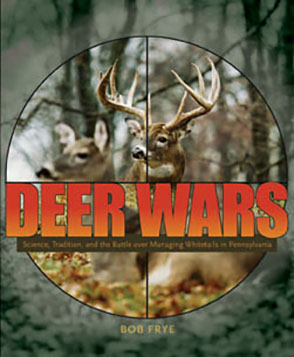
Deer Wars
Science, Tradition, and the Battle over Managing Whitetails in Pennsylvania
Bob Frye
“A well-balanced, carefully documented must-read for anyone involved in the politics of modern day wildlife management in Pennsylvania.”
- Description
- Reviews
- Bio
- Table of Contents
- Sample Chapters
- Subjects
“A well-balanced, carefully documented must-read for anyone involved in the politics of modern day wildlife management in Pennsylvania.”
“True to his award-winning style, Bob has produced a meticulously researched, superbly written, and often humorous and emotional exposé about Pennsylvania’s premier game animal. This prodigious book should be on the shelves of every serious conservationist and wildlife scholar.”
“Go to any barber shop in Pennsylvania and you will discover at least one expert and many strongly held opinions on deer management. I urge fellow hunters and wildlife enthusiasts to read this well-written and fascinating book that explores the checkered history of deer management in Pennsylvania.”
“Deer Wars—a wealth of information on Pennsylvania’s current deer management program—what it’s about, how it developed and where it may be going—along with the controversy it’s created along the way. It is the first publication to give readers the Big Picture. It combines the science, the personalities and the opinions—from biologists to legislators to sportsmen to non-hunters—that lead to significant changes in Pennsylvania’s deer management program, and will lead to additional changes as the science and the personalities continue to evolve. It delves into the reasoning behind the significant changes we’ve seen, be they antler restrictions or herd reduction through expanded seasons and programs such as DMAP. Frye doesn’t hesitate to provide all sides of the issues, whether they’re scientifically based or simply personal opinions.
Throughout the book, Frye manages to maintain that image of “sportsmen—the first conservationists,” which is truly the theme driving the current program, as it should be. Hunters and non-hunters alike should take the opportunity to read this book. Non-hunters stand to learn about the problems uncontrolled wild animal populations can create as well as the purpose and role hunting plays in managing those populations and problems. Hunters—when you’re finished you’ll have a much better understanding of deer management as it’s practiced today, whether or not you agree with it. More importantly, it will help you determine if you truly are a conservationist, or simply just a hunter. (Both types are quoted frequently—if you can recognize them.) Frye won’t give you the answer at the end—he lets you make that decision for yourself!”
“Bob has interviewed an amazing array of characters on all sides of the deer management issue—in fact, I can’t think of any major player he hasn’t interviewed. In his unbiased, reporter-style coverage, he almost never takes a position; he just reports what other people say, often providing quotations from others with conflicting views. This book certainly represents the most comprehensive documentation of the history of deer management in Pennsylvania.”
“Every Pennsylvania deer hunter should get—and read—Deer Wars: Science, Tradition, and the Battle Over Managing Whitetails in Pennsylvania, a new book by Bob Frye. Not because the book will help those who still have a deer tag get a buck, but because this work offers a clear presentation of the history, lore and complexity of living with deer in the modern world. It’s the book our state needed decades ago. Deer Wars examines all aspects of the questions: How many deer should Pennsylvania have? Why? And who says so?”
“If I had the power to do it, I’d make Deer Wars mandatory reading for every deer hunter, anti-hunter, wildlife manager, farmer, forester and environmentalist in the state. It’s that good.”
“From the field notes of Emil Johnson, state game warden for Warren County in the 1920s, to recollections of Dick Gerstell, Game Commission research director in the 1930s, to a fitting tribute to the work and writings of Roger Latham in the 1950s, Frye knits together a very informative and readable in-depth history. He also does a credible job of reviewing the other contemporary issues facing deer managers in Pennsylvania and elsewhere, including suburban/urban deer management, chronic wasting disease and deer farming. . . . Deer Wars is a carefully researched, comprehensive, 328-page, softcover history of one of the wildlife profession’s most vexing sagas. It is well worth reading by anyone interested in deer management, wildlife management history, human dimensions of wildlife or with a Pennsylvania hunting license.”
“Frye’s book is thoroughly researched, comprehensive, and an easy read. Whether you’re a hunter, an anti-hunter, a farmer, a forest manager, a politician, a biologist, an environmentalist, or just an ordinary person who wants to understand what’s happening with deer management in Pennsylvania, read Deer Wars by Bob Frye.”
Bob Frye is an award winning outdoors journalist and the Outdoors Editor of the Tribune-Review.
Contents
Foreword
Acknowledgments
1. How Much Is Enough?
2. The Nature of Overabundance
3. When You Can’t See the Forest for the Deer
4. Too Many Mouths in the Grocery Aisle
5. At Home in the ’Burbs
6. Bambi Versus the Buick
7. Heroes or Goats?
8. Questions and Answers
9. Getting to the Point of Managing Deer Correctly
10. In the Eye of the Storm
11. A Wild Card in the Deer Management Deck
12. A Look to the Future
Index
How Much Is Enough?
The door of the one-room schoolhouse burst open with a bang, quieting in an instant the normal before-class chatter. Goosebumps rose on the flesh of the students, in part because of the icy blade of cold air that knifed through the room.
More than that, though, it was the look on the face of their classmate. Eyes wide, hair askew from ripping off his cap, out of breath from running through the snow, he was stammering, the words running together like water droplets over a falls.
Charlie May was one of the students who turned to see what the stir was about. Only minutes before, he had settled into his seat after hanging his coat on a peg by the door. It was just before Christmas 1931 and there were several inches of snow on the ground.
That hadn’t kept May from walking to school, of course. It was only a few miles from home, and he was all but a man anyway. Fifteen and in eighth grade, his last year of school, he’d soon be leaving books behind to join the rest of the men in Gowan City, Schuylkill County, in working for the Reading Coal Company. His relative maturity left him immune to some of the crises that occasionally sent his younger classmates into a frenzy. This was to be something different, though.
“Hey! Hey everybody! You’ll never guess what I just saw!” yelled the excited youngster at the door behind him. “I saw a deer track!”
It took a second for this to sink in, and then the room was on fire with excitement. Just imagine, a white-tailed deer track, and in the snow on the same road the children walked to school every day! It was almost unthinkable. Even the teacher—whose first instinct must have been to put down the sudden disturbance before it led to general mayhem—got caught up in the pandemonium.
“Get your coats on, everyone,” the teacher said. “We’re going to go see it.”
“It seems funny now, but my dad said the whole class walked about a mile in the snow just to see that track—it wasn’t even a deer, just a track—because it was unheard of,” said Charlie May, the same-named son of that Schuylkill County teenager. “I remember my dad telling me that was one of the few times he ever saw a deer track as a kid, and he was in the woods a lot, more than most. There just weren’t many deer back in those days.”
I was thinking of that story as I pulled the minivan over to the edge of the road. It was an August evening, seven decades removed from Charlie May’s last year of school, and the air was just beginning to cool. My wife, Mandy, and I had weathered the afternoon heat by swimming with our sons, Derek and Tyler, in the lake at Laurel Hill State Park, in southwestern Pennsylvania’s Laurel Mountains. When we left, an hour or so before dark, we decided that rather than head straight home, we would detour on some side roads to look for deer.
Now we were parked on the edge of the two-lane blacktop, the driver’s-side tires in the gravel, watching a six-point buck. It was the sixth or seventh deer we’d seen so far, but the first with antlers. It had crossed the road in front of us from right to left, inexplicably leaving the security of Forbes State Forest for a forty-yard strip of greenery that stood between us and the Pennsylvania Turnpike, a cross-state, four-lane superhighway. It was just inside the tree line, peering back at us over its shoulder. Derek, then age nine, and Tyler, then age six, craned their necks to get a better look.
“Can we unbuckle?” Tyler asked, frustrated by his inability to get closer to the window on the deer’s side because of the restrictions of his seat belt.
We saw a truck coming toward us and tried to catch the driver’s eye, hoping to alert him to the buck’s presence. I’m not sure he knew what we were trying to tell him—he slowed only a little—but fortunately the buck never moved.
We stayed another minute, then left when it seemed we might be the reason he was staying so still, so close to the road. If that deer was going to get hit by a vehicle, we didn’t want to cause it, and we certainly didn’t want to see it.
We continued through that state forest area, swung by some game lands managed for wildlife by the Pennsylvania Game Commission, then drove along a few roads at the base of the Laurel Ridge, where houses are sandwiched between the road and the woods. Having chosen the air conditioning of our minivan over the extra ground clearance of our Wrangler earlier in the day, we stayed on the pavement now.
Still, in that final hour of daylight we saw thirty-nine deer, not an unusual number by any means. Only that one was a buck—a telling fact at the time—but we saw several spotted fawns, including one set of triplets and two sets of twins. We saw some fat, healthy-looking deer. We saw a doe or two that seemed gaunt. We saw so many deer of so many kinds that before our trip was over Derek and Tyler had tired of watching them. “Uh-huh,” they’d say without lifting their heads when Mandy or I would say, “there’s one!” or “there’s a bunch!”
“Would we have been home already if we went straight there?” I heard Tyler ask.
“Yeah, we’ve been driving for an hour, and it takes an hour to get home from the park, so we’d have been there by now. But mom and dad want to look for deer,” Derek said, before going back to looking at the dog encyclopedia that he carried with him everywhere we went that summer.
Both kids love animals, both love to go for hikes, both look forward to tagging along with Dad in hunting season. If they’re the first to spot a deer, they brag about how good their eyes are. But deer are everywhere, and they see them all the time. Coop them up in the van for more than an hour, and the novelty of spotting whitetails loses its appeal.
If that might have shocked Charlie May in 1931, it doesn’t shock his son today. The younger May spent about thirty years working as a wildlife conservation officer with the Game Commission, serving in Fayette County, in the state’s deer-rich southwestern corner. During that time he was in the woods more than most, as his wiry frame and tanned skin attest. The difference is that the younger May enjoyed, each day, the potential to see more deer in a single afternoon than his dad could ever have imagined.
“Seeing deer today for a lot of people is like seeing cows,” May said. “They’re everywhere. Unless someone sees a really, really big buck, they don’t even mention it to me anymore.”
While Derek and Tyler and May’s neighbors might take all of those deer for granted today, their counterparts just a few generations couldn’t do the same. Pennsylvania is a big state by eastern standards, comprising forty-five thousand square miles divided into sixty-seven counties. Yet in 1916, about the time the elder May was born, hunters killed only 1,722 deer, all bucks. In 1931 the statewide harvest was still less than a hundred thousand.
Today, drivers kill that many or more on the roads each year. Hunters take another four hundred thousand annually, and still the deer population was thought to be something like 1.6 million animals heading into the fall of 2003.
At first glance, it’s hard to consider this population explosion anything but a wonderful development, especially in Pennsylvania, which has considered the white-tailed deer its state animal since 1955. Whitetails are unquestionably beautiful. Watching one bound across a field in great leaps, its signature white tail held high, or dodge and weave through an oak forest, you can’t help but wonder at their combination of form and function. Does have the deep brown eyes and long lashes of a movie starlet. Bucks, especially those in the rut, have a primeval masculinity about them that bespeaks raw power. They’re lithe, fleet, and have the grace of a Baryshnikov. Just about everyone, hunter or nonhunter, likes to see them. What both sexes share, though—and this is what makes them so potentially devastating—is the ability to destroy the very habitat they rely on to survive.
“Deer are second only to humans in their impact on a forest ecosystem,” says Dr. Gary Alt, head of the Game Commission’s deer management section and the man responsible for recommending when and how to control deer numbers. “They can, and will, dictate what other animals will survive there.” The trick for Alt and biologists like him all around the country is not figuring out how to manage deer. That’s relatively simple. The trick is figuring out how to manage the people who love deer. That’s much harder.
Ask how many deer are enough and the answer you get may vary widely, depending on whether it’s a hunter or a farmer or a forester or a homeowner doing the talking. When people as often as not want to manage deer populations based on values and desires instead of the amount of available habitat, the right answer is not always the popular one.
Dr. Joseph Kalbfus, a dentist by day who served as the Game Commission’s first executive director, knew as much nearly a century ago. Speaking in 1917, he said that the biologist or executive who tried to manage deer based more on science than on social pressures was in for a fight.
“Thank God I won’t be in charge of this work 10 years from now, because someone is going to have hell to pay,” Kalbfus wrote. How right he was. Almost ninety years later the job of managing deer on the basis of their impact on habitat, and not on how many animals people want to see, remains a challenge.
“I’ve been on the [Game Commission] board for years, and I see no organization standing in line to take on deer management in Pennsylvania,” says Steve Mohr, until recently a commissioner from Lancaster County. “It’s no small task.”
It is, though, perhaps the most important task facing the agency at the beginning of the twenty-first century. In Kalbfus’s day, few people, other than the hunters who went to the woods in search of them, interacted with deer. Today, each and every one of the state’s 13 million residents is likely to see or be affected by deer somewhere along the line. That’s raised the stakes considerably.
Vern Ross, executive director of the Game Commission, knew as much when he persuaded Alt to dive into the deer debate. Ross said then that deer management was “the issue that would decide the future of the Pennsylvania Game Commission and the future of hunting in Pennsylvania.” Bruce Smith, the York County Republican who chairs the Game and Fisheries Committee in the state House of Representatives, agreed when he said that “deer hunters and deer management can make or break the Pennsylvania Game Commission.”
These are pretty dramatic statements, but they’re also probably close to the mark. After all, it was the decimation of the state’s deer herd that in large part sparked the formation of the Game Commission. And it’s the debate over deer that may very well determine what happens to the agency in the future.
To understand what could happen in the future, though, it’s necessary to first take a look at the past. History shows that there was no shortage of deer in Pennsylvania when the first European settlers arrived. The Keystone State was home to wildlife of all kinds—deer, elk, turkeys, even caribou and bison—in great abundance.
“The food the woods yield is your elks, deer, raccoons, beaver, rabbits, turkey, pheasants, heath-birds, pigeons and partredge innumerably; we need no setting dogs to ketch, they run by droves into the house in cold weather,” wrote William Penn, founder of the state, upon his arrival in Pennsylvania on October 29, 1682. Penn was equally enthusiastic about the state’s rich wildlife resources in other letters, like the one he wrote to the Earl of Sutherland on July 28, 1683. “I have had better venison, bigger, more tender and as fatt as in England,” he wrote.
Settlers were quick to take advantage of that bounty, by whatever means necessary. Deer were taken in such quantity that the state enacted its first hunting regulations on August 26, 1771. That’s when Provincial Governor Sir William Keith outlined a law that protected “buck, doe, fawn, or any other sort of deer whatsoever” from January 1 to July 1. Violators paid a fine of twenty shillings, though Indians were exempt.
This restriction did little, though, to slow the market hunters who could make money by selling venison to the residents of America’s growing cities. They continued to kill deer by any means possible, including many that are now illegal. They shot deer over salt licks. They chased them with dogs. They even perfected the art of jacklighting, or shooting deer at night, often from a boat, with the aid of a pitch-pine torch. The light from the torch transfixed the deer momentarily, giving the shooter time to score a killing hit.
Hunters of the era, who wrote of taking as many as a hundred deer each fall, decimated the herd. Things got so bad that Potter County residents circulated a petition seeking “passage of a law to prevent all persons, except actual residents or the holders of lands, houses or tenements, in the county of Potter, from killing or destroying any deer therein, at any period of the year whatsoever.” That request failed to become law, and the devastation continued unchecked. Other laws were adopted later, but to no effect. In 1869 the state legislature limited deer season to September 1 to December 31; in 1876 it was shortened again, from October 1 to December 31. In 1895 it was scaled back one more time, from October 15 to December 15.
All of this was too little too late. Constant hunting pressure, combined with widespread clear-cut logging that, in the practice of the day, left entire mountainsides without a single tree standing, had destroyed the deer population. With 70 percent of what had been “Penn’s Woods” converted to agricultural fields by the 1890s, there were few deer and little food or cover for those that remained.
John M. Phillips, a prominent businessman who went on to become one of the state’s leading conservationists, summed up the situation in a story he told at the fourteenth American game conference in New York City. He and a friend were hunting in what is now the Allegheny National Forest region, between Ridgway and Brockway. They jumped a buck in the morning.
“About six inches of snow had fallen, so we tracked it all day, camped on the trail that night, followed it the next day, then rested overnight at the town of Brockwayville. In the morning we took up the trail again and succeeded in jumping and killing the buck,” Phillips said. “During all that long chase we didn’t cross another deer track. I said to my friend, ‘I am done—I think I have killed the last deer in Pennsylvania.’”
He hadn’t, but he probably wasn’t far off the mark. The harvest in 1906 was estimated at only eight hundred deer, 350 of which were bucks. The following year, when Pennsylvania had its first-ever bucks-only season, the kill dropped even lower, to two hundred bucks and thirty illegal does.
Things began to change only when sportsmen began to lobby aggressively for changes in deer management. First, in 1895, hunters led the way in creating the Pennsylvania Game Commission, the state’s first agency mandated with protecting wildlife. In 1913, with the help of a letter from former president and conservationist Theodore Roosevelt, sportsmen prompted the inauguration of a $1 hunting license to fund the Commission.
In the years between those two events, the Commission, again with the backing of hunters, established refuges known as game preserves. The first was formed in Clinton County in 1905, and several others followed. They had several things in common. They averaged about thirty-two hundred acres. All hunting was prohibited. And they were located on state ground in the hope that game populations would take root there, then spread onto other property.
To speed things up, the Game Commission stocked white-tailed deer on those preserves beginning in 1906. The first shipment of fifty deer was purchased from a wildlife propagator in Michigan. Over the next nineteen years twelve hundred more deer were purchased from commercial deer farms in Pennsylvania, Kentucky, Maine, Michigan, New Hampshire, New Jersey, North Carolina, and Ohio, and were stocked throughout Pennsylvania.
A friend and fellow deer hunter, Jeff Nelson, provided me with a fascinating firsthand account of how those refuges and stocking efforts worked. Over lunch one day, he showed me some documents belonging to his grandfather, Emil L. Nelson, who was a game warden for the Game Commission in the early 1920s. One of the mementos Emil passed down to his grandson was a blueprint-like map of game preserve 29, located in his district in Warren County. Dated April 18, 1922, and signed by chief of lands W. Gord Conklin, the map shows a parcel bounded by Warren Boro to the north, the Allegheny River to the west, Minister Creek to the south, and Clarendon Boro to the east.
There’s no way to tell what the many lines and numbers on the map mean. The map does, however, provide a wonderful reference when you’re looking through some of Emil’s old notes. Jeff gave me two shirt-pocket-sized notebooks that Emil carried when he was on duty. Bound in leather and still in excellent shape, they smell slightly musty, like old library books that haven’t been cracked open in quite a while. They’re veritable treasure chests of information, though.
Emil, using his own form of shorthand, penciled inside each notebook a record of his activities on a daily basis. His notes speak of a hardworking man from a long-ago era. In 1923 he wrote, “working about buildings,” “had horse shod,” “working on telephone lines,” “fighting fire along east line,” and “with two men planted 2,350 seedlings.” He recorded how many miles he traveled each day and how he did it—for example, “12 car, 6 foot, 6 trolley.” There are details about his expenses, too: eighteen cents for the trolley, ten cents for the phone, and $1 for stamps.
There are camp names and rosters, arrests—“Arrested Arthur Woodland. $25 fine paid. Rained all day”—and all sorts of scribbles, figures, and odds and ends. What’s most interesting, though, are the notes Emil Nelson kept about releasing deer into game preserve 29. The notebooks cover various months between December 1921 and March 1923. There are many, many references to Emil’s trips to Clarendon—perhaps there was a train station there?—to pick up deer and return empty crates that might be used to bring more whitetails in. He also recorded details about what happened to the deer after they were released.
A sampling of his notes looks like this:
Dec. 19, 1921: Unload deer. 4 bucks, 2 does
Dec. 20, 1921: Paid express on deer $80
Dec. 29, 1921: To Clarendon and return for deer. 4 fawns, 2-point buck
Jan. 5, 1922: 4 does. One died 1/6/22
Jan. 6, 1922: Clarendon and return for deer. 11-point buck and buck fawn
Jan. 9, 1922: Paid express on two does. Crates $16.35. Deer $27.80. Dinner 40 cents. Telegram 53 cents.
Jan. 15, 1922: Brought out alfalfa for deer
Jan. 31, 1922: Found doe one mile from Clarendon
Feb. 12, 1922: Found one doe, hind quarter part eaten
Feb. 23, 1922: Found fawn, no marks
March 13, 1922: Found 10 point buck
March 11, 1923: Clarendon SGL, two trips looking for shipment of deer
March 12, 1923: Brought out three bucks, two does
Flipping gently through Emil’s notebooks, I’m amazed. Emil stocked a deer here, two there, a half dozen somewhere else. He took some pictures of the animals. Jeff showed me a few dim black-and-white prints, one of them capturing a child staring eyeball to eyeball with a seemingly travel-weary and dazed buck. And now we’ve got more than a million and a half deer? It seems incredible.
What undoubtedly helped bring the deer back was that, at the same time the refuges were being established and the stocking effort was under way, sportsmen were lobbying to have deer hunting restricted to bucks only. The idea—a good one in the circumstances of the day—was to boost the herd by saving as many antlerless deer, or does, as possible. The Game Commission listened, and doe seasons were closed from 1907 through 1922 and periodically thereafter.
All of these factors—game preserves, transplanted deer, less hunting pressure—were in play at the same time that the state’s forests were beginning to grow back. Most of deer’s natural predators had been eliminated, too, courtesy of a culture that saw everything from hawks to wolves as evil. The result was a boom in the size of the deer herd.
“It was what I call a perfect storm,” said State Representative Dan Surra, an Elk County Democrat who counts many hunters and anglers among his constituents. “You look at the old pictures. There wasn’t a tree left standing in Pennsylvania. I mean every hillside was clear-cut down to the dirt. I knew a storeowner who told me that in the 1920s, if you found a deer track, you scooped it up and made soup out of it.
“But as soon as the forests started to grow again, all at the same time across the whole state, the deer herd just went crazy. There was so much browse and feed that the deer couldn’t help but explode.”
Roger Cowburn of Galeton, Potter County, described those days to me as we sat in his home amid the antique railroad equipment he collects. Perched on a stool by his bar, surrounded by several deer mounts and the rack from a moose he had collected in a lifetime of hunting, the seventy-three-year-old Cowburn talked about living in what was the heart of Pennsylvania’s deer country in the mid-twentieth century.
Cowburn grew up in the woods, the son of a hunting father. In time he put his woodsman’s skills to use guiding “flatlanders”—people from outside the state’s mountainous north-central area—on deer hunts, informally in the 1950s and, beginning in 1966, from a lodge he ran for five years. The lodge employed eight other guides and hosted as many as fifty-six hunters each week of deer season.
“Back in 1952 and 1953, there was one farm where I could take you and you could see five hundred deer in one field every night,” said Cowburn. “One time in doe season, in 1966, we guided twenty-three hunters, and we had twenty-three deer by lunchtime.”
No one should have been surprised by that kind of success. Pennsylvania’s deer herd, by the Game Commission’s estimates, doubled between 1913 and 1915, doubled again by 1919, again by 1921, again by 1924, and again by 1927. That trend continued for decades, with the size of the herd spiraling upward unabated.
The problem with that unchecked growth is the same one that has plagued the Game Commission and its biologists ever since. Namely, the hunters and policymakers who set the direction of deer management in the decades that followed the population explosion couldn’t or wouldn’t change, even though Pennsylvania’s deer herd and the woods it called home certainly did. While the deer herd went from being too small to being too large for the available habitat, and the ratio of bucks to does got out of balance, hunting seasons generally stayed the same.
Pennsylvania could get away with mismanaging deer fifty years ago, says Gary Alt, because the state had fewer people, fewer roads, fewer cars, fewer suburban housing developments. Today, deer affect people everywhere. That means it’s past time to undo the mismanagement that Alt calls “the greatest skeleton in the closet of the Pennsylvania Game Commission” and develop strategies that balance deer populations with the available habitat.
“Hunter expectations were developed in an era with extremely high deer densities,” Alt says. “That caused a love affair with seeing lots of deer. They loved it so much they got hooked on it. That fueled their desires. The result, though, was that those desires prevented proper deer management, and caused billions of dollars in ecological damage. We have to realign those expectations with reality.
“We have never done that, at least not over the long term. If you want to look at where we’ve failed in the past as game managers, it’s been our inability to educate the general public and communicate among ourselves about what the problems caused by deer are and how to fix them.”
Certainly, biologists have tried. Richard Gerstell was a young go-getter with the Game Commission in 1935, a Yale graduate and one of the agency’s first full-time wildlife managers who went on to a distinguished career as a biologist and author. Despite his talents, though, he couldn’t make hunters or the general public understand the relationship between deer and their habitat.
We talked about that one warm summer evening in 2000. I had been reading some of Gerstell’s work, and when I learned that he was living in Lancaster County, I gave him a call. He was ninety years old then and still a gentleman, but his memory had, in his own words, started to slip. He wasn’t sure how much help he would be, but he agreed to a meeting.
Photographer Greg Sofranko and I were scheduling interviews all over the state then, taking people as we could get them. On this occasion we left my home, east of Pittsburgh, at about 4:00 A.M. for an interview in the woods of McKean County, then several hours later set out for Lancaster. Arriving while dinner was still being served, we found Richard, his wife, and the other residents dressed in blouses and skirts and jackets and ties. They were being served by waiters and waitresses outfitted in black pants and crisp white shirts and bow ties. Still in our boots and jeans, wearing camouflage ball caps, we waited on a bench in the hallway, trying not to get mud on the carpet and feeling like a couple of wayward gardeners.
Richard, though, put us at ease. Still thin and dapper, he led us out to a garden where we sat on a bench and talked for more than an hour. We talked a lot about the dead deer that he and others used to routinely discover each winter. The deer were generally young ones, those least equipped to survive the harsh conditions found in forests that had too many deer and not enough food to sustain them.
“They went down the worst whenever the weather hit them, like a bad snow. There were a lot of them that starved,” Gerstell said. “Some places you never saw that, but in other places you did.”
Gerstell tried to educate sportsmen about the need to balance deer with their habitat in an article he wrote for the Pennsylvania Game News magazine entitled “Pennsylvania Deer Problem in 1935.” Gerstell warned of the need to balance the deer herd with the forest ecosystem. “Steps must be taken to remedy present conditions or both the deer herd and the deer range will suffer unprecedented and irreparable losses,” he wrote.
What concerned Gerstell was that deer were dying in winter because of malnutrition. Field officers for the Game Commission did a survey from December 16, 1934, to May 1, 1935, in which they collected 964 deer that had died from “pathological causes”—that is, something other than old age, gunshot wounds, accidents, or the like. Of those deer, fewer than 1 percent died from poisoning. Fewer than 1 percent died from parasites. Another 7 percent died of unknown causes. The majority—881 of the deer, or more than 91 percent—died from malnutrition. Gerstell theorized that the number was even greater, though, because at least some of the deer that died from unknown causes were probably victims of malnutrition, too.
“This state of malnutrition was, of course, due to the fact that the density of the deer population throughout a large part of the deer range exceeded the carrying capacity of that particular portion of the range,” Gerstell wrote. “As a result, many deer actually ‘starved’ to death with full stomachs. Such a state of affairs seems impossible, but such, unfortunately, was indeed the case and the facts are easily explicable.
“The demand for food exceeded the available supply and all suitable and attainable food was consequently devoured without fulfilling the demand. The deer, therefore, consumed various greens, twigs and other materials in an attempt to satisfy their craving for food and in doing so filled their stomachs, but the material contained therein was so low in actual food value that although the stomach was full, the animals perished from lack of nourishment.”
Such a situation should not be allowed to continue, Gerstell argued. Overpopulation and inadequate food made the deer herd especially susceptible to disease. Worse, the drain the deer were placing on the state’s forestland would “permanently reduce its food producing capabilities.”
The answer to the problem was not artificial feeding, a tactic that some sportsmen advocated then as well as now. For starters, such a project would be prohibitively expensive. Emergency feeding was tried on a large scale during the winter of 1935–36, Gerstell noted, at a cost of $28,000 in feed and labor, and had minimal effect. Thousands of deer were still found dead of starvation the following spring.
What’s more, Gerstell estimated that a deer herd comprising half a million animals would eat about a million pounds of food per winter day, based on a rate of two pounds of food per hundred pounds of deer. To feed ear corn to even one-fourth of the deer herd would cost about $25,000 per week, and the effort would probably have to be sustained for eight to ten weeks. That put the effort of feeding just a portion of the deer herd at $250,000 in 1938 dollars.
Worst of all, Gerstell warned, was that even if you could save deer one winter using artificial feeding, what then? The resulting overabundant deer herd might yet starve after the weather changed, when even the bounty of summer would not be enough to feed them all. And any deer that made it to the following winter would arrive in poorer shape than the ones saved a year before.
Gerstell concluded that the only real solution was for hunters to shoot more does, thereby decreasing the deer population enough to let the forest repair itself. He knew that this advice went against tradition. In the previous twenty years hunters had killed 216,826 bucks in Pennsylvania, but only 83,969 does. But he was convinced that an expanded doe harvest was best not only for Pennsylvania’s forests but for its deer.
“Since a carefully regulated open season on antlerless deer would result in the removal of many of the 1935 fawns which will be during the winter most susceptible to the inroads of malnutrition and since such a season would also tend to balance the sex ratio of the deer herd by the removal of does, does not such a season appear to be the most logical solution to the Pennsylvania deer problem?” Gerstell asked.
Logical, yes. Popular, no. Following Gerstell’s advice, the Pennsylvania Game Commission held a doe season in 1935, its first since 1931. A total of 46,668 does were harvested, but there was such a backlash from hunters that the season was closed for the following two years.
When 1938 rolled around, the Game Commission had decided that simply adding a doe season wasn’t enough. Instead, the agency closed buck season and forced hunters to shoot does exclusively. It was a plan the Commission had tried once before. From 1915 to 1927 Pennsylvania held only four doe seasons, with harvests ranging from a low of eight to a high of 1,295. That didn’t solve the problem, so biologists closed the buck season in 1928. Hunters killed 25,097 does, but they didn’t like it, and doe season was closed in 1929.
If biologists thought things would be different in 1938, if they thought Gerstell’s work had convinced hunters of the need to shoot does, they were wrong. The deer herd had grown so much that hunters killed more does in 1938 than anyone probably imagined possible. The harvest was 171,662, almost double 1931’s state-record deer kill, when bucks and does were both legal. But hunters reacted angrily again, and doe hunting was shut down by 1941.
Still, biologists continued to warn that the deer herd was too large for the available habitat. In an August 1940 Game News article, the same John M. Phillips who once worried that he had shot the last deer in Pennsylvania wrote about the devastation—both to the environment and the deer herd itself—brought about by the overabundance of whitetails.
He noted that the Game Commission, by its own count, lost 75 to 90 percent of the thousands of trees, shrubs, and food plots it planted as wildlife habitat each year to ravenous deer. Despite those plantings, and despite the supplemental feeding of wildlife carried out by various sportsmen’s groups, the state lost more than nine thousand deer to starvation in 1939. “Many were found in and along the streams and the April trout fishermen say the stench from the decaying carcasses was nauseating and the water not fit to drink,” Phillips wrote.
Robert McDowell, chief of the Game Commission’s Wildlife Research Division, wrote about the same kind of thing in a letter to the Commission’s executive director, Thomas D. Frye, on March 30, 1950. He described the ugliness found during a winter survey that year on state game preserve 59 in Pleasant Valley Township, Potter County.
“We checked two miles of stream in Fish Hollow. In these two miles, on March 27 and 28, we found 26 dead and dying deer—22 were fawns; 4 were mature does, 3 yearlings and one older. All deer were suffering from malnutrition as proven by examining the marrow of the femur. No animals were suffering from pathological conditions and there were no heavy manifestations of nasal botflies,” McDowell wrote.
An examination of the deer’s stomach contents found corn (put out by the Game Commission), poor browse, spruce (from roadside plantings), and grasses. Artificial feeding in the form of timber cuts meant to provide additional browse was not the answer. “It is evident that cuttings made in January and February will not maintain a large number of deer,” McDowell concluded.
Phillips also wrote about the impact of too many deer on other wildlife species. “It is variously estimated that there are from five hundred thousand to a million deer in the state. They have not only destroyed their own food so that many thousands die during the winter, but have destroyed the ground food and cover for small game, which gives sport to the great majority of our hunters,” he wrote. “Our cottontails and snowshoe rabbits, grouse and wild turkeys are disappearing in many sections where deer are too plentiful.”
If Phillips’s words had any effect, it was apparently minimal, because a few years later Ross L. Leffler, president of the Game Commission, felt compelled to write about the same subject. In an article in the September 1944 issue of the Game News, Leffler blamed the Commission for failing to educate hunters about game management. He promised to correct this shortcoming, but then urged hunters to look beyond their own immediate wishes and do what was right for the future of hunting and wildlife—namely, get the deer herd under control. “Furthermore,” he concluded, “the 640,000 licensed hunters of this state must remember that there are over 9,000,0000 additional residents of Pennsylvania who have a stake in its wildlife and in the natural resources with which the Keystone State is so richly endowed.”
Leffler, in looking at the state’s landscape, did not place all of the blame for the lack of forest regeneration on the overabundant deer herd. As trees grow old, they naturally shade out competition from below, he noted. But allowing deer to become so numerous that they were eating almost every shoot that sprang from the ground had exacerbated the problem. And because the kind of reckless, hell-bent timbering that had created the conditions so favorable to deer early in the twentieth century were never likely to be duplicated again, it was up to hunters to control deer numbers.
“Unless we have strict management of deer herds, there will be little or no deer hunting in this state 25 years from now,” Leffler wrote. “You will probably want to blame the Game Commission for that. In one of our counties where there do not seem to be a great many deer now, some of the people will say, ‘Well, it’s because we killed off the does.’ But it is actually because we did not kill them off early enough in the game.”
Until Gary Alt arrived on the scene, however, no one carried the message about the need to balance deer and their habitat to the public as passionately as Roger Latham. Latham should have been, and was for a time, one of the bright lights of the Game Commission. A graduate of its first class of trainees at what is now the Ross Leffler School of Conservation for wildlife conservation officers in 1936, he served for about five years as a game protector, until the outbreak of World War II.
After spending time as the leader of a Pittman-Robertson project and at Cornell University for the War Department, Latham returned to the Commission full-time in 1946. He stayed a little more than year, until he was granted a two-year paid leave to complete his degree at Penn State University. There he studied on a scholarship awarded by the Wildlife Management Institute in Washington, D.C.
He came back as a senior research technician, then advanced to chief of the Commission’s Wildlife Research Division. He was a star on the rise, and he looked the part. A picture of him examining a dead deer in the 1950s shows a dark-haired, athletic-looking young man in his prime.
Ultimately, though, Latham was fired, his sin having been to argue for trimming Pennsylvania’s deer herd. He wanted hunters to shoot more deer overall, and to shoot more does in particular, to bring the herd into line with their available habitat, to prevent the possible outbreak of disease, to make the state’s forests a better home to a greater variety of plants and animals, and to make the deer themselves healthier, bigger, and less susceptible to starvation.
His most valiant effort to broadcast this message came in September 1950, when the Game Commission issued a special edition of the Pennsylvania Game News devoted entirely to deer management. Latham, who wrote the entire issue, laid out everything from the life history of white-tailed deer and the management problems they presented to possible solutions.
“In this issue the well-qualified author presents a clear and unbiased account of the recreational value of the Pennsylvania deer herd, as well as its devastating effects if not properly controlled,” read the foreword. Latham said the goal of the Game Commission’s deer management effort was to provide the “best possible deer hunting on a sustained basis—that is, maximum production for next year, 10 years later, and for generations to come.” He also said, though, that well-meaning hunters who didn’t understand how to reach that goal had hampered the effort for thirty years.
The problem was that hunters had not kept pace with changes in the state’s forests. At the beginning of the century Pennsylvania’s forests had been young and brushy, sprouting from the hillsides that had been clear-cut only a decade or so earlier. They offered lots of browse and could support one deer on every eight to ten acres. Two decades later, it took twenty-five acres of forest to support a single deer, Latham said, because the state’s forests had entered the “pole timber” stage, when trees are too small to produce large amounts of mast but too large to provide browse.
Sportsmen and game managers who failed to notice that change, and who called for ever-higher deer populations, were being irresponsible, Latham argued. He suggested that whereas the state had had too few deer in 1905, it was beginning to have too many in some places as early as 1925.
Latham compared raising deer in the state’s forests to raising cattle on a farm. Every farmer knows he can support only so many cattle on a finite piece of ground. If the number of cattle is kept in line with the ability of the range to grow good grass, the herd grows fat and healthy. Try to run too many cattle, and they grow thin and give less milk. The herd destroys its own range and the land is unable to support as many cattle as before, perhaps forever. The same is true with deer: the forest can only support so many. “Unfortunately,” Latham wrote, “the herd has been maintained above the level of the true carrying capacity since the early 1920s.”
This problem was not unique to Pennsylvania. The famous conservationist and author Aldo Leopold, professor of wildlife management at the University of Wisconsin, estimated in the 1930s that thirty of the forty-eight states were experiencing problems with overbrowsing by too many deer. Reducing deer herds was the only sure way to prevent a “tragic shrinkage” of both a deer herd and its range, he wrote.
Pennsylvania was already beginning to see that shrinkage, as Leopold had warned years before Latham arrived on the scene. He estimated that half of the total deer range in Pennsylvania had already been depleted. “In 1931 the Pennsylvania herd was estimated at 800,000 and the carrying capacity of the range at 250,000. The several doe seasons prevented a serious die-off, but not before thousands and thousands of acres of good range was spoiled,” Leopold wrote.
Anyone who looked at Pennsylvania and saw mile upon mile of forest needed to realize that deer are not spread uniformly across that land, Latham argued, especially at certain times of year. In winter, deer move from the tops and sides of mountains to the valleys that offer the most shelter, especially when the snow is deep. The result is that the majority of deer concentrate on just a portion of the forest—3 to 4 million of the 10 to 15 million acres that are occupied during warmer weather—at a time when food is scarcest. At such times, deer “eat themselves out of house and home” and suffer the dire consequences, he said.
“During the 1935–36 winter it was possible to count from 50 to 100 dead deer while walking for a mile or less along some of the state’s mountain streams,” Latham wrote. “Today, nine out of 10 of these valleys are ‘eaten out,’ and they have become death traps for the deer which remain. To permit animals to suffer in this manner and to permit this waste of a natural resource is surely not judicious management!”
The impact of too many deer was visible not only on the forest but on the deer themselves. Experiments at the Game Commission’s wildlife experiment station revealed that deer body weights had dropped over a period of twenty to thirty years, when deer populations were climbing, Latham noted. Whereas bucks weighing 200 pounds field dressed—meaning with their insides removed—were once common, and weights of 150 pounds or more were average, by 1941 the average buck weighed 105 pounds. Some were as small as 80 to 90 pounds.
Average antler sizes had also decreased. The number of ten- and twelve-point bucks had dropped as spikes became increasingly common. That was a bad sign, Latham said. “Any spike buck is an abnormality, reflecting the over-browsed condition of the range, and spikes are common only when the animals are improperly nourished. That is, bucks should normally have from four to 10 points the first time they produce antlers at 18 months of age.”
Malnutrition among does was obvious when examining fawning patterns, Latham continued. A healthy adult doe should give birth to twins or triplets and, in good range, as many as 30 percent of yearling does—those six to seven months of age—might produce fawns. Pennsylvania was seeing little or none of that. Most does were not having fawns their first year, and few gave birth to more than one fawn their second year. “The important consideration here from a management standpoint is that 50 well-fed does will produce as many, and perhaps even more, fawns as 100 poorly-fed does,” Latham wrote.
The good news for hunters, he continued, was that if deer were kept in line with the available habitat, sportsmen could have healthier forests, a healthier deer herd composed of larger animals, and good populations of other game and nongame animals, all at the same time. The question was how to bring that about.
Latham suggested two means of balancing deer and their habitat. The first alternative was to prevent the forest, or at least a large portion of it, from ever maturing. Some advocated just such tactics, calling for the Game Commission to regularly bulldoze, cut, burn, or otherwise harvest large tracts of timber. Such talk was impractical, Latham said, because the state did not own enough forest to indefinitely support large numbers of deer. What’s more, the state’s residents—hunter and nonhunter alike—could ill afford to waste the timber and other natural resources provided by the forest “just because a few selfish individuals want to maintain deer in such numbers that they constitute an ecological menace.”
The only option, Latham said, was to reduce the size of the deer herd, primarily through increased doe hunting. He was decades ahead of his time in advocating all-age, all-sex hunting seasons. Expecting some to oppose that idea—and boy, did they ever—Latham tried to temper fears about what reducing the herd meant.
“Many hunters . . . will immediately oppose any such suggestion because they feel that the proposed herd reduction will ruin their sport. Many sportsmen visualize a wholesale slaughter followed by years and years of poor hunting,” Latham wrote. “Fortunately, the wildlife manager’s meaning of herd reduction is far different from this. He wants to reduce the number of animals held over the winter when browse is at a minimum and when deer may die by the thousands. There would actually be little or no reduction in the numbers of deer available for the hunting season. Instead of ruining the deer hunting as many sportsmen believe, the wildlife manager is confident that the hunting can and will be improved by herd reduction.”
Latham laid the responsibility for managing deer at the feet of hunters, and said they had to decide whether they wanted to do it the right way—relying on “scientific study and management by well-trained wildlife men”—or the wrong way, based on “the whims, fancies, and selfish desires” of well-meaning but misguided sportsmen.
Like the man in the fairy tale who was presented with a pile of gold coins for his good deeds, hunters had been given a treasure in the state’s deer herd, Latham said. The question was whether they would make the same mistake as the man with the coins. Overcome by greed and oblivious to the fairy’s warnings, he tried to stuff his sack too full, putting more and more coins in until the seams parted, and his fairy and all of the gold disappeared.
The Game Commission had spent decades warning hunters they were trying to stuff their sack too full, Latham said. As a result, the state’s forests and fields were already bursting at the seams with deer. “Has not the Game Commission warned repeatedly for the past 20 years that the bag contained more than it could safely hold?” Latham asked. “Have not the seams begun to break and the gold pieces started to trickle through (winter mortality)? And is there no imminent danger that the whole bottom may fall out if some of the pieces are not removed and the strain relieved?”
Hunters did not get the message, or did not care to listen if they did. When the 1950 deer season rolled around, counties still had the option of overruling the Game Commission and closing doe seasons. Fourteen did just that, and the statewide doe kill decreased from 84,121 in 1949 to 31,515 in 1950, just when Latham said it should be increasing.
By 1951 the Commission had persuaded the state legislature to give it complete control over doe seasons, but it did not prove a much better steward than the hunters had, at least initially. The kill still did not rise appreciably in either of the next two years. Hunters took 37,952 does in 1951 and 37,829 in 1952.
This prompted Latham to write another article in February 1953 that dripped with the frustration and bitterness he was obviously beginning to feel. It appeared in the Pennsylvania Game News and was entitled “Too Many, Too Long!” He told hunters to sit down before reading the article, because the predictions it contained “will probably hit you right between the eyes.”
“Remember the good old days when there was a whitetail behind every bush, and it was not unusual to start 50 or 100 deer on one drive? Remember how every member of some upstate families would kill a deer—including Mom and Grandpop? Remember how a car with five hunters would have four or five deer tied on the outside? And remember how hunters scoffed at doe hunting because it was just like shooting cows?
“Those lush days are about gone except for a small area in the north-central counties, and within five years this pocket will probably go as have the other great concentration areas of the state,” Latham wrote. “Closing the season entirely would only hasten the process. Shooting deer down to rock bottom would help but little because now it is too late. There would be no recovery because there is no food for recovery. Much of it is a desert—a forest desert with rotting bones of starved deer.”
Still hunters and game managers did not listen. Instead of shooting more does and allowing the habitat to recover, they shot even fewer, and doe hunting became a yo-yo. The 1953 doe harvest was just 16,252; in 1954 the season was closed. Doe hunting returned in 1955—hunters shot 41,111—but closed again in 1956, ending Latham’s career with the Commission in the process. When he continued to argue for more aggressive doe hunting, he was fired on August 21, 1957.
It was a sad end to a sorry chapter, but it hardly signaled the end of efforts to control deer numbers. Biologists managed to get a doe season back in 1957, and they never lost it again. Those who followed Latham, including fellow Game Commission biologist and contemporary Glenn L. Bowers, also continued to carry his message.
“There is little doubt that had more deer been harvested in earlier years, our forests would be more productive of deer food today, and also would provide better living conditions for small game species such as snowshoe hares, cottontails and grouse,” Bowers wrote. “We could have maintained a large deer herd in better condition—heavier animals with better racks and an increased rate of reproduction—if closely regulated harvests of antlerless deer had been accepted by sportsmen.”
Deer management took a bit of a scientific turn in the 1960s, when the Game Commission developed its first comprehensive deer management policy, which set deer density limits for different types of habitat. In 1964 the agency began to try to calculate the size of its deer herd and allocate antlerless licenses accordingly, based on a “minimum deer population index.” That same year it created a special regulations area in parts of counties bordering Philadelphia to check the booming urban deer population there.
But this was too little too late. It was obvious even then that what Gerstell, Phillips, Leffler, and Latham had predicted had come to pass—the first areas in the state to recover from turn-of-the-century logging practices, the first places where the forest had come back, the places considered “the deer woods” for so long, were showing the effects of overbrowsing. Areas outside the traditional deer range, which were behind the curve in terms of regeneration, had become the better places for deer.
“A most apparent fact is that the best deer, from the standpoint of size and health, are found in places not necessarily considered deer country,” reported Game Commission biologist Lincoln Lang in 1965. “On the other hand, many of the poorer quality deer are found in our Big Woods country where deer populations are usually high.”
That situation persists today, nearly four decades later. The population of Pennsylvania has grown by 3 million people since Leffler wrote his article about the need to control deer for the good of all in 1944. The deer herd is also larger, numbering somewhere around 1.5 million animals. And the counties that routinely produce the most deer, and the biggest bucks in terms of both body size and antlers, are located outside the traditional deer range. The state’s northern tier may have most of the deer camps and most of the public land and most of the deer hunting tradition, but it’s the southwestern corner of the state, home to the city of Pittsburgh and innumerable suburban housing developments, that has given up more big bucks and more deer overall every year for a decade.
“When you read the history of deer management in this state, it reads like a horror novel,” Alt says. “Every time anyone tried to change things by talking about deer in relationship to their habitat, they just got killed. They either quit, got transferred, or got fired. Even now, when you look at the problems facing us and when you talk about the solutions, it’s kind of eerie. It sounds just like it did all of those years ago when Aldo Leopold and Roger Latham and Richard Gerstell were talking about deer management.”
The question, then, is what the sportsmen, policymakers, deer managers, and others who care so deeply about deer will do this time around. In Emil Nelson’s day, when their fathers and grandfathers were hunting, the answer to the question of how best to save deer was to not shoot very many of them. Today, ironically enough, the answer to saving Pennsylvania’s deer—and their habitat—seems to be to shoot a lot of them, at least in the short term. Will the policymakers who set deer seasons give them the chance to do it, and will sportsmen respond?
It’s probably too early to say. Like his predecessors, Alt ran into his share of opposition for advocating higher doe harvests. He came to the deer section’s top job with a lot of credibility, earned over two decades as a pioneering black bear researcher. But he did not survive either, quitting in frustration after five years on the job. Steve Mohr had warned everyone early on that this might be Alt’s fate. “Sportsmen are not going to put blinders on. As long as progress is being made, they’re going to be willing to give him time. But they want him to produce. There’s a lot of that attitude out there.”
George Venesky, a former Commission board member who was removed from his post by then-Pennsylvania governor Tom Ridge—largely, he believes, for not going step for step with Alt and the deer team—was even more blunt. “If sportsmen don’t see progress, it will be ‘Gary who?’” Venesky said. “He’s a great guy and people have a lot of respect for him, but this is a different ballgame.”
The members of the Game Commission board have endured some criticism, too, not only from the people who don’t want to shoot too many deer, but also from those who think they didn’t listen enough to Alt and his staff. In Pennsylvania, biologists recommend seasons and bag limits. The commissioners, though, have the final say about whether to adopt them or not. Sometimes, board members have said, those decisions have to be based as much on social and political concerns as on biological ones.
Roxane Palone, a commissioner from Greene County, agrees with those who believe commissioners, sportsmen, and others must do the right thing, no matter how it affects their recreation in the short term. Hunter satisfaction is important, Palone says. She’s a deer hunter, too. But the hunters of the early twentieth century were the state’s first conservationists, and they put aside their own wants for the long-term good of the deer. The hunters of the early twenty-first century must be equally selfless in doing what’s right for whitetails and their habitat, she adds. “Wildlife is not a commodity, manufactured on assembly lines. We cannot increase or decrease production based on a good or a bad quarter. The programs that we institute today will affect most greatly those generations after ours, as those management decisions of the past affect us now,” says Palone.
“The Game Commission should not focus solely on the wishes of current hunters. There is very little it can provide in using short-term deer management, other than giving political victories to those who demand short-term solutions. Short-term and shortsighted solutions will only result in long-term failures,” she says. “Our goal should be a sustainable deer herd for the generations that follow. It is morally unjust to borrow from the trust fund of our forests to give one or two generations unsustainable numbers of deer. It is unjust to leave the future forests and the next generations of hunters with a habitat devoid of regeneration, unable to provide all the benefits we’re enjoyed in the past.”
Bob Gilford, a game commissioner from Clarion County, agrees, though he also stresses that deer need hunters as much as hunters need deer. “You just cannot please everyone and still do what’s best for the resource,” Gilford says. “I think we’re going to have to withstand some public pressure. If sportsmen will stick with the program and let the habitat come back, they’re going to see more deer. But they’re going to have to weather a few years where they might not see as many.
“By the same token, we have to respect the hunters. Without them we have no effective way to control the deer herd. We just can’t do it. If we lose our hunters, we’ll have real problems.”
Indeed, no one should look at Pennsylvania’s hunters as the bad guys in the state’s deer story, says Jim Seitz, former president of the Pennsylvania Deer Association. It was hunters who helped bring the state’s whitetails back from the brink a hundred years ago, and who funded the acquisition of game lands to benefit deer and other wildlife in the decades since. Hunters will do the right thing from here on out, too, he believes, once they learn the nature of the deer problem and what needs to be done about it. Educating hunters is the key.
“We’ve got hunters who want to just be able to drive to a state game lands, jump out of the car, walk fifty yards into the woods and shoot a deer. That’s their idea of hunting. But you can’t have that. You can’t continue to manage for that many deer,” Seitz says. “We want to see a deer herd that’s in line with the available habitat.”
“It’s going to be a long, slow educational process. I think we just have to keep chipping away at it,” agrees George Kelly, a retired deer biologist from the Game Commission. “It took us at least 70 years to get here, so things aren’t going to change overnight.
“We just have to set a goal and get the train moving in that direction. And I don’t think that with an ever-growing deer population the train was moving in the right direction.”
For his part, and despite some setbacks, Alt also remains optimistic that Pennsylvania is on the right rack. He traveled thousands of miles around the state over the winters of 2000, 2001, and 2002, talking about the need to manage deer properly, filling school auditoriums, sportsmen’s clubs, and civic centers at each stop along the way. He’s come away thinking that the majority of sportsmen are willing to try new management approaches if they can be explained. “When sportsmen hear the truth and they see how deer management works, they will sign on,” he says.
Alt credits game commissioners for having the courage to implement changes like antler restrictions, concurrent buck and doe seasons, and October doe seasons, too. Those things radically broke with decades of tradition and were all controversial in their time. Some remain that way today. But commissioners have stayed the course on those fronts, he says.
If there’s one problem on the horizon, Alt says, it’s that the Game Commission is funded almost exclusively by one constituency, namely, the hunters who buy licenses. That puts the agency in a tough spot. Biologists can determine that an area has too many deer. But if hunters—the agency’s only paying customers—demand more deer than the habitat can support, what are commissioners to do? Prior to 2000 they always caved in and backed away from doe seasons, higher doe license allocations, and new opportunities to kill antlerless deer. Even in 2005, after several years of high deer kills, and just as forests around the state were starting to show evidence of tree regeneration, commissioners lowered the doe license allocation. The biggest cuts came in the wildlife management units with the most complaints from hunters.
Given that, Alt worries that no board of commissioners, no matter how committed they are to doing the right thing by deer, wildlife, and even hunters, can ultimately withstand the political pressure that comes from being answerable to only one group.
“I don’t hold any animosity toward the Game Commissioners, or anyone in the agency’s executive office, or on the staff. I think they’re all genuinely dedicated to the resource,” Alt said. “But they can’t win. The system won’t allow them to. You’re never going to be able to move far enough and fast enough to solve this problem so long as hunters who want more deer at all costs, even when they’re in the minority, can hold you hostage.
“If and when the Game Commission has a broader funding base and a broader constituency, you’ll see real change, I think. But not before. The system is broken. It needs to be fixed.”
Commissioners bristle at those kinds of comments. They’ve “stayed the course” in terms of trying to bring deer numbers into balance with their habitat, Palone says. It’s true, deer numbers will have to be kept down for a while. None of the young trees that have sprouted up in forests across the state in the past few years have outgrown deer yet, and the only way to make sure they will — even on Commission-owned state game lands — is to fence deer out. But the agency is moving in the right direction, she says.
Alt, who says some of his best memories are of hunting with his father and his son, is less convinced. He remains, hopeful, though, that some day hunters and biologists, working together, can manage Pennsylvania’s deer for the benefit of everyone. The job will never be easy, he says. The people with a stake in the deer issue are diverse, and they all have their own hopes and goals. But it can be done.
“Running this deer program is like piloting a plane, and the plane is going down. You’re yelling ‘mayday, mayday,’ while someone behind you is saying, ‘there’s gum on my headrest,’ or ‘the toilet’s not working,’ or whatever. We must save the plane first, then we can go in and address those other issues.
“Once we do, though, Pennsylvania is going to be a model for the rest of the nation,” Alt says. “Everything we do here will make it easier for biologists and hunters and deer managers elsewhere to set things right in the places where they are.”
Also of Interest
Mailing List
Subscribe to our mailing list and be notified about new titles, journals and catalogs.