


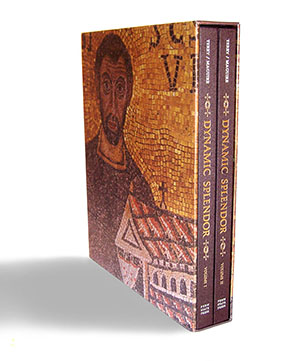
Dynamic Splendor
The Wall Mosaics in the Cathedral of Eufrasius at Poreč
Ann Terry and Henry Maguire
Dynamic Splendor
The Wall Mosaics in the Cathedral of Eufrasius at Poreč
Ann Terry and Henry Maguire
“Long overshadowed by their more extensive neighbors at Ravenna and Venice, the glittering mosaics of Porec have rarely been subjected to detailed scrutiny. Repeatedly restored in the late nineteenth century, they have been regarded with suspicion by scholars and quickly passed over by tourists. Terry and Maguire compensate for this neglect with meticulous examination from the scaffold and judicious study of the relative merits of pre-restoration drawings, photos, and written records . . . with a battery of color photographs unparalleled in any other work on early Byzantine mosaic.”
- Media
- Description
- Reviews
- Bio
- Table of Contents
- Sample Chapters
- Subjects
Winner of a 2008 AAUP Book Jacket and Journal Show, Scholarly Illustrated Winner of the 2007 PSP Award for Excellence in the category of Art and Art History Winner of a 2007 Choice Outstanding Academic Title
It has only recently been possible to study the mosaics at Poreč closely, due to favorable conditions in Croatian Istria, where the mosaics reside, and to the discovery of the original restoration documents in Vienna and Trieste. Terry and Maguire have tracked the condition and restoration of these works, distinguishing between the original mosaics and later contributions. Beyond creating an important archival source, the authors consider the making of the mosaics, their thematic structure, their relationship to the cathedral complex, and their connection to the patron, Bishop Eufrasius, while drawing parallels with other renowned works.
“Long overshadowed by their more extensive neighbors at Ravenna and Venice, the glittering mosaics of Porec have rarely been subjected to detailed scrutiny. Repeatedly restored in the late nineteenth century, they have been regarded with suspicion by scholars and quickly passed over by tourists. Terry and Maguire compensate for this neglect with meticulous examination from the scaffold and judicious study of the relative merits of pre-restoration drawings, photos, and written records . . . with a battery of color photographs unparalleled in any other work on early Byzantine mosaic.”
“At a time when many academic publishers speculate about the demise of the art-history monograph, Dynamic Splendor is a welcome retort about what would be lost without the commitment of university presses to rigorous and elegant scholarship.”
“The number and quality of the images as well as its high standard of scholarship make this handsomely produced boxed set, priced at only $95, surely the best buy in the book market now. The press deserves congratulations.”
“This magnificent two-volume work presents the sixth-century mosaics that survive in the three apses of the church in all their glory, but also in all their controversy. With more than two hundred colour photographs, the book provides invaluable visual documentation and it is hard to envisage it being surpassed in the future. This is an indispensable research tool for anyone interested in Early Christian art.”
“Beautifully and extensively illustrated with color photographs of the mosaics in the basilica together with a generous number of comparanda, this book recuperates for scholars a major, long ignored monumental program.”
“With the publication of Dynamic Splendor, Ann Terry and Henry Maguire have erected a monument of their own in honor of the Basilica Eufrasiana. . . . It will serve many uses: as an object of aesthetic appreciation, a record of valuable research, and a thoughtful model for future monographs.”
Ann Terry is an independent scholar and the author of A Century of Archaeology at Poreč (1847–1947) with Ffiona Gilmore Eaves (2001).
Henry Maguire is Professor in the Johns Hopkins History of Art Department. His publications include Earth and Ocean: The Terrestrial World in Early Byzantine Art (Penn State, 1987), the edited volume Byzantine Magic (1995), and Icons of Their Bodies: Saints and Their Images in Byzantium (1996).
Contents
Preface
Note to Readers
Introduction
1. Documentation of the Mosaics Prior to the Late Nineteenth-Century Restorations
2. Philosophy and Methods of the Restorers
3. Porec and Ravenna: Affiliations and Chronology
4. Mosaic Artistry in Sixth-Century Poreč
5. Sixth-Century Iconography: Questions of Identification
6. Sixth-Century Iconology: Questions of Meaning
Conclusion: Mosaic as a Dynamic Medium
Appendix I: Survey of Authentic and Restored Sections
Appendix II: A Note on Twentieth-Century Restorations
Notes
Frequently Cited Sources
Index
Illustrations Volume
List of Illustrations
Figures and Plates
Illustrations Credits
Introduction
The episcopal complex of Eufrasius at Pore_ , the ancient Roman Parentium, in Istria is among the most complete examples of church architecture to have survived from the early Middle Ages (fig. 197). However, like all such buildings that have been in use for centuries, the complex has undergone many changes and alterations over the years, so that its present well-preserved appearance is, in reality, a fiction created by time. As with the architecture, so with the decoration. The most renowned features of the complex at Pore_ are the mosaics that adorn the eastern end of the cathedral of Eufrasius (fig. 1). But these mosaics, too, have undergone fundamental changes since their creation in the sixth century. This is especially true for the late nineteenth century, when restorers systematically intervened with the original work. The purpose of this book is to reconstruct the history of the wall mosaics inside the Eufrasiana and to examine not only their original creation and meaning, but also the methods and philosophies of their later restorers.
Any mosaic that has survived from the sixth century is treasured, but the Eufrasian mosaics are remarkable beyond their longevity. Their extent is rivaled only by the churches of Ravenna. In addition to the mosaics in the main apse and on the triumphal arch (figs. 1–2), the side apses retain significant portions of their mosaic decoration, though the center of each was lost when windows were cut into the apses (figs. 159, 179). Mosaics are also found on both external façades. Those on the east façade and upper west façade have been reduced to traces, but the panels between the windows on the west façade still survive, albeit restored (fig. 198).
In this book, we concentrate on the mosaics inside the cathedral, which are by far the best preserved. The introduction provides a brief survey of the architectural complex in which the basilica of Eufrasius is embedded and summarizes the history of the building up to the present day. The first chapter surveys the documentary evidence, both written and visual, for the history of the mosaics prior to the late nineteenth-century restorations. The second chapter is devoted to the renovations carried out in the eighteenth and nineteenth centuries, with particular emphasis on the methods and philosophy of the nineteenth-century restorers in the context of the debates concerning restoration at the time. The third chapter discusses the affiliations between the mosaics of Porec and their closest relatives in Ravenna and assesses the Ravenna mosaics as evidence for the dating the program at the Eufrasiana. The fourth chapter analyses the various techniques and practices employed by the sixth-century artists who designed and executed the mosaics at Porec. The last two chapters take up issues of content and interpretation. Chapter 5 examines problematic details of the iconography of the mosaics, in order to determine their authenticity. Chapter 6 builds on the conclusions of the preceding chapter to make new observations about the meanings and function of the mosaics commissioned by a sixth-century bishop in Istria. Finally, there are two appendices. Appendix I is an inventory of the interior mosaics at the Eufrasiana, which also identifies the interventions of the restorers in each portion of the work and determines the authenticity of the motifs. Appendix II offers a note on the relatively minor repairs carried out by restorers in the twentieth century.
The primary goal of our study of these mosaics, and the purpose of this book, is to make them available to the scholarly community at large. We see our role as analogous to that of editors of an important original text. A text cannot be used by historians until it has been properly edited. In this case, the mosaics are the texts, and editing them entails distinguishing between the original work done in the sixth century and later interventions in the eighteenth and nineteenth centuries. With later interpolations identified, the text can be approached with some degree of confidence. In addition, this book indicates some of the ways in which these newly clarified mosaics shed light on historical matters such as church politics, doctrinal controversies, and private devotion in the sixth century, philosophies of restoration in the late-nineteenth century, and mosaic making in both periods.
The Architectural Setting
The mosaics of Parentium remain in a setting that is still evocative of its original state, both in terms of architecture and ornament. The basilica preserves representative portions of every aspect of its original adornment, including marble columns, capitals, and furnishings, opus sectile, and stucco. The modern visitor also experiences the mosaics in an architectural context that appears exceptionally well preserved, and this circumstance lends special insight for appreciation of the mosaics. Though it has undergone changes and restorations, the Eufrasiana remains the single best-preserved example of a cathedral complex designed to serve the needs of a bishop of the period (figs. 197–199). In addition to the basilica, the complex includes a baptistery, chapel, atrium, and the only extant episcopal palace from antiquity to survive in its full height (fig. 199). In the sixth century, bishops held civil as well as ecclesiastical power, to some extent filling the shoes of the former Roman provincial governors. Episcopal architectural settings reflected their broadening authority and significance, as the grand audience hall at the episcopal palace at Pore_ demonstrates (fig. 200).
The cathedral, built by Bishop Eufrasius, whose donor portrait and inscription appear in the apse mosaic (fig. 22), represents the culmination of a series of ecclesiastical structures reaching back to Maurus, an early bishop and patron of the city, who is also depicted in the mosaic next to Eufrasius. The continuity is material as well as iconographic. Well-preserved walls, pavements, and sculptures from several periods effectively illustrate the development of an early Christian cathedral complex. The Eufrasiana was preceded by a group of structures generally dated to the fifth-century and a basilica of the late fourth century.
Since the ecclesiastical architecture in Parentium is not easily accessible through recent publications, we begin with a description of the complex and an overview of its development. The heart of the complex, the basilica, is simple in plan, with three aisles and three apses (figs. 197–199, 201). The central apse projects externally in the form of half a dodecagon, but internally, both in plan and elevation, it is stilted in a horseshoe shape. The small side apses, semicircular in plan, are inscribed within thick masonry walls. The unadorned rubble limestone masonry of the exterior, as is typical of the period, belies an interior resplendent with adornments (fig. 1). The capital and columns that screen the wide central nave from the narrower side aisles are of Proconnesian marble imported from the Sea of Marmara (fig. 201), as are other furnishings, such as the doors, synthronon and cathedra (fig. 202), and chancel panels. The synthronon ends in panels that depict dolphins, images of which abound in the church, in the opus sectile, marble sculptures, and stuccoes (figs. 1, 205). Stucco relief work still bearing pigmentation decorates the arches of the north arcade (fig. 201). The interior culminates in the richly embellished main apse. Beneath the mosaics, exceptionally rare panels of opus sectile fuse many types of marble, colored glass, and mother-of-pearl in unusual designs (figs. 1, 202). A splendid design of a dove in the floor of the south apse gives a hint of the quality of the original Eufrasian mosaic pavements (fig. 203). The ciborium, which today commands attention in the apse, is an intrusion of the thirteenth- century, tessellated by Venetian mosaicists (fig. 1).
The narthex of the basilica forms the eastern arm of the atrium, an open court defined by four cruciform piers and screened from its walkways by triple arcades, whose capitals are also of Proconnesian marble (figs. 198–199). The western walk of the atrium opens into the octagonal baptistery, which retains its hexagonal font (fig. 199).
To the north of the baptistery lies the episcopal palace. Until recently it was almost unknown, entombed by later annexes and disguised by centuries of alterations (figs. 199–200). A decade of restoration work has brought this extraordinary building to light. On the ground floor level, a square central hall is flanked by side wings to the east and west, each ending in an apse. A colonnaded portico served as the main south façade and two doors in the east façade open onto a walkway of the Eufrasiana, a continuation of the narthex that separated the palace and an earlier basilica adjoining the Eufrasiana on the north side. A large ceremonial hall occupies the center of the upper level of the palace. Its well-lit, elevated apse is screened by a stately tribelon (fig. 200). Side wings, each ending in an apse, flank this hall. An oculus, now walled in, distinguishes the apex of the south wall. Among the surviving ornamental features are accomplished stucco reliefs, still showing some pigmentation, on the intrados of the main arch in the great hall, a marble column and capital from the tribelon, relief sculpture in marble and limestone, and a limestone window transenna still in situ. A medieval writer noted that a mosaic in the private chapel of the palace still showed the images of Saints Julianus and Demetrius, who were identified by inscriptions.
At the core of the complex is the basilica of Eufrasius. The bishop claims it as his own not only in his portrait in the apse, in which he is shown offering a model of the church to the Virgin (fig. 33), but also in a dedicatory inscription executed in mosaic at the base of the semidome (figs. 2, 60) and in his monograms, prominent in the opus sectile panels flanking his throne, on the imposts of the capitals, and on the lintel over the main western door into the nave (fig. 204). Apart from the legend attached to his portrait, Eufrasius is named in two other surviving inscriptions at the complex. The first is in the form of a dedication on a marble altar, which Eufrasius consecrated in the eleventh year of his episcopacy with the deposit of relics (fig. 205). The second inscription, in the mosaic beneath the apse vault, is much more prolix (figs. 2, 60). It may be translated as follows:
At first this temple, with ruin shaking it, was terrible in its (threatened) collapse, being neither solid nor secure of strength, small, filthy, and then devoid of great mosaic decoration; the rotted roof hung only by the power of grace. Immediately when Eufrasius, provident bishop and fervent in the zeal of faith, saw that the church was about to fall under its own weight, he forestalled the ruin with saintly inspiration; he demolished the ruinous temple in order to set it more firmly. He built the foundations and erected the roof of the temple, finishing what you now see, shining with new and varied mosaic. Completing his undertaking, he decorated it with great munificence and naming the church he consecrated it in the name of Christ. Thus, joyful from his work, a happy man, he fulfilled his vow.
Although the inscription credits Eufrasius with raising the cathedral from its foundations, the assertion, a topos in such inscriptions, is clearly an exaggeration. In fact, Eufrasius re-used parts of the earlier cathedral, known as the Pre-Eufrasiana, including its baptistery. The Pre-Eufrasiana was a double basilica which has been loosely dated to the fifth century. The earlier complex contained two parallel basilicas, a narthex that ran to the west of both, a baptistery axial to the main basilica, and ancillary spaces between the two basilicas (fig. 206). Eufrasius’s new basilica was superimposed on the old main basilica. Parts of its north, south, and west walls were reused and even the same door openings were incorporated. The only part of the old main basilica that was fully built anew was the triple-apsed east end, destined for splendid new mosaics. The earlier basilica to the north continued in use, and thus, as we have seen, the Eufrasian complex constituted also a double basilica. Eufrasius linked the existing baptistery and the rebuilt basilica by adding an atrium. A triconch chapel projected between the two basilicas. Though the palace was most probably a product of the Justinianic period, the issue of whether it was Eufrasian remains unresolved.
Rather than constructing a cathedral foundation ex novo, Eufrasius integrated components of the earlier complex, added new structures and rebuilt or renovated older ones. If his architectural claim is exaggerated, his pride in its ornament (“decoravit munere magno”) is more than justified. It would be difficult, in fact, to overestimate the role of the costly adornments in sculpture, opus sectile, stucco, and mosaics in the persuasive transformation that was achieved. The total exceeds the sum of the parts. The mosaics, in particular, stand out in this regard. Eufrasius’s inscription refers to the gleaming mosaic decoration (“Quas cernis nuper vario fulgere metallo”), and, indeed, it is the mosaics which, more than any other feature, continually transform the modest limestone masonry.
Even though Eufrasius’s complex is an amalgam of buildings and renovations of different periods, its redesign expresses a unified aesthetic in emphasizing its perpendicular axes. The dominant axis, reflecting that of the mosaics, is longitudinal, linking the basilica, atrium, and baptistery (fig. 198). The arches in the east and west tribelons of the atrium, higher than those in the north and south tribelons, draw attention to that primacy. Originally, the three aisles of the basilica flowed seamlessly into the atrium and then into an ambulatory that once surrounded the baptistery, but which no longer exists. The antiphonal nature of the hexagonal main apse and the hexagonal font in the baptistery further articulates this axis (fig. 199). As recent excavation has shown, a second longitudinal axis joined the former north basilica to the episcopal palace. The narthex of the main south basilica extended to the north, fronting both basilicas, thus creating a strong horizontal axis (fig. 206).
The positioning of the cathedra in the basilica of Eufrasius appears to be of particular significance. We know that the cathedra was vertically aligned with a chamber marking the central east end of the preceding basilica, and that an inscription naming Maurus, the early bishop of Parentium, was found buried at the foot of the cathedra in 1846–47. This limestone panel, generally dated to the fourth or fifth centuries, and which some believe to have come from Maurus’s sarcophagus, had been buried in this location when the apse floor was raised in the thirteenth century. We are not certain where the inscription was prior to that time, but there is some evidence to suggest it may originally have been aligned with the cathedra. The inscription identifies Maurus as a confessor and a bishop, and associates him with ecclesiastical construction at the site. Thus, through the superimposed siting of the inscription and the throne, Eufrasius appears to have aligned himself with his illustrious predecessor.
The Eufrasiana After Its Construction
We have seen that the Eufrasiana, exceptional in extent, preservation, and setting, offers scholars a unique opportunity for study. But its magnificent mosaics, though widely known, have been relatively little researched. While the mosaics have been included, at least in passing, in many survey texts, they have not received the same degree of detailed examination in monographs and articles as accorded the mosaics of Rome and Ravenna. The reasons for this paradox lie in the geopolitical history of the region and the fate of the complex over time.
The ancient city of Parentium, today the old town, is a minuscule peninsula situated midway along the western coast of Istria, part of the ancient Roman province of Venetia et Histria (fig. 207). Its geographic position is relevant to our question in several ways. The peninsula of Istria stretches out into the Adriatic in close proximity to the eastern coast of Italy. Indeed, Istria drew its ruling elite from Italy from the ascendancy of Rome through the Venetian and Austro-Hungarian empires. Through the centuries, the city had been closely linked, in turn, with the cities of Aquileia, Ravenna, and Venice. But this historical identity has largely been lost, eclipsed by more recent alignments. After World War II, Istria was joined to Yugoslavia, and most recently it has become part of the independent republics of Croatia and Slovenia. Though contiguous with the Italian border, Istria has, in fact and perhaps even more so in perception, been isolated from the West since the mid-twentieth century, a span of time that now constitutes living memory. Local and regional scholars in Istria had limited contacts with resources and scholarship in the West, and relatively few western scholars had access to its monuments, either with regard to languages or to opportunities to carry out on site research. These factors effectively insulated the cathedral in Pore_, as well as many other monuments, from the mainstream of modern western scholarship.
Second, the mosaics have been ignored because Parentium itself, for much of its history, languished as a backwater. Relatively modest in antiquity, the city grew less important over time. The cathedral was left to wither from the fifteenth century on. Yet it was this neglect, paradoxically, that served its preservation. The more famous monuments of Rome and Ravenna, continually in the limelight, were repeatedly repaired and restored. The deplorable conditions of neglect into which the cathedral of Pore_ fell during the post-medieval period are the primary reason that the mosaics emerged relatively unscathed by restorers until the end of the nineteenth century.
We know little about the fate of the complex in the early medieval period, but from the later Middle Ages to the eighteenth century the declining fortunes of Parenzo precluded major refurbishments. In 1354, the Genoese sacked and burned the city, and carried away with them the body of Maurus, the patron saint. An earthquake in 1440 toppled the south aisle, and, as will be shown in chapter 1, subsequent repairs and alterations, including the opening of windows in the side apses caused the destruction of the lower mosaics in those spaces. Repeated outbreaks of the plague from the Middle Ages through the eighteenth century ravaged the population and impoverished the city. Eventually, during the worst of the misfortunes, certainly by the seventeenth century, the bishops abandoned the cathedral and took refuge in a new palace in the nearby town of Orsero (Vsar), where the air was believed to be healthier.
Contemporary accounts are telling. The pilgrim Pietro Casola, who visited the city “on Friday the 6th of June at the sixteenth hour” in 1494, left this sad impression: “We arrived opposite Parenzo and had it not been necessary to procure a supply of mutton for the galley, the captain would have passed by without stopping. . . . We went to the Cathedral. It is an ancient church. I think it must have been very beautiful judging by the mosaics of the tribune and by the pavement which shows some signs of having been worked in mosaic. Now . . . it has a neglected appearance. . . . The said church has a little atrium in front and the baptistery is at the end. I think few persons go there because everywhere the grass is long.”
By the seventeenth century, the population had dropped to some one hundred fifty inhabitants. Seventeenth- and eighteenth-century documents in the Venetian archives detail the deprivation. In the 1630s, we are told, the cathedral, left with virtually no canons, all but ceased to function. In 1677 one of the canons reported that the church “in many parts threatens imminent ruin.” In a period when the mosaics in Ravenna had already faced the earliest of many restorations, those at the Eufrasiana were left to deteriorate, which ironically protected them from restoration or replacement.
Even in the eighteenth century, when the city began to emerge from its long decline, as the population increased and repairs and alterations to the cathedral were begun, the mosaics themselves were left relatively unchanged. Bishop Gaspare Negri, who oversaw a sweeping renovation of the cathedral, was the first to recognize the mosaics as early Christian. As will be discussed in chapters 1 and 2, we have reason to believe that during these renovations gaps in the mosaics were filled with painted plaster. This undoubtedly further helped to preserve them by leaving intact at least some of the original setting bed, with its traces of the patterns and shapes made by tesselation, and covering nearby tesserae still in place. Just such plasterwork still exists in the north apse, where plaster we have dated to the eighteenth century covers part of the band of jewels, and can be seen to ride over tesserae in situ (fig. 177). Though most of the painted plaster in the main apse was removed by restorers, some traces still adhere in places in the semidome (fig. 137, the gray near the bottom right and the gold in the upper left; fig. 148, the gold along the lower left edge of the shell). In the north apse mosaic work associated with the eighteenth century survives in some places, indicating that the repairs extended to patching with newly inserted tesserae.
In 1846–47 Bishop Peteani carried out another program of renovations. Although more historically conscious than Negri’s, it did not include restoration of the mosaics. Peteani’s comprehensive remodeling of the basilica was designed to reclaim the glory of a cathedral whose venerable age and historicity was increasingly seen in a positive light. Impressed during a visit to Rome with the grandeur of the city’s architecture, he sought to bring such luster to his own ancient foundation. His reversal of earlier alterations did return some of its original format to the basilica. As may be seen by comparing a plan from 1783 (fig. 208) with one drawn up in 1877–78 (fig. 209), the original chancel area was partly reconstituted, in that the choir stalls that once blocked light from entering the side apses were removed. The windows cut into the side apses were closed up again. But many of these structural and ornamental alterations, however evocative of early Christian forms, can in no way be construed as accurate restoration. The addition of transept-like chapels transformed the plan from a simple basilica into a Latin cross (fig. 209), which, while mimicking the major early Christian churches with transepts, was in this case hardly authentic. The ornamentation was similarly deceptive. Blind arcades in low relief stucco along the north and south walls of the basilica gave the illusion of a five-aisled basilica. Copies were made of original sculptures and original sculptures were recut to form furnishings such as a hexagonal ambo, since dismantled. As seen in figures 210 and 211, the side apses were painted with faux opus sectile, copies of the panels in the main apse. Amidst these and other alterations, however, we find no evidence of any intervention in the mosaics.
The mosaics were brought into the light only in the late nineteenth century, during more than a decade of restoration. Overseen by Austrian officials, a trial restoration was effected in 1887 by Luigi Solerti of the Neuhauser firm in Innsbruck. A full restoration was carried out from 1890 to 1900 by Pietro Bornia of the Vatican. Ironically, the mosaics emerged from obscurity only to fall under a different kind of cloud. Solerti’s trial was considered unacceptable, and the reaction to Bornia’s restoration was hostile. As will be seen in chapter 2, a public and polemical debate about the quality of Bornia’s restoration arose before he had even finished. Giacomo Boni of Rome accused Bornia of destroying the original mosaics, while Paolo Deperis, the pastor of the cathedral, launched a counterattack in defense of Bornia. Doubts raised by these debates have never been fully dispelled, and remain today in the form of uncertainties about the extent to which the mosaics should be attributed to the nineteenth rather than the sixth century. Such questions recently have been articulated by Clementina Rizzardi, who lamented the fact that the individual mosaics at Pore_ “remain problematic, because of the heavy restorations to which they were subjected which render an iconographic, let alone a stylistic, evaluation very difficult.”
The isolation of Parentium appears to be ending however, a change epitomized by the Eufrasiana’s accession in 1997 to the UNESCO List of World Heritage Sites. Permission to study the mosaics from scaffolding, a key to our study, was granted beginning in 1997. Equally important, the documents that detail their restoration have recently been discovered, transcribed, and published. Thus, for the first time, it has been possible to combine a close examination of the mosaics with the documentary records of their restorations. This book presents the results of that study.
Also of Interest
Mailing List
Subscribe to our mailing list and be notified about new titles, journals and catalogs.