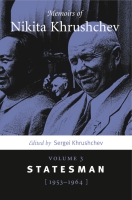




Memoirs of Nikita Khrushchev
Volume 3: Statesman, 1953–1964
Edited by Sergei Khrushchev
“Nikita Khrushchev was one of the most important political leaders of the twentieth century. Without his memoirs, neither the rise and fall of the Soviet Union nor the history of the Cold War can be fully understood. . . . The fact that the full text of Khrushchev’s memoirs will now be available in English is cause for rejoicing.”
- Description
- Reviews
- Bio
- Table of Contents
- Subjects
In the first two volumes, published by Pennsylvania State University Press in 2005 and 2006, respectively, Khrushchev tells the story of his rise to power and his part in the fight against Hitler’s invasion of the Soviet Union. He also discusses agriculture, the housing problem, and other issues of domestic policy, as well as defense and disarmament. This volume is devoted to international affairs. Khrushchev describes his dealings with foreign statesmen and his state visits to Britain, the United States, France, Scandinavia, India, Afghanistan, Burma, Egypt, and Indonesia.
In the first part, Khrushchev talks about relations between the Soviet Union and the Western powers. Of particular interest is his perspective on the Berlin, U-2, and Cuban missile crises. The second part focuses on the Communist world—above all, the deterioration of relations with China and the tensions in Eastern Europe, including relations with Tito’s Yugoslavia, Gomulka’s Poland, and the 1956 Soviet intervention in Hungary. In the third part, Khrushchev discusses the search for allies in the Third World.
The Appendixes contain biographies, a bibliography, and a chronology, as well as the reminiscences of Khrushchev’s chief bodyguard about the visit to the United Nations in 1960 at which the famous “shoe-banging” incident occurred—or, perhaps, did not occur.
“Nikita Khrushchev was one of the most important political leaders of the twentieth century. Without his memoirs, neither the rise and fall of the Soviet Union nor the history of the Cold War can be fully understood. . . . The fact that the full text of Khrushchev’s memoirs will now be available in English is cause for rejoicing.”
Sergei Khrushchev is Senior Fellow at the Thomas Watson Jr. Institute for International Studies at Brown University. He is the author of Nikita Khrushchev and Creation of a Superpower (Penn State, 2000).
Contents
Acknowledgments
Abbreviations and Acronyms
The Memoirs
Relations with the West: The Cold War
Before and After the Peace Treaty with Austria
The Four-Power Summit Meeting in Geneva (July 1955)
Meeting with Adenauer (September 1955)
The Visit to Great Britain
Beginning of the Visit to the United States
From New York to Iowa
Washington and Camp David
The Visit to France
The Four-Power Summit Meeting in Paris (May 1960)
The Visit to the United Nations
John Kennedy and the Berlin Wall
The Cuban Missile Crisis
Visiting the Scandinavian Countries
The Socialist Commonwealth
On the Road to Socialism
Mao Zedong
Friendship with China After the Victory of the People's Revolution
Turn for the Worse in Relations with China
Further Worsening of Relations with China
Ho Chi Minh
Albania
Yugoslavia
Germany
Poland
Hungary
Czechoslovakia
Romania
Opening a Window Onto the Third World
India
Burma
India, Afghanistan, Iran, and Again India
Indonesia
Egypt
The Six Day War in the Middle East
From Syria to Yemen
Relations with African Countries
Appendixes
How Khrushchev Subdued America
Biographies
Chronology
Bibliography
Index
Also of Interest

Mailing List
Subscribe to our mailing list and be notified about new titles, journals and catalogs.