


Painting and Politics in Northern Europe
Van Eyck, Bruegel, Rubens, and Their Contemporaries
Margaret D. Carroll
Painting and Politics in Northern Europe
Van Eyck, Bruegel, Rubens, and Their Contemporaries
Margaret D. Carroll
“This is an important book that deserves to be listened to, debated, and absorbed into the discourse of this field.”
- Media
- Description
- Reviews
- Bio
- Table of Contents
- Sample Chapters
- Subjects
Publication of this book has been aided by a grant from the Millard Meiss Publication Fund of the College Art Association
The narrative follows the way painters responded to the emergence of “modern” theories of politics and natural law from the classical and medieval tradition. Carroll begins by addressing paintings that identify the natural order with consensual social relations in a stable political hierarchy, then turns to paintings that stress the struggle for mastery in a perilous and unstable world. These paintings may be valued not merely as historical artifacts of a bygone era but as interventions in a cultural discourse that continues to this day.
“This is an important book that deserves to be listened to, debated, and absorbed into the discourse of this field.”
“The author’s erudition, lucid writing, and meticulous research make these essays on the themes of marriage, politics, social harmony, and discord excellent reading for undergraduates as well as researchers.”
“In this compelling study, Margaret D. Carroll explores how shifting political and cultural climates, in part the result of longstanding foreign domination, fueled an extraordinary flourish of pictorial invention in the early modern Lowlands. Through six carefully chosen case studies, the author investigates how certain seminal works of Netherlandish art inventively register contemporary responses to local, political discourse. While Carroll casts her sociohistorical net broadly, a focused discursive thread drives the choice and chronological arrangement of her case studies and her broader ideological concerns. She argues that a fundamental philosophical progression in the Brabant—from an ethos of relative social cooperation based in accelerating capitalist interests in the Burgundian Netherlands to one of social strain and conquest wrought by rising demands of absolutist courts in the late sixteenth and early seventeenth centuries—stimulated local artistic innovation in very pointed ways.”
“With her superb individual studies and her searching investigations into questions of historical belief-systems and their transformations over time, Carroll’s important, clearly written book makes an impressive contribution to contextual art history and the history of ideas. It is certain to stimulate scholars, and likely to engage non-specialists and students who have an interest in this volatile, fascinating extended period and region.”
Margaret D. Carroll is Professor of Art History at Wellesley College. Her publications include numerous articles on Van Eyck, Rembrandt, and Rubens, as well as the essay ‚ "Accidents Will Happen: A New Look at the Nightwatch‚" in Rethinking Rembrandt (2002).
Contents
List of Illustrations
Acknowledgments
Introduction
1.. The Merchant’s Mirror: Jan van Eyck’s Arnolfini Portrait
2. Breaking Bonds: Marriage and Community in Bruegel’s Netherlandish Proverbs and Carnival and Lent
3. The Conceits of Empire: Bruegel’s Ice-Skating Outside St. George’s Gate in Antwerp and Tower of Babel
4. The Erotics of Absolutism: Rubens and the Mystification of Sexual Violence
5. “Womanliness as a Masquerade”: The Case of Marie de Médicis
6. The Nature of Violence: Animal Combat in the Seventeenth Century
Notes
Bibliography
Index
Introduction
Painting and Politics in Northern Europe examines the ways in which Netherlandish artists in the early modern period drew upon the imagery of contemporary political discourse as material for pictorial invention. My inquiry began with a question: How might one account for the vogue in sixteenth- and seventeenth-century European courts for scenes of violent sexual abduction? Other questions followed. What were the circumstances that prompted Jan van Eyck to create a new portrait type in the Arnolfini Portrait (1434): a man and wife standing side-by-side in the luxurious confines of their home? Why does a mismatched couple figure so prominently near the center of Pieter Bruegel’s Netherlandish Proverbs (1559)? In each of these cases I set out to explore the possibility that these artists were responding, in part, to significant changes in the political climate of their time—and that they registered those changes by finding new ways of depicting the relationship between a woman and a man.
The theoretical premise that the relation between a ruler and his subjects is analogous to that between and a man and a woman goes back to the ancient philosopher Aristotle. Just as a natural impulse prompts men and women to join together to raise children and to form households, Aristotle claims in the Politics, so too does a natural impulse prompt humans to gather into communities and to form states. The relationships between the members of a household and state are, moreover, “naturally” hierarchical. Just as it is “natural” for a man to rule the woman who will bear his children, so too is it “natural” for a master to rule his slaves, and a king, his subjects. Aristotle’s strategy of drawing analogies between power relations within a state and power relations within a family, and of grounding them in the natural order, has had a long afterlife in Western thought. But as cultural and material circumstances changed in the early modern period, so did formulations about what was natural in domestic and political life. This book is a critical study of works by Netherlandish artists that are responsive to some of those changes.
In Chapter 1 I look at the way in which van Eyck’s Arnolfini Portrait engages with the themes of contract and consent that emerged as important political values in the early fifteenth century. In keeping with the Christian doctrine of the spiritual equality and freedom of all believers, medieval theologians rejected Aristotle’s notion of natural slavery; they also claimed that marriage was a contractual bond formed by the freely given consent of husband and wife. This in turn prompted political theorists to reformulate Aristotle’s analogy between marriage and the state. They argued that mutual vows of obligation and protection bound subjects and rulers, like spouses, to each other. This chapter explores how the image of a couple joining hands in the Arnolfini Portrait evokes those principles of mutual consent and fidelity, which were viewed as fundamental to proper marital, economic, and political relationships.
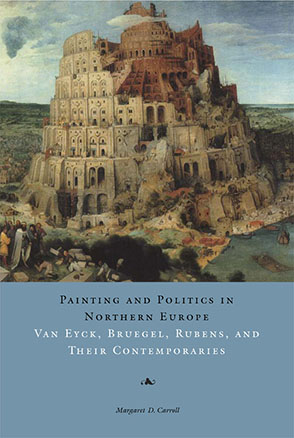
In Chapter 2 I examine how the image of a discordant marriage in Bruegel’s Netherlandish Proverbs—in which a wife pushes her husband from behind while hanging the “blue cloak” of deceit over his head—serves as a figure of a social and political world in which the “natural order” of relations between both a husband and his wife, and a ruler and his subjects, has fallen into disarray. I show further how Bruegel’s Carnival and Lent (1559) might have been paired with Netherlandish Proverbs to offer an idealized vision of what social and political life would be like, should that natural order be restored. In Bruegel, I argue, we see an artist putting the idea of natural order to polemical use—a common rhetorical strategy in the sixteenth century, when resistance against unjust rulers was justified by the claims that tyrannical rule was “against nature” and that subjects could legitimately use violence to defend their “natural rights.” Chapter 3 argues that Bruegel’s jarring depictions of architecture in the Roman imperial style in Ice-Skating Outside St. George’s Gate in Antwerp (1558) and The Tower of Babel (1563) likewise intimate the “unnatural” character of the intrusion into the Netherlands of Hapsburg imperial rule.
As political violence became more virulent in the sixteenth and seventeenth centuries, political philosophers presented new ways to account for the natural foundations of the state. The French theorist Jean Bodin (1530–1596) discounted Aristotle’s claim that an innate, sociable impulse motivates humans to form states. Rather, Bodin argued, “force and violence are the source and origin of republics.” At the same time he revived Aristotle’s hierarchical analogy to validate a theory of absolutism: just as a husband may exercise absolute dominion over his wife, so may a king exercise absolute dominion over his subjects. Chapter 4 examines the ways in which the vogue for rape imagery in early modern European courts—exemplified by Giovanni da Bologna’s Rape of a Sabine and Peter Paul Rubens’s Rape of the Daughters of Leucippus—is consonant with a dawning recognition of the centrality of violence in human and political life. These works are consonant with the revival of Aristotelian arguments that affirmed the coercive power of rulers over their subjects, of masters over slaves, and of men over the women who bear their children.
Of particular importance to Rubens and his circle was the intellectual legacy of the Neostoic philosopher Justus Lipsius (1547–1606), whose views of nature and politics are explored at greater length in the final two chapters. For Lipsius, the natural order and political life are founded upon principles not of concord and harmony, but of conflict and instability: “Every kingdom is unstable and insecure . . . the king is the object not only of fortune, but also of hatred. . . . The excessive power of kings is often the cause . . . but there is another cause that lies in our nature: that is that no one willingly concedes the honor of ruling to another.”
Chapter 5 analyzes how Rubens’s painted cycle The Life of Marie de Médicis (1622–25) places the problem of violence in a broader, more ambiguous context in keeping with those Neostoic views. Here violence appears less as a mode of conduct by which monarchs successfully display their power than as an uncontrollable force by which they themselves may be felled. The arena is the court and the French royal family, and here the “natural order” is fraught with the conflict and instability that characterize relations not only between a ruler and his or her subjects but even between a mother and her son.
In the last chapter, the perspective expands to consider a pictorial genre that gained favor in the seventeenth century: easel paintings of fighting animals. Focusing on Frans Snyders’s Cockfight (1615) and on Otto Marseus van Schrieck’s paintings of reptiles and insects battling in the forest (1660s and 1670s), I explore the ways in which these depictions of animal combat naturalize violence and predation in keeping with the assertions of Hugo Grotius (1583–1645) and Thomas Hobbes (1588–1679) that humans in a state of nature have a “natural right” to use force against others to procure what is necessary for survival.
Arranged now in roughly chronological order, the chapters follow an arc that accords with a narrative of the emergence of “modern” theories of politics and natural law from the classical and medieval tradition. The first three chapters address paintings in which the natural order is identified with an ideal model of sociable relations in a stable political hierarchy. The last three are concerned with paintings in which the natural order is identified with a struggle for mastery and the need to use force in a perilous, unstable world. I did not conceive of this narrative arc at the outset of my inquiry. One question simply followed another. Of greater interest to me than the question of what ideological claims a particular painting might promote is the question of how its creator mined the imagery of contemporary political discourse for its pictorial possibilities. My ambition has been to amplify the critical appreciation of the paintings considered here as works of art, not to reduce them to illustrations for a history of political thought.
Painting and Politics in Northern Europe also aims to explore how these artists took the occasion to reformulate their pictorial aims and means while painting the works in question. In Chapter 1 I argue that the principle of consensus—signifying both “consensual agreement” and “shared experience”—also informs the formal organization of the Arnolfini Portrait. This pertains not merely to the carefully balanced placement of the spouses and to the meticulous rendering of all the elements in the painted scene, but also to the claim the work makes for the role of the artist: a witness who faithfully recreates for his public his subjective “sense” of the figures posing before him. Bruegel’s paintings and prints are far more elusive interventions. Works like Netherlandish Proverbs, Carnival and Lent, and The Tower of Babel do not pretend to reproduce the artist’s view of a single scene from contemporary life, but are inventively composed arrangements of figures and motifs that serve to occasion dialectical reflection and to steer it, however discreetly, in the direction of political dissent.
A very different set of political and aesthetic investments is at issue when we turn to the scenes of rape or abduction by Giovanni da Bologna and Rubens. Their works engage with contemporary assertions about the overmastering power of rulers and husbands and are responsive to a critical discourse that correspondingly applauds works of art that demonstrate the force, manliness, and virtuosity of their creators. In Rubens’s Life of Marie de Médicis, the spectacle of political insecurity is effectively matched by an aesthetics of instability and flux. Moreover, whereas the Leucippus gives the impression of being an effortless display of the artist’s virtuosity—a work conceived and executed in a singular burst of creativity—the complexities and ambiguities of the Médicis series bespeak an almost torturous process of invention, one requiring prolonged negotiations between Rubens and the queen’s advisers. A scenographic ensemble that speaks to the uncertainty and precariousness of the lives of rulers and courtiers speaks as well to the complex and volatile conditions in which a court artist worked—conditions over which he exercised far from absolute control.
Theatricality and violence are also features of the animal paintings of Otto Marseus van Schrieck. Now, however, the painted arena is the forest undergrowth—a fictive space which in its intimacy corresponds to the habitats that Marseus constructed for the plants and creatures he collected. In keeping with the interests of contemporary investigators, Marseus attempts to convey not merely the appearance and distinguishing features of his specimens but also the dynamic processes involved in living, dying, and fighting for survival. In these works, the painter emerges as more than a recording witness. He takes on the role of an experimental impresario—not unlike naturalists of the time, who performed their grisly experiments as theatrical entertainments for patrons and participants in early modern scientific communities.
Although an interest in the themes of sexuality and gender has driven much of this inquiry, for the most part I have framed my analysis using the terminology of “nature” and “the natural.” After all, when formulating propositions about men and women, or husbands and wives, late medieval and early modern theorists used the vocabulary of nature, not of gender—a word that was not even used the way it is today. Aside from allowing my critical language to accommodate that of the texts I was consulting, the more capacious significations of “nature” and “the natural” allowed me to extend my inquiry to a related tradition in seventeenth-century art and thought in which gender is not always a significant factor: the discourse of predation and scenes of animal combat by Snyders and Marseus.
Over the years in which I have been writing Painting and Politics in Northern Europe, I have come to appreciate more fully the complexity of the issues that the works under consideration raise. Though here I discuss Rubens’s Leucippus as a purely celebratory depiction of sexual conquest and capitulation, I can now imagine how, in another project, one might want to explore the multivalence of that and other rape scenes by Rubens. In most cases, I have learned, it is more fruitful to ask how works of art pose problems and provoke reflection rather than to ask how they call forth unequivocal judgments of condemnation or praise.
Seen in this light, the paintings studied here may be valued not merely as historical artifacts of a bygone era, but also as interventions in a cultural discourse that continues to this day. What is “natural” in a man? In a woman? What is “natural” in marriage, or in maternity? What can we learn about the dynamics of power from clashing antagonists in a baroque court—or on the forest floor?
Also of Interest
Mailing List
Subscribe to our mailing list and be notified about new titles, journals and catalogs.